Archive for the ‘qrp’ Category
 Chinese Kit Invasion
 March 9th, 2016 |
  Author:
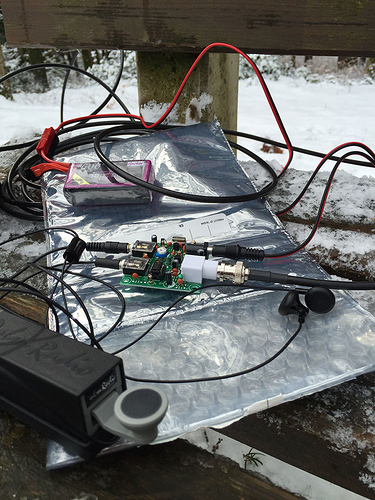
 A few days later I stumbled upon an entry on the SOTA reflector entitled "QRPp Activation with a $3.56 Chinese Pixie..." by Manuel HB9DQM. Manuel had seen the radio on EBAy and couldn't pass up the opportunity to give it a shot. He not only built the radio, which takes the better part of an hour, but he decided to put it to the test in the field.
 |
| HB9DQM Pixie Station |
Using the configuration above, running 300 milliwatts, he made 16 QSO's from a summit top bench. Pretty cool. 300 mw, wire antenna, battery power and a straight key, ah the magic of Ham Radio.
Of course the radio has limitations, it's crystal controlled, the radio comes with a 7.023 crystal (HB9DQM used a 7.030 crystal) and the bandwidth on receive is very wide, but as Manuel demonstrated, you can have some good, cheap fun with this little radio. He said he was listening to the world news, in English (courtesy of a BC station), while he worked the callers. An interesting diversion.
I did some further research on YouTube and found many happy campers who had purchased and assembled the kit. So I took the big plunge. I even went overboard and bought a couple of extra's as projects for my teenage grandsons who are hams.
There is one thing a little troublesome about this kit invasion however, at these prices, the other QRP kit providers can't compete. What will happen to them? Such is the world these days.
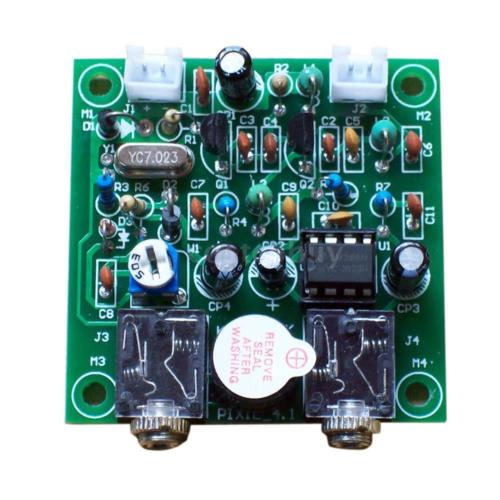 |
| Chinese version of the Pixie 2 |
Chinese Kit Invasion
A few days later I stumbled upon an entry on the SOTA reflector entitled "QRPp Activation with a $3.56 Chinese Pixie..." by Manuel HB9DQM. Manuel had seen the radio on EBAy and couldn't pass up the opportunity to give it a shot. He not only built the radio, which takes the better part of an hour, but he decided to put it to the test in the field.
|
| HB9DQM Pixie Station |
Using the configuration above, running 300 milliwatts, he made 16 QSO's from a summit top bench. Pretty cool. 300 mw, wire antenna, battery power and a straight key, ah the magic of Ham Radio.
Of course the radio has limitations, it's crystal controlled, the radio comes with a 7.023 crystal (HB9DQM used a 7.030 crystal) and the bandwidth on receive is very wide, but as Manuel demonstrated, you can have some good, cheap fun with this little radio. He said he was listening to the world news, in English (courtesy of a BC station), while he worked the callers. An interesting diversion.
I did some further research on YouTube and found many happy campers who had purchased and assembled the kit. So I took the big plunge. I even went overboard and bought a couple of extra's as projects for my teenage grandsons who are hams.
There is one thing a little troublesome about this kit invasion however, at these prices, the other QRP kit providers can't compete. What will happen to them? Such is the world these days.
|
| Chinese version of the Pixie 2 |
Can this be done??

Oh and by the way of a radio report..... I was on the rig yesterday not much going on the CW portion of 20m and 30m during the early part of the afternoon. I ventured back around 22:00 UTC and 20m was sending some DX my way. Some of the stations heard but I was unable to contact were LZ300MSP (that call is a key full), T77CS, EA3AIZ from Spain struggled to hear my QRP signal but there was just to much QSB at his end. All was not lost DL3DXX heard me in Germany and gave me a 559 report.
The N3ZN Iambic CW Paddle
Behold… mechanical beauty
 |
| N3ZN ZN-QRP Iambic Paddle (sporting my new call sign) |
I re-entered the amateur radio hobby in the summer of 2015 after a bit of a hiatus. To get my General license in 1996 a Morse code proficiency test was required. At that time I had purchased a cheap MFJ practice key and a used version of the ubiquitous Bencher BY-1 paddle. My Bencher was in reasonable shape but I just never became comfortable with it. It always felt a bit imprecise to me and I wasn’t happy with the width and size of its paddles.
How-To: Send Perfect Morse Code by Hand (Vintage Video)
What is the proper (and most efficient) technique for creating Morse code by hand, using a manual Morse code key? Ham radio operators find Morse code (and the ‘CW’ mode, or ‘Continuous Wave’ keying mode) very useful, even though Morse code is no longer required as part of the licensing process. Morse code is highly effective in weak-signal radio work. And, preppers love Morse code because it is the most efficient way to communicate when there is a major disaster that could wipe out the communications infrastructure.
While this military film is antique, the vintage information is timeless, as the material is applicable to Morse code, even today.
More about Morse code, at my website: http://cw.hfradio.org
Thank you for watching, commenting, and most of all, for subscribing. By subscribing, you will be kept in the loop for new videos and more… my YouTube Channel: https://YouTube.com/NW7US
See my Video Playlist for related Morse code vidoes:
The Grand Illusion
Five by Nine... QRP... How can it be?
 |
| The real gain doesn't come from transmitter watts |
I gave him reports as he switched back and forth from running barefoot ~75w to his amp ~500w. With his amp on he was an S9, running barefoot he was S8. So the amp gave him one additional S unit. In terms of hearing him I would have been hard pressed to tell much difference simply by volume. He was perfectly copyable without noise with the amp off.
We also did some tests with my station at reduced power (as if...) At 10w-12w output I received a S9 to S9+10. Reducing output to 5 watts netted me a S8 report and when I reduced to 1 watt (one watt) he was still able to comfortably copy me and I received an S5. So with my station at 1 watt and his running 500 watts we could still converse via SSB. Ladies and Gentlemen you don't need as much output wattage as you think you do.
He was running through a newly constructed homebrewed vertical while I was using my 80m OCF Dipole. We didn't discuss what sort of radial system he had installed, but the difference in antennas was likely the deciding difference in our stations. We were about 500 miles apart and his vertical probably had more low-takeoff gain than my dipole, or possibly more ground loss so I probably had better high angle gain on him for the short 500 mile skip. I think the take-away from this exercise is that the antenna is generally the key rather than transmitter power. If I can get 6 dB of gain from my antenna I have in essence quadrupled my effective radiated power. Quadrupled? Yes, Quadrupled effective output power.
Power and S-Units
- A Power Ratio: dB = 10 Log P2/P1
- A Voltage Ratio: dB = 20 Log V2/V1
You increase 3dB each time you DOUBLE your power
You increase 3dB each time you DOUBLE your power. So to gain one S-Unit you must quadruple your power.
Antennas offer the cheapest increase in dB
Note the statement above "using the same antenna system". That's the key then isn't it? It's easier to get 6 dB of gain from an antenna than from wattage. A 40m doublet can offer significant directional gain especially when operated on higher bands. Now unless it's rotatable you will be at the mercy of the directionality of its lobes but if you have trees or tall structures you can very cheaply string up a few dipoles oriented in different directions and for far less money that a 500 watt amp (6 dB). If you can only have one wire antenna you may miss out on some DX in the antenna's nulls but you will have some stellar gain in the direction of the lobes. Of course rotatable yagis and beams are the best but now we are talking about real money again. I'm talking bang for the penny. You don't have to buy a wire antenna. Some Dacron rope or weed-eater line and some surplus insulated wire is all you need. You can even make your own feedline cheaply from electric fence wire and insulators.We have a great hobby, but there are so many aspects of it that sound like common sense when they really are not... like increase your power.
Increasing power gains you very little compared to a better antenna systems. Put that in your 811A amplifier tube and smoke it !
That's all for now.
So lower your power and raise your expectations (or your antennas)
72/73 (Note: 72 is a common substitute for 73 among QRPers... as in "not enough power for 73")
Richard, N4PBQ
Portable Goals and NPOTA!
I can’t believe it has been almost a year since I have posted here! I have lots of interests and tend to bounce around between them.
But for 2016 I want to be more consistently in ham radio. So I have set a goal…
There are about 45 weeks left in 2016, so my goal is to complete 45 portable activities this year and document them here on my blog!
Also, tomorrow, February 25th, 2016 I will be activating NPOTA TR07,TR11,TR14 (Oregon NHT + Santa Fe NHT + California NHT) from Lone Elm park in Olathe, KS.
I will be operating my KX3 5 watts CW (maybe SSB if time allows) into a vertical. 14.060+/- and 7.030 +/-. I plan to arrive about 19:00 UTC (1:00 pm local) and operate for a couple of hours.
If you hear me please spot me. This will be my first activation, and my CW is a bit rusty, so the sending speed will be slow! Be patient with me!
This park has historical significance because it was used as a major campground along these 3 trails. Originally it was about 80 acres, and so many trees were cut down by the campers it became known as “Lone Elm”.
That’s all for today, I will report back after the NPOTA activation tomorrow!













