Archive for the ‘hf’ Category
 What’s a Country?
 November 19th, 2011 |
  Author:
  Recently on Google Plus there was a discussion of what qualifies as a separate country in the amateur radio world. The confusion point was that Alaska was showing up in logging software as a “country”. It turns out is is both a country and a state.
The generally accepted countries list is established by the DXCC award. Actually, the correct term is entities, not countries, but in normal conversation people seem to use countries. DXCC stands for DX Century Club, with the minimum award being 100 (Century) countries.
Back to the issue of Alaska — it clearly is one of the 50 United States, so you’ll need to work it to achieve Worked All States (WAS). It is geographically separated from the lower 48 states, so it is also considered a separate country. The same is true for Hawaii — counts as a state and a country.
To find out what counts as a country, you need to study the DXCC Country List. A peek at this list reveals that these US possessions are all considered separate countries for DXCC purposes:
K,W,N, AA-AK# United States of America
KG4# Guantanamo Bay
KH0# Mariana Is.
KH1# Baker & Howland Is.
KH2#* Guam
KH3#* Johnston I.
KH4# Midway I.
KH5# Palmyra & Jarvis Is.
KH5K# Kingman Reef
KH6,7#* Hawaii
KH7K# Kure I.
KH8#* American Samoa
KH8#* Swains I.
KH9# Wake I.
KL,AL,NL, WL#* Alaska
KP1# Navassa I.
KP2#* Virgin Is.
KP3,4#* Puerto Rico
KP5# Desecheo I.
So there are 19 countries, just inside US territory.
The DXCC Rules that define a country are complex, a mix of geographical and political considerations. I won’t even try to explain it here. Be aware that as the political boundaries change, countries can be added or deleted from the list.
73, Bob K0NR
This Spewed Out of the Internet #20
 There’s lots of information spewing forth from the interwebznet. Here are a few items of interest.
The amateur radio community is buzzing with excitement from the excellent propagation on the HF bands during the CQ Worldwide DX Contest last weekend. For example, see the radio-sport.net post or my post.
One of our local Boy Scouts passed his Technician exam on the Saturday before the contest, showed up in the FCC database on Friday and was working DX on 10 Meters on Saturday. He managed to snag some good ones, including Australia.
The ARRL is reporting that Logbook of the World is having trouble keeping up with the influx of radio logs. Although it would be nice if they could put a little more compute horsepower on the system, I think it is great that LoTW is seeing this kind of volume.
The Interstate Highway Rest Area Society is making a pitch to encourage hams to monitor 146.52 MHz when mobile. I usually try to do this and every once in a while I will stumble onto a great QSO that way. This group is also promoting ham radio activation of highway rest areas. Yes, really, it is not a hoax.
73, Bob K0NR
Another Great HF Slacker Weekend
 I had previously admitted to being an HF slacker…that is, I only really enjoy the high frequency bands when the DX is loud and plentiful on 15 and 10 Meters. For almost a half decade, I’ve listened to the True HF Enthusiasts say things like “move to the lower bands when the solar activity is weak.” Fortunately, things are starting to change.
This weekend was the CQ Worldwide DX Contest (SSB) and the propagation was outstanding on the higher bands. I heard some people say that 10 Meters was never this good before but I suspect their memories may be faulty. But make no mistake, conditions were really awesome. Here’s a report from radio-sport.net.
I was up at our cabin in the mountains, running the FT-950′s 100 watts into a trap dipole at about 30 feet. Clearly, this is not your Big Gun Station but I was able to make 177 contacts, operating most of Saturday and a few hours on Sunday. Mostly, I was just chasing DX and trying to pick up a few new countries. I have to admit that my memory had a little rust problem concerning international call sign prefixes (where is C5A anyway?) but the N1MM software helped me out.
In the end, I did contact a dozen or so new countries, ranging from Mongolia to Croatia. I sure hope these guys upload their logs to Logbook of the World. I really don’t want to be chasing down those QSL cards manually. As I said, I am an HF Slacker.
73, Bob K0NR
California QSO Party, Dude
The last 24 hours here in Upstate NY has been flood warnings and weather watches, and I want to get away from that for a bit. A good place to go, I think, is California. So why not join in on their 45th running of their QSO Party which is probably the largest in the U.S.

Image of Flag of California/Wikipedia
So the object of the party is of course to work as many stations in the Golden State as possible on phone and CW. Stations may be worked once per mode/band combination for points with California Counties (58 of them) as individual multipliers. And California stations will get credit for working stations inside and outside of the state with US States and Canadian Provinces as their multipliers. The party runs from 16:00 GMT October 1st till October 2nd at 22:00 GMT.
The Northern California Contest Club sponsors the CQP and offers a variety of awards open to stations inside and outside of California. Some of the awards include plaques for the top operators in the Youth (under 18) and YL categories. California QSO Party chairman, Rick “Rhino” N6RNO, says that last year the contest attracted a record number of log submissions, and they are hoping to beat the previous record this year, by as big a margin as they can.
The rules for the contest, as well as a complete list of awards can be found on their website.
73.
Rich also writes a Tech blog and posts stories every Tuesday and Thursday on Q103, The Rock of Albany’s website, as well as Amateur Radio stories every Monday thru Friday on AmiZed Studios and hosts a podcast called The Kim & Rich Show with his fiance’ Kim Dunne.
Ham Radio Backpacking [VIDEO]
Some weeks, it’s all I can do to find something to talk about, some weeks things just seem to fall into my lap to talk about. This I think is going to be one of the latter. If you enjoy the outdoors and Ham Radio, this video shows you some HF work on a hill near the Bay Area.I don’t know the person’s callsign, as he didn’t share it in the video, but still, it’s a nice little video to watch. And it looks like a lot of fun too.
73.
Rich also writes a Tech blog and posts stories every Tuesday and Thursday on Q103, The Rock of Albany’s website, as well as Amateur Radio stories every Monday thru Friday here on AmiZed Studios.
Should I or shouldn’t I?
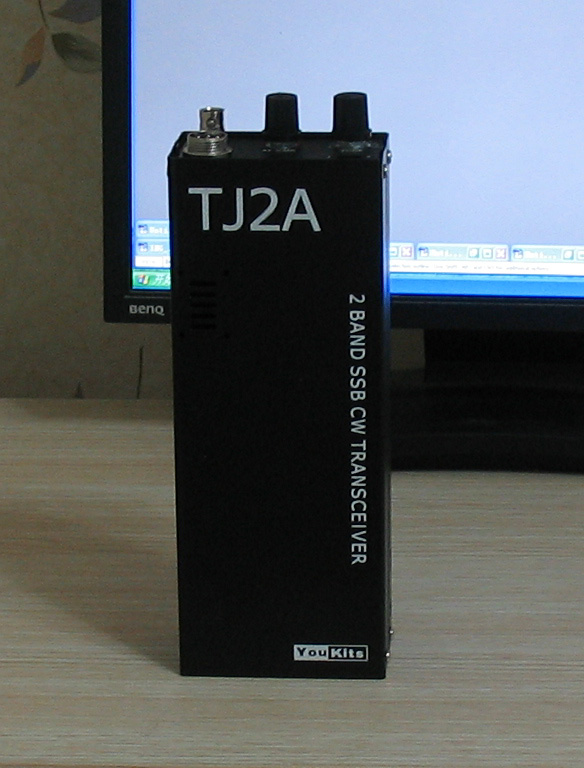
Thanks to the latest blog post from John AE5X I have the web page for a new QRP kit open in another browser tab and the pointer keeps hovering over the Buy Now button. The kit in question is the TJ2A, a two-band handheld SSB/CW transceiver for the 20m and 40m bands that has just been produced by YouKits of China.
Regular readers of my blog will know of my fondness for handheld radios. I’m finding this one very hard to resist even though I have an FT-817 and so no need for another handheld 20m/40m radio. At this point in my life I’m not even sure if building it is still within my capabilities. If I did try, it would be the most difficult kit I have attempted since my Elecraft K2, and I built that 12 years ago when my eyes were a lot sharper and I was not suffering the after effects of a brain operation. Should I or shouldn’t I?
The TJ2A looks like an updated and improved version of the Mizuho HF handhelds that were produced during the late 1970s which still fetch a tidy sum whenever they change hands on eBay. Like the Mizuhos, the TJ2A is VXO controlled and covers a portion of each of the two bands, though you can install alternative crystals if you would prefer to have full coverage of one band in two ranges. You could also choose other bands by changing the VXO crystal and bandpass filters.
The building instructions are on the web and it looks as if the kit uses mostly through hole components but there are some SMD transistors. It isn’t perfect. There is mention of warm-up drift in the first 5 minutes after switching on or changing bands. There is also a mod already to stop BFO leakthrough into the IF stages. And there doesn’t appear to be any high SWR protection for the PA so using the rig with handheld antennas – or any type of antenna that presents a mismatch prior to tune-up – might be problematic.
But it looks really cute. And it’s a kit. There are few things in ham radio more rewarding than hearing the first signals, then making the first contact, on a radio you built yourself. Should I or shouldn’t I?

A day by the lake
The fine weather we have enjoyed for several weeks was forecast to change, so on Wednesday Olga and I decided to take the bus and go for a picnic lunch by Bassenthwaite Lake. For radio entertainment I took the UV-3R (in case of any SOTA or WOTA activations) and the FT-817ND.

HF conditions were pretty dire – WWV has been predicting blackouts – and I initially heard nothing above 20m. But even though I called the loudest stations that weren’t calling “CQ DX outside Europe” no-one even acknowledged my existence. (What’s wrong with working stations inside Europe, I’d like to know, especially when no-one is replying to your CQs anyway?)
The antenna I was using, the Wonder Wand L-Whip, could have been better. It does, however, have the advantage that it is small and light. At the moment I can’t carry much, needing one hand for my walking stick and the other for balance, so everything has to fit in a small shoulder bag. So I didn’t have anything else suitable.
The UV-3R produced a contact with Terry, G0VWP/P activating Walla Crag, the lowest Wainwright, prompting Olga to comment that the small radio was better than the big one!
After lunch I tuned around some more and heard some activity on 15m and 17m. And whilst tuning 17m I stumbled across this. Actually, that’s what I heard a couple of minutes later after I’d dug my smartphone out of my jacket pocket to make the recording using Voice Recorder. What I heard first was ZD8D (Ascension Island) calling CQ. Repeatedly. With no takers. He was not very strong – about S4 on the ‘817 S-meter – with some QSB, but perfectly clear. Clearer in fact than in the recording. I called, but needless to say he didn’t hear me.
As I’ve said before, I have little interest in working stations just to tick countries off a list. But I have a particular interest in the British colonies of Ascension Island and St. Helena as I visited both places during a “trip of a lifetime” in 1999 but have never worked either of them. Just my luck to come across a DX station calling CQ with no pileup when I’m surrounded by mountains and running just 5W to an extremely inefficient antenna!














