Archive for the ‘hf’ Category
 How to Get a $10,000 FCC Fine
 March 9th, 2013 |
  Author:
  The ARRL web site reported on this Notice of Apparent Liability for Forfeiture from the FCC. That’s government talk for “we are fining you.”
In case you are wondering how you can get fined by the FCC, here’s the sequence of events that resulted in a $10,000 fine for this person:
- Get a Technician License and then let it expire.
- Repeatedly transmit on 14.312 MHz, interfering with licensed radio amateurs.
- Have FCC agents track the signal to your house
- When the FCC agents enter your house to inspect your radio station, leave the transmitter sitting on 14.311 MHz.
- Tell the FCC agents that you will remove the microphone from the transmitter and only use it as a receiver.
Hmmm, why does 14.312 MHz sound like a familiar frequency? 
73, Bob K0NR
More of a Shout than a Whisper…..
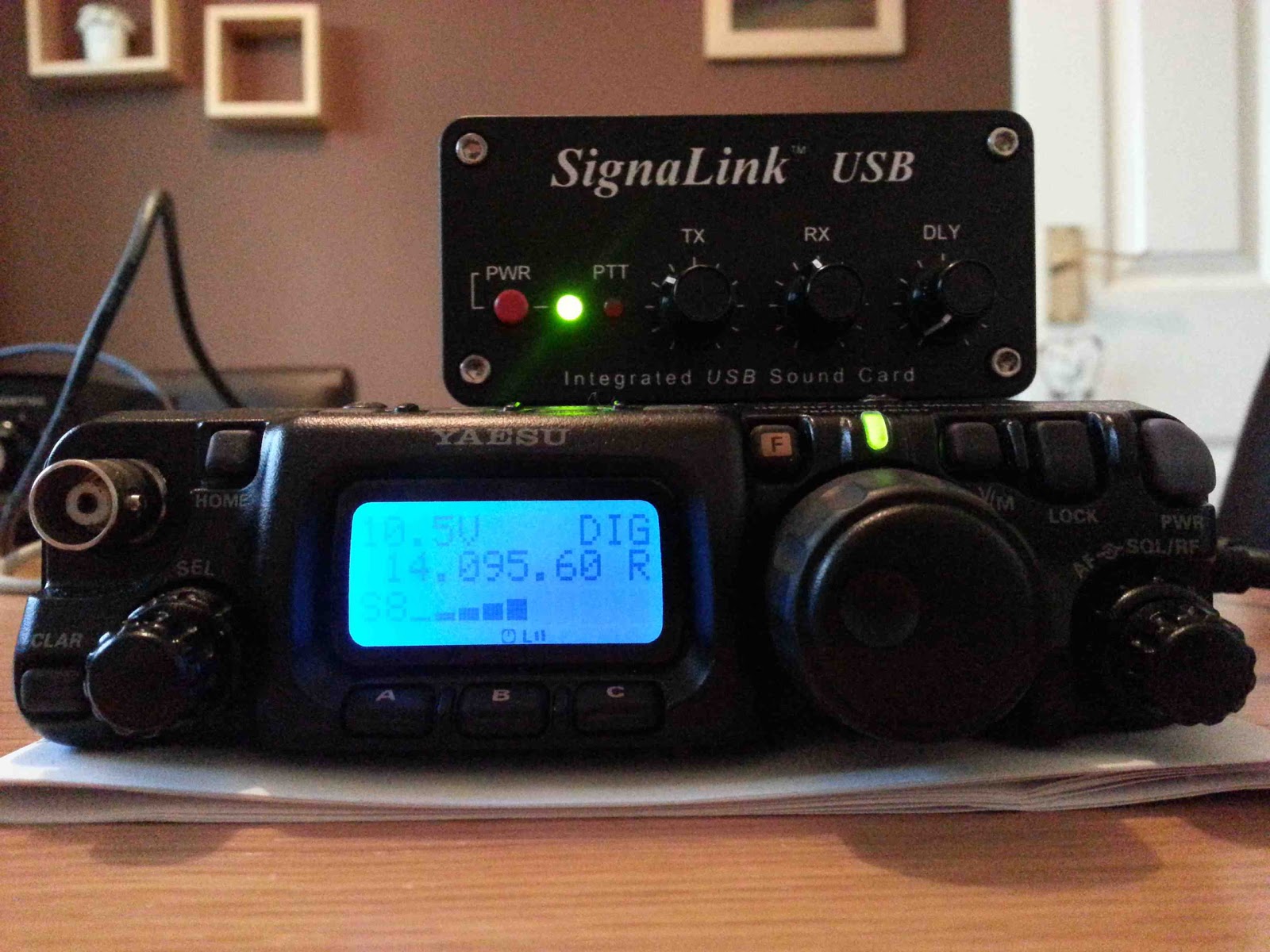 |
| FT-817 and Signalink USB Interface |
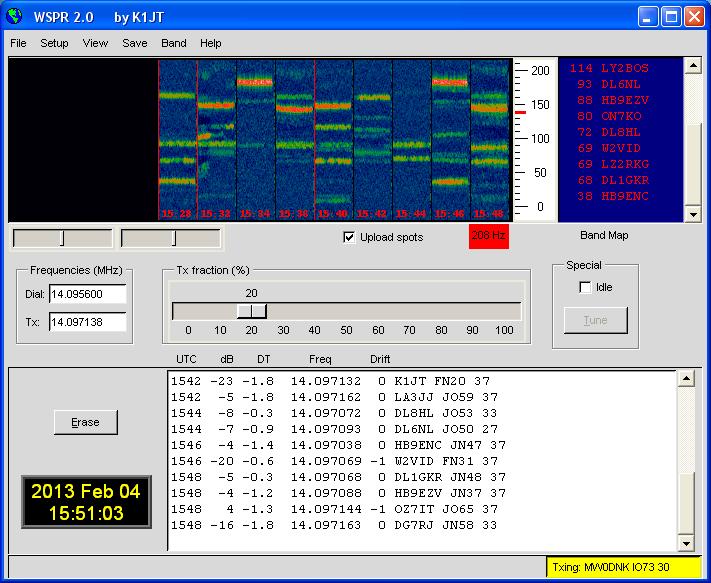 |
| WSPR Control Software |
 |
| 10 mins on 17m! |
 |
| 10 mins on 20m! |
WWVBTrigger
If you have been following my adventures, specifically with the Etherkit OpenBeacon, you will know that I was investigating a method of triggering WSPR transmissions without leaving it attached to a computer. My requirements were that it be Arduino based, since I am learning about that as well, and have a very stable time source as necessitated by WSPR.
The available options for stable time sources in the Arduino time library include NTP, RTC, and GPS sources, I decided to go a different direction!
While investigating time sources I ran across the WWVBClock Project on Github and thought WWVB would make an interesting time source for this project. The first step was to find a receiver, which are far less common from online shops than I expected, but I was able to find one at my local Wal-Mart in the form of a self setting alarm clock for the reasonable cost of $10.
 WWVBTrigger Clock
As soon as I got home I opened it up to ensure that the module was not integrated into the main PCB as that would be of little use and to my delight it was a separate unit as shown below. It is the module on the left hand side of the larger PCB and the antenna is located at the top. A pair of cutters and one minute later, I had a WWVB receiver module.
 WWVBTrigger Clock Inside
Locating a datasheet for the module proved a little challenging, but I was able to locate the datasheet for IC used on the module, which is located here.
 WWVBTrigger Module
Having all of the necessary information, it was time to start playing. I breadboarded all of the components as show in the schematic and started hacking apart the code from the WWVB Clock Project.
 WWVBTrigger Schematic
 WWVBTrigger Breadboard
My initial plan was to use the WWVB receiver and the Arduino time library to set the internal clock with hopes that it would keep accurate time when a WWVB signal wasn’t available. This proved to be a lost cause as it was 4 seconds behind after 90 minutes without a WWVB signal, far beyond the 2 seconds of accuracy required by WSPR.
The second, and current implementation, only transmits when a WWVB signal is available to guarantee accurate timing. The code by default will transmit at 4 minute intervals, but this value is configurable by manipulating the triggerInterval variable. During normal operations the code displays, via the serial port, each time an output signal is sent, enabling you to not only track transmissions, but also the availability of the WWVB signal in your area.
 WWVBTrigger Output
Here are the spots as reported on WSPR for the last 24 hours all of which have been triggered by this project.
 WSPR Spots
This project has been a lot of fun and works quite well! A WWVB signal is consistently available here in Central Arkansas, in the Central time zone, from about 7PM through the 10AM, honestly much more than I expected. The code for the project is available on Github, so feel free to use it and experiment!
QRP v QRO – Blood on the Floor?
 |
| FT-817. 5W on 10m. |

Ham Radio Action Next Weekend – Sept 8/9
 There are three excellent ham radio activities going on this coming weekend. Check these out and see if there is an activity that catches your interest. This is written for people in Colorado but items #1 and #3 are North American wide.
- ARRL September VHF QSO Party – noon MDT on Saturday until 9 PM MDT on Sunday http://www.arrl.org/september-vhf
- Colorado FM Sprint – a mini version of the September VHF QSO Party,
using FM only on these bands: 146 MHz, 222 MHz and 440 MHz
Saturday from noon to 7 PM MDT
http://www.qsl.net/k0yb/Colorado_FM_Sprint.html
Suggested frequencies: 146.58, 146.55, 223.5, 446.000, 446.100 MHz FM simplex - North American Summits On The Air (SOTA) Weekend
SOTA activations all over North America
http://na-sota.org/NASOTA_Weekend.html
Go here to see announced summit activations: http://www.sotawatch.org/
VHF contacts are usually on 146.52 MHz
(Note: this frequency is NOT allowed for contacts in the
Sept VHF QSO Party and Colorado FM Sprint)
HF contacts are on frequencies listed on sotawatch.org
Wow, lots of stuff to choose from!
At the very least, I’d suggest getting on the air Saturday afternoon to see if you can work some of the VHF contest stations. They are likely to be some mountaintop SOTA stations active at that time, too. Some of these folks may try to work the VHF contests AND do the SOTA thing on the same expedition.
73, Bob K0NR
K0NR Colorado QSO Party Results
It was a fun day working the Colorado QSO Party from the cabin near Trout Creek Pass. State QSO parties are contests designed to focus attention on a particular state, with an emphasis on activation of counties. This brings out the County Hunters and other folks interested in working that particular state.I decided to operate from our cabin near Trout Creek Pass in Park County, which is considered “rare” by most folks. My station was a Yaesu FT-950 running 100W to a trap dipole up in the trees. I mostly operated phone since I don’t consider my CW skills up to that challenge of a contest. I did make a few CW contacts at the request of a few folks than wanted Park County on CW.
Thanks to all of the mobile stations out there, both in Colorado and out of state. I was surprised how many people were mobile or operating portable (often camping out for the holiday weekend). I normally monitor 146.52 MHz while up at the cabin for anyone out hiking or mobile. I heard Eric W0ECE doing a SOTA activation on Mt Evans and worked him for QSO Party points and SOTA points.
The score below includes the CW contacts so the score will drop a bit when I submit in the phone only category (77526, I think).
I was disappointed with the Qs on 15 Meters but I looked in my log from last year and it was also light on 15 Meter contacts. Twenty meters is always a bit crowded and I really like when 15M and 10M open up. I almost doubled my score from last year, so I was happy with the result.
        Band  Mode  QSOs    Pts   Sec   Mul
            7  CW       3      12    2    0
            7  LSB     93     186   23    1
           14  CW       1      4     1    0
           14  USB    400     802   41    0
           21  USB     23      64    5    0
           28  USB      1      2     0    0
          144  FM       4      8     3    0
        Total  Both   525    1078   75    1
           Score : 81,928
Thanks to the Pikes Peak Radio Amateur Association for sponsoring this event.
73, Bob K0NR
Colorado QSO Party Coming This Saturday
The Colorado QSO Party will be held this Saturday September 1, from 6 AM to 10 PM Mountain Time. This is a fun radio contest where amateurs outside of Colorado try to work as many Colorado stations as possible.
It looks like we will have quite a few counties on the air for this event, so it will be a good opportunity to work any Colorado counties that you might be missing. Complete rules are available here.
Thanks to the Pikes Peak Radio Amateur Association for sponsoring this event.
73, Bob K0NR













