Archive for the ‘hf’ Category
 Weekly Propagation Summary – 2016 Sep 26 16:10 UTC
 September 26th, 2016 |
  Author:
Here is this week’s space weather and geophysical report, issued 2016 Sep 26 0103 UTC.
Highlights of Solar and Geomagnetic Activity 19 – 25 September 2016
Solar activity reached low levels this period due to isolated C-class flare activity. Region 2595 (N11, L=099, class/area=Dao/120 on 20 Sep) was the most productive region this period. In addition to multiple low-level C-class flares Region 2595 produced the largest event of the period, a C5 flare at 22/0547 UTC. Region 2597 (S13, L=349, class/area=Dsc/120 on 24 Sep) developed late in the week and produced an isolated C1 flare at 25/1914 UTC in addition to numerous B-class flares. No Earth-directed coronal mass ejections were observed this period.
No proton events were observed at geosynchronous orbit.
The greater than 2 MeV electron flux at geosynchronous orbit reached high levels on 21 Sep, moderate levels on 22-23 Sep, and was at normal levels throughout the remainder of the period.
Geomagnetic field activity reached G1 (Minor) geomagnetic storm levels on 20 Sep with active levels observed on 21 Sep in response to the influence of a negative polarity coronal hole high speed stream. G1 (Minor) storm levels were observed again on 25 Sep due to prolonged periods of southward interplanetary magnetic field orientation. Quiet conditions were observed on 22-24 Sep and quiet to unsettled levels were observed on 19 Sep under a background solar wind environment.
Forecast of Solar and Geomagnetic Activity 26 September – 22 October 2016
Solar activity is expected to be at very low levels throughout the period with a chance for C-class flare activity.
No proton events are expected at geosynchronous orbit.
The greater than 2 MeV electron flux at geosynchronous orbit is expected to be very high on 02 Oct with high levels expected on 29 Sep-01 Oct, 03-11 Oct, and 18 Oct following periods of an enhanced solar wind environment associated with coronal hole high speed stream influence. Normal and normal to moderate flux levels are expected throughout the remainder of the period.
Geomagnetic field activity is likely to reach G2 (Moderate) geomagnetic storm levels on 28-30 Sep and G1 (Minor) storm levels on 26 Sep, 01-02 Oct, and 17 Oct due to the anticipated influence of multiple, recurrent coronal hole high speed solar wind streams. Active conditions are expected on 27 Sep, 03 Oct, and 18 Oct with generally quiet and quiet to unsettled conditions likely throughout the remainder of the period.
Don’t forget to visit our live space weather and radio propagation web site, at: http://SunSpotWatch.com/
Live Aurora mapping is at http://aurora.sunspotwatch.com/
If you are on Twitter, please follow these two users: + https://Twitter.com/NW7US + https://Twitter.com/hfradiospacewx
Get the space weather and radio propagation self-study course, today. Visit http://nw7us.us/swc for the latest sale and for more information!
Check out the stunning view of our Sun in action, as seen during the last five years with the Solar Dynamics Observatory (SDO): https://www.youtube.com/watch?v=zXN-MdoGM9g
We’re on Facebook: http://NW7US.us/swhfr
Weekly Propagation Summary – 2016 Sep 19 16:10 UTC
Here is this week’s space weather and geophysical report, issued 2016 Sep 19 0130 UTC.
Highlights of Solar and Geomagnetic Activity 12 – 18 September 2016
Solar activity was at very low levels throughout the period. Region 2585 (N08, L=222, class/area=Ekc/590 on 03 Sep) was the largest and most magnetically complex region on the disk this week, however, the region only produced low-level B-class flare activity before rotating out of view early in the period. Region 2592 (N14, L=027, class/area=Bxo/10 on 18 Sep) produced several low-level B-class flares in the latter half of the week, but was relatively simple throughout the period. No Earth-directed coronal mass ejections (CMEs) were observed this period.
No proton events were observed at geosynchronous orbit.
The greater than 2 MeV electron flux at geosynchronous orbit reached high levels on 12-14 Sep, moderate levels on 18 Sep, and were at normal levels on 15-17 Sep.
Geomagnetic field activity was quiet on 13, 16-27 Sep and quiet to unsettled on 12, 14-15, and 18 Sep under a mostly nominal solar wind regime.
Forecast of Solar and Geomagnetic Activity 19 September – 15 October 2016
Solar activity is expected to be at very low levels with a change for C-class flares throughout the period.
No proton events are expected at geosynchronous orbit.
The greater than 2 MeV electron flux at geosynchronous orbit is expected to reach very high levels on 02-05 Oct with high levels expected on 21-25, 29 Sep-01 Oct, and 06-11 Oct following solar wind enhancements associated with the influence of multiple coronal hole high speed streams. Electron flux is expected to be at normal or normal to moderate levels throughout the remainder of the period.
Geomagnetic field activity is likely to reach G2 (Moderate) geomagnetic storm levels on 28-30 Sep and G1 (Minor) storm levels on 19-20 Sep and 01 Oct due to the anticipated influence of multiple, recurrent coronal hole high speed streams. Active conditions are expected on 21 Sep and 02-05 Oct with generally quiet or quiet to unsettled conditions likely throughout the remainder of the period.
Don’t forget to visit our live space weather and radio propagation web site, at: http://SunSpotWatch.com/
Live Aurora mapping is at http://aurora.sunspotwatch.com/
If you are on Twitter, please follow these two users: + https://Twitter.com/NW7US + https://Twitter.com/hfradiospacewx
Get the space weather and radio propagation self-study course, today. Visit http://nw7us.us/swc for the latest sale and for more information!
Check out the stunning view of our Sun in action, as seen during the last five years with the Solar Dynamics Observatory (SDO): https://www.youtube.com/watch?v=zXN-MdoGM9g
We’re on Facebook: http://NW7US.us/swhfr
NPOTA: Grand Teton, Yellowstone and Rocky Mountain
 To celebrate the 100th anniversary of the National Parks Service, the ARRL is sponsoring National Parks On The Air (NPOTA) during 2016. Joyce KØJJW and I happened to have a trip planned to visit several of the National Parks, so it was great opportunity to take along some radio gear and operate portable from the parks.
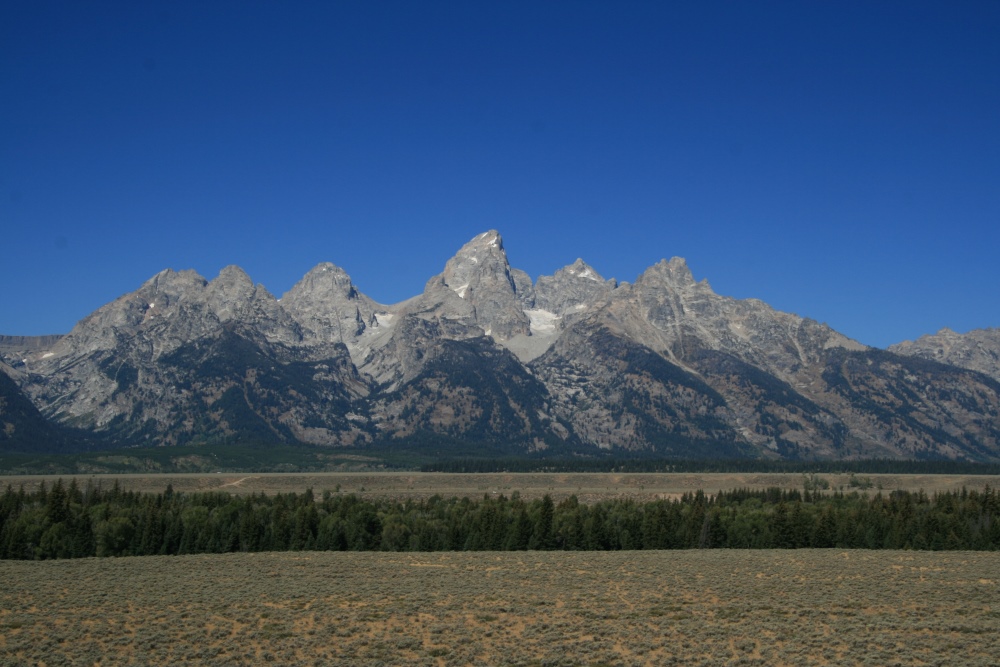
First stop was the Grand Teton National Park (NP23) in Wyoming. I operated from Signal Mountain, which is also a Summits On The Air (SOTA) peak. See my previous blog posting: SOTA plus NPOTA on Signal Mountain.

We continued on to Yellowstone NP (NP57), where we saw lots of wildlife: buffalo, elk, deer, bear and antelope. (Click on any of the photos to get a larger image.)
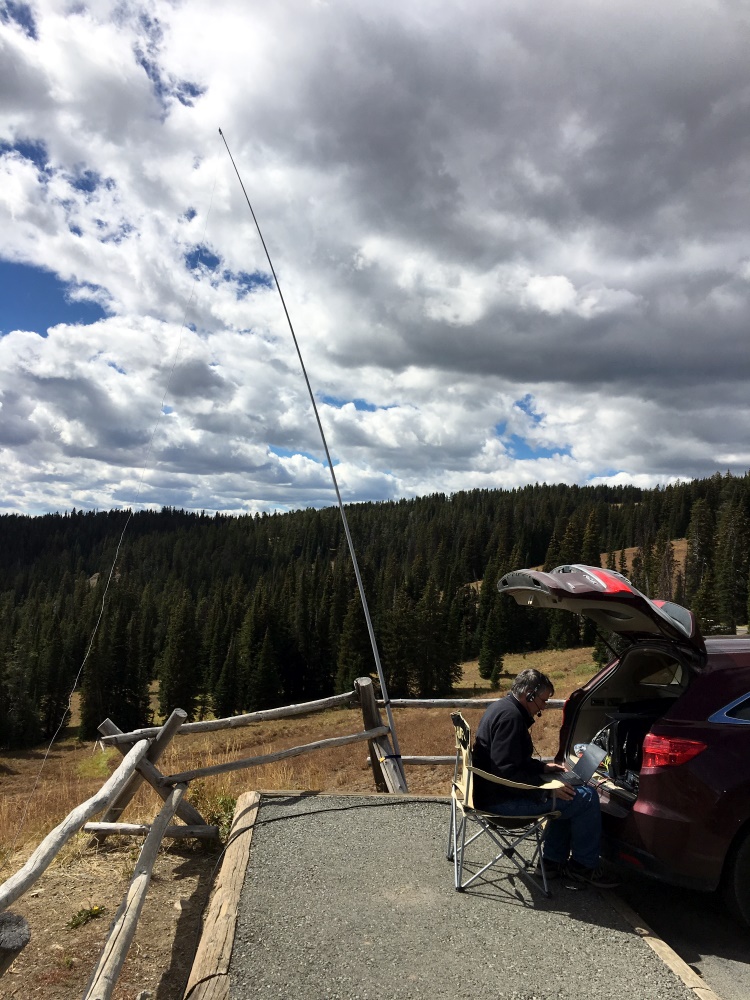
As described in the Signal Mountain post, my portable station was a Yaesu FT-991 driving an end-fed halfwave antenna on 20m. I used a SOTABEAMS pole to support the antenna, lashing the pole to whatever posts I found available. It was not too difficult to find a suitable parking spot close to mounting post. I was prepared to operate on other bands but 20m seemed to be the best choice based on current band conditions. I made 48 contacts on 20m ssb in about 30 minutes.
As we headed back home to Colorado, we visited Rocky Mountain National Park (NP48). We entered the park from the west side and crossed over to the east entrance via Trail Ridge Road. Love that drive! But first we stopped on the west side to do another NPOTA activation. Again, 20m phone was the operating mode and I made 33 contacts with stations across the US and Canada.

We took our time leaving the park around dusk so that we could spot some elk. The strategy paid off as we saw more than 20 elk in various locations.
Our top priority was enjoying the parks and viewing wildlife so we did not spend a huge amount of time doing NPOTA activations. Still, we activated three of our favorite National Parks, making 121 QSOs. We also worked in two SOTA activations on the trip as a bonus. All in all, it was a great trip with some fun ham radio activity included.
The SOTA and NPOTA logs have all been submitted (SOTA database and Logbook of The World, respectively.)
73, Bob K0NR
The post NPOTA: Grand Teton, Yellowstone and Rocky Mountain appeared first on The KØNR Radio Site.
SOTA plus NPOTA on Signal Mountain (W7Y/TT-161)
Signal Mountain (W7Y/TT-161) is now my favorite spot in the Grand Teton National Park. The summit is well-marked on the Grand Teton NP map, on the east side of Jackson Lake. It has a paved road to the top and it provides excellent views of Jackson Hole and the surrounding mountains. Oh, and it’s a great location for ham radio.
On this summit, I did a combination Summits On The Air (SOTA) and National Parks On the Air (NPOTA) activation. Well, sort of. It turns out that when I packed for the trip, I included my usual SOTA gear, which is all VHF. For NPOTA, I loaded up my HF DXpedition gear that needs a pretty hefty power source. These means that the HF stuff uses my car battery, so it is not SOTA-compliant. Oh well.
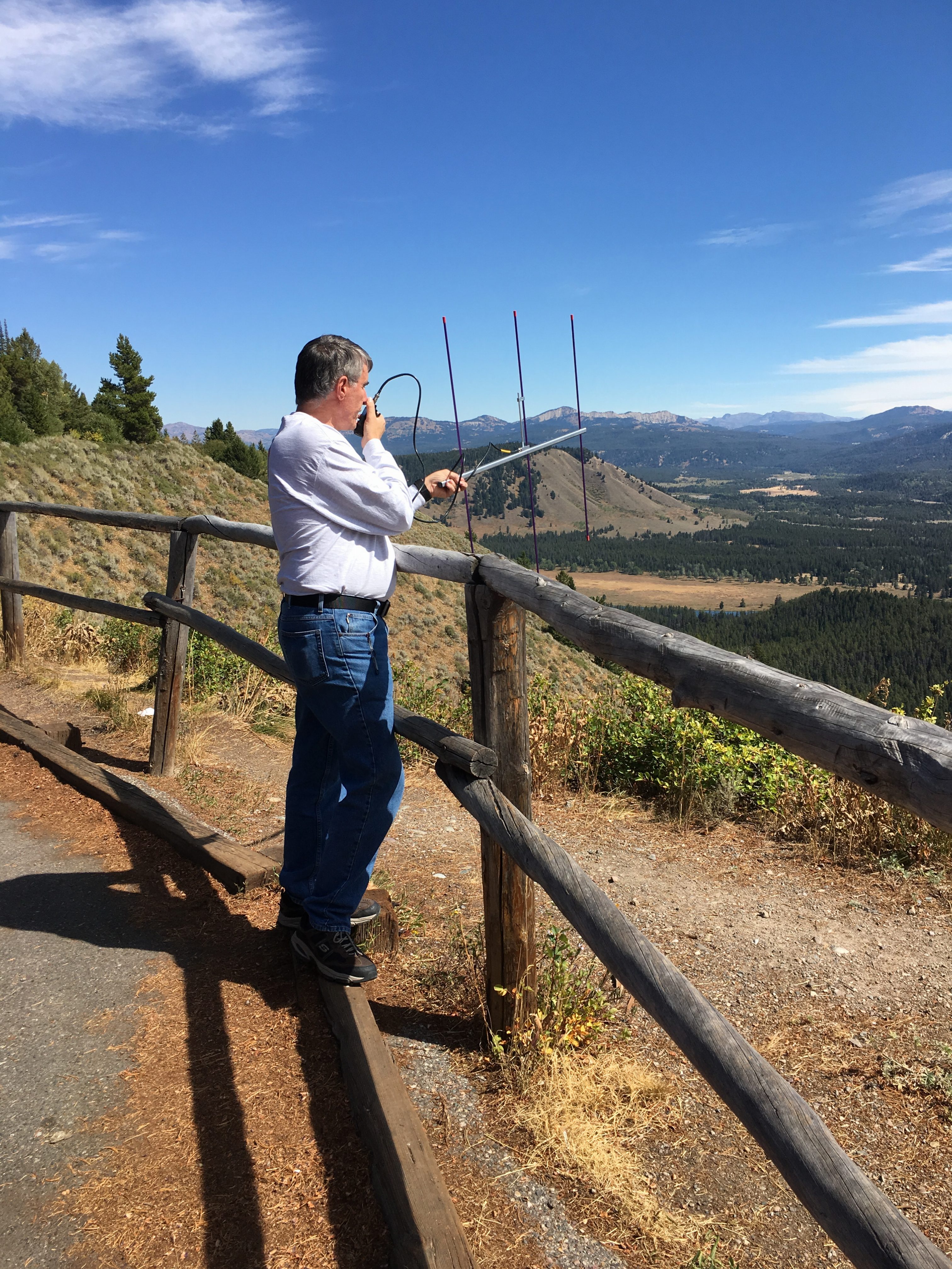
For the SOTA activation, I used the Yaesu FT-1DR and my 3-element Arrow yagi antenna to work a handful of stations on 146.52 MHz. I was a little concerned about finding enough stations listening on 52, but once again a little bit of patience payed off and I made my four QSOs.
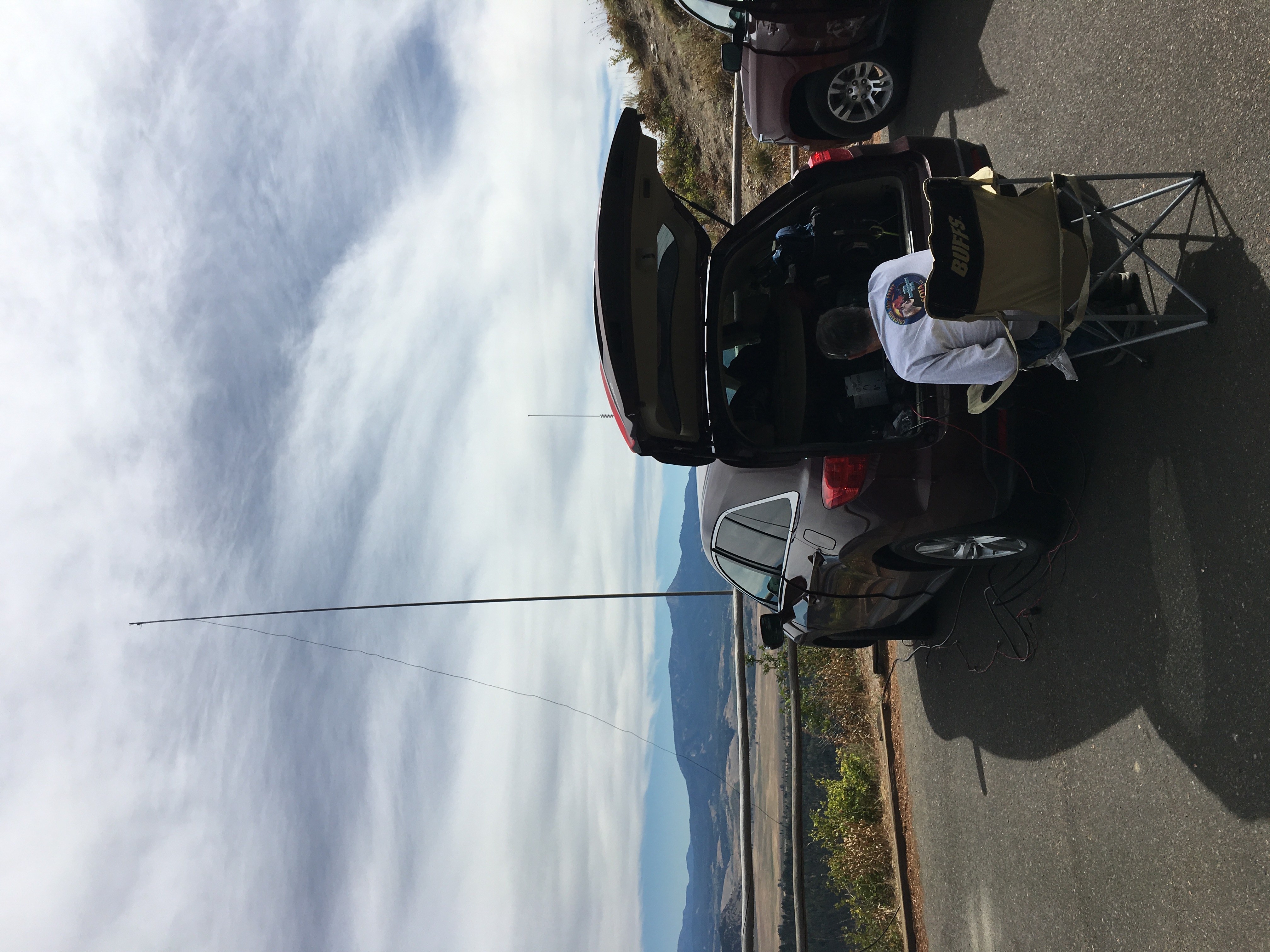
Then I set up the NPOTA station to activate Grand Teton National Park (NP23). My equipment was a Yaesu FT-991 driving an end-fed half-wave for 20m from LNR Precision. I’ve tried a number of different portable antennas over the years but have found that a half-wave radiator up in the air is a pretty effective antenna. This could be a center-fed dipole antenna but that can be a challenge to support, depending on the physical location.
The end-fed half-waves (EFHW) from LNR Precision are easily supported using a non-conductive pole such as the 10m SOTABEAMS pole. The top two sections of the pole are too thin to support much of antenna, so I have removed them. This makes my pole about 9 meters in length which is still long enough to support a 20m halfwave. (The antenna angles out a bit as shown in the photo but its pretty much vertical.) I attached the pole to a fence post using some hook/loop straps. I don’t fiddle with the length of the antenna, I just let the antenna tuner in the FT-991 trim up the match. This is the same configuration I used in Antigua (V29RW), where it worked great.
The FT-991 is a great little radio for this kind of operation. The SUV we were driving is not set up for HF operation so I just located the radio in the back of the vehicle and plopped down on a folding camp chair. For power, I clipped directly onto the vehicle battery with fused 10 gauge wires.
I started by making a few calls on 20m ssb. As soon as I was “spotted” on the usual web sites, I had a good pileup going. I worked 40 stations in about 40 minutes, so averaged one QSO per minute overall. Thanks to everyone that worked me; all contacts have been uploaded to Logbook of The World.
Oh, and it was a lot of fun.
73, Bob K0NR
The post SOTA plus NPOTA on Signal Mountain (W7Y/TT-161) appeared first on The KØNR Radio Site.
Weekly Propagation Summary – 2016 Sep 12 16:10 UTC
Here is this week’s space weather and geophysical report, issued 2016 Sep 12 0323 UTC.
Highlights of Solar and Geomagnetic Activity 05 – 11 September 2016
Solar activity was at very low levels on 05-11 Sep. Region 2591 (N05, L=144, Cro/025 on 11 Sep) produced a B9.6 flare at 10/1920 UTC, the strongest of the period. No Earth-directed CMEs were observed were observed during the period.
No proton events were observed at geosynchronous orbit.
The greater than 2 MeV electron flux at geosynchronous orbit was at very high levels on 05 Sep and high levels from 06-11 Sep due to CH HSS influence. The largest flux value of the period was 56,842 pfu observed at 05/1815 UTC.
Geomagnetic field activity was at quiet to minor storm levels on 05 Sep due to a period of prolonged southward Bz during the waning phase of a CH HSS. Solar wind speed continued to decline over the period from a high near 600 km/s to 340 km/s by the end of the period. Activity decreased to quiet to active conditions on 06 Sep and to quiet to unsettled conditions on 07 Sep. A final increase to quiet to active conditions was observed on 08 Sep before quiet conditions dominated for the remainder of the period.
Forecast of Solar and Geomagnetic Activity 12 September – 08 October 2016
Solar activity is expected to be at very low to low levels throughout the forecast period.
No proton events are expected at geosynchronous orbit.
The greater than 2 MeV electron flux at geosynchronous orbit is expected to be at normal to moderate levels on 12-20 Sep and 26-28 Sep. High levels expected on 21-25 Sep, 29 Sep – 01 Oct, and 06-08 Oct. Very high levels are likely between 02-05 Oct. High and very high levels are anticipated to result from recurrent CH HSS events.
Geomagnetic field activity is expected to be at quiet to active levels on 12 Sep as a solar sector boundary crossing is anticipated to transition into a weak, negative polarity, CH HSS. As the CH HSS influence wanes, quiet to unsettled levels are likely over 13-14 Sep. Quiet conditions are expected on 15-16 Sep under an ambient solar wind environment. 17-21 Sep will likely to be at quiet to active conditions as a negative polarity CH HSS influences the near-Earth environment. Quiet conditions are again expected from 22-25 Sep. 26-27 Sep are likely to be at unsettled to active conditions from a small, positive polarity, CH HSS. 28-30 Sep are likely to see field active range from unsettled to major storm levels from a strong, positive polarity, CH HSS. As the CH HSS influence wanes, unsettled to minor storm levels are likely on 01 Oct and quiet to active levels are expected from 02-05 Oct. Quiet conditions are expected to return over 06-08 Oct under a nominal solar wind regime.
Don’t forget to visit our live space weather and radio propagation web site, at: http://SunSpotWatch.com/
Live Aurora mapping is at http://aurora.sunspotwatch.com/
If you are on Twitter, please follow these two users: + https://Twitter.com/NW7US + https://Twitter.com/hfradiospacewx
Get the space weather and radio propagation self-study course, today. Visit http://nw7us.us/swc for the latest sale and for more information!
Check out the stunning view of our Sun in action, as seen during the last five years with the Solar Dynamics Observatory (SDO): https://www.youtube.com/watch?v=zXN-MdoGM9g
We’re on Facebook: http://NW7US.us/swhfr
Weekly Propagation Summary – 2016 Sep 05 16:10 UTC
Here is this week’s space weather and geophysical report, issued 2016 Sep 05 0405 UTC.
Highlights of Solar and Geomagnetic Activity 29 August – 04 September 2016
Solar activity was at low levels from 29-31 Aug. Regions 2583 (N13, L=025, class/area Dao/130 on 29 Aug) and 2585 (N08, L=222, class/area Ekc/590 on 03 Sep) were responsible for the C-class activity. Activity dropped to very low levels for the remainder of the period. No Earth-directed CMEs were observed.
No proton events were observed at geosynchronous orbit.
The greater than 2 MeV electron flux at geosynchronous orbit was at high levels on 29 Aug and 02-04 Sep due to CH HSS influence.
Geomagnetic field activity was at quiet to unsettled levels on 29-31 Aug with active conditions late on 30 Aug due to CH HSS effects. Mostly active to major storm conditions were observed on 01-03 Sep due to effects from an extension of the northern polar coronal hole. Active to minor storm levels prevailed on 04 Sep due to continued CH HSS effects.
Forecast of Solar and Geomagnetic Activity 05 September – 01 October 2016
Solar activity is expected to be at very low to low levels throughout the forecast period.
No proton events are expected at geosynchronous orbit.
The greater than 2 MeV electron flux at geosynchronous orbit is expected to reach high to very high levels on 05-12 Sep due to CH HSS influence. Normal to moderate levels are expected from 13-20 Sep and 26-28 Sep. High levels are expected on 21-25 Sep and 29 Sep-01 Oct due to effects from anticipated recurrent CH HSS events.
Geomagnetic field activity is expected to be at unsettled to active levels on 05-06 Sep with minor storms expected early on 05 Sep as CH HSS effects continue. Quiet to unsettled conditions are expected on 07-08 Sep as effects begin to subside. Mostly quiet conditions are expected from 09-18 Sep with isolated unsettled periods likely on 13, 14 and 17 Sep due to weak recurrent CH HSS events. Quiet to unsettled levels are expected on 19-21 Sep with active periods possible on 19 Sep due to effects from a recurrent, negative polarity CH HSS. Mostly quiet conditions are expected from 22-25 Sep. Quiet to unsettled conditions are expected on 26-27 Sep followed by active to major storm levels from 26 Sep-01 Oct due to effects from the northern polar coronal hole extension.
Don’t forget to visit our live space weather and radio propagation web site, at: http://SunSpotWatch.com/
Live Aurora mapping is at http://aurora.sunspotwatch.com/
If you are on Twitter, please follow these two users: + https://Twitter.com/NW7US + https://Twitter.com/hfradiospacewx
Get the space weather and radio propagation self-study course, today. Visit http://nw7us.us/swc for the latest sale and for more information!
Check out the stunning view of our Sun in action, as seen during the last five years with the Solar Dynamics Observatory (SDO): https://www.youtube.com/watch?v=zXN-MdoGM9g
We’re on Facebook: http://NW7US.us/swhfr
Weekly Propagation Summary – 2016 Aug 29 16:10 UTC
Here is this week’s space weather and geophysical report, issued 2016 Aug 29 0520 UTC.
Highlights of Solar and Geomagnetic Activity 22 – 28 August 2016
Solar activity was at very low levels the majority of the period with low levels reached on 28 August due to an isolated C1/Sf flare at 28/2128 UTC from Region 2583 (N13, L=023, class/area Dao/030 on 28 Aug). Regions 2579 (N12, L=034, class/area Dao/090 on 23 Aug) and 2581 (N12, L=337, class/area Cao/110 on 28 Aug) were the largest spot groups on the visible disk, but were in a decay phase as of 24 and 28 August, respectively. No Earth-directed coronal mass ejections were observed during the period.
No proton events were observed at geosynchronous orbit.
The greater than 2 MeV electron flux at geosynchronous orbit was at normal levels on 22 August, moderate levels on 23-24 August, and high levels from 25-28 August. The maximum flux reached 2,334 pfu at 27/1705 UTC.
Geomagnetic field activity ranged from quiet to G1-minor storm levels during the period. The beginning of the period, solar wind conditions were nominal with solar wind speeds between 350 km/s and 420 km/s. The geomagnetic field was at quiet levels on 22 August. By 23 August, total field increased to around 14 nT with the solar wind speed increasing to around 550 km/s as a negative polarity coronal hole high speed stream (CH HSS) moved into geoeffective position. By midday on 24 August, total field had decreased to near 5 nT, however solar wind speeds remained elevated until late on 25 August when they began to decline. The geomagnetic field responded with quiet to G1-minor storm levels on 23-24 August, followed by quiet to unsettled conditions on 25-27 August. Quiet conditions were observed on 28 August under a nominal solar wind environment.
Forecast of Solar and Geomagnetic Activity 29 August – 24 September 2016
Solar activity is expected to be at very low to low levels throughout the period.
No proton events are expected at geosynchronous orbit.
The greater than 2 MeV electron flux at geosynchronous orbit is expected to be at normal to moderate levels with high levels expected on 31 August-12 September and again from 21-24 September due to recurrent CH HSS activity.
Geomagnetic field activity is expected to be at unsettled to active levels on 29 August-08 September, 13-14 September, 17 September, and 19-21 September with G1-minor storm levels likely on 29-30 August due to recurrent CH HSS activity.
Don’t forget to visit our live space weather and radio propagation web site, at: http://SunSpotWatch.com/
Live Aurora mapping is at http://aurora.sunspotwatch.com/
If you are on Twitter, please follow these two users: + https://Twitter.com/NW7US + https://Twitter.com/hfradiospacewx
Get the space weather and radio propagation self-study course, today. Visit http://nw7us.us/swc for the latest sale and for more information!
Check out the stunning view of our Sun in action, as seen during the last five years with the Solar Dynamics Observatory (SDO): https://www.youtube.com/watch?v=zXN-MdoGM9g
We’re on Facebook: http://NW7US.us/swhfr













