Archive for the ‘dx’ Category
 A couple of things
 March 28th, 2014 |
  Author:
 1) Worked a few more DX stations today during lunch. The bands were decent again.Had QSOs with TI8/AA1M in Costa Rica, LZ2HR in Bulgaria and F6ALQ in France. The QSO with Bernard in Soissons, France was a bit more than just your typical “599 TU” DX QSO. We actually conversed a bit! Wow …. Amateur Radio is actually well suited for conversation, don’t ya know?!? Next few days look like rain, so I probably won’t take the gear with me to work tomorrow.
2) Got skunked in the 80 Meter Fox Hunt tonight. I almost worked Ray K9XE in Illinois as he had three out of the four characters of my call sign several times. But he stated more than a few times throughout the hunt that he had S9 noise on his end. Oh well, he tried and I tried – no fault in that.
3) The date and time are set for the 2014 NJQRP Skeeter Hunt – Sunday, August 10th. You can check either http://www.qsl.net/w2lj/, or the Skeeter Hunt page of this blog. The exchange is a bit different this year. Instead of RST, I decided to go with the op’s first name instead. Just trying to be a little different this year. Oh, and Skeeter numbers will be given out starting on June 21st, the First Day of Summer – so please, don’t try to sweet talk a number out of me before then, OK?
Oh, and I had a Skeeter professionally drawn for this year’s logo. Here he is:

72 de Larry W2LJ
QRP – When you care to send the very least!
I think we have a pile-up …
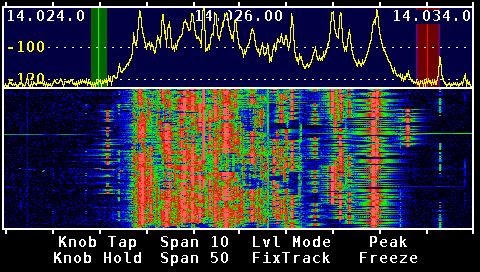
Got ’em!
A very big “Thank You” and a tip o’ the old callsign cap to Will NQ2W who sent me an e-mail letting me know that he had worked TX6G from his home near Albany, NY with 5 Watts on 10 Meters.
I just ran down the basement, and after figuring out the pattern, also snagged them with 5 Watts.
Thanks again, Will!
72 de Larry W2LJ
QRP – When you care to send the very least!
Been a busy boy
JT-65HF
I have been using my newly built datamode interface in anger.
As well as running WSPR on occasion I have also been active using JT65-HF.
JT65 is a communication mode developed by Joe Taylor, K1JT, (specification here) originally intended for amateur radio communication with extremely weak signals such as Earth-Moon-Earth (EME) contacts on VHF it has gained popularity on the short wave bands using JT65-HF an adaptation of the JT65A protocol.
Being restricted to 10W it is an attractive method of making contacts. The protocol includes error-correcting features that make it usable even when the signals are too weak to be heard or are being subject to interference.
There are several how-to guides available
Get On the Air with HF Digital (from the ARRL)
JT65-HF -- an 'Odd' but Fun Digital Mode (from eham.net)
A number of software packages support JT65, the most popular being JT65-HF originally developed by Joe, W6CQZ. Sadly Joe is no longer developing the software, but the last version released still works, and is available at http://sourceforge.net/projects/jt65-hf/
Thankfully the project was open source and Beat Oehrli, HB9HQX as developed his own version with the catchy title JT65-HF-HB9HQX-Edition, available at http://sourceforge.net/projects/jt65hfhb9hqxedi/ This is the version I have been using with great success, the colour coding and simple button pressing makes a QSO straight forward and the built in logging and exporting make uploading to QRZ, eQSL and HRDlog painless.
Whilst to a traditionalist amateur operator it is perhaps a little slow, remote and impersonal (each exchange occurs during alternate minutes) I really like it! One advantage is I can set up the radio in the shack with CAT control via HRD and then have QSOs while VNC'ing into the computer from the laptop whilst in front of the TV with the wife and the dogs! (Thanks Tim G4VXE for that suggestion!)
I have been active on the 10/20/30 and 40M bands over the past few weeks making contacts with Bulgaria, Canada, Denmark, Germany, Greece, Iceland, Kazakhstan, Poland, Russia, Serbia, Sweden, Thailand, Ukraine, USA and Venezuela.
Contesting 'DX' Headset and Interface
I have become hooked on the RSGB UKAC VHF contests, operating on a Tuesday evening on different frequencies (50MHz, 144MHz, 432MHz depending on which week of the month) Whilst my results are small-fry compared to the big guns I have been more than happy with my modest antenna set up and less than ideal location (previous blog posts)
I soon appreciated that using headphones rather than the speaker made life easier but I was still using the stock supplied hand microphone. Several times I have found it difficult to make myself understood and suspected that not only am I plagued by my 'Black Country' accent and poor enunciation but maybe the microphone wasn't quite cutting it.
Not able to afford or justify the purchase of a Heil headset just yet I took inspiration from Charlie M0PZT and his recommendation for a budget solution using a £10 computer headset from CPC (product AV21444).
On the Yaesu FT-857D the microphone connector is a 8-pin RJ45 socket which is behind the removable front panel with the lead coming out of one of a number of openings. Whilst the panel is easily removable I didn't want to keep removing it when switching between microphones, also re-purposing an obvious CAT5 network lead was problematic as they are often thicker than the openings.
 | |
| The lead removed from MH-31, RJ45 on interface |
 |
| Mic lead connected and headset |
 |
| The budget 'dx' headset |
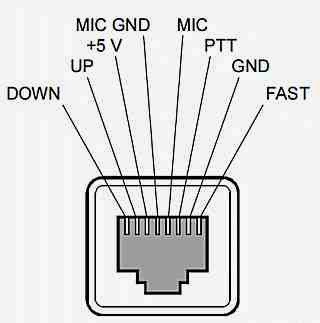 |
| Yaesu FT-857D mic socket as view from front |
The box also has a PTT switch, this could have simply grounded the PTT line but I wanted to have a LED indication on the box and again I could have just wired a LED and resistor to 5V and to the PTT line so it would light when the switch was closed, pulling PTT to ground and completing the circuit. I opted to use a simple transistor open collector switch to add a little isolation.
The interface works well and I used it for the first time last night in the 50MHz UKAC with my homebrew MOXON antenna...
6M/50MHz MOXON
My first contest back in January was the 50MHz UKAC and as I blogged I made a solitary contact due to antenna issues, i.e I didn't really have one!
I missed the February contest so this month I really wanted to have a decent stab at it which meant building an antenna. I decided early on that a Moxon was probably the easiest to construct, so I downloaded the MoxGen program to calculate the element lengths.
Using 1mm diameter 'garden wire' for the driven element and reflector. I had various bits of flexible plastic pipe kicking about and decided to use them to construct an x-shaped spreader, unfortunately the pipe was obviously from different batches and as soon as it was tensioned by the wire it bent into all sorts of strange shapes due to the different elastic properties so I abandoned that design.
I had left the build to the last minute and needed a quick solution, so yesterday morning plan-B was to go an get some cheap timber from the local B&Q on the way to work and build a simple frame to wrap the wire round.
 |
| Moxon on garage floor |
 |
| Coax and common-mode choke, and sturdy support! |
One thing I hadn't appreciated was just how big the final antenna was, it wasn't heavy just big! So last night an hour before the contest started I fitted the choke balun and coax to the terminal block. To be safe I removed the other antenna from the mast and hoisted her up.
 |
| Up in the night sky |
Moment of truth, thankfully the VSWR was around 1.5:1 at 50.2MHz, rising to nearer 2:1 at the top end of the band. Not ideal but close enough. The VSWR measurements would suggest that the Moxon is a little bit long, interestingly some online Moxon calculators suggested dimensions for a slightly smaller Moxon than the downloaded Moxgen program did? Something to tweak/experiment with possibly using some thicker wire to increase the bandwidth.
50MHZ UKAC 25 March 2014
I was sorted! Moxon antenna up, contesting headset and interface plugged in and a quick scan up and down and I could clearly hear several stations testing and setting up. I poured myself a beer and soon the contest started.
 |
| Time between QSOs for a 'selfie' |
I was not disappointed in fact I was quite happy with what my 10W, my new headset and home brewed antenna had achieved. The Moxon showed great promise and directional characteristics but for some reason just couldn't get south as the map indicates.

Out of interest I wondered what the line of slight view from my mast looked like so I strapped a camera on to the moxon this afternoon..
Need more height I think, especially if pointing South and a rotator would be nice!
Well that wraps it up for the moment.. 73
The allure of DX
is a very good thing, but can be bad at times. My buddy W3BBO describes it as an “obsession” or an “addiction”. I’d have to agree with him there. Once you get your first taste and get hooked, there’s no turning back. Add QRP power to the mix and, if you’re addicted to challenges – stick a fork in you, you’re done.
The bands were alive with signals again during lunchtime today. But yet, I only worked two stations. My addiction got in the way. I worked Laci HA0NAR in Hungary, who I have worked many times before. I also worked LY10NATO, who asked me to spot him, as he was calling CQ without many takers. Being in the car, away from the Internet, I didn’t have that luxury.
My downfall came when I heard TX6G on 12 Meters. He was LOUD. 599+ loud at times. I immediately thought, “Wow! THAT loud, here’s my chance to work them QRP.”. Not today, Grasshopper, not today.
Undoubtedly, if I wasn’t so hard headed, I could have worked at least three or four more stations in my limited time allotment. However, my stubborn Polish side got the better of me, and I did a Don Quixote, and chased a windmill.
The windmill won.
72 de Larry W2LJ
QRP – When you care to send the very least!
Disappointment and then …. jubilation!
Amateur Radio is lot like other areas in life. There highs and there are lows – there are valleys and there are peaks. Often, the journey from one extreme to the other takes places within minutes of each other.
This evening, I was tooling around 10 Meters late. It was after 7:00 PM local time. The sun was already down, but sometimes – just sometimes, this is when the good ones can be heard. Twiddling the dial, I heard a very weak BY5WJ. China! So I turned up the power, as I’ve never worked China and started tapping out my call, Woo hoo! Success! “W2LJ UR 579 TNX LARRY DE JOSH”.
Josh? In China? Me, 579? Can’t be! Then I realized it was 6Y5WJ – not BY5WJ. It was Josh in Jamaica, and we have worked a few times before. Obviously, being in his log, my info popped up and that’s why he answered me by name. After a few minutes, the band changed, and he became “normally loud” for what I would have expected a Jamaican station to sound like in New Jersey. So in a few seconds, I raced around the globe from the exotic Far East to the warm shores of the Caribbean. A bit of a disappointment, to say the least (no offense, Josh!).
At that point I started switching bands. 12 Meters – not much. 15 Meters – W1AW/5 in New Mexico is coming in strong. 17 Meters – not much. 20 Meters – OK, a lot more signals than the other bands (as we all know, 20 Meters is usually open to somewhere). What’s that? VU2what? A few more seconds of listening – it was VU2PHD, Mat in India. Wow! I very rarely ever hear India on the air. Still set at 75 Watts from my failed China QSO, I tapped out my call. Holy crow – I hear “W2?” coming back. I sent out my call a few more times, following up with my suffix twice, “W2LJ W2LJ LJ LJ”. I got a “W2LJ UR 559 QSB. UR CALL AGN?” I immediately sent back “DE W2LJ W2LJ UR 579 579 IN NJ NJ. OP LARRY LARRY”. Or something like that, I’m so exhilarated right now, I can’t even remember the exact exchange. All I know is that this was my first QSO with the Indian sub-continent, and is only about the second or third time I have even heard them on the air! And I’m in his log!
I immediately ran over to my e-mail program to send a quick note to my buddy Bob W3BBO in Erie, PA. Bob is my friend, my DX Guru, and is the only person I actually know who is on the DXCC Honor Roll. To my surprise he had already written me, “Did I hear what I think I heard on 20 Meters?”
I was able to answer in the affirmative and asked him how he happened to be listening. He had worked Mat earlier in the week and was going to make another attempt, as he wasn’t sure that Mat got his call correctly the first time. He had heard Mat come back to me and sent a quick e-mail to confirm. Whatever the reason, one of my best friends was on the scene to hear me work a new one. It just doesn’t get much better than that!
72 de Larry W2LJ
QRP – When you care to send the very least!
Norway, Bulgaria and Philly – QRP!
Had a brief time to head to the park at lunch today – and once again had a blast!
Here is the low down….
LA5UF – Joe was calling CQ on 21.040. It took him a bit to dig me out and get my call right. He gave me a 449 and he was a solid 559 here in Kansas. Joe hails from Norway.
LZ2HR – I heard him calling CQ on 28.0299 with no takers. I threw my call out and he came right back to me. He gave me a 589 and he was a solid 599 here. Fun!
I called CQ for some time on 10 meters, and even though I was spotted all over on the RBN – no dice.
Then I heard….
K3DY calling CQ on 21.0469. We had a nice QSO with more than just a contest exchange. The band was a bit up and down, but solid copy both ways. Tony said he was reading my page as we talked. Thanks for the nice QSO Tony! Tony is outside Philadelphia, PA.
Any lunch time with a little CW is always fun!
I hope to get a version of my Portable QRP Antenna installed in the attic this weekend. We will see how that goes. I would really like to get a station setup at home, and eventually try some of the digital modes.













