Archive for the ‘dx’ Category
 Working VK2SSI From My Backyard
 July 27th, 2015 |
  Author:
 This past weekend I was testing portable configurations for a trip I will be taking to Philmont Scout Ranch in Cimarron, New Mexico next week. I am the President of the Alamo Area Council of the Boy Scouts and will be going through some training there. So, this trip I will not operating from a summit, but rather I need to work an IOTA Island that I need that will QRV the week I am there.
I use EFHW's from summits all the time, but at QRP power levels, this time I will be running ~100 watts from a battery, so I thought an on air test would be a good idea. I conduct such tests in my backyard "Outdoor Radio Laboratory". I test portable configurations in an outdoor environment to simulate the conditions I will be operating in. I was running ~100 watts from an old Yaesu FT-100D to the EFHW on a 30' pole tied off in a tree. I was tuning on 17m and I found and was able to work VK2SSI on OC-194, Solitary Island. So a portable to portable QSO would bode well for the capability of the set up.
Below is a video of the set up.
I think I have more fun in my backyard than in my regular shack.
New Sunspot Region: Flare Activity Expected This Week
There is a new sunspot region rotating into view, producing moderately-strong (M-class) x-ray flares. This video shows you the first 11 hours of May 5, 2015
Expect flares throughout this week, which will degrade HF propagation DURING the flare, but enhance propagation overall (due to the higher Radio Flux). There might be occasional coronal mass ejections, too.
Fredbox – 2m transceiver

Many years ago I designed and made the 2m AM Fredbox 2m AM transceiver. At the time it was the smallest 2m transceiver I’d ever seen or used. Several close copies were made. It worked some impressive DX including several 60 mile handheld contacts and one over 100 miles to Brittany from the South Devon coast. All these were with whip antennas on the rig and not beams. Most QSOs were with locals. The power was only 10mW AM. It was ideal for contacts around Cambridge where I lived at that time.
Some years ago, I rebuilt the transceiver and had some decent QSOs yet again.
As with the Sixbox, I would suggest the design is taken as a springboard for your own version. It is certainly ripe for further development.

Happy Morse Code Day!
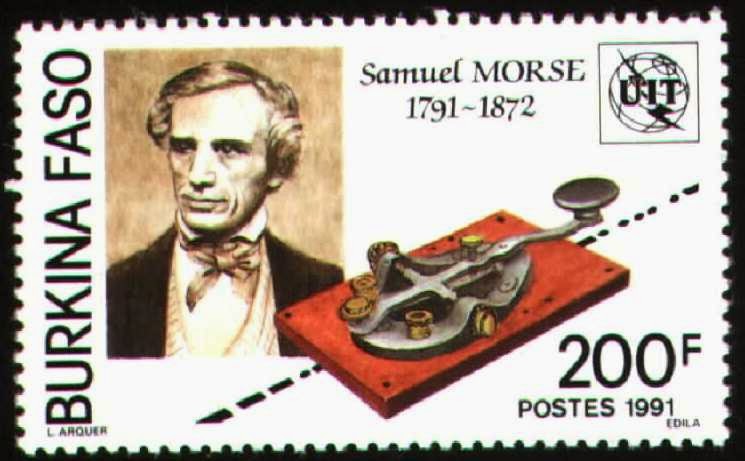
Does this make Samuel the original "Old Man"? Sorry Mr. Maxim*, I think Mr. Morse has seniority on you for that title, as Mr. Morse would be celebrating his 224th birthday today, were he of the kin of Methuselah.
Now that QRPTTF is over, except for e-mailing in my log summary, I thought I'd post where my signal was being heard on Saturday, according to the Reverse Beacon Network.
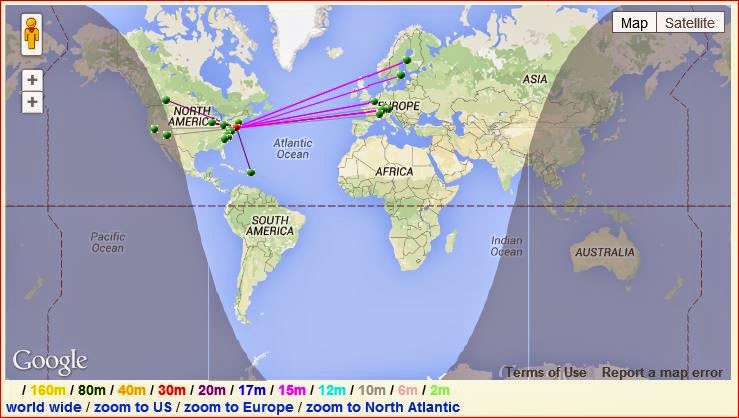
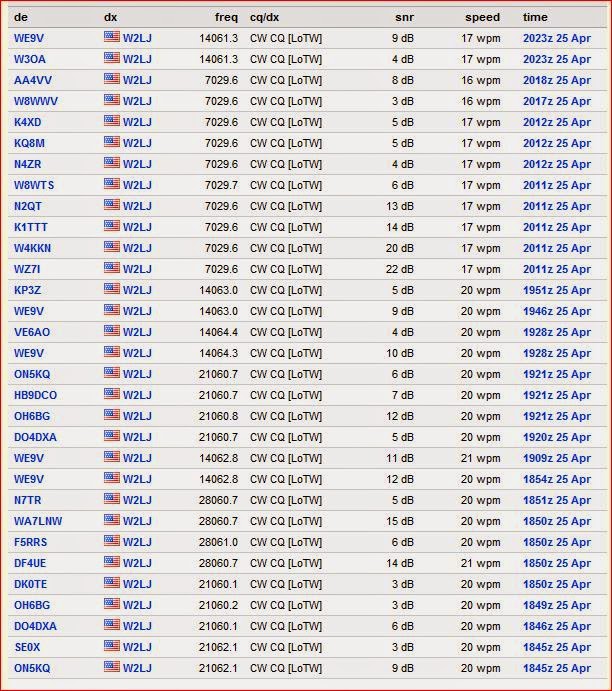
Bob W3BBO and I were discussing QRPTTF yesterday amongst ourselves, and it occurred to both of us that the western half of the nation seems to have reported larger QSO totals than the eastern half of the nation. This based on e-mails sent to QRP-L that we had read. Not sure what that means, but so far I haven't seen many e-mails from anyone east of the Mississippi with log summaries of around 40 QSOs or so. It will be interesting to see how it breaks down geographically once the results are in.
The EARCHI does get heard, and being on the top of a high hill (we call those mountains, here in NJ) sure makes a difference. And this makes for the other important lesson I've learned from events such as these. As nice as it would be to come in 1st place in a contest such as QRPTTF, the real prize won is enjoying a day outdoors, playing radio in the fresh air and sunshine, being able to forget about everyday worries, cares and concerns, even if it's just for a couple hours.
72 de Larry W2LJ
QRP - When you care to send the very least!
* - For those of you who are new to the Ham radio game, Hiram Percy Maxim who founded the ARRL, often wrote editorials under the pseudonym "The Old Man". Since HPM lived from 1869 - 1936. I guess that makes Mr. Morse the rightful holder of "The Old Man" title.
Watch stunning highlights, last 5 years of the Sun
We rely on the Sun for HF radio communication propagation. For the last five years, we have an amazing front-row seat: the SDO spacecraft. Here is a video with highlights of the last five years of solar activity as seen by NASA and the SDO AIA spacecraft. This is worth seeing on a larger monitor, so try to view it full screen on something larger than your palm. The music is pretty good too. It is worth the 20-some minutes of stunning viewing. Be sure to share!
Enjoy!
Details:
This video features stunning clips of the Sun, captured by SDO from each of the five years since SDO’s deployment in 2010. In this movie, watch giant clouds of solar material hurled out into space, the dance of giant loops hovering in the corona, and huge sunspots growing and shrinking on the Sun’s surface.
April 21, 2015 marks the five-year anniversary of the Solar Dynamics Observatory (SDO) First Light press conference, where NASA revealed the first images taken by the spacecraft. Since then, SDO has captured amazingly stunning super-high-definition images in multiple wavelengths, revealing new science, and captivating views.
February 11, 2015 marks five years in space for NASA’s Solar Dynamics Observatory, which provides incredibly detailed images of the whole Sun 24 hours a day. February 11, 2010, was the day on which NASA launched an unprecedented solar observatory into space. The Solar Dynamics Observatory (SDO) flew up on an Atlas V rocket, carrying instruments that scientists hoped would revolutionize observations of the Sun.
Capturing an image more than once per second, SDO has provided an unprecedentedly clear picture of how massive explosions on the Sun grow and erupt. The imagery is also captivating, allowing one to watch the constant ballet of solar material through the sun’s atmosphere, the corona.
The imagery in this “highlight reel” provide us with examples of the kind of data that SDO provides to scientists. By watching the sun in different wavelengths (and therefore different temperatures, each “seen” at a particular wavelength that is invisible to the unaided eye) scientists can watch how material courses through the corona. SDO captures images of the Sun in 10 different wavelengths, each of which helps highlight a different temperature of solar material. Different temperatures can, in turn, show specific structures on the Sun such as solar flares or coronal loops, and help reveal what causes eruptions on the Sun, what heats the Sun’s atmosphere up to 1,000 times hotter than its surface, and why the Sun’s magnetic fields are constantly on the move.
Coronal loops are streams of solar material traveling up and down looping magnetic field lines). Solar flares are bursts of light, energy and X-rays. They can occur by themselves or can be accompanied by what’s called a coronal mass ejection, or CME, in which a giant cloud of solar material erupts off the Sun, achieves escape velocity and heads off into space.
This movie shows examples of x-ray flares, coronal mass ejections, prominence eruptions when masses of solar material leap off the Sun, much like CMEs. The movie also shows sunspot groups on the solar surface. One of these sunspot groups, a magnetically strong and complex region appearing in mid-January 2014, was one of the largest in nine years as well as a torrent of intense solar flares. In this case, the Sun produced only flares and no CMEs, which, while not unheard of, is somewhat unusual for flares of that size. Scientists are looking at that data now to see if they can determine what circumstances might have led to flares eruptions alone.
Scientists study these images to better understand the complex electromagnetic system causing the constant movement on the sun, which can ultimately have an effect closer to Earth, too: Flares and another type of solar explosion called coronal mass ejections can sometimes disrupt technology in space as well as on Earth (disrupting shortwave communication, stressing power grids, and more). Additionally, studying our closest star is one way of learning about other stars in the galaxy.
Goddard built, operates and manages the SDO spacecraft for NASA’s Science Mission Directorate in Washington, D.C. SDO is the first mission of NASA’s Living with a Star Program. The program’s goal is to develop the scientific understanding necessary to address those aspects of the sun-Earth system that directly affect our lives and society.
Please visit my channel on YouTube, and subscribe ( https://YouTube.com/NW7US ).
— Twitter: https://Twitter.com/NW7US
— Facebook: https://www.facebook.com/spacewx.hfradio
— Web: http://SunSpotWatch.com
( Data feed Twitter https://Twitter.com/hfradiospacewx )
Credits:
Music Via YouTube “Free-for-use” Creation Tools
Video clips of the Sun are from NASA’s Goddard Space Flight Center/SDO which are in the Public Domain
By the way, this is an example of what I am trying to produce on a more regular basis, once I launch the space weather YouTube channel that I have started. If you wish to help, here is the GoFundMe link: http://www.gofundme.com/sswchnl
All continents in one night on WSPR
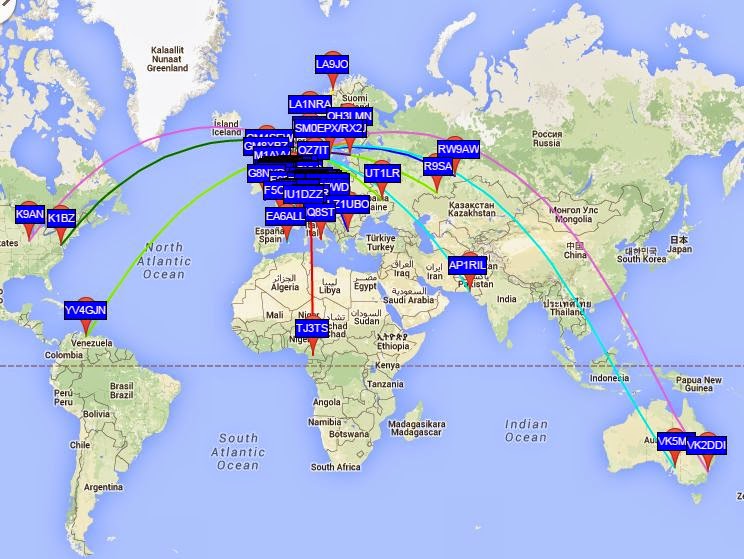
For me South America, Australia, and Africa are quite rare on WSPR. But they all heard my tiny 0.2 W signal the night between 31 March and 1 April in addition to North America, Asia and Europe. That’s a new one for me and worthy a brag post on the blog, I think! Hopefully, it may also inspire others to try low power WSPR.
In Australia and South America I was heard on the 10 MHz band, in Africa on 21 MHz, in Pakistan on 14 MHz, while 7 and 10 MHz worked into Siberia. North American stations also heard me on the 7 and 10 MHz bands.
This was on my untuned 80 m horizontal loop fed with open-wire feeder and a 4:1 balun. This shows both that the bare-foot Ultimate 3 kit is very tolerant of loads with SWR much different from 1, and that WSPR gives amazing results.
All continents in one night on WSPR
For me South America, Australia, and Africa are quite rare on WSPR. But they all heard my tiny 0.2 W signal the night between 31 March and 1 April in addition to North America, Asia and Europe. That’s a new one for me and worthy a brag post on the blog, I think! Hopefully, it may also inspire others to try low power WSPR.
In Australia and South America I was heard on the 10 MHz band, in Africa on 21 MHz, in Pakistan on 14 MHz, while 7 and 10 MHz worked into Siberia. North American stations also heard me on the 7 and 10 MHz bands.
This was on my untuned 80 m horizontal loop fed with open-wire feeder and a 4:1 balun. This shows both that the bare-foot Ultimate 3 kit is very tolerant of loads with SWR much different from 1, and that WSPR gives amazing results.













