Posts Tagged ‘WSPR’
 Resonant Frequency Video Edition 1 (short Intro to Linux for Radio Operators)
 January 29th, 2011 |
  Author:
 This is a short introduction to Linux for Amateur Radio Operators showing a few things that are available for Amateur Radio.
Sporadic-E on 6m
The first bit of live data I received from my APRS VHF propagation alert reflector was a warning of a possible Sporadic-E opening on six metres. I was rather surprised that there was Sporadic-E this early in the year, but I went to the DX Sherlock website and sure enough contacts had been reported between a station even further north than here and one in the Czech Republic. I then clicked on the map to see the actual contact details and was surprised to find they were WSPR spots!
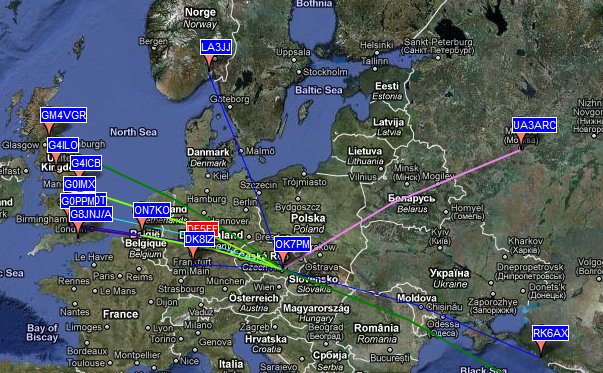
I went to the WSPR website and sure enough the same signals were shown. I decided to fire up WSPR on 6m myself but by then the OK station had gone and no new spots appeared from anywhere.
I have been, and still am, somewhat sceptical of the value of WSPR in showing VHF Sporadic-E propagation. One of the characteristics of Sporadic-E, particularly at the start and end of the season or on the higher frequencies like 2m is that it is very fleeting. A signal can be there for one minute, literally, and gone the next. On the other hand, signals can be really strong when reflected by Sporadic-E. WSPR is designed for detecting weak signals under steady propagation conditions and uses a 2 minute transmit cycle during which the data is transmitted very slowly. It seems to me that what you want to detect Sporadic-E is a mode with short transmit cycles where the data is transmitted quickly, perhaps something more akin to the modes used for meteor-scatter. I wonder if K1JT could come up with something?
Nevertheless I am very interested in anything that helps to detect VHF openings that might otherwise go undetected. I plan on WSPRing more on the 6m band, as long as there are others doing likewise so there is a chance of being received!

60m WSPR using 500mW QRP
I have been beaconing WSPR using 500mW all day today. The KAT3 didn’t want to repeat its trick of matching my multi-band dipole so the best SWR I could manage was about 1.8:1. I don’t know how much of the 500mW ended up warming up the ATU or the coaxial feeder.
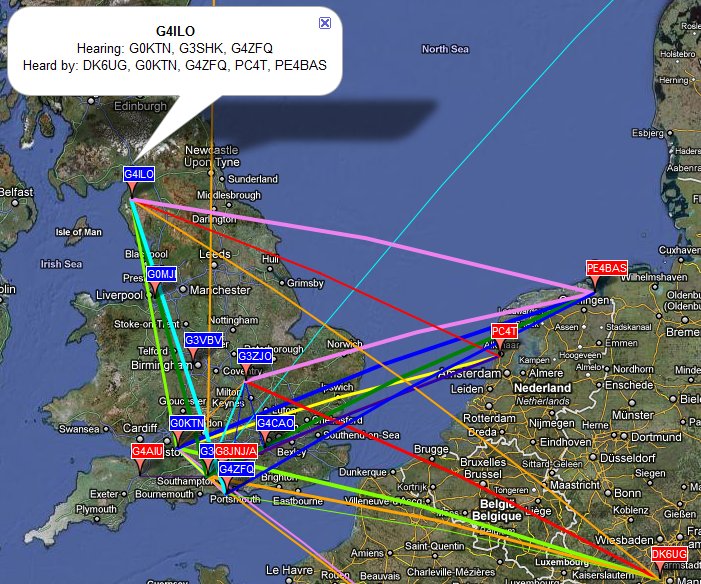
This is a shot of the WSPR propagation map taken just before 1800z today. As you can see, the 500mW is getting out pretty well. I think I have been received by all the G stations that have been monitoring at some time during the day, and a few others. And it was nice to see fellow bloggers Paul PC4T and Bas PE4BAS monitoring even though they can’t transmit on 60m, and better still spotting me!
Just after I posted this, my 500mW was also spotted by LA3JJ!

First emissions on 60m
On looking through the mail at lunch time I saw that I had received a letter from Ofcom. My NoV permitting me to operate on the 60m experimental band had arrived!
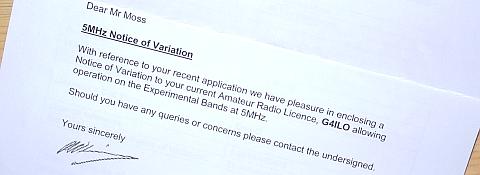
Until now I hadn’t been bothered about operating on 60m because I couldn’t see how I could possibly find room for an antenna for that band. However a couple of weeks ago I heard someone activating a SOTA summit in the Lake District on 60m and was frustrated that I could not reply to them. So I decided to put in an application for permission to operate and here I am.
I don’t have an antenna that is resonant on 60m so I tried tuning up my multiband dipole using the K3 auto ATU. After a lot of persuasion it managed to find an acceptable match on the higher frequency channels but it gave up on the lower ones. So I should be able to manage some activity on the new band.
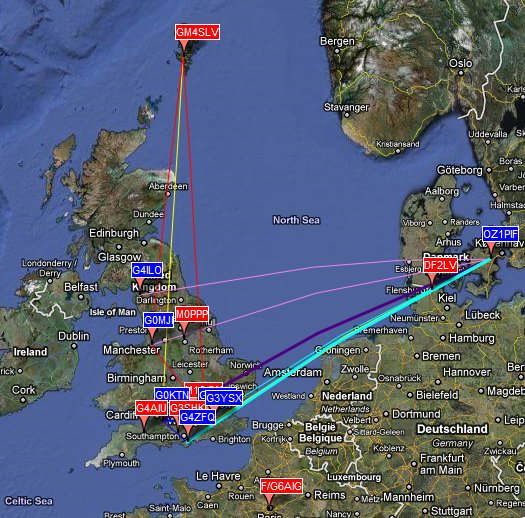
Fortunately, the channel allocated for beacon and WSPR use is one of the ones I was able to match. And today just happened to be a 60m WSPR activity day. So I fired up the WSPR software and beaconed on 60m using 2 watts, increasing to 5 watts in the evening when propagation went long and most of the traces faded out. The 5 watts did me no good at at all, but my 2 watt signal was heard by 7 different G stations all around 400km distance from me plus F/G6AIG at 760km. I received 6 different G stations including G4ZFQ at 458km running 20mW, plus OZ1PIF (my best DX at 984km) and LA3JJ.
Tomorrow is QRP day on 60m when everyone is supposed to run 500mW or less. I have not decided yet how little power I will run but I will be WSPRing on 60m all day. Hopefully there will be a few more people who manage to spot me.

LHS Show Notes #056
Introduction:
- Intro from Pete, VE2XPL, host of the wAVEgUIDES pODcAST.
- Promo for the GNU World Order podcast.
Announcements:
- Hello to the new folks in the chat room.
- The Mintcast podcast is either going to stop or will have new hosts after the next episode. If you’re interested in hosting a podcast, contact the folks over there.
- Please spread the word about MAGNetcon, the Mid-America GNU/Linux Networkers Conference, to be held May 6-7, 2011 at the St. Louis Union Station Marriott. If you know anyone that might be a sponsor, exhibitor, or speaker, please let us know. Application forms are available on the web site.
- Check out the new website for Resonant Frequency.
- Also mentioned, the Going Linux podcast and Computer America, “America’s longest-running nationally syndicated radio talk show about computers.”
Feedback:
- Richard, KR4EY, writes about CW… wait, we did this one in Episode 52.
- John, KC8DAX, weighs in on the Windows vs. Linux debate: there are hams that will buy a wire antenna and there are others that will build one. He thinks it’s the same thing with operating systems. Would you want a radio you couldn’t open? Our hosts discuss.
- We received a donation from Charles to help send Linux in the Ham Shack to the 2011 Dayton Hamvention. Thank you, Charles!
- Joe, K1RBY, recently discovered the podcast and is catching up, but is having a problem using gpodder to retrieve episodes. Yes, Joe, there is a bug in one of the WordPress plugins on the web site that contributed to the problem (see lhspodcast.info for a description of the problem.) It has been corrected.
- John, K7JM, also had the problem with gpodder and sends his appreciation for the fix.
- Richard, KJ4VGV, tells us that he is a new amateur radio operator since May and has published an article: Antenna Restrictions: Are They a Catastrophe Waiting to Happen? Good job, Richard!
- James, N2ENN, comments about our episode 52 when we discussed Unity, and offers his thoughts on Wayland, Debian and Ubuntu. Our hosts discuss, and digress to a discussion of browsers, plugins, drivers, ALSA and PulseAudio on Debian vs. LinuxMint Debian Edition. They also commment on Bill Meara’s (of SolderSmoke fame) efforts to get WSPR running under WINE in Ubuntu.
- Paul, KE5WMA, writes “PIC micro controllers are getting more popular in HAM projects. Any suggestions on programming software and boards?” Well, Paul, Linux does still support serial ports, but this may be a good topic for another show. You might find something useful in the many hits returned by a Google search on “Linux PIC programmer”.
- B.B., KC5PIY, asks for help with getting Windows programs for programming radios, such as the Icom IC-2820H and IC-706 MkIIg, running under Linux. He’d also like an APRS client. Richard recommends UIView as an APRS client for Windows, and Xastir for Linux. Russ suggests that most of the radio programming applications will run under WINE in Linux. Also, check out CHIRP, free Linux software for programming a variety of D-STAR radios. You may also want to explore the D-RATS mailing list. It’s not likely you’ll be able to dual-boot Windows and Linux on that netbook, but you can install Ubuntu Linux using WUBI, which would allow you to run Linux within Windows, or install Linux to a USB flash drive using Pen Drive Linux.
- Craig, KB5UEJ, writes about learning IPv6: “I went through the Hurricane Electric certification program and really learned lots about IPv6. I’m now running IPv6 on my home using HEs IPv6 tunnelbroker service. It’s no longer the big bad scary thing that it used to be.” Russ also talked about IPv6 on episode 6 of his QSK podcast.
- Matt shares his thoughts about building “simple” projects from junk box parts and the similarity to running Linux.
Contact Info:
- Contact Richard at [email protected], Russ at [email protected], or both at the same time at [email protected].
- Listen to the live stream every other Tuesday at 8:00pm Central time. Check the LHS web site for dates.
- Leave us a voice mail at 417-200-4811, or record an introduction to the podcast.
- Sign up for the LHS mailing list.
- Sign up for the MAGNetcon mailing list.
- LHS merchandise is available at the SHOP! link on Web site. Check out the Badgerwear or buy one of the other LHS-branded items at PrintFection.com/lhs or Cafe Press. Thanks!
- Thanks to Dave from Gamma Leonis for the theme music.
Music:
- “Balboa” by Ness from the album Fiesta, courtesy of Jamendo.
- “Crawling Back In” by Deathalizer from the album It Dwells Within, courtesy of Jamendo.
WSPRing on 80
A blog post by Roger, G3XBM, about how far he was able to be received running 5mW of WSPR on 80m using a lash-up antenna prompted me to give QRPP WSPR a try. But before I could start, I needed to make an attenuator. The lowest power my K3 or K2 will go down to is 100mW, but not with very much accuracy. I decided to make a 20dB attenuator which would divide my power by 100, so I could run 1W and get 10mW output.
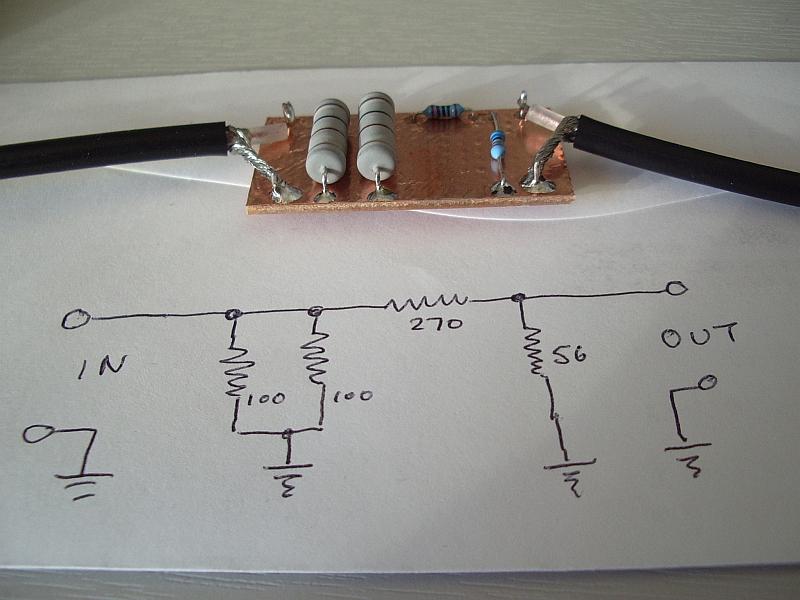
There are numerous websites that will design an attenuator for you given the working impedance and amount of attenuation required. I was not looking for precision – I would be surprised if the output of either of my radios was within 10% of the selected power anyway – and moreover I wanted to build it now using parts from my junk box not have to send off for some exact values and wait for several days for them to arrive. My attenuator was built as shown above and gave a 1.2:1 SWR over the HF range which was good enough for my purposes.
I started yesterday evening running 10mW on 80m into my end loaded attic dipole. I received no spots at all initially. I was puzzled as to why I could hear the WSPR audio using the K3 monitor even though the extension speakers I use with the K3 were switched off. I was about to compose an email to Elecraft enquiring whether the last firmware update had the effect of routing the monitor audio to the internal speaker even when an external speaker is connected when I realized the sound was coming from the computer speakers! Windows had decided to renumber the sound cards since I last used WSPR and although the receive channel was still the same and spots were being decoded the transmit audio wasn’t going to the radio. Doh!
Some time after I began transmitting I received a couple of spots from G3XLW 478km away in the south of the country. But that was all. I decided to leave it running overnight and received spots from David off and on throughout the night. These were augmented in the morning after 0800z by three spots from M0DDT at a distance of 355km to the south east. Not as impressive as Roger’s results. I guess my attic dipole, being very low for an 80m antenna, is a cloud-warmer and sends most of the RF straight up. Roger was loading the feeder of his 10m halo which doesn’t sound like much of an 80m antenna but in effect he had a top loaded vertical which probably has more lower angle radiation. That’s my theory, anyway.
It was an interesting test and I shall try very low power WSPR again on other bands. However I don’t agree with the extremist view held in some circles that people should only use WSPR with such low powers. It’s certainly interesting to discover if you can get to the end of the street on 10uW but higher powers of a few watts will reveal propagation to places lower powers won’t, information that is likely to be more useful when applied to making contacts using other modes.

LHS Show Notes #053
Announcements:
- Thanks, again, to Gamma Leonis for the opening and closing music for the show.
- LHS Merchandise is available at PrintFection and Cafe Press. LHS items make great Christmas gifts! Or, make a donation by clicking the Donate link on the website. Donations cover such things as the telephone lines, server fees, and more. Thank you!
Topics:
- Articles seem to be popping up at www.amateurradio.com designed to get us talking about Linux and Amateur Radio. The latest one is by Anthony, K3NG, self-proclaimed radio artisan. Our hosts discuss his assertions that:
- Ham Radio Deluxe, DXLab, and N1MM software all beat any Linux offerings. (Note: Russ has found that both Ham Radio Deluxe and N1MM logger will run under WINE in Linux. DXLab, on the other hand, will not.)
- There is more amateur radio software available for Windows than Linux.
- CQRLOG is an adequate Linux program for casual logging, but not great for contesters.
- “Quite simply, if one intends on using Linux exclusively in the hamshack they have to lower their expectations and requirements for logging and are between a rock and a hard place when it comes to contesting.”
- He does praise fldigi, but still claims Windows software is better.
- In summary, he thinks hard-core contesters may wish to stay with Windows. Our suggestion: run Linux and write a program that works better!
- Russ talks about his success with WSPR and Echolink.
- He found that instead of using “dpkg -i” to install the latest Debian WSPR package, use “dpkg -x”. You’ll extract the files to the current directory. You then run the program from a terminal session in your home directory using “./wspr”. If you run it that way, instead of letting it install, it seems to work a lot better. The Gnome launcher doesn’t seem to work with that sort of installation, but running it from a terminal works well.
- Russ has Echolink running under WINE v1.13. This version of WINE was chosen for it’s native support of PulseAudio, which made configuring EchoLink much easier. Russ’ node is on 146.225MHz simplex, Echolink node 54711.
- Russ then tells us why Echolink and IRLP are different and why IRLP might be “better.” (Hint: Echolink may not have an amateur radio anywhere in the link, while IRLP definitely uses a radio somewhere in the link.)
Feedback:
- Scott, HL2/AD7MI, sends his appreciation for the discussion in Episode 50 of his blog entry about his Ubuntu installation, and adds a note about problems with running CQRLOG under 64-bit Linux. He says you can install CQRLOG on a 64-bit machine, but it will only work with the 32-bit version of hamlib. Unfortunately, that breaks 64-bit fldigi, which expects the 64-bit version of hamlib. This issue has been reported on both the linuxham Yahoo group and the CQRLOG forum. Scott has also successfully installed Xastir, and is looking forward to receiving a MicroHAM III interface.
- Matt, KC8BEW, asks “What is a good and easy Linux distribution for a web server?” Russ recommends a plain vanilla installation of Debian server, without the X-windows environment, and either Apache or nginx (a light-weight web server).
- Dave, M0DCM, tells us of his success running fldigi and CQRLOG under Ubuntu 9.10 on an Acer Aspire A0751h netbook. Well done, Dave!
Donations:
- A very generous donation was received from Gerrit R. Thanks, Gerrit!
Contact Info:
- Contact Richard at [email protected], Russ at [email protected], or both at the same time at [email protected].
- Listen to the live stream every other Tuesday at 8:00pm Central time. Check the LHS web site for dates.
- Leave us a voice mail at 417-200-4811, or record an introduction to the podcast.
- Sign up for the LHS mailing list.
- Sign up for the MAGNetcon mailing list.
- Thanks to Dave from Gamma Leonis for the theme music.
Music:
- “Steel Concrete” by Mad Mav from the album “Black Sheep II”, courtesy of Jamendo.













