Posts Tagged ‘WSPR’
 Whispering with wonder
 August 8th, 2011 |
  Author:
 A few days ago I dug out of the cupboard the Wonder Loop portable magnetic loop that I made a while ago. I had lost the pieces of uPVC electrical conduit that made a Heath Robinson support for the coaxial cable loop element. But I had always felt the saggy coaxial loop was a bit of an eyesore anyway. So I decided to make a new loop using microbore copper tubing. It turns out that you can buy this stuff on eBay – any diameter and length that you want shipped to your door next day by first class post. Three metres of 1cm dia tube cost just over £12.

The new loop looks a lot better and certainly hasn’t harmed the performance of the antenna which continues to amaze me. I tested it using WSPR at a 1W power level on all bands (40m – 15m) that my Wonder Loop covers. The best result was obtained yesterday afternoon on 20m, between 16:30 and 19:38z, when I received 15 reports from VK2XN of from -9 to -25dB SNR, at a distance of 16579km. This, I repeat, was using just 1 watt from the FT-817 with the Wonder Loop sat on my shack “workbench” almost exactly as in the picture. (The FT-817 was moved to the radio/computer desk during transmission.)
I also spotted 9 reports of VK2XN during the same period, which surprised me due to the extremely high noise level I have here on 20m. The SNRs weren’t so good, though, and he was running 10 watts. Still, that almost qualifies as a two-way contact.
I haven’t tried other modes yet, mainly because the shack is so small and these days I’m a bit wary about sitting inches from an antenna even if it is radiating no more than a watt or two. But the original Wonder Loop was very successful using PSK31 and I hope to try this one with JT65A shortly.
The one disadvantage of the new copper loop is that it isn’t exactly portable, which had been one of my original objectives when building the antenna. If you could get hold of some metal strip it might be possible to make the loop from six pieces that you can join together using bolts and wingnuts to form a hexagon. Possibly you could even do this using tubing, flattening the ends of each 60 degree segment and then drilling them so the loop could be bolted together. But as I’m not planning on taking the antenna anywhere at the moment I’ll keep the one-piece loop which I can stick behind the shack door for storage.
This is a really great antenna that should enable anybody to operate HF from anywhere.

K2 audio switchbox
My vision and steadiness of hand have improved to the point that I am able to build projects! Here is a picture of a switchbox I made for my Elecraft K2 a couple of days ago which allows me to switch the audio input source from the microphone to the computer sound card.
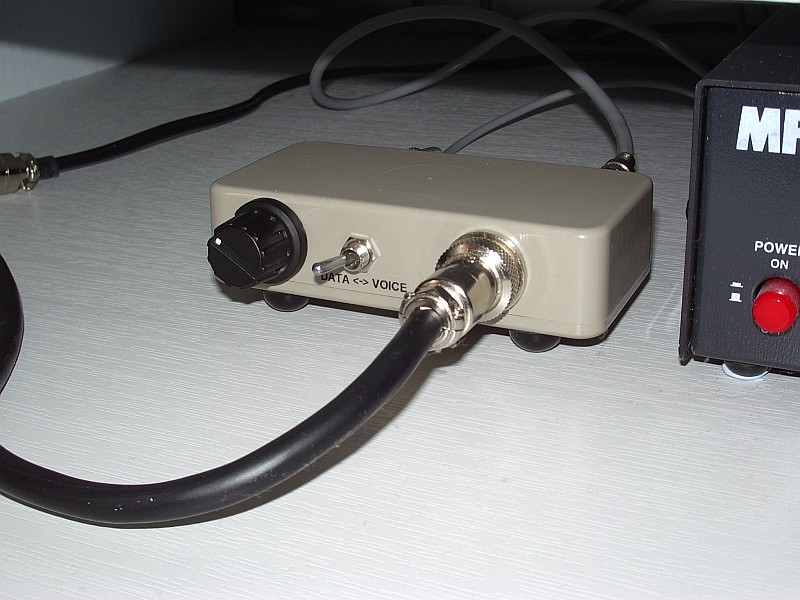
One of the niggling annoyances of the K2 is that it does not have separate inputs and outputs for voice and data modes. Most users carry out one of several published mods to obtain a fixed level audio output for the computer. Mine is tapped off the KAF2 filter module and runs to an RCA phono socket on the back panel. But for transmit most people just swap the mic lead and data lead over.
I used my K2 like that for years, though it wasn’t a great hassle mainly because I hardly ever used a microphone anyway. But I finally decided to come up with a better solution – hence the switchbox. It was easy to make and I thought it would be within my capabilities. Here is a picture of the internals.
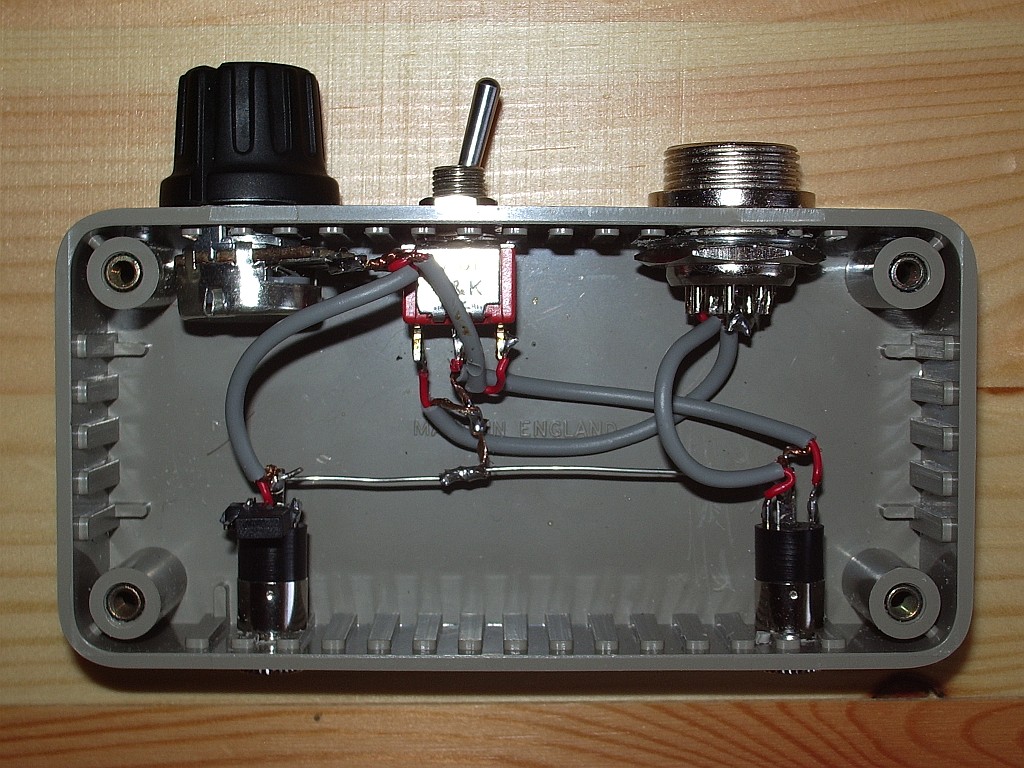
In one position of the front panel switch the microphone signal is switched straight through. In the other, the audio comes from the computer sound card headphone output via a potentiometer. Since taking that picture I added some resistance to the hot side of the pot so the control can be used over a greater range as the K2 mic input is very sensitive and needs some attenuation. As you can see, I don’t bother with isolating transformers. I’ve made dozens – well at least a handful – of computer/radio interfaces in my time and I have never, ever found the need for one. YMMV.
To celebrate the restoration of my constructional skills I have ordered a W5OLF WSPR beacon kit. John Harper, AE5X, recently reviewed it and wrote that it took him 50 minutes from starting to build to receiving his first spot. So I figured it shouldn’t be too difficult, though it will probably take me longer than 50 minutes. It would be nice to successfully complete a kit before I start undergoing the treatment that I expect will make me too tired to do all the stuff I am managing to do at the moment.

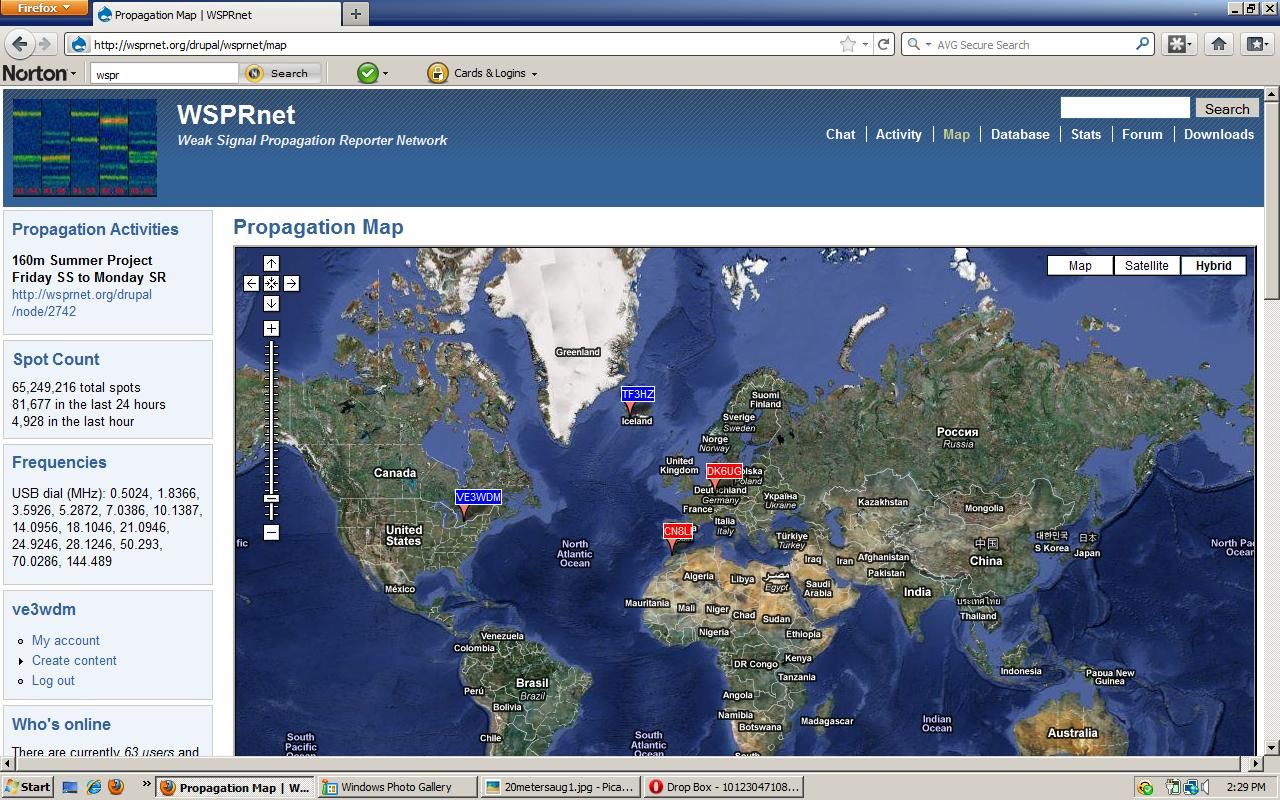
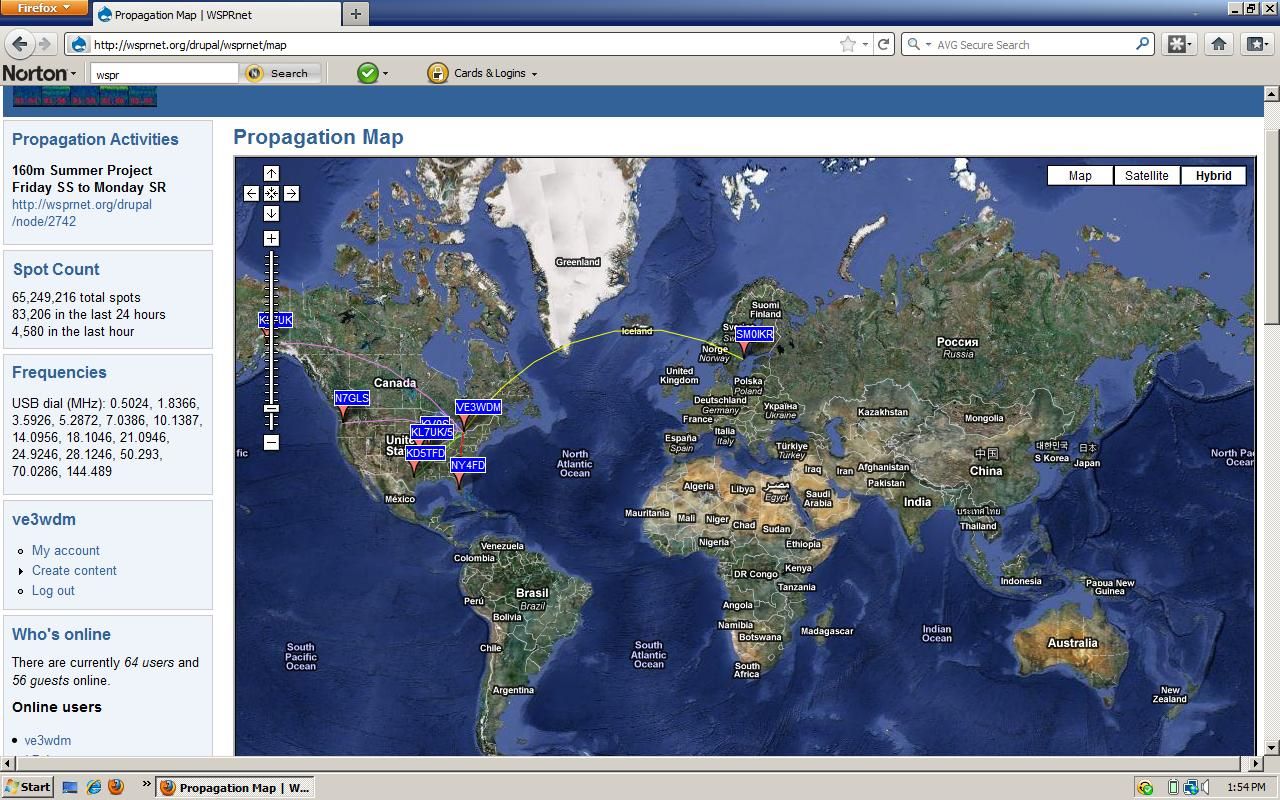
You can count on WSPR
 |
| 10 meters |
 |
| 15 meters |
 |
| 20 meters |

Life on 6m
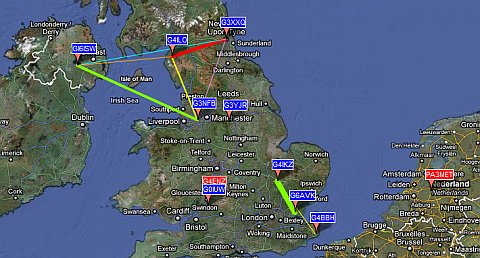
The 6 metre band is showing signs of life, as this map of WSPR activity from this afternoon shows.
However, some of the traces on the WSPR application screen look a bit odd.

I don’t claim to be an expert but I think what I am seeing is the result of doppler shift on the signals being reflected by fast-moving Sporadic-E clouds. In several cases what seems to be a trace has not been decoded.
I’ve said this before, but I wonder if WSPR mode with its 110 second transmit periods and tiny frequency shift encoding is really suitable for detecting Sporadic-E propagation. But no-one has ever commented on this, leaving me to wonder whether they think I’m an idiot who doesn’t know what he is talking about or whether nobody knows.
The digital mode most people seem to use on 6m is JT6M, however this entails using the WSJT program which I find rather confusing. I’m interested in trying JT65A but I’m not sure if it is any more suitable than WSPR for this type of work.
In the absence of any expert advice I’m going to try JT65A using a dial frequency of 50.276MHz. With the JT-Alert accessory to tell me when anyone replies I can leave the rig calling CQ whilst I am otherwise occupied. It will be interesting to see what we can work on 6m with the JT65A mode.

Life on 6m
The 6 metre band is showing signs of life, as this map of WSPR activity from this afternoon shows.
However, some of the traces on the WSPR application screen look a bit odd.
I don’t claim to be an expert but I think what I am seeing is the result of doppler shift on the signals being reflected by fast-moving Sporadic-E clouds. In several cases what seems to be a trace has not been decoded.
I’ve said this before, but I wonder if WSPR mode with its 110 second transmit periods and tiny frequency shift encoding is really suitable for detecting Sporadic-E propagation. But no-one has ever commented on this, leaving me to wonder whether they think I’m an idiot who doesn’t know what he is talking about or whether nobody knows.
The digital mode most people seem to use on 6m is JT6M, however this entails using the WSJT program which I find rather confusing. I’m interested in trying JT65A but I’m not sure if it is any more suitable than WSPR for this type of work.
In the absence of any expert advice I’m going to try JT65A using a dial frequency of 50.276MHz. With the JT-Alert accessory to tell me when anyone replies I can leave the rig calling CQ whilst I am otherwise occupied. It will be interesting to see what we can work on 6m with the JT65A mode.
Time to ditch Dimension 4
Digital modes such as WSPR and JT65A are time-synchronous and require the computer clock to be accurate to within a second. New users frequently don’t realize this and find that they aren’t decoding any signals. When they go to a forum for advice they are inevitably advised by well-meaning helpers to run a bit of software called Dimension 4.
Once upon a time there may have been a good reason for using this program but today it is not a good idea at all. I have seen several forum threads where people have installed Dimension 4 and believed that their PC clock was now accurate, but were still not decoding signals. I suspect that this is because newer versions of Windows have tightened the security controlling whether programs are allowed to do things like change the system clock. Dimension 4, being last updated in 2004 according to its website, knows nothing of this.
There may or may not be ways to make Dimension 4 work under Windows 7 or Vista but there is no reason to bother with them. Instead, just install Meinberg NTP for Windows. Not only is this every bit as free as Dimension 4, it is also the official Network Time Protocol client software. Nothing is ever going to keep your computer clock more accurate than this, and if installed using the default settings it will “just work” even on the latest versions of Windows.
So please, computer Elmers, stop telling people who need to get their clocks synchronized to install an old and unsupported program.

Sign of things to come?
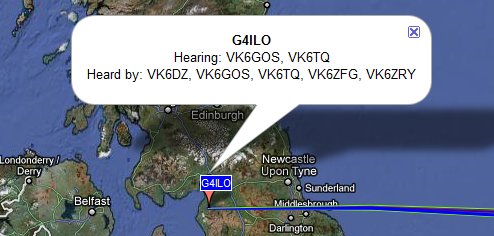
I finally got caught up with things so I could find time to experience the HF band conditions everyone has been talking about. I put the K3 on 10m WSPR while I was doing my computer jobs. I missed some chances of being heard because the WSPR rig control doesn’t switch the K3 into DATA mode and in SSB mode only the microphone is live not the line input. My apologies if the sound of typing affected anyone’s WSPR reception! After spotting the error and correcting it I was received by five VK stations, which is quite pleasing for 20 watts to an attic dipole!
When I was finished with the computer I had a listen around the 10m band. There wasn’t as much happening as the WSPR results would suggest so I tried 12m, where some PSK31 was heard. After making one contact there (ER1RY, Moldova) I went back to 10m and saw some faint traces. I worked several Russians and heard but didn’t work three South African stations. I was also spotted from Madagascar by someone on the PSK Reporter site. That would have been a nice contact! I checked the SSB end from time to time but only heard a handful of signals too weak to work.
Ten metres is one of my favourite bands so it is great to see some signs of life. But I fear that improved propagation is going to bring problems for digital mode enthusiasts. As Paul, PC4T complains in his latest blog post, when you get good propagation people operate wherever they can within the band plan so the weak signal modes get trampled over by the wide, loud modes.
Unfortunately there is no “gentleman’s agreement” that says PSK has exclusive use of 14.070 – 14.072 or that only JT65A can be used from 14.076 to 14.078. Here in Europe, even the band plan separating CW, digital and voice modes is only a gentleman’s agreement. The frequencies mentioned above, like the QRP frequencies and others, are just “watering holes” that benefit people who operate those modes but can be ignored by others with no fear of any official penalty.
There has been an explosion in the use of digital modes over the last few years as more hams connect their computers to their radios and discover sound card software. The effect of this has mainly been that you could often find PSK31 activity when nothing else could be heard. Poor conditions have prevented the bands from getting too overcrowded.
But with better propagation people are going to be fighting for space. PSK is going to need to spread beyond its usual 2kHz on the most popular bands, as will JT65A. The “modes du jour” most of which offer no significant benefit over those that already exist will cause confusion by operating on top of one another. And the outmoded, inefficient RTTY, for which no technical justification for its continued use exists, will stomp over everything running the legal limit just as it always has, only this time more people are going to have their contacts spoiled and get angry about it.
It’s going to be a fun few years!














