Posts Tagged ‘SOTA’
 SSB Makes the Difference on Prospect Mountain
 April 27th, 2014 |
  Author:
 Spring is finally making an appearance in the Rocky Mountain region which means it is time to get on top of some SOTA peaks and transmit some RF energy. On Saturday, Joyce K0JJW and I had planned to drive through the Big Thompson Canyon to Estes Park and also sneak in a quick SOTA activation. Matt K0MOS suggested a few peaks and we chose Prospect Mountain (W0C/FR-069) just south of Estes Park. See Matt’s trip report for a good overview of the hike.
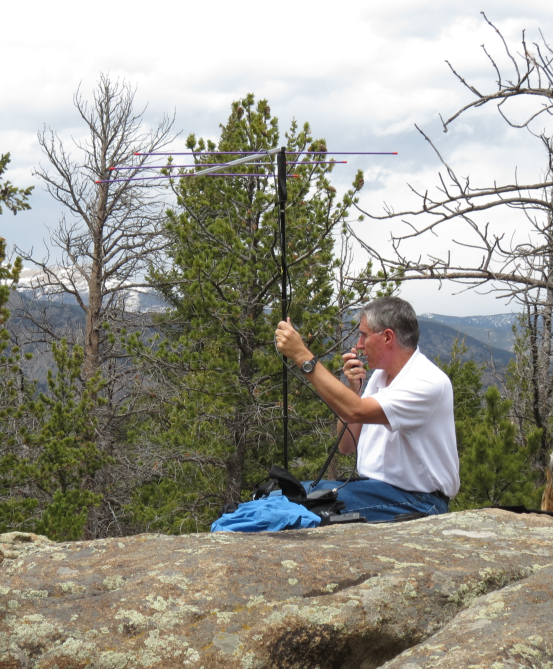
For a low hassle SOTA activation, I usually just take my Yaesu FT-60 handheld radio and operate 2m FM. Most of the VHF activity is on FM anyway and I usually rustle up some SOTA contacts that way. On this trip, I also brought along my Yaesu FT-817 so that I could operate 2m ssb, to provide better weak signal options. For SSB operation, my 3-element Arrow yagi antenna was mounted on my walking stick for easier pointing, with horizontal polarization.
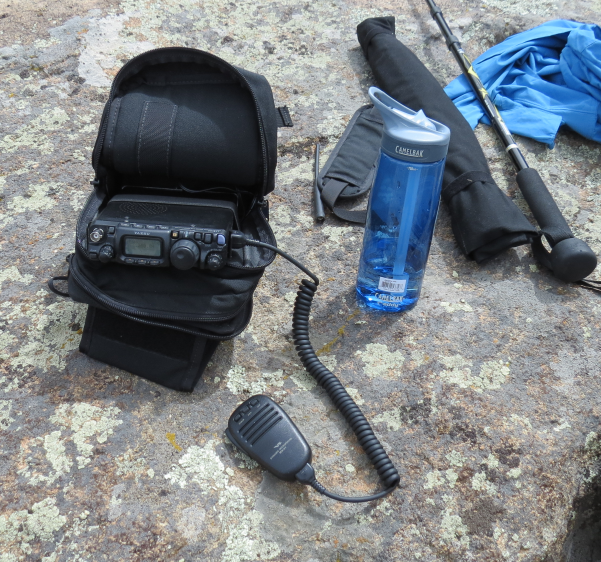 The above photo shows the FT-817 in its Sitting-On-A-Big-Rock operating position, using the AMP-3 carrying case with lead-acid battery inside.
I had arranged a sked with Stu W0STU who was located ~100 miles away with a group of Scouts at Peaceful Valley Scout Ranch. There wasn’t a solid radio path between our two locations, so I wasn’t sure if we’d make it or not. I did not think we could make the contact on FM but the efficiency of SSB should do better. He had a small yagi pointed in my direction driven by an FT-857 transceiver but we tried working on 144.200 MHz SSB without any success. Another station W6LEV near Loveland came up on the calling frequency so I worked him.
After working a few stations on 146.52 MHz using a half-wave whip on the FT-60, I decided to try to work W0STU one more time. I sent him a text message and confirmed that he was available. However, snow was moving into his location (welcome to spring) so he had dismantled his yagi antenna and only had a vertical antenna on his truck. I told him to give me a call on 144.200 SSB and I’d try to find him. I flipped my yagi to vertical polarization and pointed in his direction.
At first, I heard nothing but noise. I was about to give up when I rotated my antenna around to see if the signal peaked up in another direction. Sure enough, when pointed S/SW, I could hear Stu’s signal rise to just above my noise floor. His actual direction from me was SE, so we were probably getting a reflection off one of the mountains to the south. My signal was right at his noise floor, so we just barely completed a contact. Without the weak-signal performance of SSB and the gain of the yagi antenna, I am sure we would have never completed the contact. Another lesson is that it pays to point your antenna in different directions, since you don’t always know what the best propagation path will be.
Another fun day messing around with ham radio.
73, Bob K0NR
Nice SOTA Trip to New Mexico
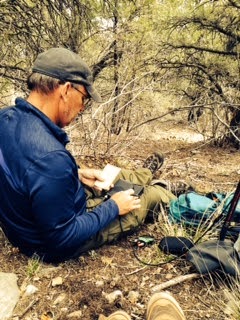
As the days passed, I activated 6 summits. Two each on Thursday and Friday and one each on Saturday and Sunday. Three of the peaks are mountains I had done before, Ortiz, Montoso and 7472 while the other three were new ones for me, Tetilla, Palomas and Escobas. Including the winter bonus I was able to collect 58 points to bring my total activator points to 349 or a little more than a third of the way to my goal of 1,000 points. On this trip I used the FT-817, pico paddle, Elecraft T-1 tuner and an LNR 40-20-10 EFHW mounted on my carbon fiber extendable 21' fishing pole. I operated 30 meters through 12 meters on most summits.
1. My activating process is much more efficient, i.e., pack weight, antenna configuration, set-up time.
2. I am much more confident in my previously rusty orientation skills. I don't need a trail to get to a summit and back.
3. I'm in much better shape than when I started. I've dropped pounds and added endurance.
4. I've explored much more of this country, getting to summits off the beaten path, than I would have ever done otherwise.
5. I've met a fantastic community of activators and chasers who share a common bond of a love a radio and the outdoors.
It is exciting when two of your hobbies converge into one activity and that is what SOTA is to me.
The First Activation of a South Texas SOTA Summit – Peak 2002
I have only done limited research and actually stopped looking when I found the first accessible summit. The summit, named "2002" for it's elevation because it is otherwise unnamed. The summit is an escarpment, which is defined as, "a long precipitous, cliff-like ridge of land, rock, or the like, commonly formed by faulting or fracturing of the earths crust". Peak 2002 is just that with a summit ridge that runs for nearly a mile. Accordingly it has a large activation zone. (In SOTA, the operator doesn't necessarily need to transmit from the actual summit, in Texas the activation zone is anywhere within 150 vertical feet of the summit). The majority of the summit ridge is on private land, however the eastern third of the summit lies within the boundries of the Texas Hill Country State Natural Area. So an easy, state park hike, should be easy.
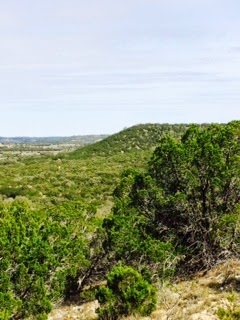
Looking at the layout of the park, the ranger told me which trail would get me to the summit ridge, trail 4B. I downloaded the map and the trail was in the middle of the park, but I would be able to drive to the trail head right, wrong. The Ranger informed me that because this is a Natural Area I would have to walk. What I thought was, at most, a 2 mile round-trip was now a 6 mile round-trip. Wait a minute this is just a 1 point summit. But I was there, but I knew I didn't have enough water for 6 miles, so I bought a bottle of water at the Park Office, got directions and took off.
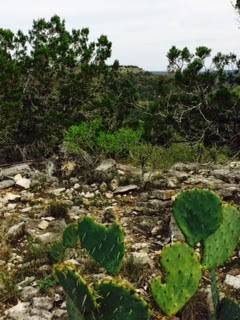
So what was a 2 mile round-trip which had now become a 6 mile round-trip, turned out to be nearly 8 miles. I missed a trail due to a poorly marked trail sign and was almost a mile down that trail when I realized my error. So I had to back track and get on the right trail. Finally 1 hour and 40 minutes after leaving the trail-head I reached the summit ridge.
From that point, it was a fairly normal activation. I used my MTR and a 20/40m EFHW and my Pico Paddle. I managed 22 QSO's with the first being AE4FZ and the last being KD5KC, Mike who did the bulk of the work to get the additional Texas Summits approved. Thanks Mike. I was also able to work a little DX with OK1CZ calling in on 20m.
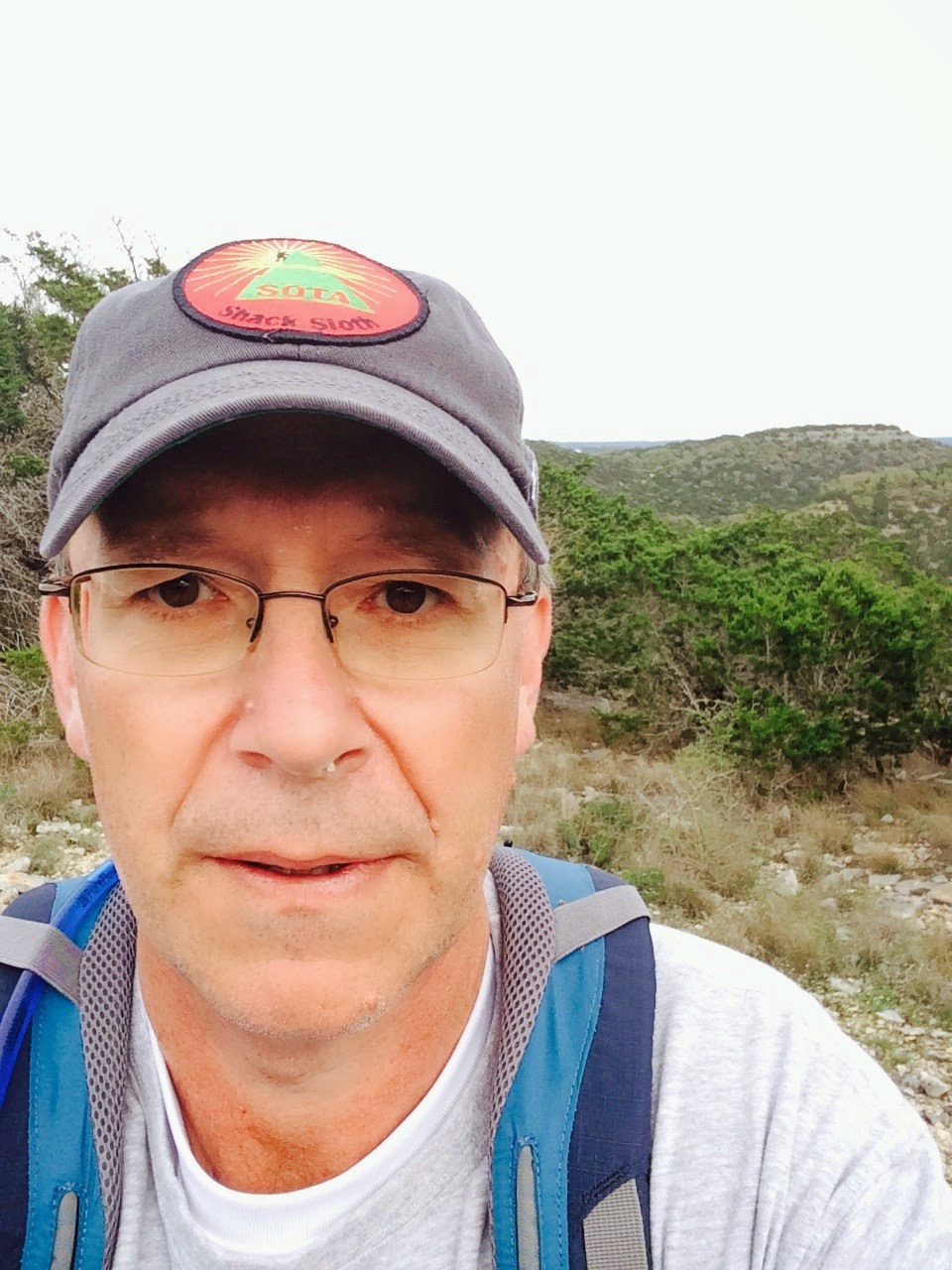
So this was another SOTA first and I'm glad I was able to be the first to activate a South Texas Summit. I will have to say though, this was the toughest SOTA point I ever earned. Eight miles of hiking for 1 point, the miles per point is pretty high. If you extrapolated that ratio to a 10 point summit a person would have to walk 80 miles. Well as they say, everything is bigger in Texas.
Thanks to all the chasers and thanks again to Mike KD5KC who was a catalyst in getting these summits approved.
From Russia with Love…
Its been to many months since my last lunch time QRP session! Finally had a warm day with no work activities over lunch so I headed out to my favorite park and had a blast!!
As soon as I turned the KX3 on I heard…
KC2EE calling CQ on 14.060 – we exchanged 559 reports – he was in Houston, TX. Working Sid brought back the great feeling of sending some CW – although I was rusty!
Then I went on to work…
NA6MG was spotted on SOTA GOAT, so I tuned to 18.090 and there he was coming in at 599. Dan was on W6/CT-231.
OH4MDY was calling CQ on 18.075 and was a solid 599 here. I had to call a couple times, but finally made it. Retu was in Finland!
Next up was my best DX yet!
R7LA – Vasily was calling CQ on 24.893 with no takers. He really had to work to pull my callsign out, but then it seemed to get better. He copied my well after getting my call, so the conditions must have improved. He gave me a 559 and he was 599 here. He must have pulled up my QRZ page while on air because he told me that my QRP signal was FB! What a hoot! Thanks Vasily for pulling my 5 watts out of the mud, you made my day!
Not that spring is here, I will be operating much more at lunch time. I am still working on getting my home station set up. Antenna is ready, I just need to get it in the attic! I really want to start working some digital modes from home. I think they might work best because of the loud interference I experience there. We will see.
Five Summits in Three Days
To feed my addiction I made a trip to my QTH in Santa Fe, NM. I arrived there on my birthday February 13th. I had been planning this trip for more than a month and was worried about how the weather would be since the long weekend in Santa Fe would be my only chance to activate summits for a while. The weather forecast was for highs in '60's. Perfect.
. I had a different strategy for this trip, since none of the hikes would be more than a mile one way, I carried my FT-817 and an Elecraft T-1 tuner with plans to get on the WARC bands since the ARRL DX-CW contest would be going on the weekend. The FT-817 is fresh from getting modified with the W4RT on-board filter for both SSB and CW and the DSP as well.
DAY 1
So on Friday the 14th, I met up with Fred, KT5X aka WS0TA. We had two summits on the agenda, Peak 7119, W5N/PW-037 and Glorieta Mesa, W5N/PW-032. The day was windy, but the temps were comfortable. While the climbs were short, they were very steep to both summits. There were probably easier ways up, but what the heck, we were looking for adventure.
Propagation was good on the first summit, Peak 7119, I worked 5 EU stations, OH9XX, DJ5AV, EA2LU, ON4LI and G4OBK. My antenna was an LNR Trail Friendly 40-20-10 EFHW strung over as high a limb as my pole could reach and then to my carbon fiber fishing pole and down to the rig, an inverted L configuration. the antenna tuned great on the WARC bands. Fred and I employed a strategy that maximized available bands. I started on 12m and worked my way down to 20m while Fred started on 20m and move down to 30m and 40m. So as a team we made the summit available in several bands. I made 20 QSO's; 11 on 12m, 3 on 17m, 5 on 20m and 1 on 30m. I did have a couple of S2S's, one with N6JZT and another with N7CW, both with huge signals. Thanks guys.
The Glorieta Mesa expedition was executed in a very similar manner, same radio, same antenna configuration, except this time I made 25 QSO's on the following bands; 10 on 12m, 5 on 15m, 2 on 17m and 8 on 20m. The only DX was DJ5AV on 15m.
It was a good day, 45 QSO's, two nice hikes and 20 SOTA points.
DAY 2
Fred was unable to go on Saturday, so my buddy Jeff from Red River, NM was visiting, so he set out with me for the days activities. Again, there were two summits on the agenda, Peak 8409, W5N/PW-027 and Peak 9420, W5N/PW-020.
Peak 8409 is a relatively easy summit, with only about a 75 vertical feet ascent required to get into the activation zone. I used an AlexLoop on this summit as I wanted to get set up quickly. Propagation must have been in the process of warming up. I only made 9 QSO's 8 on 12 meters and 1 on 30 meters. The stations I heard were loud, but there weren't many of them. I never was spotted on RBN. I tried to self spot on SMS but put a slant bar in the summit reference which is the incorrect format. I didn't figure this out until later. So, I had to pack up to make the scheduled time on Peak 9420, so Jeff and I made our way down the hill to the car and were on the way to the next summit.
Peak 9420 is an excellent SOTA Summit. It climbs 800 feet over a distance of about one mile, which is relatively steep, but the hike is only a mile to the summit and it has a nice trail with lots of switchbacks to take some of the sting out of the hill. I'm in relatively good shape and it took me 23 minutes to get to the top. The weather was cooler and the wind was blowing at a stiff clip. There was some snow on the ground at the top, but not too much. It was too windy right on top, so I moved down a little to get out of the wind. I used my FT-817 with the Elecraft T1 tuner and the EFHW. I netted 31 QSO's , 11 on 12m, 9 on 20m and 11 30m. During my run on 30m, I heard a faint but copiable signal and a slow but sure fist calling. It is K7NIT, Rachel, calling for an S2S, followed soon thereafter by K7ATN. Thanks guys. Another fun thing happened, after my first run on 12 meters I didn't work either W4DOW or AE4FZ both of which are well up the standings on the 12 meter challenge. I worked AE4FZ on 20m so I knew he was out there. So after the pile-ups died down I went back to 12m and threw out the bait. Like two big trout after a fly, very quickly after calling CQ I worked both W4DOW and AE4FZ. I knew then it was okay to QRT.
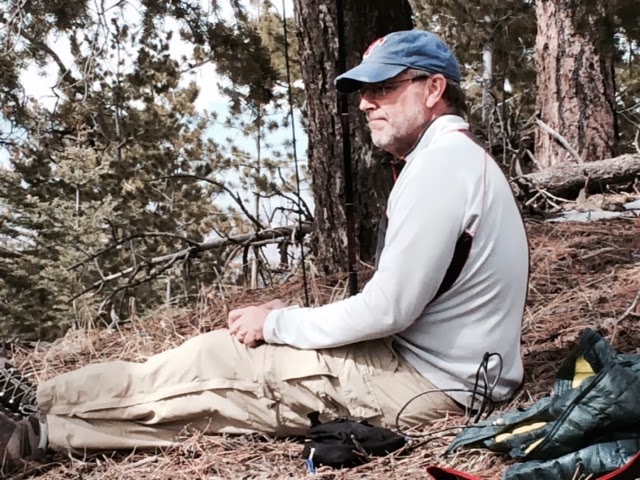
For the day, 40 QSO's and 22 SOTA points (including bonus points)
DAY 3
Day 3 would require a little driving. I was headed to Sandia Crest, W5N/SI-001. Sandi Crest is dominant peak in Albuquerque, NM. My XYL accompanied me on this trip. It is a drive up to the summit which sits at ~10,600 feet. We also wanted make the drive on HWY 14 out of Santa Fe which is a beautiful drive. In addition to the views it goes through Madrid which is where much of the Tim Allen film, "Wild Hogs" was filmed. Its a very cool little town. We didn't have time to stop, but will make a special trip next time.
At the summit it was cold. In the 30's and very windy. I would have to find a spot out of the wind. Because of the cold my wife decided to sit this one out, in the gift shop. Now this was probably a mistake on my part, because when I was done with the activation she had found several nice things to put in our house. Another way of looking at this is that it's a small price to pay for a SOTA pass:-).
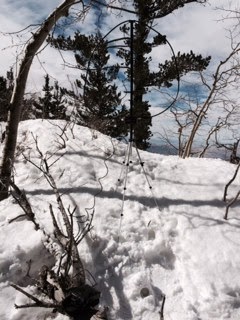
I hiked about a quarter of a mile south of the summit structures and found a place where I could sit on a log, out of the snow, be sheltered from the wind but yet give my antenna a good look at the world. The picture below is what I found. The log in the foreground was where I sat and the Alexloop, with the tripod anchored in the snow, has a nice look over the snow bank. I again used the 817.
Colorado 14er Event – August 3, 2014
 During the Colorado 14er Event, Amateur Radio operators will be climbing many of Colorado’s 14,000-foot mountains and SOTA summits to set up amateur radio stations to communicate with other radio amateurs across the state and around the world. Join in on the fun on Sunday August 3 and see how many of the mountaintop stations you can contact.
The new Colorado 14er Event logo is now available on t-shirts and more.
Starting in 2012, Summits on The Air (SOTA) is part of this event. This means there are over 1700 summits that you can activate in Colorado, with a wide variety of hiking difficulty. This opens up the event to a lot more people and a lot more summits. See the new SOTA page.
Radio operators with 14er climbing experience who plan to activate a summit should log their name and intended peak at the Ham14er Yahoo group. This is also the email list for discussing the event and asking questions.
QRP/SOTA Fun Without Climbing A Mountain
So I set up my operating position just as I would on a summit. I was testing one of the SOTA beams EFHW antenna with counterpoise and a homebrew 29 ft. wire. I brought along two tuners including Hi-Tee Tuner from SOTAbeams and a recently acquired Hendricks SLT+ 80m-10m end fed half wave tuner.
The SOTAbeams combo was my first configuration. I put the antenna over a limb about 15ft. up and let it slope down to another limb about 7 feet up and then down to the radio. The antenna wire terminated into a 4mm plug that prevented me from running through the eyelets of my pole. I plugged the wire into the tuner (which will only take a 4mm plug, there is no binding post) as well as the counter poise. The antenna tuned nicely and I had QSO with a station in Arizona. As I finished that QSO I tuned across the SOTA frequencies and heard W0CCA calling CQ SOTA from a summit in Arizona on 20m. Cool, now could I work him with this set-up? I usually don't have to wait long in a pile-up but for this QSO I would have to. I was tempted to run over to the QRO shack and make the contact to ensure I got the points since he was on a 10 pointer, however I resisted the temptation. My faith in QRP was rewarded, Cap finally heard me and gave me a 229. Cool.
So now I set-up the simple 29 ft. wire. Since it didn't have the banana plug on it, the Hi-Tee Tuner was useless, so I set up on the SLT+. I was able to use my pole this time, so the wire was higher off the ground in an inverted L configuration. By that time KX0R was calling CQ SOTA on 20m from a summit in Colorado. Evidently the pile-up had run it's course because I got him on the first call. So my little tuned wires had netted 12 SOTA chaser points. I am regularly amazed by QRP, how much you can do with a few watts and some wire.
A great day of QRP/SOTA fun.













