Posts Tagged ‘SDR’
 ATS-4 and SDR Cube
 November 11th, 2010 |
  Author:
 Two exciting new possibilities for portable HF have become available.

Steve Weber KD1JV's ATS-4
A few hours ago Steve Weber KD1JV announced that the ATS-4 kit was available again. These apparently sell out very quickly – so if you’re interested, act now!
Many people hanging around the AT_Sprint Yahoo group have been waiting patiently for many weeks for this morning’s announcement.
The ATS-4 is a “miniature 5 band CW rig with digital mode capabilities” designed for 80, 40, 30, 20 and 17 or 15 meter operation in the field. The AT stands for Appalachian Trail. It’s tiny – according to the KD1JV site, about 1/3 larger than an Altoids tin – the universal QRP standard of enclosure measurement – at 4.9″ wide, 2.7″ deep and 1″ tall.
ATS-4 features include a built-in Iambic A or B mode keyer with three message memories. The rig can convert Morse input via paddle to transmit as PSK31. And PSK31 and RTTY are possible using Pocketdigi software on a PC, laptop, netbook or PDA.
The other exciting portable possibility – which was designed to be independent of this kind of hardware – is the SDR Cube. George Heron, N2APB and Juha Niinikoski, OH2NLT developed this self-contained and portable SDR Transceiver using a Softrock front end and embedded Digital Signal Processing. One of the features of this design is that no PC is required. This follows naturally from George N2APB’s work developing the NUE-PSK modem which liberates portable PSK31 & RTTY ops from lugging along a laptop.

The SDR Cube
The SDR Cube is still available for ‘early-bird’ special prices, so again, not one to put off considering for too long. It’s also available in a range of different forms, from bare PC boards through to kits and assembled and tested. The design is deliberately open and flexible to accommodate experimentation. As the comprehensive SDR Cube site explains
The SDR Cube is a totally self-contained, embedded SDR transceiver for CW & SSB using a Softrock for the RF front end and a pc board implementation of an HF modem. A PC is not needed for using the SDR Cube, as all DSP processing is accomplished by an embedded DSP processor on the three internal pc boards. The Cube is designed to fit into an optional 4” x 4” x 4” pre-cut black powder-coated aluminum enclosure containing all controls, a blue graphic display showing the transceiver settings and an exciting 8 kHz-wide band scope of spectrum signals, and the popular Softrock RXTX v6.3 board.
Full ordering details for the SDR Cube can be found here.
SDR needs more UX
Spotted a very interesting post from Tobias, DH1TW on his blog ‘Contesting & SDR‘ titled Does SDR really suck?. He wonders out loud if the performance, flexibility and cost of SDR is so excellent, why hasn’t it taken off? What possible barriers might there still be to it assuming a place matching its promise and achievement?
He identifies the missing link as adequate user interface. He mounts a case arguing for a similar level of investigation and development on the user experience front to match the investment and experimentation on RF and signal processing.
And he acknowledges that there may be more than one user interface solution. Contesting and HFPack have different UX demands as other experts understand. Look at Elecraft‘s K3 and KX1, or the Steve Weber, KD1JV designs, especially the ATS series. And now Tobias argues, SDR gives us the opportunity to re-think user interface design from the ground up.
Who says that the radio controls must be on the front of a black box and located perpendicular to your shacks desk? SDR allows us for the first time to completely redefine and optimize the radios User Interface! Are you serious into contesting? If so, you want to pay special attention to ergonomics. Why not having the control console directly next to your keyboard? Or do you prefer portable, backpack operations? Then your focus will lie on the limited physical dimensions. N2ABPs SDR-Cube is a nice example on this.
A very timely – and well illustrated – read.
Heathkit Genesis
Last week at the Waverley Amateur Radio Society monthly meeting there was a fascinating and well-prepared talk from Justin Lavery VK2CU on the history of the Heathkit company.
The scene at the front of the clubroom was not unlike this great shot from the website of Fred W1SKU.

Heathkit equipment on display at W1SKU
Only there were more pieces of equipment on display! Justin’s clearly been collecting for a while, specialising in valve gear and the SB series. He had a stash of catalogues dating back to the early 1960s which evoked memories for many of us there old enough for Heathkit – even on the other side of the Pacific Ocean – to have been a radio icon.
Justin filled in the deep history of the company, with its kit airplane beginnings through to its heyday when it actually made economic sense to build your own colour TV!
He also managed to evoke the history of the time – which is some achievement for someone who I don’t think was actually alive for most of it!
MAKE magazine beautifully evokes the times and the anticipation – those long painful delicious moments between posting the order and the kit arriving.

Heathkit times (MAKE Online)
I was especially interested in observations about how the fortunes of the company were in synch with a strong tradition of making it yourself – which seems to be a core part of both the US and Australia. We both have frontier experiences still in our recent folk memory.
I wonder what Heathkit would make of the kit market today if they were still around. They certainly set a benchmark. And they certainly sold a lot of kits over the years.
So it was an interesting coincidence for me at least that on the same day as I’m thinking about Heathkit and how I used to long to own an HR-10 and a DX-60, I received my Genesis G59 Mk2 SDR transceiver kit.
The Genesis G59 is a very exciting sounding project. I believe I’ll have a pretty impressive SDR transceiver once it’s complete.
While GenesisRadio is more cottage industry in scale than Heath – who grew so much they opened a factory in the UK – the quality is there where it counts. Part of the decision to take the plunge was an estimation of the support both from Nick Hacko VK2DX and the online community of builders on the Yahoogroup.

One step in phase 1 building the G59 SDR kit
The then and now comparison shows how much kit building has changed. Kits now can be delivered across the world in days. Speedy support from a global network of enthusiasts is available via email. Documentation is able to be kept up-to-date and builders alerted to important developments. And most amazing, of course, the firmware can easily be updated and improved.
The key to the success of all of this is the social glue of the builders online. That’s another reason not to delay the build and to glean maximum advantage of the communal energy available there.
The Genesis documentation is clear with excellent photos. Not the component by component style of Heathkit, but totally adequate.
So far I’ve completed phase 1 successfully (the power supply) and am in the middle of the second phase (the microcontroller circuit). I’m taking it slowly and really enjoying those moments at the end of the night when I can get to it. That lateness is the one reason I’m taking it slow. The other is – I really enjoy this part!
Cross Country Wireless SDR update
Cross Country Wireless has just announced an updated version 2 of its low cost SDR Receiver. The new version has an RF preamplifier using a power MOSFET after the RF bandpass filter which is claimed to improve sensitivity – which was a criticism of the earlier version – and reduce local oscillator output at the antenna port.
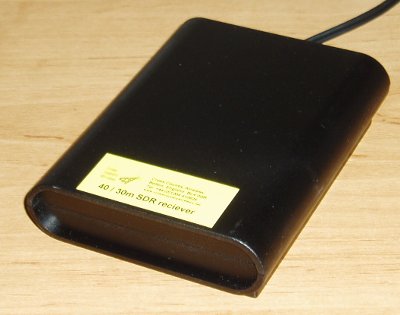 The designer Chris, G4HYG, claims that the receiver will now display a CW carrier at a level of -135 dBm on the waterfall of SDR-Radio using a 48 kHz sound card. The level of the local oscillator at the antenna port is now specified as -65 dBm, though a more typical measurement is -70 dBm. This should make it an ideal choice as a panadapter for radios such as the Elecraft K3. In fact, Chris recently stated that most orders for the receiver have been for use as panadapters, in conjunction with a sound card and suitable software such as PowerSDR-IF.
The cost of the standard SDR is £49.95. For panadapter use you will need a custom crystal for your radio’s IF which increases the price to £59.95. The SDR has two (switched) local oscillators so the other one could be specified to cover 40m or 30m for use as a conventional receiver. It’s also available as a built and tested board for assembly into your own case (at a significant saving.) If you built a USB sound device into the same box then it would be rather neat.

Arctic DXpedition
Over the weekend sunspot 1112 erupted and produced a strong solar flare. Now according to Space weather sites there’s a 25-35% chance of high latitude auroras on 19-20 October.
And right now a group of four Norwegian friends are enjoying their annual DXpedition to Kongsfjord – well and truly in the high latitudes – at 70°43′N 29°21′E at the top of Norway.

Kongsfjord, Norway - a nice place to set up your 500 metre Beverage antenna
Four of the main participants are Arnstein Bue, from Trondheim, Bjarne Mjelde (host), from Berlevåg, Odd-Jørgen Sagdahl, from Trondheim and Tore Johnny Bråtveit, from Trondheim. As you’ll see if you visit their pages these men are serious medium wave and short wave DXers, with impressive equipment racks and listening achievements to match.
Arnstein Bue’s blog DX Paradise gives a sense of some of the QSL trophies. DXpedition host, Bjarne Mjelde’s blog Arctic DX has an entry logging their first day last Friday anticipating the weather awaiting them:
“+2 Celsius, 15-20 m/s (35-45 mph) northerly winds, rain and sleet showers…”
As I write this it’s early afternoon there and according to their website it’s warmed up to +4 Celsius!
They also appear to operate remotely from this spot. Their antennas include a new 500 metre long Beverage aimed at the North Island of New Zealand which is clearly working very well. Two shorter Beverages (225m & 330m) and a Quad Delta Flag Array complete this dream DXing antenna farm.
And if you visit the site you’ll see ample evidence that they clearly know how to enjoy themselves at the dining table as well. Local King crabs are accompanied by the finest New Zealand wines. Their dining notes are as tempting as their DX!
Main course was pork sirloin marinated in garlic and chili, served with tagliatelle, basil, leeks and cherry tomatoes. With the pork we tried Kim Crawford’s Pinot Noir. Maybe a bit light for the quite tasty meat, but absolutely a super wine!
For dessert we had local blueberries with grappa – another Kongsfjord signature dish! And now we are off to listen to more recordings and prepare for another – hopefully eventful night. The solar indexes are going down and the K-index for Tromsø is now 0, and we hope that it will remain like this!
The main website is also the repository of a number of documents on DXing issues by Dallas Lankford. There are also data sheets for a large number of receivers (including AOR, Racal, Rohde & Schwarz, R L Drake Company, Siemens, Harris, TenTec, Icom etc) and information about antennas. Bjarne Mjelde has distilled his experience into a definitive article about the best antenna wire. The conclusion? A thumbs up for galvanised steel and aluminium. A number of his reviews are also aggregated on the site, including reviews of the IC-703 and the Perseus SDR.
Their sites demonstrate how much a part SDR plays in modern DXing and monitoring. There are some huge SDR recordings and mp3 files available as well. Retrospective analysis of these files enables them to find rare stations as well as – presumably – traditional live listening.
It’s been a delight checking in on their site each day to catch up with the activities of such a convivial group of friends. Truly inspiring to this reader on the other side of the globe.
Keyboard Trays, QRP Rig, and SoftRocks
Time, as they say, has been of the essence of late. So, when I do have time to play radio, I rarely have a chance to write about it. Here are some photos of my latest tinkerings.
Keyboard Trays
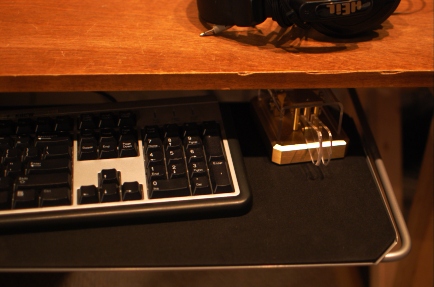
Sarah has always talked about using a keyboard tray at work as a part of an ergonomic workstation. Until recently, my work invovled enough variety of computer and non-computer time that I did not think about it. But, after coming home from work with stiff shoulders and wrists, I decided something should be done. While I was at it, I upgraded the HF and VHF/SDR operating positions at K8GU with pull-out trays, as well. These were $10 each at IKEA and pretty easy to install, although I told Sarah that I was grateful that she didn’t witness my contortions to hold them up with my knees while driving the first screws.
Liberating my inner QRPer
Back in high school, I built a Small Wonder Labs SW-40 that I had seen in a QST article. It lived in a variety of enclosures, but spent the last decade in the ugly PC board half-enclosure that looked like a redneck pickup truck at right. I decided to put it into a proper enclosure, being the diecast box at left.
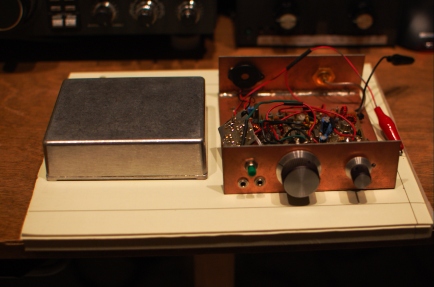
Despite the fact that I made the radio impossible (no room for front panel controls) to assemble the first time I drilled the board mounting holes, I’m pleased with the result. Four dabs of gray epoxy cover the errant holes. I probably could sand and polish those now. The power connector is a pair of Anderson Power Poles.
VHF Softrock and Enclosures
Readers of the blog have seen the screen capture from my new Softrock Ensemble II VHF. Tony does not advertise these on his site because they are not 100% supported with documentation yet. Robby, WB5RVZ has done a great service to the community by preparing step-by-step instructions for most of the SoftRock series. I’m not a step-by-step kind of guy, so I just used his photos showing the locations of the 0.1 uF and 0.01 uF chip capacitors and built the rest my way: mount all chip caps, all SMT ICs, all through-hole ICs and sockets, all through-hole resistors and diodes, all through-hole capacitors, all inductors, and all connectors. It worked right away.
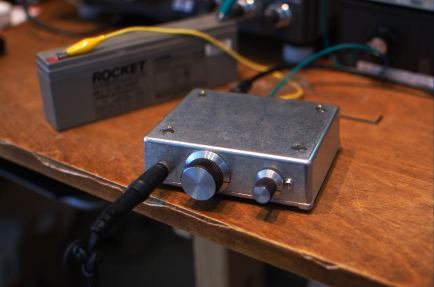
I also have two v6.0 SoftRocks that I built a few years ago while I was in grad school. One of these (for 160) has been a bare board all these years and the other (for 40 and 80) has been living in an ugly little RadioShack black plastic project box. I decided to upgrade them to diecast boxes with external power connectors (also PowerPoles—I’m slowly switching the station over) and a switch for 40 and 80 meters. Here’s the happy family of little radios…
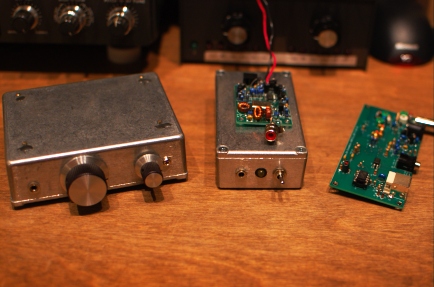
The 160-meter SR v6.0 is on top of the diecast box holding the SR v6.0 40/80. The Ensemble II VHF is on the right. It’s unfortunately too long for either size diecast box. I don’t like the commercially-available box for it. So, we’ll have to see…
144-MHz SoftRock
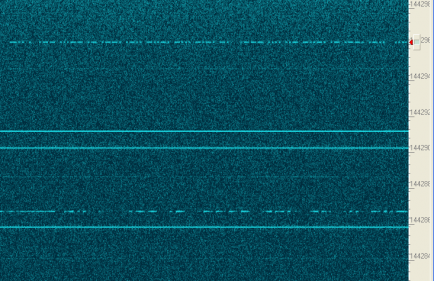
144-MHz SoftRock Ensemble II VHF by KB9YIG and VE3NEA Rocky 3.6. Yup, that’s W3APL/B (off the back of the beam) and WA1ZMS/B in the same waterfall. How cool is that?! More later… This has many implications for many projects!













