Posts Tagged ‘SDR’
 SDR Cube
 September 27th, 2010 |
  Author:
 News via the NUE-PSK email list that over the weekend George N2APB presented and demonstrated a prototype of the SDR Cube project at the TAPR Digital Communications Conference in Vancouver, WA near Portland, Oregon.
The SRD Cube’s formal title is “A Portable Software Defined Radio Utilizing An Embedded DSP Engine for Quadrature Sampling Transceivers” and it was devised by George Heron, N2APB and Juha Niinikoski, OH2NLT.

N2APB's SDR Cube
A companion to his NUE-PSK modem, it’s designed to provide “a standalone SDR transceiver (no PC required) that is quite portable and trail friendly”.
“So far the most attention has come from the SDR Cube’s “live bandscope” showing a +/- 4 kHz spectrograph of band activity along the top of the graphic display. Some preliminary pics are on the start of the website … http://www.sdr-cube.com“.
From his earlier 11 September email where the SDR Cube was first announced:
“a totally self-contained embedded SDR transceiver using a Softrock for the RF front end and a pc board implementation of an HF modem that couples tightly with the NUE-PSK Digital Modem. The Cube is designed to fit into a 4” x 4” x 4” pre-cut black powder-coated aluminum enclosure containing all controls, blue graphic display showing the familiar band scope of spectrum signals, and the popular Softrock RXTX v6.3 board.”
The latest update this morning from George is that the pricing “is not yet established … but soon will be. I think the cost of the parts and pcbs is around $100, so you can guess what the corresponding price might be.”
They’re aiming for the range of offerings (bare PCB, kit, assembled & tested etc) to be available in about six weeks. As well the plan is for there to be a direct digital connection between the SDR Cube and the NUE-PSK by the shipping date. In the meantime check out the pics at http://www.sdr-cube.com. Also brief mention on WETNET.
UPDATE: George N2APB has posted some videos of the SDR Cube in action. There’s a 25′ overview and five shorter clips.
The sdr-cube.com website now (30 Sept 10) has much more information about the rig including hardware and software architecture diagrams, a photo gallery, a very detailed 26 page pdf of the TAPR DCC conference presentation (7.5MB) and this feature list.
- Standalone SDR transceiver … no PC, portable, compact
- Self-contained single band … based on the I/Q RF front end
- Softrock-compatible … designed to interface with SR v6.3 RXTX, etc.
- Low Power … 90ma (Cube), plus 100 ma (Softrock Rx) or 300 ma (Software Tx
- Add-on RF Amp & Attenuator … good control of incoming RF, optimize some SR features.
- Quadrature Sampling Clocking options … DDS, Si570, or I2C to target Softrock
- Built-in Keyer … 1-50 wpm, Iambic A, B, or straight key
- Popular HF modes … SSB, CW, AM, Digital (with special interface to NUE-PSK)
- Special interface to NUE-PSK Modem … digital interface provides best quality
- Graphic LCD Display … Provides clear indications of the many status and options
- Bandscope … provides +/- 4 kHz spectrum visibility for Rx, signal monitor for Tx
- Audio filtering … low corner 200Hz, high corners 700, 1500, 2400 or 3600Hz
- Audio Output … Headphones or amplified speaker, Binaural Audio
- Beeper … User interface clicks, code practice oscillator, and more
- Frequency agility … Fast/Med/Slo tune, dual VFOs, memories, RIT/XIT
- Menus … Calibration, all settings, system gain, sidetone frequency, etc
- Software Upgradeable … Bootloader enables user to load new software versions
- Open Source & Hardware
A new Yahoo Group has also been set up and info can be found at http://groups.yahoo.com/group/sdr-cube/.
LATER UPDATE: 14 Oct 2010 – Tobias DH1TW has posted a 75 minute interview with George N2APB on his website – complete with comprehensive ‘shownotes’.
Another K3 panadapter option?
Cross Country Wireless recently introduced a new product, a built, boxed and ready to use SDR receiver that is optimized to work with the bog standard sound card provided with every computer. It covers two 48kHz segments which may be on one or two bands using a switched local oscillator. At £49.95 it looks like something of a bargain.
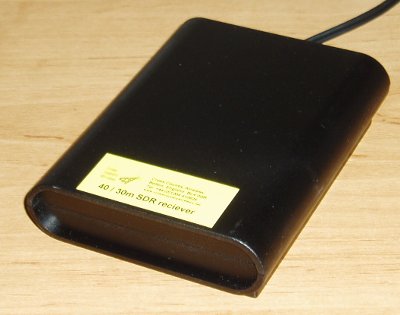 I was looking at the product’s web page this evening and the thought occurred to me that this might make a rather good inexpensive option for a panadapter for the Elecraft K3. It would need a different crystal to cover the K3 IF output frequency which is 8.215MHz, but that shouldn’t be a problem. CCW might even offer this as a stock option if there was a demand for it.
As the receiver covers 40m and 30m everything else should work OK unmodified. The key point would be whether there is adequate isolation to prevent the local oscillator leaking into the K3 IF and desensitizing the receiver – the reason why most people use a buffer amplifier when using SoftRock boards for this purpose.
I don’t have a great urge to have a panadapter display and I already have three sound cards (well, one and two USB sound modules) in use with my shack computer so this isn’t something I’m planning on trying. But I thought it might be worth mentioning the possibility for other K3 users. Even if the idea is a non-runner, the Cross Country Wireless receiver still looks like a very nice product.

Scratching the SDR itch
 One of the blogs I regularly read is that of Larry W2LJ. Larry has been watching some of the streamed video presentations about software defined radio (SDR) coming out of Dayton and believes that SDR is now mainstream and the shape of things to come.
I would be dishonest if I said that I have never looked at some of the SDR products and wished that I had one to try. SDR is becoming an itch that many of us would like to scratch. But I suspect that, in my case at least, it is an itch that once scratched would go away. Although I’m sure that software defined radio technology will find increasing use in tomorrow’s radios – as it already does in the Elecraft K3 – I hope that “black boxes” controlled via a computer console never completely usurp standalone hardware radios.
Dedicated hardware “just works”. General purpose computers are just too much hassle. There are the security issues, the updates, the driver incompatibilities, the crashes, the unfathomable problems. You switch on a radio and it is ready to use. You switch on an SDR and you must then start the computer and wait for it to boot, then start the SDR application and wait for it to load. Is this progress?
Dedicated hardware works until it dies. Computer based devices only work until a new version of Windows comes out that doesn’t support it. How many perfectly good printers and scanners have you had to throw away because they wouldn’t work with your new computer?
Real radios have an aesthetic and provide a sensory experience that simply cannot be matched by a computer interface. Isn’t turning a knob preferable to moving a slider with a mouse? Isn’t making a real audio cable easier than trying to configure a virtual one? Many of us prefer a real S-meter to a graphical simulation. Most of us spend far too much time staring at computer screens already.
With real radios you can look at the schematic and get in there with your soldering iron and make modifications or fix faults. With SDR you are dependent on somebody else unless you are a skilled programmer and have access to the source code and development tools.
I can’t see myself swapping any of my radios for a black box and a computer application interface any time soon. I’ll still work the same bands and the same modes, so what benefits would an SDR give me? A hardware radio is instant-on, intuitive, virus-proof and crash-proof, can’t be broken by some application I install on my PC, doesn’t lock me into using a particular brand of operating system and won’t be made obsolete by the next version.














