Posts Tagged ‘Propagation’
 Never heard Heard
 April 10th, 2016 |
  Author:
 And I would guess I'm in the minority as I'm not in any of their logs. In fact, I never even heard them decently well enough to work them. There were a couple of times that I could tell they were on a given frequency, but they never loud enough that I would be able to hear my own call come back to me, on the off-chance that they would have heard me. It didn't seem right to just add to the QRM.
Am I disappointed? You're darn tootin' I am! Working VK0EK would have been an ATNO for me and I sure as heck would love to have them in my DXCC tally. But I'm not depressed about it.
It all goes back to that post a few weeks ago about balance. Yes, I do not have Heard Island as an entity worked. However, the sun is still shining, the birds are still chirping, our solar system is still plowing its way throughout the galaxy. I still have to go to work tomorrow and earn a living.
And while I didn't work them, and life goes on, I still applaud their effort. It's not easy to go to a remote island near Antarctica, and brave the elements and hardships to provide the rest of us Amateur Radio ops with a bunch of excitement and fun.
Thank you Team VK0EK - even though I'm not in your log - thank you for a job very well done, indeed!
72 de Larry W2LJ
QRP - When you care to send the very least!
Stunning Ultra-HD View; Sun Timelapse 2015 NASA/SDO
This video is ten minutes of coolness.
This cool time-lapse video shows the Sun (in ultra-high definition 3840×2160 – 4k on YouTube) during the entire year, 2015. The video captures the Sun in the 171-angstrom wavelength of extreme ultraviolet light. Our naked, unaided eyes cannot see this, but this movie uses false-colorization (yellow/gold) so that we can watch in high definition.
The movie covers a time period of January 2, 2015 to January 28, 2016 at a cadence of one frame every hour, or 24 frames per day. This timelapse is repeated with narration by solar scientist Nicholeen Viall and contains close-ups and annotations. The 171-angstrom light highlights material around 600,000 Kelvin and shows features in the upper transition region and quiet corona of the sun.
The first half tells you a bit about the video and the Sun, and you can see the entire year 2015 rotate by. The second half is narrated by a NASA scientist. It is worth watching all ten minutes. And, then, sharing!
The sun is always changing and NASA’s Solar Dynamics Observatory is always watching.
Launched on Feb. 11, 2010, SDO keeps a 24-hour eye on the entire disk of the sun, with a prime view of the graceful dance of solar material coursing through the sun’s atmosphere, the corona. SDO’s sixth year in orbit was no exception. This video shows that entire sixth year–from Jan. 1, 2015 to Jan. 28, 2016 as one time-lapse sequence. Each frame represents 1 hour.
SDO’s Atmospheric Imaging Assembly (AIA) captures a shot of the sun every 12 seconds in 10 different wavelengths. The images shown here are based on a wavelength of 171 angstroms, which is in the extreme ultraviolet range and shows solar material at around 600,000 Kelvin (about 1 million degrees F.) In this wavelength it is easy to see the sun’s 25-day rotation.
During the course of the video, the sun subtly increases and decreases in apparent size. This is because the distance between the SDO spacecraft and the sun varies over time. The image is, however, remarkably consistent and stable despite the fact that SDO orbits Earth at 6,876 mph and the Earth orbits the sun at 67,062 miles per hour.

A blending of an entire year, 2015, of the Sun as seen by NASA SDO at EUV 171 Angstroms
Why This is Important
Scientists study these images to better understand the complex electromagnetic system causing the constant movement on the sun, which can ultimately have an effect closer to Earth, too: Flares and another type of solar explosion called coronal mass ejections can sometimes disrupt technology in space. Moreover, studying our closest star is one way of learning about other stars in the galaxy. NASA’s Goddard Space Flight Center in Greenbelt, Maryland. built, operates, and manages the SDO spacecraft for NASA’s Science Mission Directorate in Washington, D.C.
For us radio enthusiasts, the study of the Sun helps us understand the dynamics of radio signal propagation. And, that aids us in communicating more effectively and skill.
Thanks for sharing, voting, and watching. More information and live Sun content can be accessed 24/7 at http://SunSpotWatch.com
You can also get the Space Weather and Radio Propagation Self-study Course at http://SunSpotWatch.com/swc
The Grand Illusion
Five by Nine... QRP... How can it be?
 |
| The real gain doesn't come from transmitter watts |
I gave him reports as he switched back and forth from running barefoot ~75w to his amp ~500w. With his amp on he was an S9, running barefoot he was S8. So the amp gave him one additional S unit. In terms of hearing him I would have been hard pressed to tell much difference simply by volume. He was perfectly copyable without noise with the amp off.
We also did some tests with my station at reduced power (as if...) At 10w-12w output I received a S9 to S9+10. Reducing output to 5 watts netted me a S8 report and when I reduced to 1 watt (one watt) he was still able to comfortably copy me and I received an S5. So with my station at 1 watt and his running 500 watts we could still converse via SSB. Ladies and Gentlemen you don't need as much output wattage as you think you do.
He was running through a newly constructed homebrewed vertical while I was using my 80m OCF Dipole. We didn't discuss what sort of radial system he had installed, but the difference in antennas was likely the deciding difference in our stations. We were about 500 miles apart and his vertical probably had more low-takeoff gain than my dipole, or possibly more ground loss so I probably had better high angle gain on him for the short 500 mile skip. I think the take-away from this exercise is that the antenna is generally the key rather than transmitter power. If I can get 6 dB of gain from my antenna I have in essence quadrupled my effective radiated power. Quadrupled? Yes, Quadrupled effective output power.
Power and S-Units
- A Power Ratio: dB = 10 Log P2/P1
- A Voltage Ratio: dB = 20 Log V2/V1
You increase 3dB each time you DOUBLE your power
You increase 3dB each time you DOUBLE your power. So to gain one S-Unit you must quadruple your power.
Antennas offer the cheapest increase in dB
Note the statement above "using the same antenna system". That's the key then isn't it? It's easier to get 6 dB of gain from an antenna than from wattage. A 40m doublet can offer significant directional gain especially when operated on higher bands. Now unless it's rotatable you will be at the mercy of the directionality of its lobes but if you have trees or tall structures you can very cheaply string up a few dipoles oriented in different directions and for far less money that a 500 watt amp (6 dB). If you can only have one wire antenna you may miss out on some DX in the antenna's nulls but you will have some stellar gain in the direction of the lobes. Of course rotatable yagis and beams are the best but now we are talking about real money again. I'm talking bang for the penny. You don't have to buy a wire antenna. Some Dacron rope or weed-eater line and some surplus insulated wire is all you need. You can even make your own feedline cheaply from electric fence wire and insulators.We have a great hobby, but there are so many aspects of it that sound like common sense when they really are not... like increase your power.
Increasing power gains you very little compared to a better antenna systems. Put that in your 811A amplifier tube and smoke it !
That's all for now.
So lower your power and raise your expectations (or your antennas)
72/73 (Note: 72 is a common substitute for 73 among QRPers... as in "not enough power for 73")
Richard, N4PBQ
Useful propagation charts
This series of charts (change months and bands as required) is a useful guide to HF propagation. Like all such forecasts, caveat emptor as they said in Rome. I think this comes from G0KYA. See http://www.infotechcomms.net/propcharts/february/ .
Another source for solar data was http://www.solan.info/solar , but when I last checked this page had gone. I am not sure what happened. All I get now is a link for hotels!
Another source (which works) is http://www.solarham.net/ .
As you know, I try to add current data on my blog most days. This comes from http://www.hamqsl.com/solar.html .
Somewhere in this lot you should find the data you need.

1 Watt and a Wire… in the Attic
You can't always get what you want, but you try sometimes...
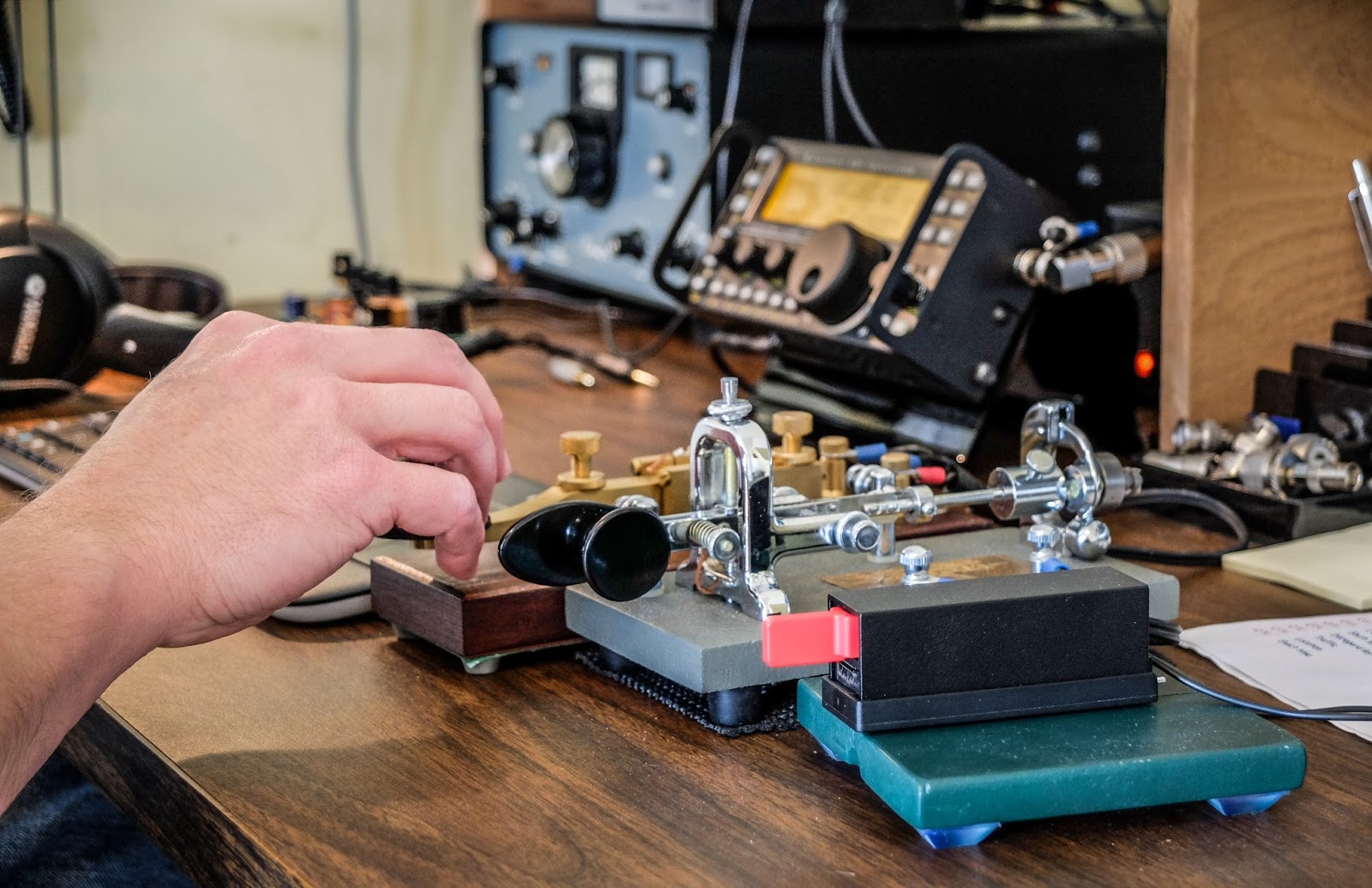 |
| Key lineup... Palm Single (paddle), Vibroplex Bug (circa 1970s), Kent Hand key |
It only seems pointless until you try
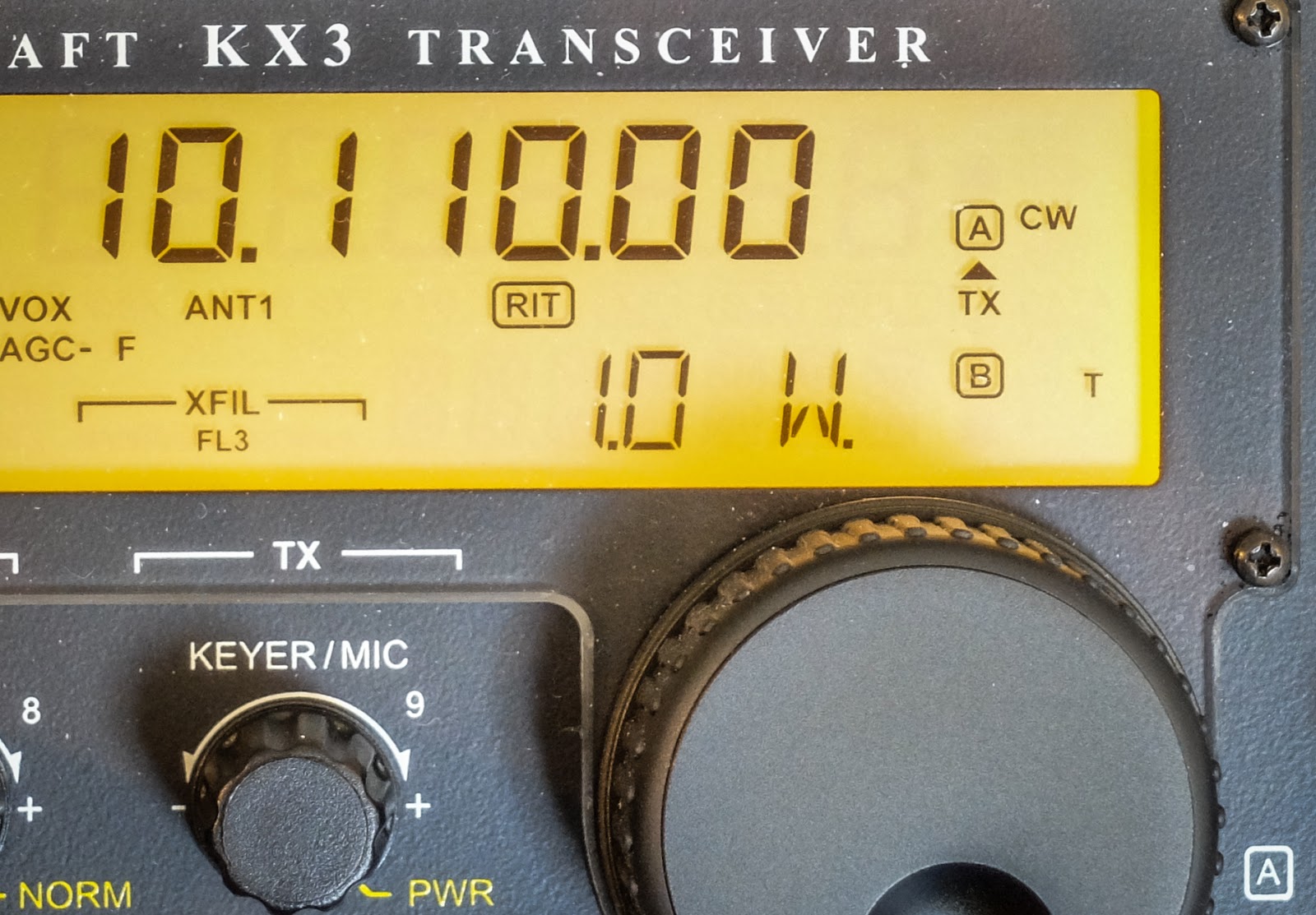 |
| 1 mighty watt |
My assumptions are often incorrect
 |
| http://www.hamqsl.com/solar.html |
Video
Trans-Canada On 630m
 |
| courtesy: http://www.bing.com/mapspreview |
Both Mitch and myself had been alerted to the excellent propagation earlier in the week, when VE3OT's CW beacon had reached S9 levels here for several hours on two consecutive nights ... but any late-night QSO attempts would have to wait until the weekend, when having to get up in the middle of the night would not conflict with Mitch's workweek schedule.
Our first attempt, late on Friday night and 3A.M. for Mitch, found that conditions had deteriorated from midweek's enhanced propagation and the low signal levels, combined with some unseasonal lightning noise, resulted in rescheduling for another shot on Saturday.
Late Saturday night found the band much quieter and propagation much improved, but not as good as it had been earlier in the week ... somehow Murphy always seems to have a hand in pre-planned events, and it's never a helpful one. Mitch's beacon signal was readable here but had a deep ten-minute fade cycle with a short-lived peak before fading out to nothing.
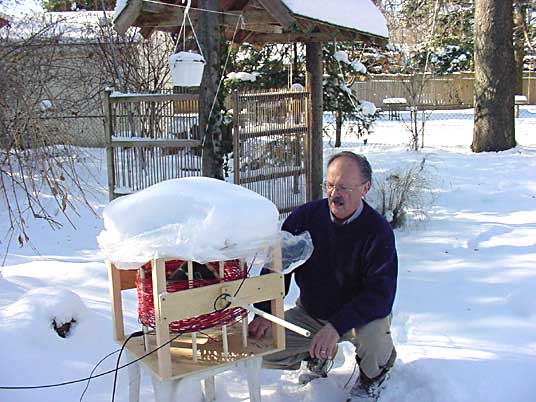 |
| VE3OT at his loop's loading coil |
 |
| LF / MF station at VE3OT |
For those of you that worked VE3OT during the recent 630m crossband event, Mitch has put together a very special QSL card!
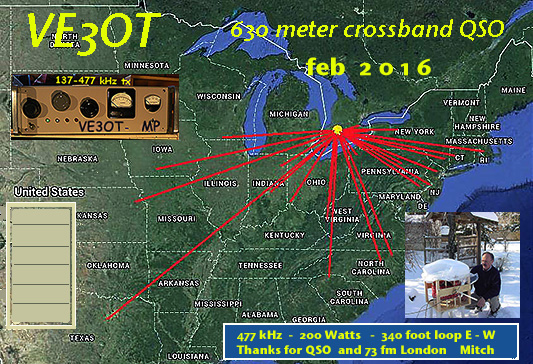
As the solar cycle winds down, the 'good' nights will happen more often, as will the truly 'great' nights. Hopefully there will be more Canadians on the band to take advantage of what lies ahead.
Hopefully the U.S.A. will soon have the band as well, which will really spark nightly activity. What is really needed right now is more Canadian activity, especially in the western provinces, where nightly CW contacts could be readily made. Time to reach for the solder iron! There are several VE7's, and one VE3, waiting and wanting to work you!
Stew Perry Topband Challenge
Last night saw another running of the winter Stew Perry Topband Challenge.
This contest is unique in that the usual density of activity on the eastern side of the continent does not necessarily provide an advantage ... contest scores are determined by the distances worked and each QSO will have a different point score, depending on its distance. The exchange is a simple one ... grid locators only ... and from these, the point score for each contact is calculated. From my way of thinking, and many others that I have discussed this with, the 'SP' is one of the fairest contests there is, putting everyone, no matter where they are located, on an even footing.
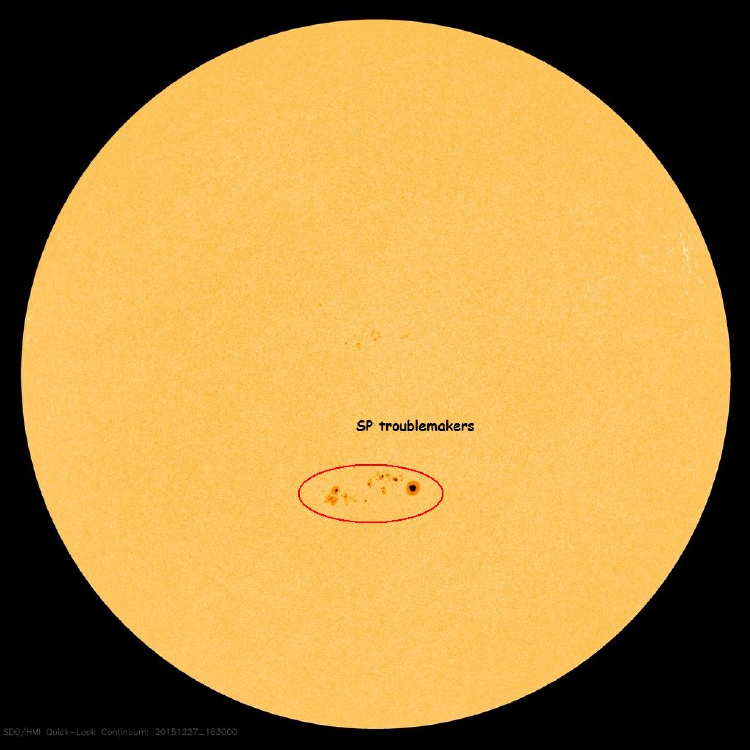 |
| Today's Sun (courtesy: http://sdo.gsfc.nasa.gov/) |
From here, operating in the 100-watt category, it was a struggle to work the normally easy single-hop stations, with no signs of the central states for several hours after sunset. Several east coast stations were worked towards midnight for the nice 12-point per QSO scores, but truth be told, almost all contacts were a struggle with many stations needing several repeats just to get the call or grid.
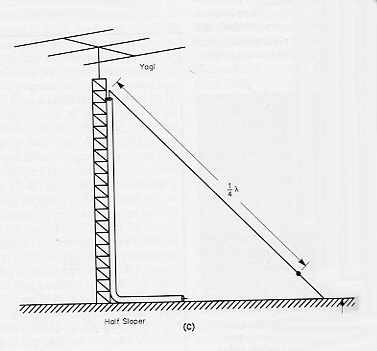
My half-sloper antenna and radial system is located right on the edge of the ocean, looking to the east, and its already low takeoff angle is enhanced with ~ 6db of sea (horizon) gain, making it a poor antenna for anything within the first-hop region ... after that it really seems to comes to life.
At 12:15 a.m., I pulled the plug, ending up with just 97 QSO's and 555 claimed points, way down from normal. Other claimed scores can be viewed on the 3830Scores.com website.
My best DX is usually JA but this time was KH6. The SP is always fun, but better conditions would have really made it a blast ... hopefully next year!













