Posts Tagged ‘Morse Code’
 Celebration of SKCC – K3Y Special Event
 January 12th, 2015 |
  Author:
 Special event, “K3Y,” the Straight Key Century Club’s annual January celebration, commemorates the Straight Key Century Club’s founding in 2006 following the American Radio Relay League’s “Straight Key Night” (SKN). A small group of participants wanted to extend the fun of SKN throughout the year. The Straight Key Century Club (SKCC) is the result.
For the first three years, the club’s founders used the special event callsigns of K1Y, K2A, and K3Y as the celebration’s special-event calls. But, someone cleverly noticed that a ‘3’ is nothing more than a backwards, curvaceous ‘E’. This “KEY” event has operated under the special event callsign of ‘K3Y’, ever since.
The on-air party is open to members and non-members alike. It runs from 0000 UTC Jan. 2 through 2359 UTC Jan. 31. It’s a great time to introduce others to the joys of hand-crafted Morse code using straight keys, bugs, and side swipers.
In this video, you can “sit in” with NW7US, the control operator of the regional activation of special event station, “K3Y/0”, during one of the many shifts during January (2015).
+ The SKCC website is at http://skccgroup.com
+ The K3Y special event page is http://www.skccgroup.com/k3y/index.php
+ The NW7US website is at http://NW7US.us
+ Some more CW/Morse code resources can be found at http://cw.hfradio.org
CW Op’s Mini-CWT Contest – Results!
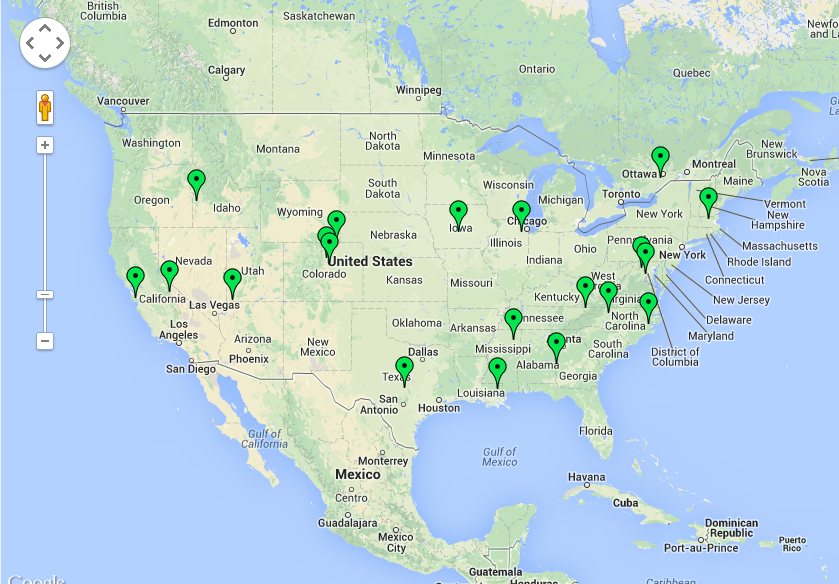 |
| Map of Stations Worked in the Mini-CWT |
Every Wednesday the CW Operators Club has a mini contest called the MINI-CWT. It runs for one hour – 10:00 pm to 11:00 pm local time here in Kansas. This time works great for me – kids are in bed, and house chores are complete!
This is the second time I have operated this contest and I had a blast. Conditions on 20 meters were awful here – I didn’t hear one signal on the band except some digital signals. So I immediately went to 40 meters and stayed there for the duration.
All told I worked 20 stations, for a score of 400 points- all stateside with one except being Canada. I was really happy with this result!
When I worked the June contest I only worked 6 stations for a total score of 36 points, so I greatly improved tonight!
You can see a map of the locations of the stations I worked during the contest last night. I created this using a site that I found that is really cool. It is QSOMap.org – and it lets you upload an ADIF file and it maps the locations.
I really enjoy working contests. Running QRP it gives you the opportunity to work some really good operators that also have excellent antennas. Everyone I called last night, I worked!
Thanks to all the ops that pulled my signal out – you made it a fun night!
Also be sure and check out my N0HYD YouTube Channel!
CW Op’s Mini-CWT Contest – Results!
|
| Map of Stations Worked in the Mini-CWT |
Every Wednesday the CW Operators Club has a mini contest called the MINI-CWT. It runs for one hour – 10:00 pm to 11:00 pm local time here in Kansas. This time works great for me – kids are in bed, and house chores are complete!
This is the second time I have operated this contest and I had a blast. Conditions on 20 meters were awful here – I didn’t hear one signal on the band except some digital signals. So I immediately went to 40 meters and stayed there for the duration.
All told I worked 20 stations, for a score of 400 points- all stateside with one except being Canada. I was really happy with this result!
When I worked the June contest I only worked 6 stations for a total score of 36 points, so I greatly improved tonight!
You can see a map of the locations of the stations I worked during the contest last night. I created this using a site that I found that is really cool. It is QSOMap.org – and it lets you upload an ADIF file and it maps the locations.
I really enjoy working contests. Running QRP it gives you the opportunity to work some really good operators that also have excellent antennas. Everyone I called last night, I worked!
Thanks to all the ops that pulled my signal out – you made it a fun night!
Also be sure and check out my N0HYD YouTube Channel!
Rectifying
As predicted, I have received some comments over at AmateurRadio.com, regarding the immediately preceding "Bug Fist" post. As I've stated there, and will state here again (for the record) that post was NOT intended to be about folks who are learning how to send Morse Code as a beginner. That post was supposed to be about people who know how to send good code - but don't, because they don't use a bug correctly.
But to answer a question posed over there. How does one learn to send good code in the first place?
Good question.
Back in the day - back in my day, the FCC had a very nice program in place. It was called the United States Amateur Radio Novice License. It was our gateway. We learned to receive Morse Code at 5 WPM. We were restricted to "Novice sub bands". You say that sounds like a curse? Heck no! It was heaven! Imagine trying to learn how to ride a bike with other kids on the playground zooming around on ten-speeds, mountain bikes, scooters and what have you. We had a little area, set aside for us, where we could zip around on our training wheels. As we rode and rode (made QSOs) we built up our confidence and eventually shed our training wheels, and we upgraded. Oh, in the process, we fell off our bikes, and got our knees and elbows bloodied along the way. But we learned!
But as they say, "Them days are gone forever." So what's a new Ham who wants to get on HF CW supposed to do?
Several things, actually.
I am going to assume you have learned the basic Morse Code character set and that you can receive at a speed of about 5 WPM. If you haven't, you need to do that. But here's an important point - if you've learned CW, whether it be from W1AW or whatever software program - you already know what good code sounds like! You will also know, conversely, what bad code sounds like. Your assignment is to send good code.
This is where code practice oscillators come in to play. They weren't invented just to teach people how to learn to receive Morse Code, they were also invented to teach people how to send Morse Code. If you have one, fine. If you don't - get one. Or ..... you can go to your rig, and turn off the VOX while in the CW mode. This should give you a nice, big, fancy and expensive code practice oscillator. Use it. Use it a lot until you are comfortable and can send Morse Code without really have to think about forming the characters too much. As I stated over at AmateurRadio.com - use a tape recorder, or the voice recorder on your cell phone and record your sending. If you can decode what you are sending, then other people will be able to, also. If you listen to your fist and find yourself going, "What?!?", then you probably aren't ready and need to practice more. It's OK to send slowly, but accurately. Personally, I would rather listen to someone sending slowly, but correctly, rather than listening someone trying way too hard, too fast, too soon, who leaves me scratching my head. (Pssst! This is why the FISTS motto is "Accuracy transcends speed.")
Once you are reasonably confident in your sending skills, you can get on the air. The Novice subbands don't really exist anymore, but you can find some slower folks hanging around together around 7.125 MHz. The FISTS and SKCC frequencies also good places to hang - from around .050 to .058. You can ply your newly discovered skills there among friends. Don't be intimidated! Relax, take a deep breath and enjoy the ride. Remember, we're not looking for a cure for cancer or cardiovascular disease here. We're supposed to be having fun. Don't obsess and don't put yourself down. We were all beginners once, and we all had to start somewhere.
I'm going to warn you. Your first half dozen or so QSOs will be a bit nerve wracking. Best thing to do is write down ahead of time a "canned QSO". Just follow the script and before you know it, you'll feel more and more comfortable and will no longer need the script. If you try to make a QSO every day, before you know it, you'll come to recognize the experience you have gained. Your speed will increase and you will really come to enjoy this new mode you have set out to learn.
Another word of caution. There will be jerks! Sorry ..... there's nothing I can do about that. Just as on the highway, there's always that idiot that has to zoom in and out of lanes at 75 MPH, you're also going to run into jerks that think 40 WPM is beneath them and will not slow down for anyone - God included. If I may get Biblical here without offending anyone ...."Just shake their dust from your feet and go onto the next village." The speed demons who won't QRS for anyone are not worth your time or effort. I've been in this game for 36 years now, and I run into my share, too. To this day, I have to ask myself why guys send at around 55 WPM in contests only to have to repeat their exchanges multiple times, because we mere mortals can't copy their "buzz saw" CW.
Conversely ..... should you answer a CQ, do not, under any circumstances, start sending faster than you are comfortable receiving! I know, we all have a tendency to do this, but it is going to get you into trouble. You are going to get yourself into a terrible experience that will make you want to run away from Morse Code forever. Any dedicated CW op worth his salt will slow down (QRS) for a newbie. Do not be afraid to ask someone to "QRS PSE?", either. We don't know for sure that your uncomfortable unless you tell us. Sometimes, we more experienced CW ops assume too much, too.
I think I covered everything and I hope this helps those of you who are newer out there and are struggling to learn the CW ropes. If you have any questions, pop something into the comments box or send me an e-mail. I will try to help in any way I can.
There's an old joke where a stranger asks a cabbie in NY how to get to Carnegie Hall. The cabbie replies "Practice!". If you want to get good at the Morse Code game, it's going to take lots of practice. No way around it, but it doesn't have to be a chore or unpleasant. Have fun and enjoy yourself!
72 de Larry W2LJ
QRP - When you care to send the very least!
This post is going to get me into trouble!
"Seems when the bands are down every person with a ‘bug’ is out calling cq. Wish they would put code oscillators and dummie loads on sale. Dits at 20 wpm and dahs at 5 wpm."
I guess it's not directly related to band conditions, and I'm not sure that John's claim is 1,000,000% accurate, however - he makes an excellent point.
Not to dump on bug users, because I have a bug. I like using a bug. Using a straight key makes the arthritis in my hands go "Hey! Stop that!" But unless I've practiced with my bug (off the air) for a while .... my sending can be pretty bad. So I try to make it a point to take the KX3 "off the air" and practice sending with my bug on a regular basis. Not as regularly as I should, but I try to keep in decent practice.
I agree with John and I would posit that listening to someone use a bug (or even a straight key or paddles, for that matter), who doesn't know how to use it properly, is akin to listening to nails being scratched across a blackboard. NB: For any younger readers, a blackboard is what we used in school before the advent of whiteboards and smartboards. If you scrape your fingernails across the surface of a blackboard, it makes a sound unlike anything you've ever heard. It literally hurts to listen to it. It will make your teeth ache. There's something about human fingernails and slate that just don't mix. Listening to someone scratch a balloon is almost as bad. But .... I digress.
The phrase, "Dits at 20 wpm and dahs at 5 wpm" resonated with me. Morse Code sent like that is not only unreadable - even worse, it's unbearable. No one is asking that all Morse be sent so that it sounds like it's coming from a keyer or a computer - but for Pete's sake - at least make sure your sending is copyable!
I would suggest that anyone who is inclined to use a bug perform this little exercise. Send some Morse and record it, either with a tape recorder (do they still make those?), or, I believe most smartphones have a voice recorder feature. Do it off the air. Either send your RF into a dummy load or turn off your "VOX" - that usually will put your rig into code practice oscillator mode.
Send some Morse, listen to it, and copy what you sent. Be honest and critical with yourself. If you can honestly copy what you've sent, then you're probably good enough to go live. It might even be a good idea to wait a day or two between the sending part and the listening to yourself part - just in order to make it a bit more objective.
I can tell you for a fact, that I have done this - I have listened to my own bug fist - and have said, "Oh my!". It was a rude, but necessary awakening. I am totally glad that I did not subject my fellow Hams to what I had thought was decent sending.
72 de Larry W2LJ
QRP - When you care to send the very least!
CWT Mini-Contest – QRP Style
 In my continuing effort to evaluate my attic dipole, several guys have given me advice to get on during a contest because the activity level is higher on the bands and I could better evaluate what I can hear.
Every Wednesday (local) evening from 0300-0400Z (Thursday) the CW Operators Club has a mini-contest the call CWT. The exchange is name and member number or name and state if a non-member.
These guys are serious CW operators, and I knew the pace would be fast. I downloaded N1MM for logging as they have a dedicated module for the contest. They also have a call history file that you can load which allows you to enter the call and it matches the name and member number up for you.
So I had everything setup and ready. I started on 20 meters and heard some activity. I made one contact there before heading to 40 meters.
On 40 meters the band was filled with signals – this warmed my heart after my recent worries with my antenna!
CW was being sent very fast – but after several listens I could usually get the call. I just looked at the scores here http://3830scores.com/currecscores.php?arg=JxfqcDz6ficvT – I ended up last in the QRP category, but NOT last in the contest!
I ended the night with 6 QSO’s during the hour long contest. Honestly, I am happy with those results. My goal was 10 contacts, but I learned some valuable lessons which will help me next time!
Here is the list of my contacts (all CW Ops Members):
K1BG Bruce 20M – MA
N1LN Bruce 40M – NC
KC4D Bill 40M – VA
N5ZO Marko 40M – CA
AD4EB Jim 40M – TN
N5AW Marv 40M – TX
So I worked 6 different states – MA, NC, VA, CA, TN, TX – coast to coast!
Thanks to those that pulled my QRP signal out! I will be back to this contest in the future!
New portable paddle
I decided that I wanted to try something new paddle-wise for my lunchtime QRP portable operations. The main criteria was that it had to be on the inexpensive side. That seems to be my main criteria these days where a lot of things are concerned. Besides working well, it would also be nice if the paddle was light in weight.
Palm paddles would probably be the ultimate, but are way too expensive and would not fit within my meager budget right now. I needed to keep it under $50 if at all possible. That really narrows down the possibilities, let me tell you. I have a Whiterook MK-33 single lever paddle. It works well and it also fits the bill, but it tends to get a bit sloppy around the 22-23 WPM mark.
I had a Bulldog paddle back when I had my K1 and I liked it. However, I included it as part of the K1 package when I sold that radio to raise money for my KX3. So, relying on my memory, I decided to give another Bulldog a try. I went to the Website: http://www.amateurradioproducts.com/, only to find out that they no longer manufacture the model I had. Mine was the one on a small triangular wooden base that had three tiny suction cups.
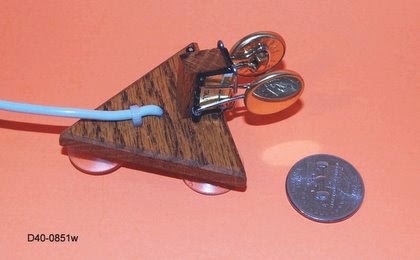
They have several different models now, and I decided to go with the BD6, the Mini-Iambic. It arrived on Saturday through the mail, and tonight was the first chance I had to try it out.
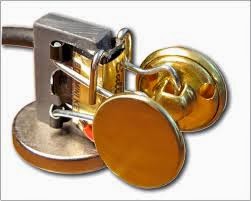
I have to admit that I was skeptical when I opened up the package that it came in. It is indeed ‘mini” – in fact, it gets lost in the middle of the 1.5 inch fender washer that serves as a base! But as usual, it turns out that looks are quite deceiving. This little paddle is smooth and is great to use just as it is, no adjustments were required, although the accompanying instruction sheet tells you how to go about that, if needed. I worked both W1AW/5 and W1AW/0 tonight at about the 21 WPM range. The paddles acquitted themselves nicely there. Then I turned up the speed a notch to work EV1R and LZ1WR and C6ATT. Even at the speed where the Whiterook goes kaflooey on me, the Bulldog stays sharp, smooth and flawless and had great feel to it. The fact that it was only $35 was icing on the cake. I will definitely bring these along for Field Day. They may be too small for some of our guest operators, but they work great for me!
72 de Larry W2LJ
QRP – When you care to send the very least!













