Posts Tagged ‘history’
 1920 film: How the Telephone Talks (A Silent Film)
 November 9th, 2013 |
  Author:
 This is for you vintage science film buffs: here is a circa 1920 film: How the Telephone Talks (A Silent Film).
This is an educational film from 1920 that explained the “modern” telephone. The concepts are still relevant to today’s modern versions, including the cell phone, which is both radio and telephone.
From Wiki:
A telephone, or phone, is a telecommunications device that permits two or more users to conduct a conversation when they are not in the same vicinity of each other to be heard directly. A telephone converts sound, typically and most efficiently the human voice, into electronic signals suitable for transmission via cables or other transmission media over long distances, and replays such signals simultaneously in audible form to its user. The word telephone has been adapted into the vocabulary of many languages. It is derived from the Greek: τῆλε, tēle, far and φωνή, phōnē, voice, together meaning distant voice.
First patented in 1876 by Alexander Graham Bell and further developed by many others, the telephone was the first device in history that enabled people to talk directly with each other across large distances. Telephones became rapidly indispensable to businesses, government, and households, and are today some of the most widely used small appliances.
The essential elements of a telephone are a microphone (transmitter) to speak into and an earphone (receiver) which reproduces the voice of the distant person. In addition, most telephones contain a ringer which produces a sound to announce an incoming telephone call, and a dial used to enter a telephone number when initiating a call to another telephone. Until approximately the 1970s most telephones used a rotary dial, which was superseded by the modern Touch-Tone push-button dial, first introduced by AT&T in 1963. The receiver and transmitter are usually built into a handset which is held up to the ear and mouth during conversation. The dial may be located either on the handset, or on a base unit to which the handset is connected by a cord containing wires. The transmitter converts the sound waves to electrical signals which are sent through the telephone network to the receiving phone. The receiving telephone converts the signals into audible sound in the receiver, or sometimes a loudspeaker. Telephones are a duplex communications medium, meaning they allow the people on both ends to talk simultaneously.
A landline telephone is connected by a pair of wires to the telephone network, while a mobile phone, such as a cellular phone, is portable and communicates with the telephone network by radio transmissions. A cordless telephone has a portable handset which communicates by radio transmission with the handset base station which is connected by wire to the telephone network.
The telephone network, consisting of a worldwide net of telephone lines, fiber optic cables, microwave transmission, cellular networks, communications satellites, and undersea telephone cables connected by switching centers, allows any telephone in the world to communicate with any other. Each telephone line has an identifying number called its telephone number. To initiate a telephone call the user enters the other telephone’s number into a numeric keypad on the phone.
Although originally designed for simple voice communications, most modern telephones have many additional capabilities. They may be able to record spoken messages, send and receive text messages, take and display photographs or video, play music, and surf the Internet. A current trend is phones that integrate all mobile communication and computing needs; these are called smartphones.
The Final Courtsey

The static crashes were coming more frequently now and I could see the lightning off in the distance. I had been driving since the early afternoon and only had about two hours left until I arrived home. The sun had set an hour ago but the moon was not up yet and it was dark as pitch. My headlights cut through the night. Shortly before the Autumn sunset, the clouds moved in from the west with the winds gusting against my pickup truck as I headed south. The rain was off and on, more of a nuisance than an impediment to driving.
It had been a long day of meetings and I looked forward to getting behind the wheel. My mobile setup in the pickup is simple: an IC-706MKIIG and a screwdriver antenna – just 100 watts. It was relaxing to hear the rush of white noise as the rig powered up and my screwdriver antenna spun up to a good match for 40 meters. I had enjoyed a few QSOs as I barreled down US Interstate 29. Traffic was light. After the sun set, the band started to go long and decided to drop down 75 meters. The screwdriver antenna coil whirled again, sending the whip up a bit higher.
As I slowly spun the dial, I heard a call coming just above the S5 noise level. “CQ CQ CQ, this is W0XRR, Whiskey Zero X-ray Romeo Romeo, calling CQ and listening.”
Gripping the handmike, I replied to the call, “W0XRR, this is Kilo Delta Seven Papa Juliet Quebec, KD7PJQ, the name is Scott and I am mobile, south on I-29.” Releasing the Push To Talk button, the noise rushed back to fill the cab of my pickup. The rain started to pick up, beating against the roof and windshield as I continued south.
“NI0L, Scott, fine business and thank you for answering my call. Name here is Bert, Bravo Echo Romeo Tango. My QTH is just outside of Atchison, Kansas – Atchison, Kansas. Good signal tonight, I would not have guessed you were mobile. Ok Scott, back to you.” Bert’s signal had gotten stronger and I easily copied him through the noise. His audio quality was as smooth as silk… no processing.
“Solid copy all Bert, you’ve got a solid signal tonight, started off a bit weak but has picked up to a solid 57 to 58. Ok on your QTH in Atchison. I am headed south on I-29. Just passed Hamburg and crossed into Missouri from Iowa. My destination is not far from your QTH. I am headed to Fort Leavenworth, Kansas. Back to you, Bert.” Despite the poor weather on the road, I was anticipating this was going to be a good QSO and hoped our ragchew would keeping me company on a pretty miserable evening to be out on the road.
“Well Scott, I am glad to make the contact. The weather is bad here and I imagine it is worse up your way. I was down here in my basement shack and decided I would warm up the tubes and see what I could find on the bands. Ok on Fort Leavenworth, just a bit south from here. I have not been out to the fort for a number of years but know it well. I retired sometime back and now spend a lot more time down here in the basement either spinning the dial or tinkering with one project or another. Lets hear from you, Scott. What’s put you out on the road tonight?” Bert asked.
I told Bert how I had been at a conference on Offutt Air Force Base in Nebraska. The event had ended a day early and I was trying to make my way back home to see the family and enjoy a full weekend. I explained how I had been in the Army for over two decades, had originally gotten my call when I was stationed at Fort Lewis, Washington, and had recently been transferred to Fort Leavenworth with my family. “We really enjoy the area. I am thinking about retiring there in Leavenworth. Back to you, Bert,” my index finger released the PTT.
Bert came back to me with his signal competing with the noise floor. “Fine business all, Scott. I used to be in the Signal Corps and did 30 years in the Army. Was stationed out there at the fort for my last assignment as well. Good posting there at Leavenworth. Glad to hear you and your family are enjoying it.” He told me about how he used to support an air defense unit that was stationed on Fort Leavenworth. His signal detachment was responsible for integrating all the communications for the Nike missile batteries in Kansas, Missouri, and Nebraska. We continued to trade war stories for another twenty minutes or so. Then his signal began to fade.
“I am starting to loose you Bert, so I better wrap this up. I really appreciate the QSO and to make the contact. Any chance you will be at the hamfest in Raytown coming up the Saturday after next? A few miles southeast of Kansas City? It would be a great opportunity for an eyeball QSO… and I am buying the coffee. What do you say? Back to you, Bert.” The rain was a constant downpour now, rolling across the road in front of me.
No reply was heard except for a few static crashes from the lightning. “W0XRR, this is KD7PJQ, thanks again for the contact, 73 Bert!”
I had begun making my deliberate ‘s’ pattern through the rows of gear (… and, lets be honest, junk) when I saw a table with some nice Collins gear. There was the transmitter (a 32S-3A), a receiver (75S-3C), and even a Collins 30L-1 amplifier. The bearded oldtimer manning the table had his undivided attention focused on a breakfast burrito and it took a moment for him to wash down a deliberate bite with a drink of coffee.
“Good morning. Nice Collins S-Line! These are in great shape – looks like they’ve been well cared for. You don’t see these everyday. Why are you selling them?” I heard older hams talk about these Collins rigs, but I had never seen them before.
“Good morning… sorry you caught me in the middle of breakfast. Yup, this is a nice set. Not mine actually. We’re selling it for the widow of a Silent Key. I’ve got more boxes here of his stuff. I think all the manuals are in one of these,” the gentleman said as he turned in his seat a leaned over to pull an open box towards him.
“The lady gave us a call to come and clear out the ham shack. He’d passed away last year but it took her until now to finally part with the gear. We picked everything up earlier in the week. Took us two trips. Here’s one of the manuals,” he said as he handed me the manual for the 75S-3C, yellowed with age but well cared for.
I flipped through the book, noticing the margin notes,,, and then a QSL card fell out between the pages and onto the table. I looked at the callsign on the card – …W0XRR. Bert McKenzie, Atchison, Kansas. There was a picture of a Nike-Hercules black and white missile elevated at 45 degrees on a launch platform as well as the crossed semaphore flags of the Signal Corps.
“Wait… who’s gear was this? What was the call of the Silent Key?”
“Well, there’s his QSL card!” The oldtimer pointed to the card on the table. “This gear belonged to Bert… W0XRR,” the oldtimer picked up the QSL card from the table.
“But when was it you said he passed away?” I was confused and trying to sort out what I was hearing.
The oldtimer stroked his beard as he set the QSL card down, with the image of the Nike missile towards the table. “Let’s see… it’s been a little over a year now. Bert passed away last year around the end of October.”
I looked down again at the QSL card on the table. This side of the card had the blanks for QSO specifics. There was handwriting on it and I tentatively lifted the card up to get a better look. On it I saw my call, KD7PJQ…. 75 meters, the date of our QSO (… less than two weeks ago), a 5-7 signal report… and a circle around “PSE QSL”. The card slipped out of my hand and onto the table.
Dazed, I lurched away from the table. I needed fresh air and sunlight.
The oldtimer called after me, “Hey! You interested in the rig? Go ahead and make an offer.”
Author’s note: This story is a work of fiction. Names, characters, call signs, locations, and incidents are products of the author’s imagination. Any resemblance to actual events, locales, or persons, living or dead, is entirely coincidental.

The Final Courtesy

  The static crashes were coming more frequently now and I could see the lightning off in the distance. I had been driving since the early afternoon and only had about two hours left until I arrived home. The sun had set an hour ago but the moon was not up yet and it was dark as pitch. My headlights cut through the night. Shortly before the Autumn sunset, the clouds moved in from the west with the winds gusting against my pickup truck as I headed south. The rain was off and on, more of a nuisance than an impediment to driving.
  It had been a long day of meetings and I looked forward to getting behind the wheel. My mobile setup in the pickup is simple: an IC-706MKIIG and a screwdriver antenna – just 100 watts. It was relaxing to hear the rush of white noise as the rig powered up and my screwdriver antenna spun up to a good match for 40 meters. I had enjoyed a few QSOs as I barreled down US Interstate 29. Traffic was light. After the sun set, the band started to go long and decided to drop down 75 meters. The screwdriver antenna coil whirled again, sending the whip up a bit higher.
  As I slowly spun the dial, I heard a call coming just above the S5 noise level. “CQ CQ CQ, this is W0XRR, Whiskey Zero X-ray Romeo Romeo, calling CQ and listening.”
  Gripping the handmike, I replied to the call, “W0XRR, this is Kilo Delta Seven Papa Juliet Quebec, KD7PJQ, the name is Scott and I am mobile, south on I-29.” Releasing the Push To Talk button, the noise rushed back to fill the cab of my pickup. The rain started to pick up, beating against the roof and windshield as I continued south.
  “NI0L, Scott, fine business and thank you for answering my call. Name here is Bert, Bravo Echo Romeo Tango. My QTH is just outside of Atchison, Kansas – Atchison, Kansas. Good signal tonight, I would not have guessed you were mobile. Ok Scott, back to you.” Bert’s signal had gotten stronger and I easily copied him through the noise. His audio quality was as smooth as silk… no processing.
  “Solid copy all Bert, you’ve got a solid signal tonight, started off a bit weak but has picked up to a solid 57 to 58. Ok on your QTH in Atchison. I am headed south on I-29. Just passed Hamburg and crossed into Missouri from Iowa. My destination is not far from your QTH. I am headed to Fort Leavenworth, Kansas. Back to you, Bert.” Despite the poor weather on the road, I was anticipating this was going to be a good QSO and hoped our ragchew would keeping me company on a pretty miserable evening to be out on the road.
  “Well Scott, I am glad to make the contact. The weather is bad here and I imagine it is worse up your way. I was down here in my basement shack and decided I would warm up the tubes and see what I could find on the bands. Ok on Fort Leavenworth, just a bit south from here. I have not been out to the fort for a number of years but know it well. I retired sometime back and now spend a lot more time down here in the basement either spinning the dial or tinkering with one project or another. Lets hear from you, Scott. What’s put you out on the road tonight?” Bert asked.
  I told Bert how I had been at a conference on Offutt Air Force Base in Nebraska. The event had ended a day early and I was trying to make my way back home to see the family and enjoy a full weekend. I explained how I had been in the Army for over two decades, had originally gotten my call when I was stationed at Fort Lewis, Washington, and had recently been transferred to Fort Leavenworth with my family. “We really enjoy the area. I am thinking about retiring there in Leavenworth. Back to you, Bert,” my index finger released the PTT.
  Bert came back to me with his signal competing with the noise floor. “Fine business all, Scott. I used to be in the Signal Corps and did 30 years in the Army. Was stationed out there at the fort for my last assignment as well. Good posting there at Leavenworth. Glad to hear you and your family are enjoying it.” He told me about how he used to support an air defense unit that was stationed on Fort Leavenworth. His signal detachment was responsible for integrating all the communications for the Nike missile batteries in Kansas, Missouri, and Nebraska. We continued to trade war stories for another twenty minutes or so. Then his signal began to fade.
  “I am starting to loose you Bert, so I better wrap this up. I really appreciate the QSO and to make the contact. Any chance you will be at the hamfest in Raytown coming up the Saturday after next? A few miles southeast of Kansas City? It would be a great opportunity for an eyeball QSO… and I am buying the coffee. What do you say? Back to you, Bert.” The rain was a constant downpour now, rolling across the road in front of me.
  No reply was heard except for a few static crashes from the lightning. “W0XRR, this is KD7PJQ, thanks again for the contact, 73 Bert!”
  It was a sunny Saturday morning with early November’s crisp Fall air. Attendance at the hamfest looked good and my parking spot was a good walk to the door. Although I knew I would spend the majority of my time browsing the aisles, I did need to pick up some Anderson PowerPole connectors as well one of those Nifty! Reference Guides for my IC-706. The guide would help me out on remembering some of the more obscure settings for the rig when I was out on the road.
  I had begun my making my deliberate ‘s’ pattern through the rows of gear (… and, lets be honest, junk) when I saw a table with some nice Collins gear. There was the transmitter (a 32S-3A), a receiver (75S-3C), and even a Collins 30L-1 amplifier. The bearded oldtimer manning the table had his undivided attention focused on a breakfast burrito and it took a moment for him to wash down a deliberate bite with a drink of coffee.
  “Good morning. Nice Collins S-Line! These are in great shape – looks like they’ve been well cared for. You don’t see these everyday. Why are you selling them?” I heard older hams talk about these Collins rigs, but I had never seen them before.
  “Good morning… sorry you caught me in the middle of breakfast. Yup, this is a nice set. Not mine actually. We’re selling it for the widow of a Silent Key. I’ve got more boxes here of his stuff. I think all the manuals are in one of these,” the gentleman said as he turned in his seat a leaned over to pull an open box towards him.
  “The lady gave us a call to come and clear out the ham shack. He’d passed away last year but it took her until now to finally part with the gear. We picked everything up earlier in the week. Took us two trips. Here’s one of the manuals,” he said as he handed me the manual for the 75S-3C, yellowed with age but well cared for.
  I flipped through the book, noticing the margin notes,,, and then a QSL card fell out between the pages and onto the table. I looked at the callsign on the card – …W0XRR. Bert McKenzie, Atchison, Kansas. There was a picture of a Nike-Hercules black and white missile elevated at 45 degrees on a launch platform as well as the crossed semaphore flags of the Signal Corps.
  “Wait… who’s gear was this? What was the call of the Silent Key?”
  “Well, there’s his QSL card!” The oldtimer pointed to the card on the table. “This gear belonged to Bert… W0XRR,” the oldtimer picked up the QSL card from the table.
  “But when was it you said he passed away?” I was confused and trying to sort out what I was hearing.
  The oldtimer stroked his beard as he set the QSL card down, with the image of the Nike missile towards the table. “Let’s see… it’s been a little over a year now. Bert passed away last year around the end of October.”
  I looked down again at the QSL card on the table. This side of the card had the blanks for QSO specifics. There was handwriting on it and I tentatively lifted the card up to get a better look. On it I saw my call, KD7PJQ…. 75 meters, the date of our QSO (… less than two weeks ago), a 5-7 signal report… and a circle around “PSE QSL”. The card slipped out of my hand and onto the table.
  Dazed, I lurched away from the table. I needed fresh air and sunlight.
  The oldtimer called after me, “Hey! You interested in the rig? Go ahead and make an offer.”
Author’s note: This story is a work of fiction. Names, characters, call signs, locations, and incidents are products of the author’s imagination. Any resemblance to actual events, locales, or persons, living or dead, is entirely coincidental.
Tidbits From the QRP History Book
It seems that Kruse felt that American operators had become too enamored with high power operation and that the QRM and inefficiencies of high power operation were precluding the "grassroots" operator from even hearing DX stations. Weiss writes,
"QST continually derided the abuse of power among American amateurs by coining a long list of derogatory epithets for the high power types. Such names as "watt-hog", "ether buster", "tribe of ampere hounds", "ampere chaser", "thunder factory', "watt burner" and "most miles per gallon" flowed across the pages of QST, leaving little doubt as to the attitude of the QST staff, and presumably the ARRL, to combat the developing dependence upon brute power by American amateurs in place of the ideals embodied in the QRP Operator...."
In, December 1923, the very first QRP contest, The Station Efficiency Contest, was announced with this subtitle, "Miles Per Watt: An Argument For The Small Set and For Intelligence In Place of Brute Force" Weiss comments, "In other words, the use of low power was inextricably linked with intelligence and diametrically opposite to high power"
Further Kruse argued, "...what if his brute power does let him cover 4,000 miles, isn't he still inferior to the other man who handled his power correctly and went twice as far per watt?"
So there you have it, QRP operation = Intelligence.
Need we say more;-)
The book goes into much more detail about the attack on high power operation and rising credibility of the QRP operator in those early days. Interesting reading and entertaining as well.
In the beginning……
 … there was Hugo Gernsback. Here are a few of his contributions:
– Established one of the first companies to sell equipment to radio amateurs in 1904.
– Founded the Wireless Association of America in 1909.
– Published two amateur radio oriented magazines: Modern Electrics in 1908 and The Electrical Experimenter in 1913.
– Initially proposed the idea of allocating 200 meters and down to amateur radio in 1912.
Why don’t we know more about Hugo Gernsback and his early contributions to the hobby? At what point did the momentum shift from Hugo and his Wirless Association of America to Hiram Maxim and his ARRL? … and why?
Hugo made a huge contribution to science fiction but it seems his contributions to amateur radio have been overlooked.
In the beginning……
… there was Hugo Gernsback. Here are a few of his contributions:
– Established one of the first companies to sell equipment to radio amateurs in 1904.
– Founded the Wireless Association of America in 1909.
– Published two amateur radio oriented magazines: Modern Electrics in 1908 and The Electrical Experimenter in 1913.
– Initially proposed the idea of allocating 200 meters and down to amateur radio in 1912.
Why don’t we know more about Hugo Gernsback and his early contributions to the hobby? At what point did the momentum shift from Hugo and his Wirless Association of America to Hiram Maxim and his ARRL? … and why?
Hugo made a huge contribution to science fiction but it seems his contributions to amateur radio have been overlooked.
A very special day
Today is a special day if you’re of Polish descent, Catholic, and a Ham Radio operator. Today is the feast day of St. Maximilian Kolbe. For those of you who are not Catholic, a Saint’s Feast Day commemorates the day that the faithful believe that the Saint left this earthly existence, directly heading to Heaven for his or her eternal reward.
It was on August 14, 1941, that Father Maximilian Kolbe, a Franciscan friar died from an injection of carbolic acid. Fr. Kolbe was a detainee at Auschwitz, during WWII. He was sent there for the crime of providing shelter and safe harbor to over 2,000 Polish Jews in his friary at Niepokalanów.
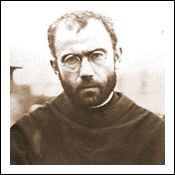
At the end of July 1941, three prisoners disappeared from Auschwitz, during what appeared to be a successful prison break. To retaliate, the deputy camp commander picked out 10 men at random to be starved to death. One of the chosen men, Franciszek Gajowniczek, cried out that he had a wife and children and begged for mercy. Fr. Kolbe heard this and asked, and was granted permission to take Gajowniczek’s place.
In the starvation bunker where the condemned men were being kept, Fr. Kolbe celebrated Mass each day and led the men in hymns and prayers. Two weeks later, after all the men had passed, Fr. Kolbe was the last condemned prisoner left alive. The Nazi’s had other plans for that bunker, so to end it all, Fr. Kolbe was given the lethal injection.
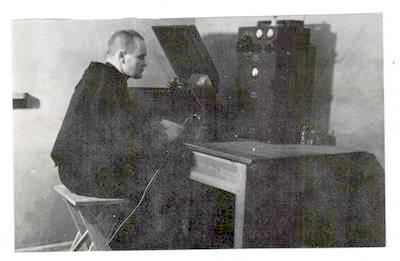
But during his lifetime here on earth, Fr. Max was unique among Saints, as he was an Amateur Radio operator. His call sign was SP3RN, and this might be the only photo in existence of him “at the key”, so to speak.