Posts Tagged ‘history’
 Hey! I almost forgot !!!
 May 31st, 2019 |
  Author:
As per the ARRL Announcement
Museum Ships Weekend will take place over the June 1 – 2 weekend, sponsored by the Battleship New Jersey Amateur Radio Station NJ2BB. Radio operation will be from a variety of vintage and noteworthy vessels. This is not a competition.
So far 75 ships are on the roster to take part. All stations working at least 15 different participating ships will receive a certificate, if they send a copy of their log showing these contacts.
While operation on any amateur frequency is allowed, most ships will be operate in the General portion of the bands. PSK31 operation will be on 14.070 MHz, 10.142 MHz, 18.100 MHz, 21.070 MHz, and 28.120 MHz.
Some ships also may be found on 75 meters (3.880 – 3.885 MHz) and on 40 meters (7.290 MHz) using AM, some using the vessel’s original restored equipment.
This is what I love about Summer - there's always something going on, just about every weekend. If you follow the link above, you'll get a list of who will be on the air. Log 15 ships and $4 will get you a piece of wallpaper for your shack.
72 de Larry W2LJ
QRP - When you care to send the very least!
Radio Virgin: the First QSO
My first QSO (and, yeah, it was with Morse code) was petrifying and…
What’s your story of your first QSO?
73 de NW7US
Some more oldies, but goodies
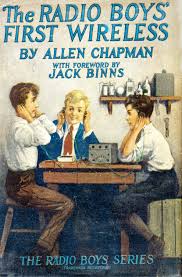
For those of you with a kindle, these can be download for FREE from Amazon.
1. The Radio Boys’ First Wireless
https://www.amazon.com/gp/product/B008476T3S/
2. The Radio Boys at Ocean Point
https://www.amazon.com/gp/product/B004TSAZWM/
3. The Radio Boys at the Sending Station
https://www.amazon.com/gp/product/B004TQF6BE/
4. The Radio Boys at Mountain Pass
https://www.amazon.com/gp/product/B006T5TLSM/
5. The Radio Boys Trailing a Voice
https://www.amazon.com/gp/product/B004TRF6S6/
6. The Radio Boys on the Mexican Border
https://www.amazon.com/gp/product/B004TIJRP8/
7. The Radio Boys on Secret Service Duty
https://www.amazon.com/gp/product/B00AQMGFB0/
8. The Radio Boys in the Thousand Islands
https://www.amazon.com/gp/product/B00AQMZS86/
9. The Radio Boys’ Search for the Inca’s Treasure
https://www.amazon.com/gp/product/B004Z0MNBU/
10. The Radio Boys Rescue the Lost Alaska Expedition
https://www.amazon.com/gp/product/B0058KSAW2/
11. Radio Boys Cronies
https://www.amazon.com/gp/product/B00848O6YQ/
12. Radio Boys Loyalty: Bill Brown Listens In
https://www.amazon.com/gp/product/B004TRO448/
13. The Radio Boys with the Revenue Guards
https://www.amazon.com/gp/product/B004UKEU2A/
So yeah, the stories are a bit campy, perhaps and the language and slang is old - but what the heck? They're free and they're almost 100 years old!
I downloaded them all to my kindle and am enjoying them. I hope you will, too!
72 de Larry W2LJ
QRP - When you care to send the very least!
ETH081 – Flying Around the World with Brian Lloyd

I’m sure that all of you have heard about Amelia Earhart and how she wanted to become the first woman to fly solo around the world. On June 1, 1937, she and her navigator took off from an airport in Florida and attempted to do just that. She however didn’t make it, but she came close. Her plane disappeared somewhere in the Pacific ocean.
Eighty years later, Brian Lloyd, WB6RQN, decided that he would attempt to fly around the world solo following(for the most part) her historic flight. Thankfully, Brian made it home back here to Texas, however it wasn’t without it’s problems.
In this episode of the Everything Ham Radio Podcast, we talk with Brian about his trip We talk about all the highs and lows, about all the awesome people that helped him along the way and generally about his adventure.
Give this episode a listen, I had a great time talking with Brian and I hope that you enjoy listening in on our conversation. You can find the show notes for the episode as well as listen to it at:
Hallicrafters Shortwave Radio; Winning WWII With Technology (1944)
Great film about a great radio manufacturer and radio set.
In 1944, this short subject film was produced by the Jam Handy Organization and sponsored by the Hallicrafters Company. It shows the construction of the SCR-299 and dramatizes its use during World War II. This is a B&W documentary presenting a look at the manufacturing and use of the (now defunct) Hallicrafters Company’s SCR-299 “mobile communications unit.” This 1944 film, produced with help from the US Army Signal Corps, and by the Hallicrafters Company, explains how, using radio gear such as this Hallicrafters shortwave radio transmitter and receiver technology, the US Forces and Allies were better equipped to win World War II.
The SCR-299 “mobile communications unit” was developed to provide long-range communications during World War II. The US Military sought improvements of range, flexibility and durability over its existing SCR-197 and SCR-597 transmitters. In 1942, Hallicrafters Standard HT-4 was selected as the SCR-299’s transmitter, known subsequently by its military designation as the BC-610. The SCR-299 was first used on November 8, 1942, during Operation TORCH involving companies of the 829th Signal Service Battalion establishing a radio net that could exchange messages between beach-landed forces and bases in Gibraltar. Despite initial problems unloading the sets from convoy ships, the SCR-299s served until the installation of permanent Army Command and Administrative Network stations. According to US Army military historians, “General Dwight Eisenhower credited the SCR-299 in his successful reorganization of the American forces and final defeat of the Nazis at Kasserine Pass.”
The SCR-299 was a “self-contained” receiving and transmitting mobile high-frequency (HF; or, shortwave) station capable of operating from 2 MHz to 8 MHz. Using conversion kits, it could operate from 1 MHz to 18 MHz. The transmitter output reached 350 watts.
The entire unit came in a K-51 truck except for Power Unit PE-95 which was in a K-52 trailer. Power could either be supplied by the Power Unit and a 12-volt storage battery or 115-volt 60-cycle AC commercial power and two spare 6-volt storage batteries. The power requirement was 2000 watts, plus 1500 watts for heater and lights.
The system could be remotely controlled up to a distance of one mile (1.6 km) using two EE-8 field telephones and W-110-B Wire kit. Remote equipment was provided for remotely keying or voice modulating the transmitter, remotely listening to the receiver, and for communicating with the operator of the station.
Read more details here: http://en.wikipedia.org/wiki/SCR-299
Public domain film from the Library of Congress Prelinger Archive.
..
73 de NW7US
..
Old, But Still Useful!
This old WWII military training video is still useful regarding Morse code:
[embedyt]https://www.youtube.com/watch?v=YqTn-165orw[/embedyt]
This is an antique United States Navy Training Film from 1943/1944, in which proper hand-sending of Morse code is demonstrated. The film covers some basic principles and mechanics of manual keying of the International Morse code, as used during WWII.
Amateur (Ham) radio operators find Morse code (and the ‘CW’ mode, or ‘Continuous Wave’ keying mode) very useful, even though Morse code is no longer required as part of the licensing process. Morse code is highly effective in weak-signal radio work. And, preppers love Morse code because it is the most efficient way to communicate when there is a major disaster that could wipe out the communications infrastructure.
While this military film is antique, the vintage information is timeless, as the material is applicable to Morse code, even today.
There’s more about Morse code, at my website: http://cw.hfradio.org
For additional joy, here are a few of old films regarding Morse code:
Morse Code – Principles and Basic Techniques (US Army Signal)
(Learn to Send Perfect Morse Code by Hand – Vintage Training Film (Ham Radio / CW))
[embedyt]https://www.youtube.com/watch?v=qmg1MlstxWM[/embedyt]
Vintage 1944 Radio Operator Training: How to Send Morse Code (CW) by Hand
[embedyt]https://www.youtube.com/watch?v=XjupJslRj5E[/embedyt]
This one is a pretty cool film:
1939 Film: New Zealand Shortwave Communications; Morse code (CW)
[embedyt]https://www.youtube.com/watch?v=H-KUat5WEkU[/embedyt]
I’ve also created a play list, and most of the videos are still online. Once and a while something changes and I have to update the list. Here is the list:
Original Title: TECHNIQUE OF HAND SENDING, by Department of Defense, Published 1944
Usage CC0 1.0 Universal
TECHNIQUE OF HAND SENDING
PIN 23735 1944
IMPORTANT PARTS OF THE TRANSMITTER, TENSION SPRING, ADJUSTING CONTACTS, ADJUSTING SPRINGS. ELEMENTS OF MORSE CODE, TIMING, AND PARTS OF BODY THAT FUNCTION WHEN TRANSMITTING CODE. IMPORTANCE OF CORRECT POSITION AND OPERATION.
Producer Department of Defense
Enjoy!
On this day, 48 years ago