Posts Tagged ‘engineering’
 Mirage Active Bias mod, Part 1
 June 10th, 2011 |
  Author: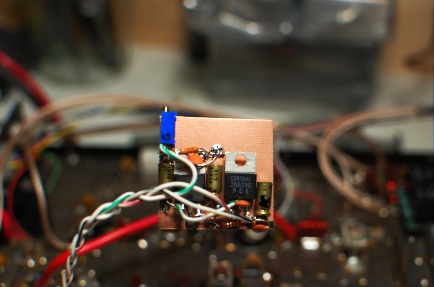
After chatting with Terry, W8ZN, about whether to keep or sell the AM-6155s (which I did sell to finance a tower), he suggested that I apply the N1DPM “Active Bias” modification to my elderly “160-watt” Mirage 2-meter amplifier. I contacted Fred, N1DPM, and he sent me a copy of his paper Linearization of Solid State “Brick” Amplifiers from the 21st Eastern VHF/UHF Conference (1995), along with some additional notes from his notebook. It’s pretty eye-opening how non-linear the amp is without the modification! I finally gathered the parts and hacked it together last night. Hope to test it soon with a “dummy” transistor and then live on the amp. The braided wires go to the thermal compensation transistor which is thermally bonded to one of the RF power transistors.
It probably won’t be ready for the ARRL June VHF this weekend, though. So, I’ll only be using the amp on CW. That’s no matter since I haven’t hung the low-loss cable (LMR and Heliax), nor have I received a D1010 432-MHz amp that will be on its way to me soon. Everything seems to take longer than it ought to!
Recycling LMR crimp connectors
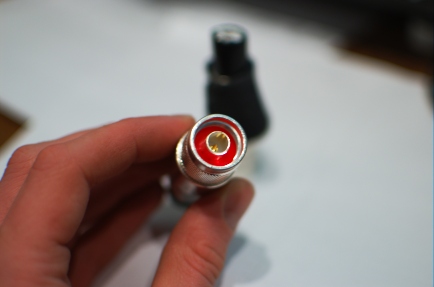
A while back, I came upon about two dozen Times Microwave Systems TC-600-NM connectors that had been improperly installed and cut off. Knowing that LMR-600 type cable is commonly available, I stashed them for later use. These connectors cost between $8 and $15 each, so the ability to recycle could offer a substantial savings. I endeavored to see just what it would take to do so.
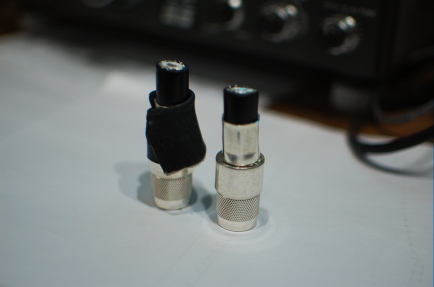
The first step is to remove the heatshrink tubing (if installed). These connectors employed a relatively easy-to-remove heatshrink, which I was able to get off with a sharp knife. (That probably means that they would have filled with water if they had been used.)
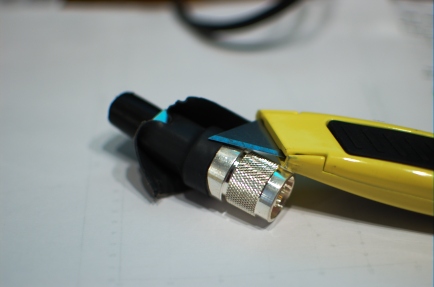
Twist off the old crimp ring with two pair of Channel-Lock-type pliers.
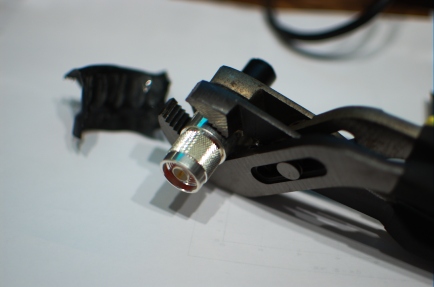
Presto! (Be sure to do this in a work area where it is easy to vacuum up the small strands of braid that will invariably fall everywhere.)
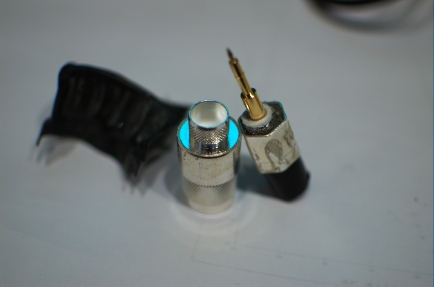
A butane torch gets the pin off in no time.
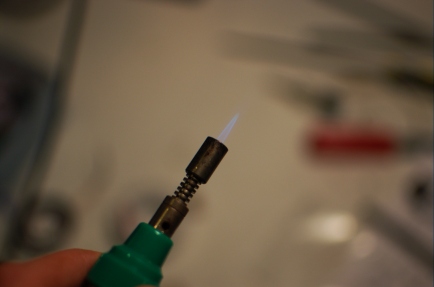
Unfortunately, I did not have enough hands to take a photograph and demonstrate the proper technique. Place the tip of the flame on the widest (diameter) part of the pin and rotate the cut-off coax with the pin hanging down. The solder will melt and the pin will drop. Reinstallation can be performed in the exact opposite sequence with the pin sitting on top of the coax.
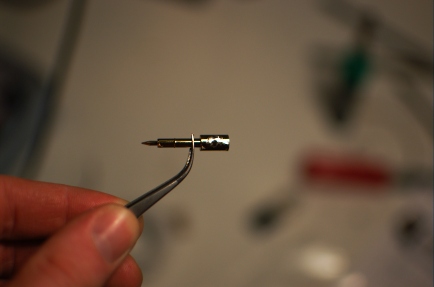
The secret to this whole operation is the replacement crimp rings. I originally was going to make them but since I did not know the dimensions, I was searching around the Web. And, I discovered that Times Microwave offers them individually (part #CR-600). So, I contacted Joel at The RF Connection and he sold me a bunch of them (second from right below) at an attractive price.
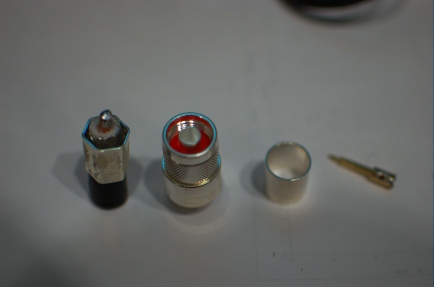
The three rightmost components—connector body, crimp ring, and solder pin, form a complete connector. You just need to add heatshrink, which is also available from the RF Connection and many other vendors. The trick to getting a correct installation on the connectors is to be sure that the pin seats (clicks) into the body before crimping the ring. The whole process of disassembly takes about as long as assembly (minus the stripping step)—just a few minutes.
I recently obtained about 250 ft (80 m) of LMR-600 pieces from various places for about what it costs to fill the gas tank in my Escort. So, this should be a relatively attractive cable for use at K8GU.
The Joy of Homebrew
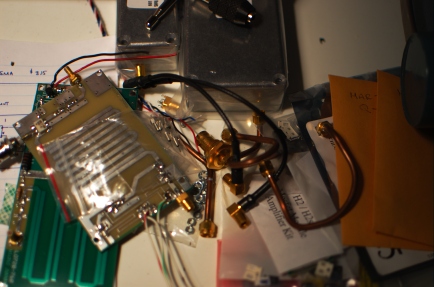
This is about building electronics, not making beer, at home; although, I am sure there are parallels. Three things brought me to writing this: 1. an eHam forum thread I responded to a few weeks ago; 2. the June 2011 issue of IEEE Microwave magazine (has articles by K2UYH, N2UO, and KK7B, perhaps others? thanks to W3KL via the PVRC reflector for bringing it to my attention since I let my IEEE/MTT membership lapse); and 3. a few minutes spent last night resuming a partially-completed Softrock kit gifted to me by a friend who decided to buy a FLEX-3000 instead.
Every once in a while, a thread appears on an amateur radio forum that goes a little bit like this, “Hi, I’m a new ham and I don’t have a lot of money to spend so I want to build an HF SSB station from scratch” or something similar. Somehow, somewhere, somebody has given the impression that it is less expensive to build your own amateur radio equipment than to buy it. That’s true in some circumstances, but certainly rarely for anything that is mature, mass-produced, and readily-available on the second-hand market. After all, there is nothing novel about a 100-watt superheterodyne HF SSB transceiver these days. The principal uncounted cost is the “engineering cost” associated with getting your first few projects working and keeping them working.
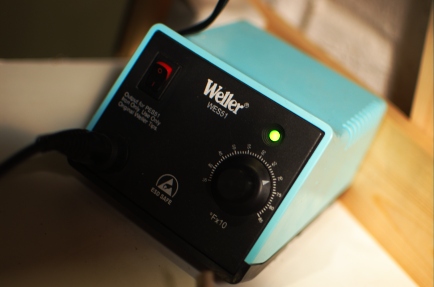
One of the first construction projects I undertook as a new ham was to build a Ramsey Electronics HR-20 (NE602-based) 20-meter receiver—$20 at a hamfest. It did actually work eventually—but this was a simple kit with maybe two dozen parts. Next, I built a ONER transmitter kit from now defunct 624 Kits. I think that was another $20. I never made any QSOs with that combination because I was always afraid of blowing out the receiver with the transmitter. The first thing that I built that I actually managed to make a QSO with was a Small Wonder Labs SW-40, which I still have. That set me back $55 and it did not work immediately. Suddenly, that’s over $100 by the time you include the money I spent on a soldering iron and solder. That’s one-third to half-way to a “real” used HF transceiver and I had two bands at 1 watt on CW only. Furthermore—these are all kits—they leverage economies of scale in purchasing parts from various vendors and they have instructions to help you along. And, I’d like to think that I was a relatively representative example of a recently-minted ham who had more ambition than money or skills…
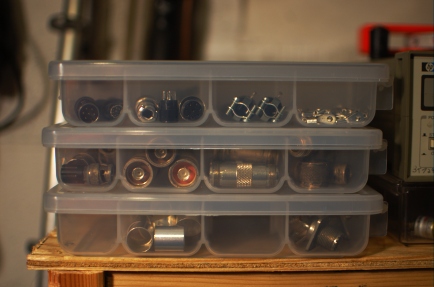
As I soldered down 1206-size (easy ones) SMT capacitors last night, I was thinking of times that I rushed through a homebrew or kit project just to get it on the air. In those instances the process was often, as I have belabored above, about saving money, not about the act of creating something. Last night was about creating, not saving, and that is the joy of homebrew.
Marrying the TI-85 and the DJ-580T
The May issue of QST arrived in the mail today and an article about building a “fox” for hidden-transmitter hunting was included. That brought back memories of a teenage project of mine that I had once thought of writing up for QST, but now just makes a good story for the blog.
The first (and only) handheld radio I’ve owned is an Alinco DJ-580T. Like most HTs of a certain age, it has provision for an external (“speaker”) microphone. The microphone input is a sub-miniature (3/32-inch, “2.5 mm”) stereo phone plug. As a high school student, one of my passions was tinkering with a graphing calculator—the venerable Texas Instruments TI-85—do kids these days even use this stuff or have they gone the way of slide rules and nomograms? The TI-85 offered the provision to link to a computer or another calculator through a similar sub-miniature stereo phone plug.
Well, one afternoon in probably 1997, I was sitting with the DJ-580T in one hand and the TI-85 in the other…and it hit me…I wonder if I can use the the TI-85 to drive the DJ-580T microphone input?
A few preliminaries are now in order. Thanks to a helpful (and still operational, albeit now with a CMS and the attendant spam) web site called ticalc.org, a few friends and I had learned to load our TI-85s with third-party binary machine code programs with considerably faster execution times than the built-in scripting language. This allowed us to play relatively powerful video games surreptitiously on a school-sanctioned platform…a tactic that worked well until the English teacher wisened up to the fact that the five students with their calculators out were not typing essays on them. Not satisfied to just play games—although I did set a very high score in Tetris during Spanish class—I sought to harness the power of the Z80 microprocessor in the TI-85 for myself. Recall that this was before widely-available and inexpensive microcontroller development systems like the PIC, Arduino, and AVR.
I gathered the tools and eventually managed to write some fairly sophisticated (given my utter lack of formal training in computing) software in Z80 assembly language, including a crude clone of Space Invaders and a crude adventure game I called “Kashmir.” Maybe some screenshots or stories about them will come later.
But, for the story at hand, I learned how to manipulate the link port. Fortunately, the sleeve was ground on both the TI-85 and the DJ-580T. So, it was just a matter of tip and ring—one was audio and the other was PTT on the radio, and both were settable on the TI-85 for some kind of two-wire communication link. So, I reasoned that I could write up a bit of assembly code that would key the PTT by pulling it low, then toggle the audio line back and forth at 500 Hz or so to generate a rough audio tone. It worked!
This was an expensive, although trivially so since I had the hardware, way to build a hidden transmitter. So, I modified the software to send my callsign in Morse code (using a look-up table) and stuffed the whole thing in a cigar box. It was good fun for a few of us teenage boys.
And, for the interested, I found the original source code, which is sadly not well commented or dated. But, it does have my old callsign (AA8UP) listed by the lookup table.
Review: K4ZA Tower Book
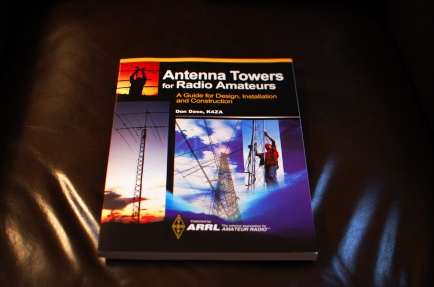
As I have commented before, I don’t generally review or endorse products on the blog. However, I was organizing my aluminum/steel pile in the back yard recently and posed a question to the PVRC reflector about potential improvements to a 402BA-S that I uncovered. One of the responses came from K4ZA, who is a well-known “tower-guy.” (His blog is a pretty good read, too!) I’ve been meaning to buy a copy of his book Antenna Towers for Radio Amateurs and I told him as much when I thanked him for his reply. He offered a copy at a small discount from the cover price and I bought it. It’s the second autographed ARRL book I have, the other being the 4th edition of ON4UN’s Low Band DXing, but I digress.
I’ve been at this whole radio thing for a few years now and have picked up a lot of the tricks. Since most of what I know about towers comes from a high-school summer job in the two-way business, chatting with “The Good Reverend,” and installing HF research radars, Don’s book really filled in the gaps for me. It is good…I read it cover-to-cover.
Don spent a career in video production before getting into the tower business full-time and it shows. He knows the importance of telling the story to impart a trade. He also includes candid stories from tower owners and workers explaining techniques and nearly-averted disasters from their own perspective. Not only is it informative, the book entertains as well.
Antenna Towers for Radio Amateurs pretty much covers everything you need to know about planning, procuring, constructing, and maintaining your tower and antenna system—everything from how to evaluate the ubiquitous used tower sections to which tools and safety equipment to buy. After reading it, you should be in a good position to understand how much of the tower-building process you are able to do yourself and how much to rely on local experts and professionals. It is an excellent book and deserves a spot on the shelf of every ham who owns or dreams of owning a tower—and a few research radar scientists and engineers…
Great Idea: Light Painting WiFi
Saw this in my Google Reader at work and had to post. Apply to work, ham radio, …? It’s clearly an artist’s take and not an engineer’s.
IC-290A disappearing display
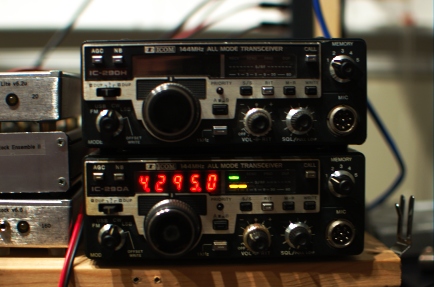
Regular readers know that I enjoy a good deal on a good project and just such an opportunity presented itself again recently, this time in the form of an Icom IC-290A, which is a 10-watt 144-MHz all-mode transceiver whose age rivals my own. It was from a large estate of much more valuable (think solid-state HF kilowatt, etc) items and the sellers were probably just happy to unload it since the display would come up at first but then disappear after a few minutes. After cleaning a film of nicotine residue off of case and knobs, I set to work diagnosing the problem.
I tuned into the two beacons that I can always hear: W3APL/B on 144.295 and WA1ZMS/B on 144.285. They sounded just as good as they did on the TS-700, the IC-290H, and the borrowed FT-736R. Then, the display went blank. But, I was tuned into WA1ZMS and I could still hear it just fine. Turning the main dial no longer changed the frequency. When I turned the radio off and back on, a clicking noise emanated from the speaker above the background hiss, but there was no receive and no display. Disconnecting the power supply and allowing the radio to sit for a few minutes restored normal operation…until the display blanked again. This seemed to me to be a thermal problem, perhaps a bad capacitor or two as I had found in a IC-290H obtained on similar terms.
I popped the cover off of the radio and immediately noticed a few dry/cold/oxidized solder joints on the “Sensor Unit” board that sits on the top of the radio behind the front panel.
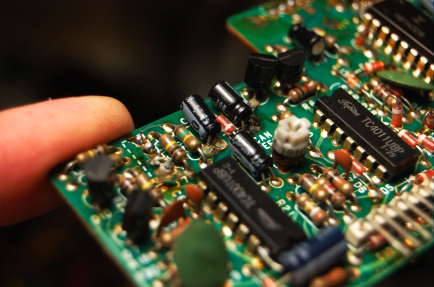
In each case, the bad joints were associated with electrolytic capacitors. I desoldered all of them, cleaned the pads, and replaced the capacitors with new units. It was somewhat of a miracle that I had all of them in my junkbox.
The problem persisted and for a while I thought it was getting worse. For good measure, I went through all of the boards looking for leaky capacitors and cold solder joints and found nothing. The “Troubleshooting” section of the Service Manual was an abject waste of pulp, but I did go through it. The “PLL” (synthesizer) alignment section yielded no clues except that the reference oscillator (6.070 MHz nominally) level was a tad bit low in amplitude. I heeded the warning of the manual that it had been carefully adjusted at the factory and should not need adjustment. When the radio arrived, it was missing a number of case screws, suggesting that someone else had been inside. So, who knows what the Golden Screwdriver hath wrought!
After reseating the row of connectors at the front of the “Logic/PLL” board just behind the radio’s front panel, I noticed that the problem seemed to have vanished. It has not failed yet since doing that and replacing the Sensor board capacitors. I hooked the radio up to a Bird Termaline wattmeter borrowed from W3APL and it made 10 watts on FM and CW. The needle barely moved on a 10-watt full scale in USB. So, I need to verify if it’s the microphone or the radio. My new plan is to use this radio as the microwave IF and keep the more-powerful IC-290H for liaison and other portable purposes. So, USB operation is critical.
So, like I always say, it seems that there are a lot of repairs that can be done just by cleaning things up. I’m not totally satisfied with the technical explanation of why reseating those connectors seemed to have fixed the problem. But, that is what happened and it is consistent with a lack of communication between the encoder/display unit in the front of the radio and the microprocessor in the logic unit. It seems to be working for now!
Note (May 6th 2011): See update here.













