Posts Tagged ‘CW’
 Just One More db …
 March 10th, 2016 |
  Author:
How often have you struggled to pull a weak signal out of the noise? "Just give me one more db", you tell yourself.
A recent posting to the Topband reflector by Frank, W3LPL, sent me to the interesting webpage of Dave, AB7E. Dave had been pondering two antenna systems, one of which would provide a 2db improvement in forward gain but at a much higher cost ... he wondered if the extra expense would be worthwhile and could he even hear the difference that 2db would make? He created a series of CW files, incrementing the signal level in 1db steps to see for himself!
Now I've always been told that you need to increase signal strength by at least 3db before your ears can detect any difference ... but listen carefully and you may be in for a surprise, as AB7E discovered.
It's probably best to listen to this signal with headphones but, even on my I-Pad's tiny speaker, the demonstration is clear. The first recording starts at "zero db", which is sent twice while the next signal is "one db", sent twice. See if you can hear the difference between each 1 db increment as he steps up to "six db":

Lastly, AB7E demonstrates the problem with sending too fast when conditions are very marginal. Here, several signals are sent at 20, 25, 30 and 35 WPM. Sending calls at high speed can often seem effective, even under poor conditions but this seems to demonstrate that slowing down just a bit would make it somewhat easier:
One of the more interesting comments posted regarding these recordings was from Bob, N6RW who cited his work in satellite communications:
"I spent part of my engineering career designing satellite command FSK
demodulators - including the deep space Pioneer Venus orbiter. To test
the performance of them, we would mix the test signal with white noise.
When you look at the FSK Bit-Error-Rate (BER) curve (bit errors versus
signal to noise ratio in a bandwidth equal to the bit rate), you can see
the BER improves by a factor of 10 to 1 for every dB in S/N ratio. In
other words, for every dB improvement, you get one tenth the errors."
Now Dave never did tell us if he bought the bigger antenna or not but I'm betting that he did ... it looks like "just one more db" may really be just enough after all.
How-To: Send Perfect Morse Code by Hand (Vintage Video)
What is the proper (and most efficient) technique for creating Morse code by hand, using a manual Morse code key? Ham radio operators find Morse code (and the ‘CW’ mode, or ‘Continuous Wave’ keying mode) very useful, even though Morse code is no longer required as part of the licensing process. Morse code is highly effective in weak-signal radio work. And, preppers love Morse code because it is the most efficient way to communicate when there is a major disaster that could wipe out the communications infrastructure.
While this military film is antique, the vintage information is timeless, as the material is applicable to Morse code, even today.
More about Morse code, at my website: http://cw.hfradio.org
Thank you for watching, commenting, and most of all, for subscribing. By subscribing, you will be kept in the loop for new videos and more… my YouTube Channel: https://YouTube.com/NW7US
See my Video Playlist for related Morse code vidoes:
The VE3OT 630m Beacon

I suspect there are probably a lot of Canadian amateurs still thinking that our new 630m is not very practical for anything other than local two-way contacts.
During the winter 'DX season', this is definitely not the case, as 630m shares many, if not all, of the propagation characteristics found in the lower end of our AM broadcast band. As well, a quick tune through the even lower NDB band on a normal night will reveal dozens of 25-watters, often from over a thousand miles away and with very robust signals.
With no 630m amateur activity yet coming from VE6, VE5 or VE4, it is difficult to get a sense of just how interesting the band could become on these normal nights, or how great it would be on a really good night of propagation. My recent CW contact with the nearest out of province station, VE3OT (Mitch), on a normal night, demonstrates that there is a lot of potential for some really effective two-way work over long distances.
So ... what do signals sound like between here and Ontario? Here is Mitch's CW beacon as heard here on the evening of February 11th, at around 2300 hours local time, using my 10' x 20' loop. I have heard Mitch at even higher levels than this, but his beacon is usually audible here on most undisturbed nights, sometimes as early as 2000 hours local time. His beacon signal runs 200 watts to a 340' circumference loop, from his London, Ontario, suburban backyard.
Even if you are not able to hear Mitch's signal audibly, it should be fairly easy to copy in one of the QRSS CW modes, such as QRSS3 or QRSS10 ... both of which could yield a reasonably quick two-way contact.
Judging from the reliability of the VE3 signal, any activity from the prairie provinces should be even easier to hear. Should any of you in the prairies take up the 630m challenge, I can assure you that you'll be very, very popular out west ... every night!
This blog also provides an opportunity for my initial use of the 'tunestotube' web site. It provides a nice online interface for posting audio files to Youtube, along with an image, or a slideshow. It seemed to work seamlessly and will save me having to link to audio files stored on my own web site, which really eat up what little space I have left.
speed = distance over time

Speed does = distance over time. In terms of CW my speed is currently around 12wpm with a character speed of around 20wpm. I have been at a distance from a qso for over a month now and I am experiencing what is called a plateau. Or is this my natural speed?
If I go for a run, I know I can run at a certain pace for a certain distance. Nowadays no amount of training will get me down to what I could once do when I was in my teens (back then I could do around 1 to 2 minutes quicker for a mile). This was the same back then. I have a capacity and I know it well. Is the same true for CW?
Can I only do a certain speed?
How do I find a natural speed and maintain it? (Overtraining is a crime!)
My normal excuse is I need a new pair of trainers. Surely I need a new morse key, right?
Trans-Canada On 630m
 |
| courtesy: http://www.bing.com/mapspreview |
Both Mitch and myself had been alerted to the excellent propagation earlier in the week, when VE3OT's CW beacon had reached S9 levels here for several hours on two consecutive nights ... but any late-night QSO attempts would have to wait until the weekend, when having to get up in the middle of the night would not conflict with Mitch's workweek schedule.
Our first attempt, late on Friday night and 3A.M. for Mitch, found that conditions had deteriorated from midweek's enhanced propagation and the low signal levels, combined with some unseasonal lightning noise, resulted in rescheduling for another shot on Saturday.
Late Saturday night found the band much quieter and propagation much improved, but not as good as it had been earlier in the week ... somehow Murphy always seems to have a hand in pre-planned events, and it's never a helpful one. Mitch's beacon signal was readable here but had a deep ten-minute fade cycle with a short-lived peak before fading out to nothing.
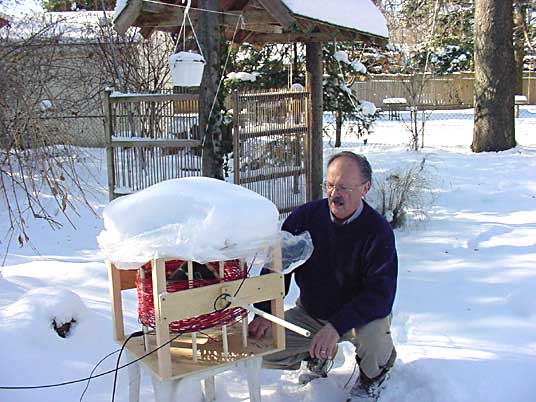 |
| VE3OT at his loop's loading coil |
 |
| LF / MF station at VE3OT |
For those of you that worked VE3OT during the recent 630m crossband event, Mitch has put together a very special QSL card!
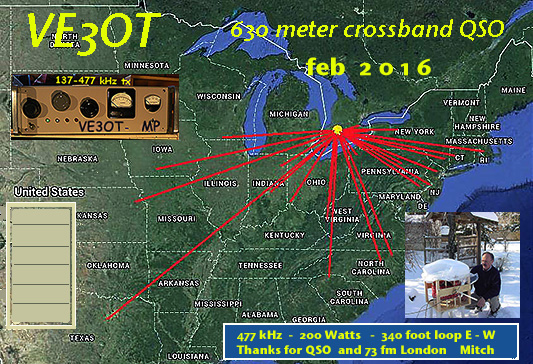
As the solar cycle winds down, the 'good' nights will happen more often, as will the truly 'great' nights. Hopefully there will be more Canadians on the band to take advantage of what lies ahead.
Hopefully the U.S.A. will soon have the band as well, which will really spark nightly activity. What is really needed right now is more Canadian activity, especially in the western provinces, where nightly CW contacts could be readily made. Time to reach for the solder iron! There are several VE7's, and one VE3, waiting and wanting to work you!
CW Lives!
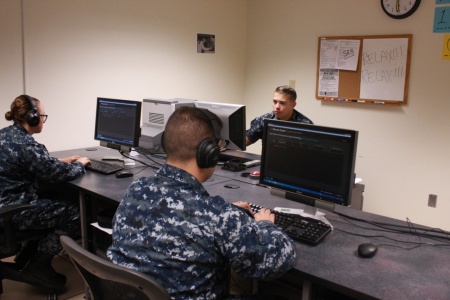 |
| courtesy: https://www.dvidshub.net/new |
Well it seems as if the U.S. Navy has rediscovered something that most hams, especially older ones, have know for a long time ... CW is pretty darn handy!
After many years of abandonment by the various branches of the armed forces, the Navy has taken another look at the usefulness of knowing how to use CW and has been training a limited number of their Cryptologic Technicians (CTR's) each year, at the Center for Information Dominance (CID) based at Corry Station in Pensacola, Florida,
I've always absolutely loved CW, ever since first learning it at around twelve years of age, eventually using my new-found skill to help me get a ticket when I turned fifteen. A big stumbling-block for many, the requirement to send and receive CW was eventually eliminated with the introduction of the no-code licence and had many hams believing it would be the end of ham radio.
As the Coast Guard and maritimers around the world abandoned CW, somehow, it has managed to not only survive, but to seemingly flourish on the ham bands. Granted, operating habits and patterns may be changing and fewer stations are to be found, randomly CQ-ing, seeking a nice CW ragchew, but a short listen during any contest weekend or during a rare DX-pedition pileup will quickly reveal that the art of CW itself is still alive and well in 2016!
One of the reasons for CW's longevity, aside from the fact that it's just plain fun, is it's ability to be understood under the worst of conditions, unlike many other modes ... and it can be used with the simplest of equipment, without needing a computer.
 |
| courtesy: https://www.dvidshub.net/new |
"In the updated course, sailors learn how to operate radio-receiving and associated computer-based equipment. From basic safeguards of security to communication procedures and systems theory to operation of communications equipment, the course teaches how to intercept Morse communications, as well as copy and send Morse code."
"Morse code continues to be an inexpensive and efficient means of communication for many states throughout the globe,” said Senior Chief Cryptologic Technician (Collection) (IDW/NAC/SW/AW) Tony Gonzales, CTR rate training manager for CID headquarters. “Manual Morse operators here at Corry Station are learning a skill set that has stood the test of time. Many of our most senior CTRs began their careers as Manual Morse operators.”
Somehow, it's very gratifying to see that the Navy is still keen on training sailors in the art ... affirming what hams have known since the earliest days of radio.
It's not clear if these folks are learning to actually send with a hand key or keyer but I rather suspect that their sending skills may be limited to how fast they can type as I don't see any keys in the training-center's photos ... but it's a start.
Maybe we'll hear a few of them on CW sometime in the future.
630m Midwinter Summary
Friday and Saturday evening's 'Midwinter 630m Activity' event was an interesting demonstration of the band's capability and, by most accounts, a real success.
At first-glance, the propagation gods appeared to favor Friday night but I'm not really so sure as both nights were quite different.
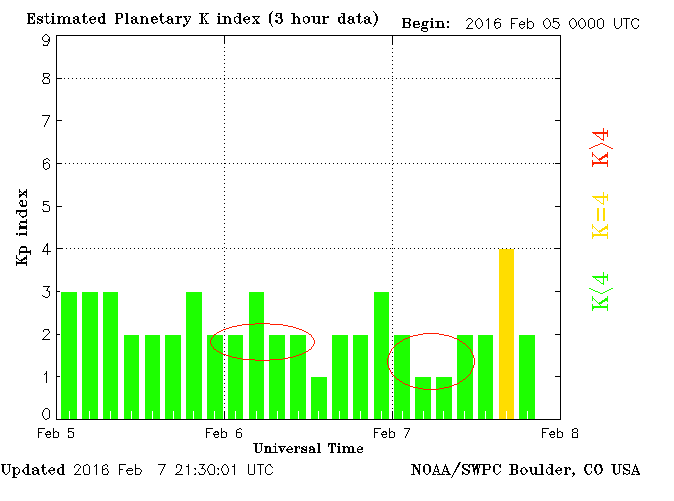
Friday night's extremely high winds and pounding rain played havoc with most of the west coast antenna systems, producing fluctuating SWR's and scopematch traces dancing crazily for most of the night. Geomagnetic conditions were playing tricks on both evenings as well, with the K-index varying between '1' and '4' ... but the sudden dip to '1' on Saturday night was immediately obvious out west. Stations that had struggled to hear any signs of the CQ-ing VE7's suddenly reported aural reception and several quick contacts were made before calling it a night at around 0700Z. Some of the lower ERP stations were never able to crack the Saturday night, generally high, K-curtain, making for a less interesting night.
 |
| courtesy: NOAA and http://www.solarham.net/planetk.htm |
The highlight of the event was assuredly the activity from Canada's most recent arrival to the band, Mitch (VE3OT) in London, Ontario. A veteran 2200m operator, Mitch recently modified his system to add 630m capability and after a few setbacks, managed to provide a lot of excitement for the crossbanders back east. I'm sure that Mitch's participation has resulted in many eastern amateurs making plans for 630m in the months ahead.
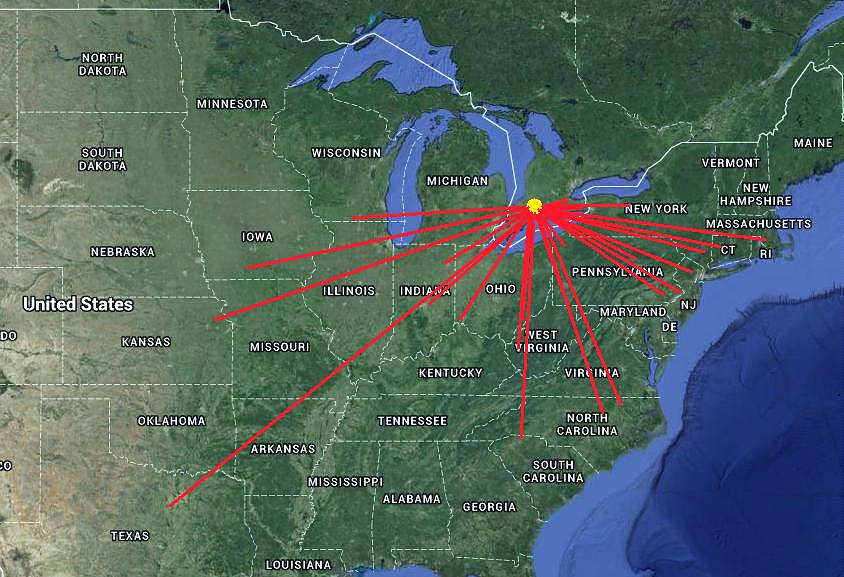
Mitch managed twenty-five two-way crossband contacts, all along the eastern seaboard and as far south as Texas, with his well-heard 200W and 340' backyard loop ... proving once again that you don't need to live in the country with several acres to have a ton of fun on 630m!
 |
| VE3OT's Crossband Coverage courtesy: https://www.google.ca/maps |
An interesting observation, noticed during previous events and reconfirmed once again, is the ability of the smaller and lower antennas used by some of the city stations, to propagate much stronger signals into closer regions such as Washington, Oregon and northern California.
On more than one occasion, my signal was reported as 'unreadable' or 'just above the noise floor', while the other backyarders were reported with, sometimes, 'booming' signals. I can only surmise that these antennas offer more high-angled (NVIS-like) radiation compared with my high seaside inverted-L, which likely has a lower takeoff angle ... Saturday night's activity tended to back up this observation. When it comes down to it, I think that all amateur 630m antennas are basically NVIS radiators due to their small size and low height but some are just a tiny bit 'less NVIS' than others!
As conditions enjoyed a short spike late on Saturday evening, NO3M and WA3TTS, both in Pennsylvania, reported good reception of my CQ's and crossband QSO's were quickly completed with both stations, as well as with KB5NJD in Texas. During the short propagation lift, ABØCW, in Colorado, also called in for a quick exchange, indicating that my previously unheard signal had quickly built from nothing to a 549.
Another highlight of the night was a report from Paul, K7CW, from his quiet receiving location in Tahuya, Washington. Paul reports reception of both VE3OT and VO1NA, with the latter being a 'first' from the west coast!
Hi Steve,
Here is my report of things I took part in or observed tonight:
0204Z - Worked VE7SL 473/3566 kHz RST 559.
0209Z - Worked VE7CNF 476.5/3558 kHz Pretty fast QSB RST 529 to 559.
0214Z - 0409Z WG2XSV 476.1 Beacon RST 559. Announced QRT and QSY at 0409Z.
0219Z - Heard VO1NA 477.4 kHz Weak with QSB. I could get or or three characters now and then. Too weak to attempt a QSO. Signal faded to nothing after about 15 minutes.
0225Z - Heard VE3OT 477.0 kHz Weak but much better than VO1NA. Also with QSB fading to nothing. I called several times, but couldn't tell if he came back to me. Strong enough to make a hopeful try. Also disappeared after about 15 minutes.
0241Z - Came across WD2XSH/20 RST 599+ in QSO with WH2XGP RST 589. 474.5 kHz.
0300Z - WD2XSH/20 472.0 599+ now in beacon mode.
0400Z - VE7BDQ 474.0 kHz RST 539 showed up and called CQ twice. I responded on 3555 kHz, but he did not call me back. He then disappeared from the QRG. There was a strong birdie on 475 kHz, but I don't think VA7MM came on.
0409Z - WG2XSV 476.1 Beacon interrupted by announcement of QRT and QSY.
0434Z - Came across VE7BDQ 474.0 kHz again calling CQ. He worked VA7JX, but apparently couldn't hear me.
With that, I took one more look for VO1NA and stopped.
Another interesting night.
73, Paul K7CW
Thanks also to AI8Z in Colorado and W7OIL in Washington for submitting reception reports!
THE LOGS
From Mitch, VE3OT, in London, ON:
Friday night:
NØFW (OH)
WA3TTS (PA)
KB5NJD (TX)
K4LY (SC)
K3OO (PA)
VE3MM (ON)
N4PY (NC)
WA9ETW (WI)
K9LA (IN)
NO3M (PA)
N2TK (NY)
KK8X (MI)
N2ZK (NY)
N8RR (WV)
VA3SC (ON)
Saturday night:
WD8DSB (IN)
K3UL ( PA)
WB2QMY (NJ)
AA1P (MA)
W2JEK (NJ)
WA3LAB (PA)
K3PA (KS)
NF4C (NC)
W1VD (CT)
WØJW (IA)
From Joe, VO1NA, in Torbay, NF:
N1CGP (ME)
VO1FOG
VO1BQ
reception reports from around the province, almost all reporting
a positive reception. Also got reports from DF6NM and PAØRDT
From John, VE7BDQ, in Delta, BC. (a description of John's station as well as other VE7's, can all be viewed here):
KGØD/7 (WA)
KU7Z (UT)
VE7KW
WØYSE/7 (WA)
VE7BGJ
W6RKC (CA)
WB2AWQ (NV)
VE7CNF
VA7MM
VE7SL
VA7JX
From Toby, VE7CNF, in Burnaby, BC:
Friday night:
KU7Z (UT)
WØYSE/7 (WA)
VE7KW
VE7BGJ
KGØD/7 (WA)
W6RKC (CA)
VE7BDQ
VA7MM
Saturday night:
K7CW (WA)
N7BYD (MT)
WØYSE/7 (WA)
VE7SL
VA7MM
As well, Toby was copied on QRSS3 mode in Illinois, late Saturday night.
From Mark, VA7MM, in Port Coquitlam, BC:
VE7KW
KU7D (UT)
VE7BGJ
WØYSE/7 (WA)
W6RKC (CA)
Beacon copied: WD2XSH/2Ø 472 kHz
Report of my signal received from N6SKM
Saturday night:
VE7BDQ
VE7SL
VE7CNF
From myself, VE7SL, on Mayne Island, BC:
Friday night:
VE7KW
KU7Z (UT)
W6RKC (CA)
VE7BGJ
KB5NJD (TX)
NO3M (PA)
KGØD/7 (WA)
VA7MM
WØYSE/7 (WA)
WB2AWQ (NV)
Saturday night:
K7CW (WA)
VE7CNF
VA7CNF
VA7JX
K7SF (OR)
VE7BDQ
KB5NJD (TX)
N7BYD (MT)
WØYSE/7 (WA)
NO3M (PA)
ABØCW (CO)
WA3TTS (PA)
VA7MM
For an even more detailed description of the weekend event, see KB5NJD's 630m blogs here.
Thanks to all participants ... you have created another successful 630m operating event. Hopefully U.S. amateurs will have access to the band before next winter, allowing all of the two-way activity to take place within the band itself ... how different that will be! Otherwise, another crossband weekend will be in store for the fall of 2016!













