Posts Tagged ‘CW’
 Upcoming 630m Crossband Weekend Reminder
 February 4th, 2016 |
  Author:
This coming weekend will host the "Midwinter 630m Operating Activity", an event that will have the 630m band no doubt sounding very crowded.
Not only will there be a dozen or more U.S. experimental stations in operation, but also six Canadian stations working crossband with other amateurs in both the U.S. and Canada.
Hopefully you will be able to participate as well, by listening for the 630m Canadians and then give them a call on their HF listening (QSX) frequency. Although specific HF QSX frequencies will be part of their CQ, the list below will provide further details regarding where and when the Canadians will be transmitting.
This event should be particularly interesting for amateurs from the central states eastward, as well as the southern states. For the first time, a mid-continent Canadian station will be on-the-air for both nights.
Mitch, VE3OT, will be looking for crossband contacts from his London, Ontario location and looking at the results of his past few weeks of CW beaconing, his 630m signal is being well-heard throughout the eastern half of the continent. For the north-easterners, VO1NA in Newfoundland will be also looking for two-way crossband contacts.
The last time this event was run, dozens of two-way crossband contacts were completed between the 630m Canadians and amateurs on HF. Canadians on the west coast worked as far as KH6 to the west and W3 to the east. With even better propagation looking very probable this coming weekend, the crossband activity could be very exciting!
Canadian Station Schedule
Time: 2130Z - 0130Z both Friday night (Feb 5 - 6Z) / Saturday night (Feb 6 - 7Z) plus QRSS3 / 12 WPM Beacon from 0130 – 1000Z
TX Frequency: 477.7 kHz
RX (QSX) Frequency: 3562 kHz
Station: VE7SL (Steve) CN88 Mayne Island, B.C.
Time: 0200Z - 0700Z both Friday night (Feb 6Z) / Saturday night (Feb 7Z)
TX Frequency: 473.0 kHz
RX (QSX) Frequency: 3566 / 7066 kHz
Station: VE7BDQ (John) CN89 Delta, B.C.
Time: 0330Z - 0700Z both Friday night (Feb 6Z) / Saturday night (Feb 7Z)
TX Frequency: 474.0 kHz
RX (QSX) Frequency: 3555 kHz
Station: VA7MM (Mark) CN89 Coquitlam, B.C.
Time: 0500Z - 0700Z Friday night (Feb 6Z)
0400Z - 0800Z Saturday night (Feb 7Z)
TX Frequency: 475.0 kHz
RX (QSX) Frequency: 1801 kHz / 3574 kHz / 7062 kHz
Time: 0300Z - 0700Z both Friday night (Feb 6Z) / Saturday night (Feb 7Z)
TX Frequency: 476.5 kHz
RX (QSX) Frequency: 1836 kHz / 3558 kHz / 7031 kHz
Time: 0000Z - 0400Z both Friday night (Feb 6Z) / Saturday night (Feb 7Z)
TX Frequency: 477.0 kHz
RX (QSX) Frequency: 3563 kHz / 7058 kHz
More information regarding the weekend's event can be found here in the initial announcement as well as on the ARRL News page here.
As in past events, many of the participants will be found on the ON4KST (2200-630m) Chat page, allowing realtime updates to keep you in the loop ... the more the merrier.
If you are getting ready for the arrival of the 630m band in the U.S., this weekend's event offers a good opportunity to get a 'feel' for the band as well as to participate in the two-way activity with the 'VE' amateurs ... we hope to work many of you this weekend!
CQ 160m CW Weekend
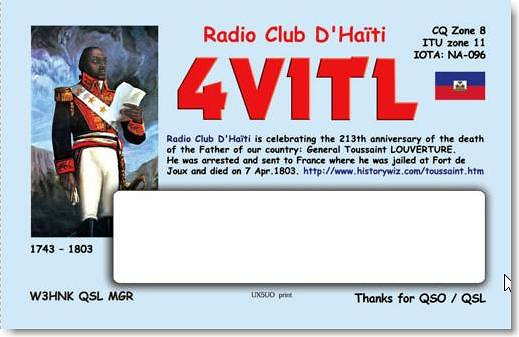
This past weekend's CQ 160m CW Contest saw the normally quiet band bursting to life with signals stacked up, one atop the other, from 1800 -1870 kHz.
At times it was very difficult to find a clear frequency to send 'CQ' and much of the contest was spent in the 'search and pounce' (S&P) mode. When a clear frequency was found I was able to have several short runs but running for any length of time while in the low power category is not realistic. I think my best hourly rate peaked at '60' for a short time as propagation would improve momentarily ... often, ten or more CQ's would go unanswered and then the next one would have two or three responses, continuing on for several minutes until the propagation would shift. These sudden 'holes' in the D-layer absorption seem to occur when conditions are marginal and it's as if the propagation switch is suddenly thrown from 'poor' to 'really good' for a few short minutes.
Overall, conditions from western B.C. were poor on Friday night and much improved on Saturday night. Although several DX stations were heard and called on Friday night, none were worked. These same stations came right back when called, on Saturday evening.
My 160m antenna is very simple, consisting of a 'half-sloper' and about fifty in-ground radials. Since the tower and antenna are mounted right at the ocean's edge, this year I threw two extra radials into the ocean ... whether or not these made any difference is difficult to say but they certainly wouldn't make things worse.

Because of the proximity to the ocean and the half-sloper producing vertical polarization, my antenna always seems to favor stations at the ends of the single-hop F2 distance ... those along the east coast and into the Caribbean as opposed to mid-continent signals. I often find myself sending several repeats to stations in the central states while those on the far coast will reply on the first call ... even stations that I can barely copy, will often come right back, which seems puzzling.
Overall, about 10 hours were spent in the contest ... ending up with 223 contacts in 51 sections and 9 DX entities. Some of the DX stations worked were PJ2, HK1, ZF2, C6, KP2 and 4V1. Checking my 160m DXCC list after the contest, I was surprised to see that 4V1TL in Haiti was a new country for me, making the contest time well worth it. Claimed scores for this, and any contest, can be viewed on the 3830 Scores website.
As the solar cycle continues to decline, 160m conditions should only get better and better, with the next few years hopefully producing a few Europeans in the 160m log once again.
K5P on QRP
I will be looking to work VP8STI on QRP. I need some band slots on QRO, but still need them in my QRP log for the first time.The pile-ups will need to die down a little before I jump in.

I like this logo, nothing against the SSB guys, but it only has a morse key on it:-)
K5P on QRP
I will be looking to work VP8STI on QRP. I need some band slots on QRO, but still need them in my QRP log for the first time.The pile-ups will need to die down a little before I jump in.
I like this logo, nothing against the SSB guys, but it only has a morse key on it:-)
I Need You in My Log! SKCC K3Y/0 Special Event (January 2016)
I need your help!
Come meet me on the shortwave (HF) ham bands for the Morse code (CW mode) special event, the Straight Key Century Club (SKCC) celebration, with special callsign, K3Y. During the shifts (time slots) listed below, I am the control operator as K3Y/0.
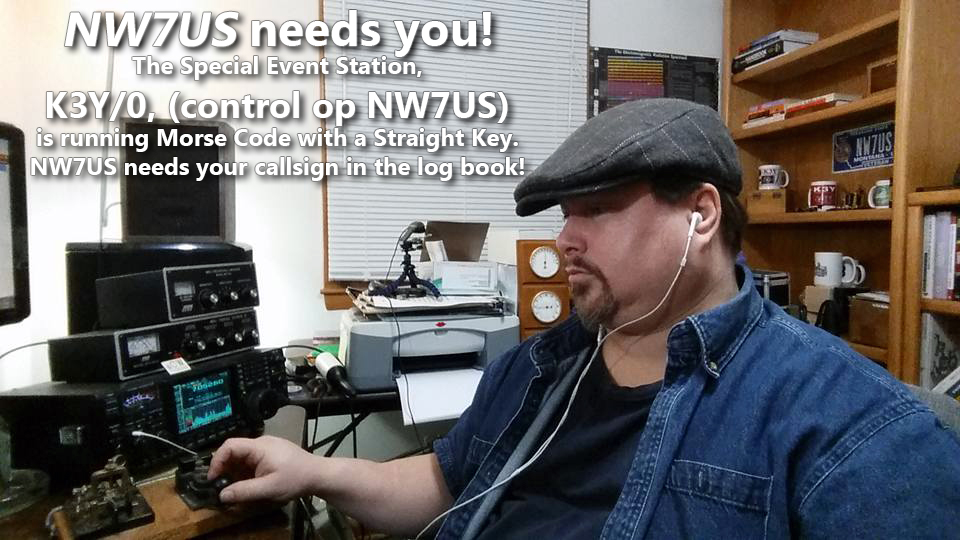 I need you to make a contact with me.
This special event takes place every year during January. We celebrate the legacy of Morse code, and promote Morse code and manual creation of the code by any non-electronic (digital) device and method. Which means that we love mechanical bugs, straight keys, two ends of a wire, or any other manual device, if Morse code is generated. The Straight Key Century Club is a free membership group. The link to their website is below.
I need you to make a contact with me, during my scheduled times, listed below.
NOTE: YOU DO NOT NEED TO BE A MEMBER OF THE (free) SKCC GROUP. To get into my logbook, you meet me on my frequency, and use Morse code to communicate with me. It is painless. If you must, you can use computer-generated Morse code. Or, you can tap it out on any Morse code signalling device, like a bug, a set of paddles, or a straight key; whatever you choose to make Morse code emanate from your HF transmitter.
HOWEVER: For those of you who want to get fully immersed in the spirit of this event, you are invited to use a straight key. And, as a bonus, you may and can join the SKCC group for FREE. Then, you would have your own SKCC number. That’d be cool; we SKCC members use that number in our exchange during our QSO information exchange. But, you don’t need that. Since it is free, why not?
What is needed is simply you, getting on the shortwave band, finding me, hearing me, and responding to me with Morse code. In other words, we need to have a QSO using Morse code. I am not a fast operator, so no problem if you are not very fast. I’ll meet your speed.
In any case, here are some of the times I will be on the air as K3Y/0… please dust off your straight key, bug, paddles, whatever, and make a QSO with me. Thanks!
My current schedule:
UTC Start/End (remember, these are NOT your local times, but are the UTC (GMT) times!)
(revised times, as of edit date)
 00:00 - 02:59 19-Jan-16
 00:00 - 02:59 20-Jan-16
 00:00 - 02:59 21-Jan-16
 00:00 - 02:59 22-Jan-16
 00:00 - 05:59 23-Jan-16
 14:00 - 18:59 23-Jan-16
 20:00 - 21:59 23-Jan-16
 00:00 - 02:59 24-Jan-16
 14:00 - 18:59 24-Jan-16
 21:00 - 21:59 24-Jan-16
 00:00 - 02:59 25-Jan-16
 00:00 - 02:59 26-Jan-16
 00:00 - 02:59 27-Jan-16
 00:00 - 02:59 28-Jan-16
 00:00 - 02:59 29-Jan-16
 00:00 - 05:59 30-Jan-16
 13:00 - 18:59 30-Jan-16
 20:00 - 21:59 30-Jan-16
 00:00 - 03:59 31-Jan-16
 13:00 - 23:59 31-Jan-16
Now, what frequency will I be on?
To find out what frequency I am on:
Visit http://g.nw7us.us/sched4SKCC and look on the right side for my callsign, NW7US. I usually post my frequency of operation right after my call sign.
Typically, evening operation is 30m, then 40m, and then possibly 80m.
If you are trying to alert me to your presence, you may message me on my personal Facebook profile, under my “Tomas David Hood” profile messages, but I may not see that right away.
Here is the detail covering the K3Y operation and the SKCC group: http://skccgroup.com/k3y
73 de NW7US
dit dit
This was last year:
https://www.youtube.com/watch?v=UfRvITFpTb4
..
..
The 1st Annual Midwinter 630m Activity Weekend
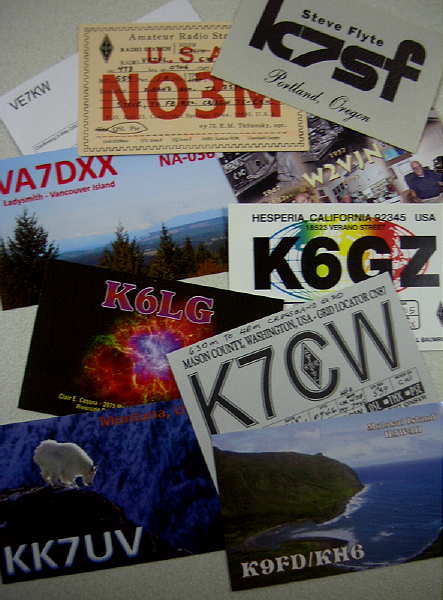
Following late fall's very successful 630m Activity / CW Crossband Weekend in November, several enquiries were soon received asking "when's the next one?" I'm happy to announce that the 'next one' will be held on the first weekend of February and will follow a similar format.
Here is the formal press release describing the event published in the ARRL News:
*****************************************
US and Canadian radio amateurs and experimenters will join forces in February for the first Midwinter 630 Meter Activity Weekend. The event will get under way on February 6 at 0000 UTC (Friday, February 5, in US time zones) and run through 2359 UTC on February 7.
“This event is being undertaken because of the new and quickly growing interest in present 630 meter activities, both in the US and Canada,” said ARRL 600 Meter Experimental Group (WD2XSH) Experiment Coordinator Fritz Raab, W1FR. “Much of the interest is in response to the strong likelihood of US amateurs receiving access to the band in the near future, while Canadian hams are eager to learn more about the present level of Amateur Radio activity on their newest ham band.” The activity weekend comes on the heels of a special event operation over the November 13-14 weekend that included participation by US and Canadian radio amateurs.and the Maritime Radio Historical Society (MRHS).
Raab said the two activity nights will offer interested amateurs in both countries an opportunity to experience the 630 meter band and, through cross-band activity with Canadian amateurs, to take part in activity in the MF spectrum. “Our hope is to see this activity become an annual operating event, to be held very winter on the 630 meter band,” Raab said. “For those who may be building for future 630 meter operation, this event will provide an opportunity to test your ‘receive’ capabilities on MF.”
Operation will be from 472 kHz to 479kHz in various modes. The two-way crossband work will be undertaken by several Canadian stations, all on CW. Canadians will operate on a schedule and listen for callers on specific QSX frequencies in the US ham allocations.
Time: 2130Z - 0130Z both Friday night (Feb 5 - 6Z) / Saturday night (Feb 6 - 7Z) plus QRSS3 / 12 WPM Beacon from 0130 – 1000Z
TX Frequency: 477.7 kHz
RX (QSX) Frequency: 3562 kHz
Station: VE7SL (Steve) CN88 Mayne Island, B.C.
Time: 0200Z - 0700Z both Friday night (Feb 6Z) / Saturday night (Feb 7Z)
TX Frequency: 473.0 kHz
RX (QSX) Frequency: 3566 / 7066 kHz
Station: VE7BDQ (John) CN89 Delta, B.C.
Time: 0330Z - 0700Z both Friday night (Feb 6Z) / Saturday night (Feb 7Z)
TX Frequency: 474.0 kHz
RX (QSX) Frequency: 3555 kHz
Station: VA7MM (Mark) CN89 Coquitlam, B.C.
Time: 0500Z - 0700Z Friday night (Feb 6Z)
0400Z - 0800Z Saturday night (Feb 7Z)
TX Frequency: 475.0 kHz
RX (QSX) Frequency: 1801 kHz / 3574 kHz / 7062 kHz
Time: 0300Z - 0700Z both Friday night (Feb 6Z) / Saturday night (Feb 7Z)
TX Frequency: 476.5 kHz
RX (QSX) Frequency: 1836 kHz / 3558 kHz / 7031 kHz
Time: 0000Z - 0400Z both Friday night (Feb 6Z) / Saturday night (Feb 7Z)
TX Frequency: 477.0 kHz
RX (QSX) Frequency: 3563 kHz / 7058 kHz
“The success of this event largely depends upon the participation of as many amateurs as possible,” Raab said. “We hope that you can find a few hours to participate in this unique midwinter event.” Submit reception reports via e-mail to the respective operators or via the ARRL 600 Meter Experiment website.
*************************************
Hopefully you will be able to participate in the crossband activity by being able to listen on 630m and then able to switch over to HF to transmit. This could involve the use of a separate receiver / transmitter or can often be easily implemented via your transceiver's 'A/B' switch.
No antenna for receiving on 630m? Surprisingly good results can often be had by using a low band wire antenna such as a dipole or inverted-L for listening on 630m ... the antenna does not necessarily need to be resonant. In fact, often times, a non-resonant receiving antenna can provide a better overall S/N ratio than one which is resonant, as these often gather more noise along with signals.
You may want to experiment before hand by listening to many of the numerous U.S. experimental stations operating nightly, mostly in the WSPR mode, between 475.6 and 475.8kHz. Most operators provide a CW identifier following their WSPR transmission but a better way to decode these signals is by installing the latest WSPR software, WSJT-X (freeware), at K1JT's website here. The software works extremely well and is easy to install and get working. If you set the software to 'upload spots', you can share your nightly catches with dozens of other listeners throughout the continent on the WSPRnet website.
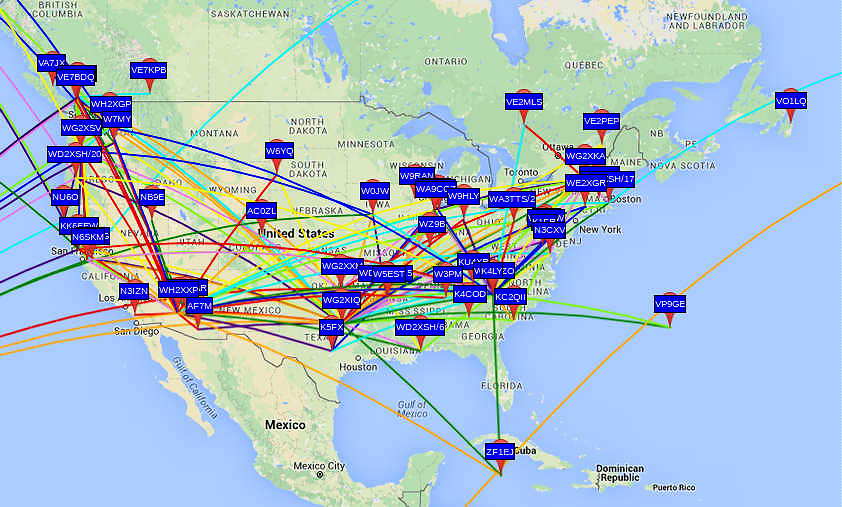 |
| courtesy: KB5NJD's 630m Daily Blog |
New Year’s Day
I got on for a bit last night for SKN. I don't know if it was just bad band conditions with the remnants of that CME lingering; or perhaps it was my atrocious bug fist. I made no contacts last night.
During the day today, I did a bit better. I worked five different NPOTA activations (6 QSOs):
N8XX - TR04 - North County National Scenic Trail
W1BXY - NS76 - Weir Farm National Historic Sight
NC8IN - NS55 - Ninety Six National Historic Sight
NR3P - SS01 - Assateague Island National Seashore
KK4ZUU - BP02 - Mnasassas National Battlefield Park
K7UPJ - NS55- Ninety Six National Historic Sight
I just realized now that I worked NS55 twice. Basically, I was dial twiddling, working the ones I could hear decently. There were a few others, but QSB was so bad on 20 Meters at times that I bypassed a few, thinking conditions would get better. They didn't, and going back to try and work those again, I found them to be gone. Sometimes the Propagation Princess is a cruel mistress!
Only N8XX and NR3P were CW, though. I had to break out the microphone and resort to SSB for the others. As Yoda would say, "A disturbing trend in The Force, I sense".
As mentioned in an earlier post, the 2016 NJQRP Skeeter Hunt will be featuring NPOTA - but let that be just a foot note. I would hope that a lot of you who read this blog regularly will step up the plate and activate NPOTA entities using CW (and QRP).
Remember, it doesn't have to be an elaborate set up, with multi ops and crazy antenna installations that last all day. This NPOTA program was tailor made for portable QRP ops! Go to one of the entities, throw a wire into a tree, or perhaps break out the Buddistick, Buddipole, Alex Loop - what have you. Get on the air for a few hours and hand out some contacts!
Also, remember that this is a year long celebration. There were a bumper crop of NPOTA activations on the air today. It seems that everyone wanted to be active on "Day One", but there are 365 days left (this is a Leap Year, don't forget). So get out there and have some fun. That's what this is all about - going outdoors, setting up and having some fun.
This is OUR specialty, guys! Let's show them how it's done!
72 de Larry W2LJ
QRP - When you care to send the very least!













