Posts Tagged ‘CW’
 Hunting NDBs In CLE 263
 December 19th, 2020 |
  Author:
It's CLE time again!
'CLE's are 'Co-ordinated Listening Events, and NDB DXers around the world focus their listening time on one small slice of the NDB spectrum.
Propagation on MF has been excellent this past month and hopefully will continue to be good.
When tuning for NDBs, put your receiver in the CW mode and listen for the NDB's CW identifier, repeated every few seconds. Listen for U.S. NDB identifiers approximately 1 kHz higher or lower than the published transmitted frequency since these beacons are modulated with a 1020 Hz tone approximately.
For example, 'AA' near Fargo, ND, transmits on 365 kHz and its upper sideband CW identifier is tuned at 366.025 kHz while its lower sideband CW ident can be tuned at 363.946 kHz. Its USB tone is actually 1025 Hz while its LSB tone is 1054 Hz.
Often, one sideband will be much stronger than the other so if you don't hear the first one, try listening on the other sideband.
Canadian NDBs normally have an USB tone only, usually very close to 400 Hz. They also have a long dash (keydown) following the CW identifier.
All NDBs heard in North America will be listed in the RNA database (updated daily) while those heard in Europe may be found in the REU database. Beacons heard outside of these regions will be found in the RWW database. These databases have recently been re-vamped and are slicker than ever before!
From CLE coordinator Brian Keyte (G3SIA), comes the following CLE info:
Hello All
It is time to confirm the details of our special Holiday Listening Event for you.
Between local midday on 25th December and local midday on 3rd January you are invited to ‘make a flight of your choice’ by logging NDBs along the way (as many pilots would have done in the old days!).
The main challenge is that you will be using your own receiver, probably from your home, for ALL your loggings. (Or you could use one Remote receiver if you prefer that).
Your log format can look just the same as usual for normal CLEs, but, very important, you must log your chosen NDBs in the correct time sequence for your journey. Your time between making two consecutive NDB loggings for your log could be minutes, hours - or even days! However, you won’t be able to go back and fill in a missed NDB earlier in your flight unless you re-log the NDBs from that one. It means that a bit of pre-planning will be very useful - and fun.
At the end of this email we have added a HELP SECTION of ‘Extras’ which include advice on how you can use the RWW database for your planning, with the help of its maps that show all of the known NDBs Worldwide.
You could choose a flight to your favourite holiday destination, or make a ‘round trip’ with interesting places along the way, or go a L O N G way, finishing far away, as NDB reception allows. You could choose to start – and/or to finish – at ANY active NDB that you can log. There is plenty of scope for you to choose something unusual and we hope that a lot of interesting and varied flights will be made.
In the Extras Section below there is also the log of an imaginary ‘flight’ using the real, active NDBs on a round trip between Rio de Janeiro and Buenos Aires in South America - and the flight map that was made from it.
In the CLE Combined Results we hope to include all of the separate flight maps, each of them made from our CLE flight logs. Each reporter’s map will probably sit nicely in a separate Excel Sheet of the results. (E.g. in Europe’s results, ‘CZE my’ in extra Sheet1, ‘DEU hw’ in extra Sheet2.. . and in Rest of the World’s results, ‘AUS SA rw’ in extra Sheet1, etc. .. )
Here are a few things to think about:
You could choose to start your flight from any NDB of your choice
- or from your local NDB.
- or from your ‘Home’ (your usual QTH) – just add the word HOME on the line immediately above your first NDB logging.
- or from your chosen Remote receiver - just add the word REMOTE on the line immediately above your first NDB logging. That remote receiver is your temporary ‘home’ for this CLE and ALL your loggings must be made using it.
The same NDB must NOT be logged more than once because your map would no longer be able to show your route – we would have to delete any same-NDB loggings after the first one.
However if you choose to start and end your flight at the same NDB (e.g. your nearest) that WILL be OK.
In normal CLEs we sometimes get the same log time for consecutive loggings. If this happens in your flight log PLEASE show the first one as 1 minute earlier (or the second one 1 minute later). If you don’t do that your flight map may go to the wrong NDB first and so have a strange zig-zag there.
PSKOV users - this applies to you too, after you have found your actual logging times (please see the Extras Section 3 below)
We don’t want to set a limit to anyone’s total count of NDBs (= loggings = flight ‘legs’). However, please bear in mind that the further away you go and/or the more NDBs you visit, your map will quickly become complex and hard to appreciate. Flights with a lot of zig-zagging and very long legs between loggings should also be avoided if you can.
Our thanks to those who have contacted us since the ‘Extra Early Advice’. There are already some good ideas and ‘themes’ for flights. We could mention what their ideas are, but that would ‘Steal their Thunder’!
Please look out for our Final Details about the Event on about 22nd December. It will have a little more quite important advice on log making, etc.
Good planning!
Brian and Joachim
HELP SECTION ‘EXTRAS’
-----------------------------------------------------
1. USING RWW TO PLAN YOUR FLIGHT:
You will find the amazing (Worldwide) database RWW very helpful.
Go to https://rxx.classaxe.com/rww/signals
Select New (top right) then Signals (left) and √NDB (in the lower box).
Then select your chosen RWW Focus (Region) and, if needed, States, Countries or Grid Squares.
Finally choose Status: Active and, in the bottom line, Map
And – you’re away!
---------------------------------------------
2. A SAMPLE ‘FLIGHT’:
Here is our ‘dummy run’ – an inland flight from Rio de Janeiro in Brazil, via Paraguay and Uruguay, to Buenos Aires in Argentina and back along the Atlantic coast. That would be practicable if you live in the south of Brazil or if you could find a good Remote receiver there (It would be a near miracle for any of us listening in Europe - and maybe from North America as well!)
The flight started and ended at NDB 330 YLA in Rio.
Test Log for a CLE263 ‘Flight’:
(any of the usual log formats will be OK)
Dec.
dd UTC kHz Ident Location Cou.
-----------------------------------------------------------------------
26 2205 330 YLA ILHA (RJ) BRA
26 2236 285 BBC Barbacena (MG) BRA
26 2341 325 VGH Varginha (MG) BRA
27 0013 310 PSN Piracununga(SP) BRA
27 0255 380 BRU Bauru (SP) BRA
28 2317 320 MRN Maringa (PR) BRA
29 0024 200 CDE Cascavel BRA
29 0259 307 P Posdas ARG
29 1947 275 URG Uruguaiana BRA
29 2020 260 TBO Tacuarembo URG
29 2129 280 P PALMERO B.Aires ARG
31 1915 239 LS Capitan Corbeta URG
31 1945 312 UI Chui (RS) BRA
31 1951 290 RG Canal BRA
31 2048 300 FB Tramandai (RS) BRA
31 2209 280 JGN Jaguaruna BRA
31 2211 235 NVG Naveagantes(SC) BRA
31 2219 320 NX Domel (PR) BRA
31 2307 330 PP Metro (SP) BRA
31 2323 430 TBE Taubate (SP) BRA
31 2344 330 YLA ILHA (RJ) BRA
Flight Map, made from the above log:

(We may choose a different program to make the flight maps)
---------------------------------------------------------------
3. GUIDANCE FOR PSKOV USERS:
It seems that the rules for this CLE (log-times in sequence with NDB stop-overs, no two logs having the same minute) collide with the way the PSKOV Log Feature works.
PSKOV always automatically uses the start-time of a particular recording as the time logged for reception of the beacons on the recording.
However, PSKOV users will know that the log-time issue can be solved by either using short recordings in Skimmer mode or, for longer recordings, finding the exact time of reception in Viewing Mode.
The users have told us that the use of short recordings for this CLE is highly recommended.
Once a beacon has been found using Skimmer mode, it can be logged with the built-in Log Feature, then transferred by copy/paste to a CLE master log (e.g. in EXCEL or text editor) and changed to show the actual time of reception.
------------------------------------------------------
If you are interested in some remote listening - maybe
due to local difficulties - you could use any one remote
receiver for your loggings, stating its location and with
the owner's permission if required.
( e.g. see kiwisdr.com )
A remote listener may NOT also use another receiver,
local or remote, to make more loggings for the same CLE.
These listening events serve several purposes. They
• determine, worldwide, which beacons are out-of-service or have gone silent since the last CLE covering this range
• will indicate the state of propagation conditions at the various participant locations
• will give you an indication of how well your LF/MF receiving system is working
• give participants a fun yet challenging activity to keep their listening skills honed
Final details can be found at the NDB List website, and worldwide results, for every participant, will be posted there a few days after the event.
The NDB List Group is a great place to learn more about the 'Art of NDB DXing' or to meet other DXers in your region. There is a lot of good information available there and new members are always very welcome. As well, you can follow the results of other CLE participants from night to night as propagation is always an active topic of discussion.
You need not be an NDB List member to participate in the CLEs and all reports, no matter how small, are of much value to the organizers.
Remember - 'First-time' logs are always VERY welcome!
Reports may be sent to the NDB List Group or e-mailed to CLE co-ordinator, Brian Keyte (G3SIA), whose address appears above. If you are a member of the group, all final results will also be e-mailed and posted there.
Please ... give the CLE a try ... then let us know what NDB's can be heard from your location! Your report can then be added to the worldwide database to help keep it up-to-date.
Have fun and good hunting!
CQ WW CW 2020 contest is on the books!
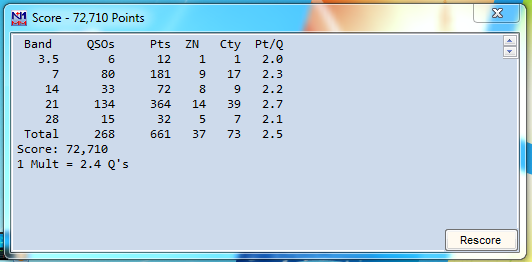
This past weekend was the CQ WW CW contest which if I can I always partake in. This year I made it a point to set aside the time to indulge.....well I'm retired now so it's really not all that hard to set the time aside. But this time around it was going to be a toss-up whether the monitor troubles I was having were going to give me issues. In a nutshell, if the monitor was turned off it was a 50/50 chance I could be greeted with a black screen. If that was the case I then had to play around starting and restarting the PC and turning the monitor off and on to get it working again. My solution was during the day when I took a break from contesting was to leave the PC and monitor on. This seemed to work very well and it was only when the PC was turned off at night did I only have one time with issues trying to get the monitor up and working.
I was really looking forward to seeing how the new upswing in the solar conditions treated me with my 100 watts of power into a mediocre Endfed antenna. I did have plans to hit the airwaves on Friday evening but Julie and I decided to have a date night COVID style at home with a home-cooked meal and a movie. On Saturday and Sunday, I was able to spend a good amount of time in the operating chair. The new solar conditions made the contest a pleasure!
There was really no dead bands from 10m to 80m in my case. The highlight for me was making contact on 2 occasions with Hawaii both times on 15m. There were other possible opportunities with some exotic places but the pile-up was that of a DXpedition. I did not want to waste valuable time to make or not make the contact.
It was a pleasure to see 10m meters open and it had me rope some contacts in South America and Europe and well as the U.S. I also gave 80m a shot as I can use my external tuner (AT200Pro II) to get a decent SWR. This opportunity netted me some U.S contact points.
My score for sure is not going to be in the CQ WW CW record books but I really enjoyed this contest and the propagation brought even more joy and really had me staying in the radio chair to make contacts.
Below is the score breakdown:
Contesting at QRPp levels!

Yesterday I dabbled in the OK/OM DX CW contest for about an hour and a half. This time for some fun and interest I entered QRP level but lowered my power to just one watt. Propagation has been surprisingly nice over the past week or so and I wanted to give the new solar flux a test run. My radio is the Icom 7610 and my antenna is a slopped Endfed antenna at about 25 feet. I stayed on 20m as the radio gods seemed to be smiling on me there. I made only 10 contacts as I was not in the contest for scoring just to see how the fishing was with one watt. I was only asked for repeats regarding my exchange twice other than that the 1 watt made it through.
Because I was operating at only 1 watt I also wanted to take the loss of my SWR into account. I checked with my antenna analyzer and the CW portion on 20m my SWR was 2.3:1. According to the power loss at various SWR readings chart at 2.3:1, I was in around 15% so this took my 1 watt down to 850 milliwatts.
Below are the results of my QRPp contest efforts:
Band 20m
QSO 10
Score 300
Contacts and Miles per watt using grid square to grid square for millage
1. OM7M 3720 miles 4376 miles per watt at .850 watts.
2. OM3CGN 3795 miles 4464 miles per watt at .850 watts.
3. OL3Z 3515 miles 4135 miles per watt at .850 watts.
4.OK7K 3503 miles 4121 miles per watt at .850 watts.
5. OK1DOL 3478 miles 4091 miles per watt at .850 watts.
Hunting For NDBs in CLE261
 |
| AP-378 Mayne Island, BC |
It's CLE time again!'CLE's are 'Co-ordinated Listening Events, and NDB DXers around the world focus their listening time on one small slice of the NDB spectrum.
This time the hunting ground is from 190.0 - 1740.0 kHz!
The challenge this time is to log just one (1) beacon from as many 'radio countries' as you can. In North America and other regions, an individual state or province counts as a radio 'country', so there are plenty of opportunities to fill your logbook.
Propagation on MF has been excellent this past week and hopefully will continue to be good.
A challenge target for listeners in North America is AP - 378kHz on Mayne Island, BC which is about 1/2 mile from me just down the beach! But 'AP' is a challenging target since, from what I can tell, has virtually no ground system. Although it has been heard as far south as Texas, it has never been heard further east than Nebraska. Listen for AP's upper sideband on 378.411kHz with your receiver in the CW mode.
When tuning for NDBs, put your receiver in the CW mode and listen for the NDB's CW identifier, repeated every few seconds. Listen for U.S. NDB identifiers approximately 1 kHz higher or lower than the published transmitted frequency since these beacons are modulated with a 1020 Hz tone approximately.
For example, 'AA' near Fargo, ND, transmits on 365 kHz and its upper sideband CW identifier is tuned at 366.025 kHz while its lower sideband CW ident can be tuned at 363.946 kHz. Its USB tone is actually 1025 Hz while its LSB tone is 1054 Hz.
Often, one sideband will be much stronger than the other so if you don't hear the first one, try listening on the other sideband.
Canadian NDBs normally have an USB tone only, usually very close to 400 Hz. They also have a long dash (keydown) following the CW identifier.
All NDBs heard in North America will be listed in the RNA database (updated daily) while those heard in Europe may be found in the REU database. Beacons heard outside of these regions will be found in the RWW database. These databases have recently been re-vamped and are slicker than ever before!
From CLE coordinator Brian Keyte (G3SIA), comes the following CLE info:
Our October Coordinated Listening Event is less than a week away.
Something very straightforward, but it is a first-time idea and it should be
good for everyone - including first time listeners.
It is a ‘One per Radio Country’ CLE!
Days: Friday 23 Oct. - Monday 26 Oct.
Times: Start and end at midday, local time at the receiver
Target: ONE NDB from each radio country
QRG: 190.0 - 1740.0 kHz
Yes, please log JUST ONE NDB from each radio country (not DGPS, NAVTEX,
Amateur or UNID).
All our radio countries are listed in the NDB List Website
(http://www.ndblist.info/ndbinfo/countrylist.pdf) There are 373 of them!
However most of the countries will be out of range for you and several are
without any active NDBs at all:
Region Radio
Countries
-------------- -------
N. America 66
C. America 35
S. America 20
Europe 63
Africa 68
Asia 60
Oceania 49
Antarctica 5
Int. Waters 7
-------
373
(UNIDs 8)
Even listening from the best location possible you will do very well if you
log 50 countries. Reaching 100 will be magnificent!
(If you would like one or more of our attractive listening awards, this
would be an ideal CLE -
Please see http://www.ndblist.info/ndbinfo/NDBAwardsList3.5.pdf)
Please look out for extra information in the Final Details in a few Days,
with advice on log-making, etc.
73
Brian
---------------------------------------------------------------------
From: Brian Keyte G3SIA ndbcle’at’gmail.com
Location: Surrey, SE England (CLE coordinator)
---------------------------------------------------------------------
If you are interested in some remote listening - maybe due to local difficulties - you could use any one remote receiver for your loggings,stating its location and with the owner’s permission if required.
A remote listener may NOT also use another receiver, local or remote, to make further loggings for the same CLE.
These listening events serve several purposes. They
• determine, worldwide, which beacons are out-of-service or have gone silent since the last CLE covering this range
• will indicate the state of propagation conditions at the various participant locations
• will give you an indication of how well your LF/MF receiving system is working
• give participants a fun yet challenging activity to keep their listening skills honed
Final details can be found at the NDB List website, and worldwide results, for every participant, will be posted there a few days after the event.
The NDB List Group is a great place to learn more about the 'Art of NDB DXing' or to meet other DXers in your region. There is a lot of good information available there and new members are always very welcome. As well, you can follow the results of other CLE participants from night to night as propagation is always an active topic of discussion.
You need not be an NDB List member to participate in the CLEs and all reports, no matter how small, are of much value to the organizers.
Remember - 'First-time' logs are always VERY welcome!
Reports may be sent to the NDB List Group or e-mailed to CLE co-ordinator, Brian Keyte (G3SIA), whose address appears above. If you are a member of the group, all final results will also be e-mailed and posted there.
Please ... give the CLE a try ... then let us know what NDB's can be heard from your location! Your report can then be added to the worldwide database to help keep it up-to-date.
Have fun and good hunting!
Hunting For NDBs In CLE260
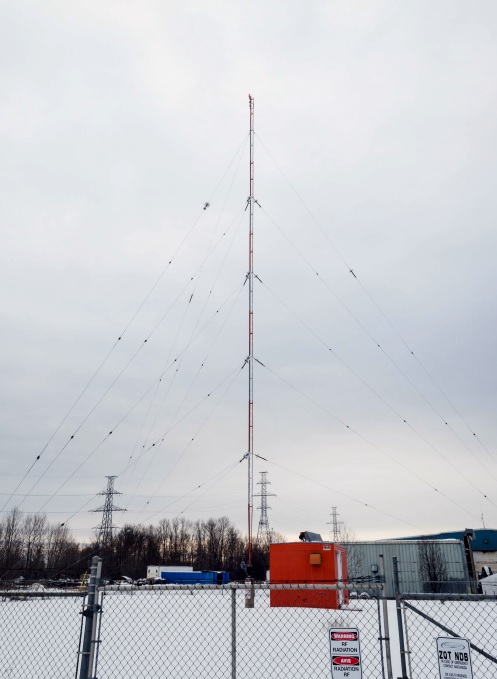 |
| ZQT-263 Thunder Bay, ON (ve3gop) |
It's CLE time again!
'CLE's are 'Co-ordinated Listening Events, and NDB DXers around the world focus their listening time on one small slice of the NDB spectrum.
This time the hunting ground is the slice from 260.0 - 269.9 kHz and 440 - 1740kHz.
Propagation on MF has been excellent this past week and hopefully will continue to be good.
A worthy target for listeners in North America is ZQT - 263kHz in Thunder Bay, southern Ontario, on the western shores of Lake Superior. ZQT has been logged from coast-to-coast but it's a challenging target. Listen for ZQT's upper sideband on 263.392kHz with your receiver in the CW mode.
When tuning for NDBs, put your receiver in the CW mode and listen for the NDB's CW identifier, repeated every few seconds. Listen for U.S. NDB identifiers approximately 1 kHz higher or lower than the published transmitted frequency since these beacons are modulated with a 1020 Hz tone approximately.
For example, 'AA' near Fargo, ND, transmits on 365 kHz and its upper sideband CW identifier is tuned at 366.025 kHz while its lower sideband CW ident can be tuned at 363.946 kHz. Its USB tone is actually 1025 Hz while its LSB tone is 1054 Hz.
Often, one sideband will be much stronger than the other so if you don't hear the first one, try listening on the other sideband.
Canadian NDBs normally have an USB tone only, usually very close to 400 Hz. They also have a long dash (keydown) following the CW identifier.
All NDBs heard in North America will be listed in the RNA database (updated daily) while those heard in Europe may be found in the REU database. Beacons heard outside of these regions will be found in the RWW database. These databases have recently been re-vamped and are slicker than ever before!
From CLE coordinator Brian Keyte (G3SIA), comes the following CLE info:
Hello all,
These are the final details for this weekend's Coordinated Listening Event which uses some challenging frequencies.
Any first-time CLE logs will also be very welcome, however modest.
Days: Friday 25 Sept. - Monday 28 Sept.
Times: Start and end at midday, your local time
Target: Normal NDBs (not NAVTEX or amateur beacons)
QRG: 260.0 - 269.9 kHz
plus: 440.0 - 1740.0 kHz
Please log the NDBs you can identify that are listed in those ranges plus any UNIDs that you come across there.
North America has a modest number of active NDBs in both ranges.
For Europe listeners there are LOTS of targets in the hf range, but they are mostly well to the east, many of them also competing with strong Broadcasting Stations.
Australia has a few NDBs in both ranges.
You can find details of the beacons in these ranges, lists and maps, if you go to http://www.ndblist.info/cle.htm and click on the 'CLE SEEKLIST' link.
If you are disappointed by having very few likely targets, you could maybe listen instead via a remote receiver located nearer to the action?
See kiwisdr.com (previously available via sdr.hu) and please also see the important footnote below.
Send your final CLE log to the List, preferably as a plain text email, not in an attachment, with CLE260 and FINAL at the start of its title.
Please show on EVERY LINE of your log:# The full Date (or Day no.) e.g. ‘2020-09-25’ (or just ‘25’) and UTC (the day changes at 00:00 UTC)
# kHz (the beacon's nominal published frequency if you know it)
# The Call Ident.
Other optional details - Location, Distance, etc. - go LATER in the same line (or in footnotes) Any extra details about new UNIDs, especially strong ones that may be near to you (maybe their approximate direction, etc.) will help us to discover more about them.
Please make your log useful to old and new members alike by ALWAYS including your own location and brief details of the equipment and aerial(s) that you were using.
We will send an 'Any More Logs?' email at about 19:00 UTC on Tuesday evening so you can check that your log has been found OK.
To be included in the combined results your log must arrive at the very latest by 08:00 UTC on Wednesday 30 Sept.
We hope to complete making the Combined Results within a day or two.
Good listening
Brian and Joachim
---------------------------------------------------------------------
From: Brian Keyte G3SIA ndbcle'at'gmail.com
Location: Surrey, SE England (CLE coordinator)
---------------------------------------------------------------------
If you are interested in some remote listening - maybe due to local difficulties - you could use any one remote receiver for your loggings,stating its location and with the owner’s permission if required.
A remote listener may NOT also use another receiver, local or remote, to make further loggings for the same CLE.
These listening events serve several purposes. They
• determine, worldwide, which beacons are out-of-service or have gone silent since the last CLE covering this range
• will indicate the state of propagation conditions at the various participant locations
• will give you an indication of how well your LF/MF receiving system is working
• give participants a fun yet challenging activity to keep their listening skills honed
Final details can be found at the NDB List website, and worldwide results, for every participant, will be posted there a few days after the event.
The NDB List Group is a great place to learn more about the 'Art of NDB DXing' or to meet other DXers in your region. There is a lot of good information available there and new members are always very welcome. As well, you can follow the results of other CLE participants from night to night as propagation is always an active topic of discussion.
You need not be an NDB List member to participate in the CLEs and all reports, no matter how small, are of much value to the organizers.
Remember - 'First-time' logs are always VERY welcome!
Reports may be sent to the NDB List Group or e-mailed to CLE co-ordinator, Brian Keyte (G3SIA), whose address appears above. If you are a member of the group, all final results will also be e-mailed and posted there.
Please ... give the CLE a try ... then let us know what NDB's can be heard from your location! Your report can then be added to the worldwide database to help keep it up-to-date.
Have fun and good hunting!
Just One More dB!

*** The following blog was originally published in 2016 but is still very applicable in 2020! ***
How often have you struggled to pull a weak signal out of the noise? "Just give me one more db", you tell yourself.
A recent posting to the Topband reflector by Frank, W3LPL, sent me to the interesting webpage of Dave, AB7E. Dave had been pondering two antenna systems, one of which would provide a 2db improvement in forward gain but at a much higher cost ... he wondered if the extra expense would be worthwhile and could he even hear the difference that 2db would make? He created a series of CW files, incrementing the signal level in 1db steps to see for himself!
Now I've always been told that you need to increase signal strength by at least 3db before your ears can detect any difference ... but listen carefully and you may be in for a surprise, as AB7E discovered.
It's probably best to listen to this signal with headphones but, even on my I-Pad's tiny speaker, the demonstration is clear. The first recording starts at "zero db", which is sent twice while the next signal is "one db", sent twice. See if you can hear the difference between each 1 db increment as he steps up to "six db":

Lastly, AB7E demonstrates the problem with sending too fast when conditions are very marginal. Here, several signals are sent at 20, 25, 30 and 35 WPM. Sending calls at high speed can often seem effective, even under poor conditions but this seems to demonstrate that slowing down just a bit would make it somewhat easier:
One of the more interesting comments posted regarding these recordings was from Bob, N6RW who cited his work in satellite communications:
"I spent part of my engineering career designing satellite command FSK
demodulators - including the deep space Pioneer Venus orbiter. To test
the performance of them, we would mix the test signal with white noise.
When you look at the FSK Bit-Error-Rate (BER) curve (bit errors versus
signal to noise ratio in a bandwidth equal to the bit rate), you can see
the BER improves by a factor of 10 to 1 for every dB in S/N ratio. In
other words, for every dB improvement, you get one tenth the errors."
Now Dave never did tell us if he bought the bigger antenna or not but I'm betting that he did ... it looks like "just one more db" may really be just enough after all.













