Posts Tagged ‘Contests’
 HF Slacker Operation for CQ WW SSB
 October 26th, 2015 |
  Author:
 The CQ Worldwide DX SSB contest was last weekend and I applied my signature HF Slacker™ operating methodology to this event. Most of the HF gear I have is kept at our cabin in the mountains but I had to be at the house this weekend due to some commitments. I decided to apply Field Day principles and rig up whatever I could with equipment on hand.
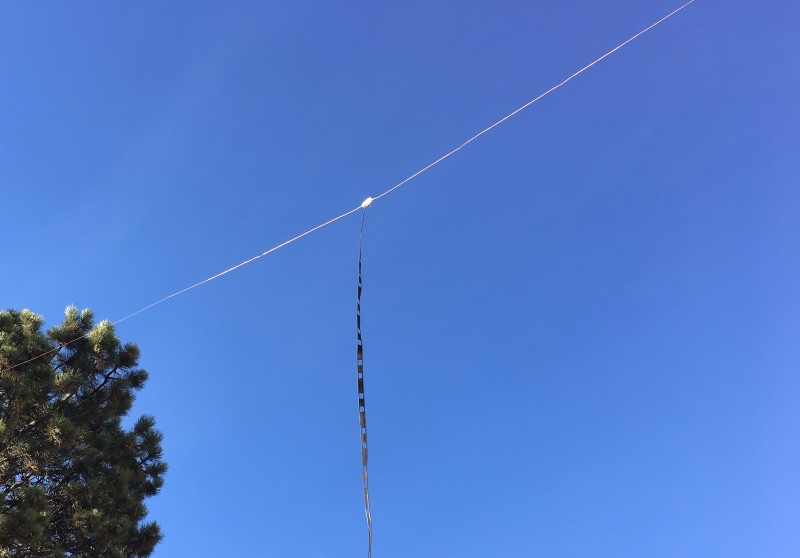
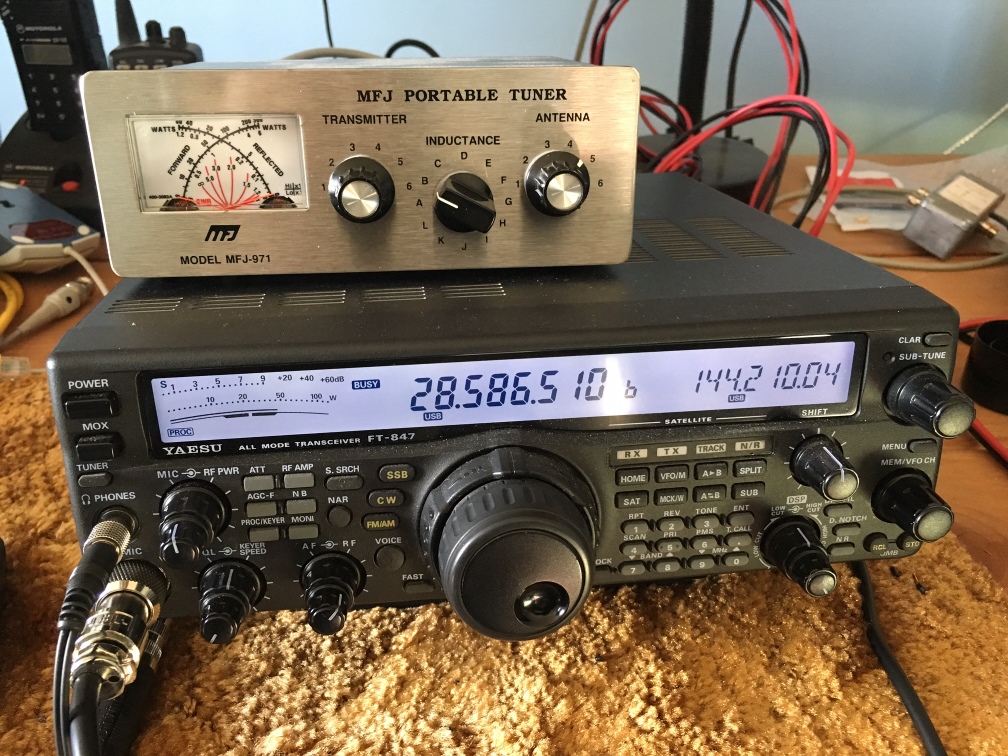 I dug out the Yaesu FT-847 transceiver, an MFJ antenna tuner and a half-size G5RV antenna to configure a basic HF station. Using a fishing pole to cast a steel washer over a tall tree in the back yard, I rigged up the antenna between the tree and the house. The G5RV is a compromise antenna…I’d much rather have something like a trap or fan dipole. But it’s what I had on hand, so I made it work. The impedance presented by this antenna is all over the map, so a decent antenna tuner is a must.
 I started out on 15m with a few contacts to Europe and Central America. Later I moved up to 10m and made even more contacts there. I was mostly searching around for the best DX but still working a few stateside stations. Later in the afternoon, the bands swung towards the west and I managed to work KH7CW and JR3NZC before going QRT for the day.
Sunday morning brought more propagation, first to Europe, then the Caribbean and South America. The high point was working AHØBT in the Mariana Islands and VK2GGC in Australia. AHØBT was not real strong, maybe S5 at my location so I thought I’d struggle to punch through the noise and QRM on the band. However, it only took a couple of calls to make the contact. That’s what I like about the 10m band!
I used the N1MM logging program during the contest. A snapshot of the log is shown below.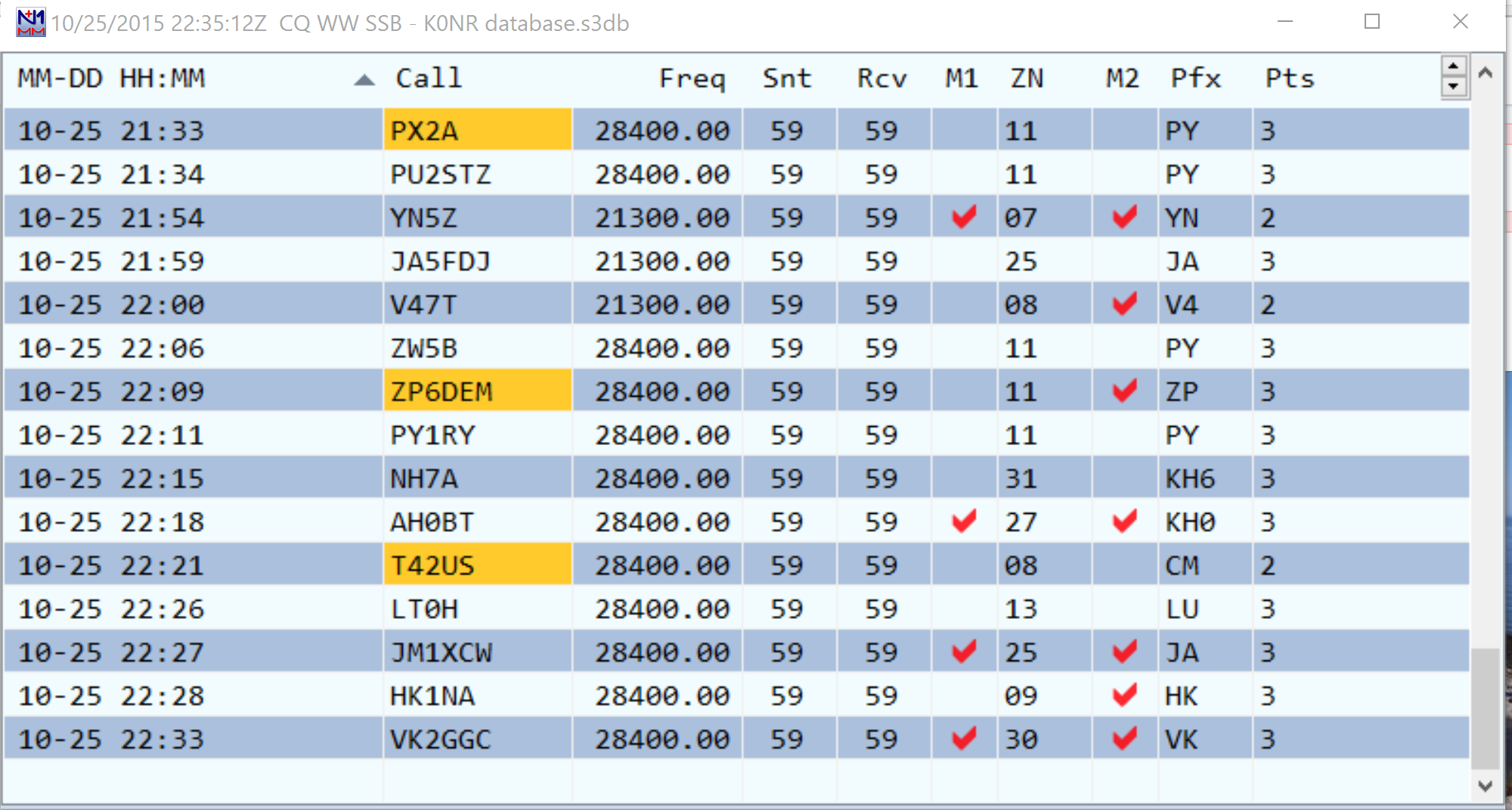 I only worked the contest intermittently on Saturday and Sunday, maybe 5 or 6 hours total operating time. Still, I managed to work 49 countries and 30 CQ Zones. That’s half way to DXCC on one weekend with a very basic HF station. Radio contests stimulate activity and DX contests bring out the DX. I point this out to encourage others to give it a try, even if they don’t have huge antennas on a tower and a linear amplifier. Almost all of my contacts were on 15m and 10m, which tend to be more productive when conditions cooperate. Twenty meters gets jammed with high power stations so it is often tough going for the little pistols.
 Band     QSOs     Pts  Zone  Country
    14       2       3    2    2
    21      30      70   13   21
    28      52     136   15   26
 Total      84     209   30   49
Score: 16,511
Another weekend of having fun messing around with radios. Even if I’m an HF Slacker™. 
73, Bob K0NR
The post HF Slacker Operation for CQ WW SSB appeared first on The KØNR Radio Site.
2014 September VHF Contest Certificate
The certificate for my entry in the 2014 ARRL September VHF Contest arrived in the mail last week. Given that it has been 11 months after the contest, I had pretty much forgotten about the effort. The ARRL VHF contest certificates look great, even if they do take a while to get issued. It turns out this contest entry was the combination VHF contest plus Summits On The Air (SOTA) activation from Mt Herman that I blogged about.
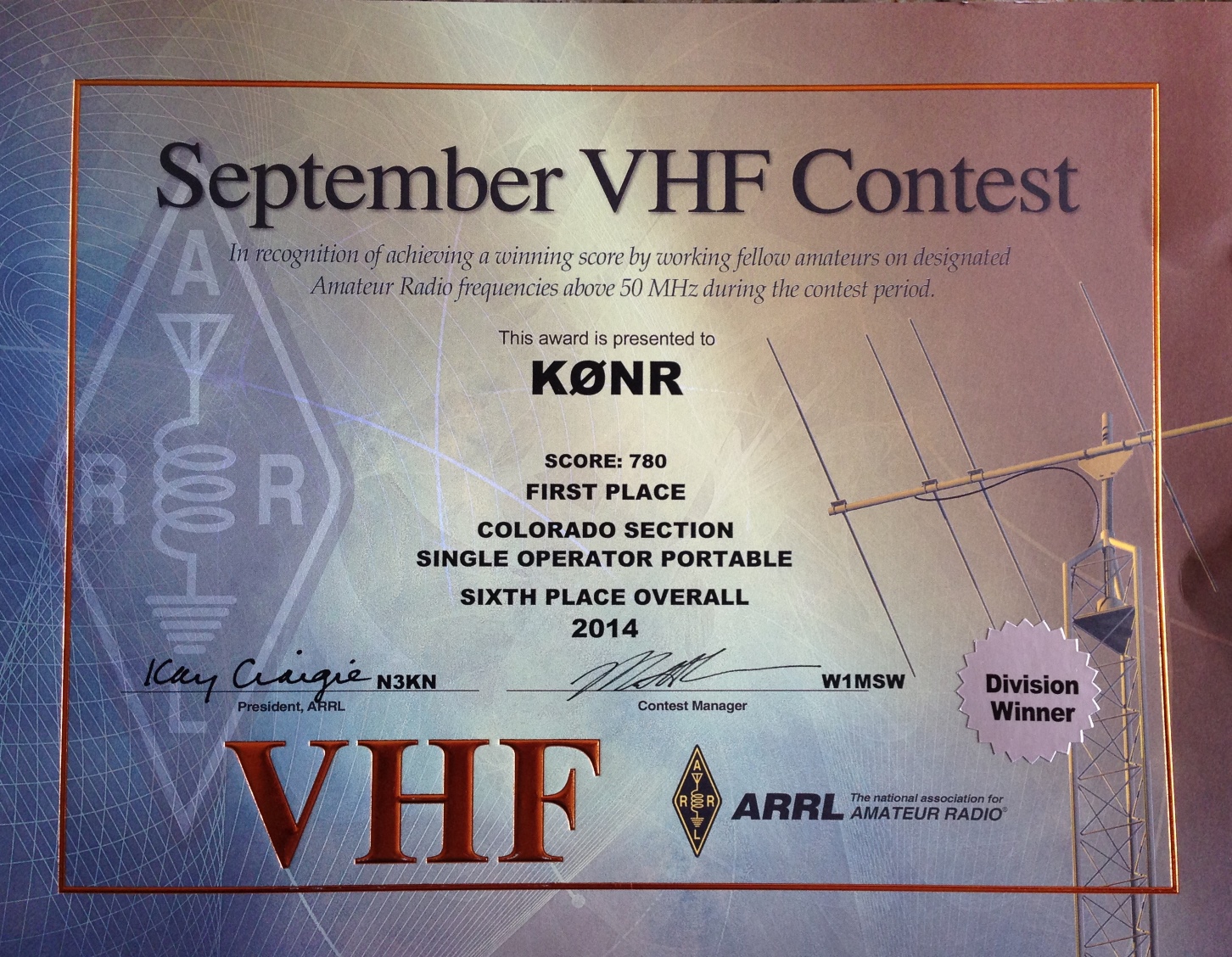 My blog posting said my score was 767 but the actual score was 780. Not a big score by any standard but not bad for ~4 hours of operating on a Saturday afternoon. As I suspected, this sets a new record for the Single Operator Portable category in the Colorado Section. What I did not expect is placing sixth in the overall contest (for my category). For the most part, this was just a really fun SOTA activation that included some VHF contest action.
Summary: The score doesn’t matter; any day having fun with ham radio is a good day.
73, Bob K0NR
The post 2014 September VHF Contest Certificate appeared first on The KØNR Radio Site.
Coming Soon: 146.52 MHz in ARRL VHF Contests
 I’ve been known to
 whine complain comment about the prohibition against using 146.52 MHz during ARRL radio contests. For example, see The One Frequency You Should Never Use on Field Day and Mt Herman: SOTA plus VHF Contest.
During my presentation on Mountaintop VHF for SOTA at the Central States VHF Society Conference in Denver today, I mentioned this is an issue. Basically, I pointed out that Summits On The Air (SOTA) operators often default to the 2m fm calling frequency, which is prohibited for use in the ARRL contests. This gets in the way when mountaintop stations do a combination SOTA and VHF Contest operation.
During my presentation, Brian Mileshosky N5ZGT, ARRL Director of the Rocky Mountain Division, reported that the ARRL has decided to remove the prohibition of 146.52 MHz in VHF contests. It will take some time for this to work its way into the actual rules, so stayed tuned for further developments.
This is great news…a cleanup of an unnecessary impediment to VHF contesting. Now, will the CQ Worldwide VHF Contest do the same?
73, Bob K0NR
The post Coming Soon: 146.52 MHz in ARRL VHF Contests appeared first on The KØNR Radio Site.
Another June VHF Contest In the Bag
Last weekend was the ARRL June VHF Contest, my favorite ham radio event of the year. For me, this is “vhf activity weekend” when all of the vhf radio enthusiasts come out to play on the bands above 50 MHz. The sporadic-e propagation that is (almost) always present during the contest means that 6 meters will be hopping.
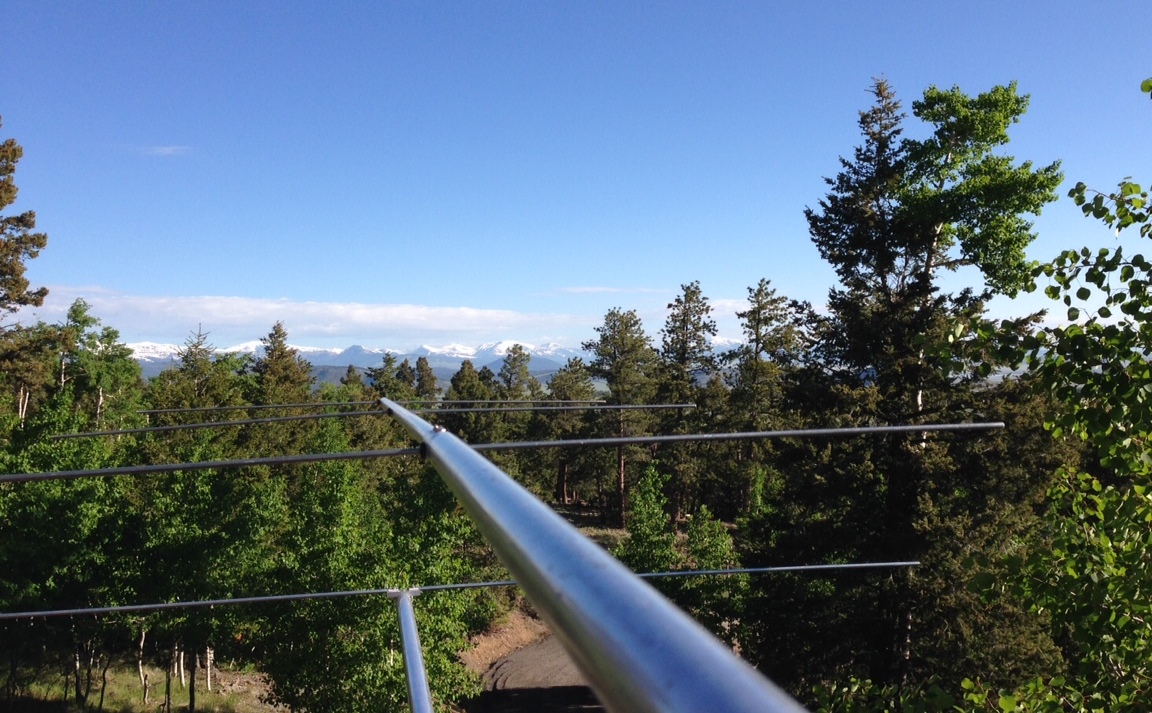 I entered in the 3-Band Single Operator category, using 6m, 2m and 70cm. My 6m rig is a Yaesu FT-950 driving a 6M5XHP Yagi antenna. For 2m and 70cm, I use a Yaesu FT-847 to drive a 2M9SSB Yagi on 2m and a similar Yagi for 70 cm. I set up portable masts at our cabin in DM78av, near Trout Creek Pass, Colorado (9600 feet).
This year, propagation seemed OK but not great. My score turned out to be about the same as last year with similar effort and same equipment, but down from previous years. 6m had sporadic-e openings very late both evenings, about the time I was ready to give up. Fortunately, I stuck with it and made quite a few contacts late into the evening.
The rovers kept things from getting too boring when 6m was not cooperating. Thanks to W3DHJ/R, ABØYM/R and WE7L/R for roving in eastern Colorado. WBØGAZ/R passed through South Park heading towards Denver and give me a few contacts. I also got a few contacts from KØCS/R and KØJJW/R. Thanks for roving!
Best DX was ZF1EJ in EK99, a new country for me on 6m.
73, Bob KØNR
K0NR June VHF Contest Summary:
 Band  QSOs  Mults
-------------------
    6:  190    83
    2:   30    13
  222:
  432:   11     6
-------------------
Total:  231    102  Total Score = 24,684
The post Another June VHF Contest In the Bag appeared first on The KØNR Radio Site.
Good Operating Habits on Field Day
In preparation for ARRL Field Day, I will be doing a presentation at our radio club meeting, explaining how FD works. We have lots of newer hams, so I want to cover the basics well. I looked around on YouTube for some video of typical Field Day contacts so our members could hear what it sounds like.
This video shows Andy K5PO doing an outstanding job of operating the WR5P Noise Blankers Field Day station. Give a listen and notice how he keeps the contacts short and to the point, clearly communicating using phonetics.
73, Bob K0NR
The post Good Operating Habits on Field Day appeared first on The KØNR Radio Site.
CQ WPX, LoTW and the End of QSL Cards
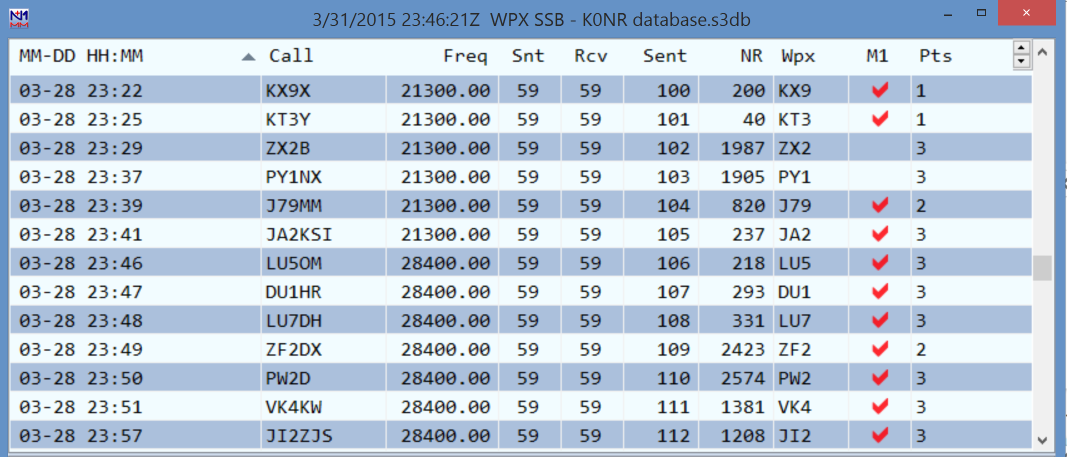 Last weekend, I had a fun time working the CQ WPX contest on SSB. I’ve always liked the format of the contest with the callsign prefix as the score multiplier (e.g., K1, K2, W1, W2, VE1, VE2 are all multipliers). Its like every new contact is a multiplier. This contest attracts plenty of DX but unlike some DX contests, everyone works everyone.
Consistent with the contest, the CQ WPX Awards Program issues operating awards based on callsign prefixes. The initial mixed mode (CW, SSB, digital) award requires confirmed contacts with 400 different prefixes. Back in the 20th century, I kept track of my confirmed contacts for WPX but lost interest along the way. I am sure I’ve worked more than 400 prefixes but the challenge was getting them all confirmed. More recently, the ARRL Logbook of the World (LoTW) added support for the CQ WPX Awards, so I started paying attention again, watching my CQ WPX total grow. I am not a big awards chaser but I have found value in using them as a specific goal to motivate me to get on the air.
Right before the CQ WPX contest, I had 380 prefixes confirmed via LoTW, so I figured that if I worked a few new ones during the contest, I could punch through 400 without too much trouble. I used my signature HF slacker approach at the cabin, using the Yaesu FT-950 to push 100 watts of RF power to wire antennas in the trees. For 40m, 20m and 15m, I used a trap-dipole antenna and for 10m I used a newly built ladder-line j-pole mounted vertically.
On Saturday, the propagation on the 10m band was smokin’ hot, strong signals from all continents. The 10m j-pole performed well. It was an absolute blast to easily work into Africa, Europe, South America, Australia, New Zealand and Asia. The 15m and 20m bands were also very productive. My approach was to tune around, looking for new prefixes to add to my confirmed total. Propagation was not as good on Sunday but still respectable but I only operated a few hours.
After the contest, I submitted my log to the contest web site and loaded my contacts into LoTW (188 QSOs and 157 prefixes). Immediately, I received two new confirmed prefixes. Over the next few hours, I checked back to watch my CQ WPX confirmed total climb on LoTW. It did not take long before it passed through 400 (and the total is still climbing). I will admit that I really liked the instant gratification of seeing my QSOs immediately confirmed.
That’s when it hit me: I am done with paper QSL cards. The amount of time and effort it takes to get 400 paper cards in my hand is just not worth it. It is soooooo 20th century.
Disclaimer: Actually, I still enjoy and use paper QSL cards…they are now just a secondary activity for me.
The post CQ WPX, LoTW and the End of QSL Cards appeared first on The KØNR Radio Site.
2014 World Radiosport Team Championship
From the World Radiosport Team Championship (WRTC) website:
The World Radiosport Team Championship (WRTC) is a competition between two-person teams of amateur radio operators testing their skills to make contacts with other Amateur Radio operators around the world over a 24 hour period. All teams use identical antennas from the same geographic region, eliminating all variables except operating ability.
WRTC2014 included 59 competing teams from 29 qualifying regions around the world. Competitors represented 38 different countries.
This is a unique contest in that the stations used are roughly identical so that operator skill is the main variable. I love watching these guys work the radios, especially the CW ops. Even if you are not a contester, take a look at this excellent video and enjoy radio hams having fun messing around with radios.
WRTC 2014 Documentary from James Brooks on Vimeo.
The post 2014 World Radiosport Team Championship appeared first on The KØNR Radio Site.













