Posts Tagged ‘Contesting’
 Interested in Amateur Radio Digital Mode FT8 Operations?
 August 3rd, 2021 |
  Author:
 A VISUAL + AUDIO AIR CHECK OF DIGITAL MODE FT8 QSOs, ON THE 30-METER BAND
Here is a video capture of the reception and transmission of many digital FT8-mode amateur radio high-frequency (HF; Shortwave) communication signals. This video is a front-seat view of the software operation performed at the radio room of amateur radio operator, NW7US, Tomas Hood.
The software packages demonstrated are installed and operational on a modern personal computer. The computer is connected to an Icom IC-7610 radio transceiver, controlled by the software. While there is no narration in the video, the video provides an opportunity for you to see first-hand how typical FT8 operations are performed. The signals can be heard.
[embedyt] https://www.youtube.com/watch?v=VROGz-x9NyE[/embedyt]
The frequency used for the FT8 communication in this video is on or about 10.136 MHz, in the 30-Meter shortwave amateur radio allocation (or, band). As can be seen, the 30-Meter band was active at this time of day (0720 UTC, onward–local nighttime).
In this video you see (and hear) NW7US make two-way contacts, or QSOs, with stations from around the country and the world.
There are amateur radio operators within the amateur radio community who regard the FT8 digital mode (FT8 stands for “Franke-Taylor design, 8-FSK modulation“, and refers to the mode created by Joe Taylor, K1JT and Steve Franke, K9AN) as robotic (automatic, automated, and unattended) computer-to-computer communications, and not ‘true’ human communications–thus negating the spirit of ham radio. In other words, FT8, in their opinion, is not real amateur radio. While they pontificate about supposed automated computer communications, many of those holding this position have not installed and configured the software, nor tried communicating with the FT8 digital mode. They have perhaps formed their anti-FT8 opinion in a vacuum of knowledge. (This writer has other issues with FT8, but not on this point–see below)
As you watch the video linked in this article, consider these concepts:
+ A QSO is defined (as per common knowledge–see below) as the exchange of at least the minimum information needed as set by the requirements of a particular award, or, as is defined by law–for instance, a QSO would have at least an exchange of the legal call sign assigned to the radio station and/or control operator, the location of the station making the transmission, and a signal report of some kind about the signal received from the other transmitter at the other end of the QSO.
+ Just how much human involvement is required to make a full FT8 QSO? Does WSJT-X software run all by itself, with no human control? Is WSJT-X a robot, in the sense that it picks a frequency, then initiates or answers a CQ call automatically, or is it just powerful digital-mode software that still requires human control?
The video was captured from the screen of the PC running the following software packages interacting together as a system:
+ WSJT-X: The primary software featuring the digital mode, FT8. (See below for some background on WSJT-X software.)
+ JTAlert: Provides several audio and visual alert types based on decoded Callsigns within WSJT-X.
+ Log4OM, Version 2: A full-featured logging program, which integrates well with WSJT-X and JTAlert.
+ Win4IcomSuite: A full-featured radio controlling program which can remote control rigs, and provide control through virtual communication port-sharing.
+ Com0Com: The Null-modem emulator allows you to create an unlimited number of virtual COM port pairs and use any pair to connect one COM port based application to another. Each COM port pair provides two COM ports. The output to one port is the input from other port and vice versa.
As mentioned, above, the radio used for the communication of FT8 at the station, NW7US, is an Icom IC-7610 transceiver. The antenna is an off-center fed dipole that is over 200 feet in total length (end-to-end measurement).
Some Notes:
About WSJT-X
WSJT-X is a computer program used for weak-signal radio communication between amateur radio operators, or used by Shortwave Radio Listeners (SWLers; SWL) interested in monitoring the FT8 digital communications between amateur radio operators. The program was initially written by Joe Taylor, K1JT with Steve Franke, K9AN, but is now open source and is developed by a small team. The digital signal processing techniques in WSJT-X make it substantially easier for amateur radio operators to employ esoteric propagation modes, such as high-speed meteor scatter and moonbounce.
WSJT-X implements communication protocols or “modes” called FST4, FST4W, FT4, FT8, JT4, JT9, JT65, Q65, MSK144, and WSPR, as well as one called Echo for detecting and measuring your own radio signals reflected from the Moon. These modes were all designed for making reliable, confirmed QSOs under extreme weak-signal conditions. JT4, JT9, and JT65 use nearly identical message structure and source encoding (the efficient compression of standard messages used for minimal QSOs). They use timed 60-second Transmit/Rreceive (T/R) sequences synchronized with UTC (Universal Time, Coordinated). JT4 and JT65 were designed for Earth-Moon-Earth communications (EME, or, moonbounce) on the Very-High Frequency (VHF), Ultra-High Frequency (UHF) and microwave bands. JT9 is optimized for the Medium-Frequency (MF) and High-Frequency (HF) bands. It is about 2 dB more sensitive than JT65 while using less than 10% of the bandwidth. Q65 offers submodes with a wide range of T/R sequence lengths and tone spacings.FT4 and FT8 are operationally similar but use T/R cycles only 7.5 and 15 seconds long, respectively. MSK144 is designed for Meteor Scatter on the VHF bands. These modes offer enhanced message formats with support for nonstandard call signs and some popular contests. (The MSK in MSK144 stands for, Multiple Frequency Shift Keying.)
FST4 and FST4W are designed particularly for the Low-Frequency (LF) and MF bands. On these bands, their fundamental sensitivities are better than other WSJT-X modes with the same sequence lengths, approaching the theoretical limits for their rates of information throughput. FST4 is optimized for two-way QSOs, while FST4W is for quasi-beacon transmissions of WSPR-style messages. FST4 and FST4W do not require the strict, independent time synchronization and phase locking of modes like EbNaut.
As described more fully on its own page, WSPR mode implements a protocol designed for probing potential propagation paths with low-power transmissions. WSPR is fully implemented within WSJT-X, including programmable band-hopping.
What is a QSO?
Under the title, CONTACTS, at the Sierra Foothills Amateur Radio Club’s 2014 Technician Class webpage, https://www.hsdivers.com/Ham/Mod15.html, they teach,
An amateur radio contact (called a QSO), is an exchange of info between two amateur radio stations. The exchange usually consists of an initial call (CQ = call to all stations). Then, a response from another amateur radio operator, and usually at least a signal report.
Contacts can be limited to just a minimal exchange of call signs & signal reports generally between amateurs previously unknown to each other. Very short contacts are usually done only during contests while longer, extended ‘rag chews’ may be between newly met friends with some common interest or someone you have known for a long time.
Wikipedia has an entry for QSO, too.
My Issue With FT8 and WSJT-X
I have written in the past, on this website, about an issue that came about during the course of the development of the WSJT-X software package. The development team decided to widen the slice of ‘default’ (pre-programmed) frequencies on which to operate FT8. The issue was how the choice of new frequencies was made, and what choices were implemented in an upcoming software release. Read more about all of this, in these three articles:
+ Land (er, FREQUENCY) Grab (Part 1)
+ One Aspect of Amateur Radio: Good Will Ambassadors to the World
+ In Response — Can’t We All Just Get Along?
Has this issue been resolved? For now, yes. There appears to be more coordination between interested groups, and the proposed new frequencies were removed from the software defaults in WSJT-X. At least, up to this point, at the time of publishing this article.
..
IOTA contest partisapation
This was the first year I took part in the IOTA (islands on the air) contest and I very much enjoyed the time I spent in the contest. It was very well attended and many Island stations were there and waiting to be contacted. I found the band conditions on my end were very challenging at times with stations going from S9 to barley above the noise floor. This is one of the challenges of a contest and just makes things more interesting. I would say it was a nice change to hear lots of stations in the contest, a sure sign that the solar cycle is improving. As a participant in the IOTA contest you can enter as CW, SSB or both and I choose to enter as a CW op.
The radio I used was the Icom 7610 with the filter set to 250 Hz with the APF (Audio Peak Filter) feature turned on. My antenna was an Endfed multiband antenna and my power output was 100 watts. One of the memorable contact I made was Cuba. With all the issues going on there it was nice to be able to make contact with that island.
I was on the air for about 3 hours in total and made 53 contacts for a score of 5,124. It sure is not a record but I very much enjoyed my time on the radio and that's what it's all about.
CQ WW CW 2020 contest is on the books!
This past weekend was the CQ WW CW contest which if I can I always partake in. This year I made it a point to set aside the time to indulge.....well I'm retired now so it's really not all that hard to set the time aside. But this time around it was going to be a toss-up whether the monitor troubles I was having were going to give me issues. In a nutshell, if the monitor was turned off it was a 50/50 chance I could be greeted with a black screen. If that was the case I then had to play around starting and restarting the PC and turning the monitor off and on to get it working again. My solution was during the day when I took a break from contesting was to leave the PC and monitor on. This seemed to work very well and it was only when the PC was turned off at night did I only have one time with issues trying to get the monitor up and working.
I was really looking forward to seeing how the new upswing in the solar conditions treated me with my 100 watts of power into a mediocre Endfed antenna. I did have plans to hit the airwaves on Friday evening but Julie and I decided to have a date night COVID style at home with a home-cooked meal and a movie. On Saturday and Sunday, I was able to spend a good amount of time in the operating chair. The new solar conditions made the contest a pleasure!
There was really no dead bands from 10m to 80m in my case. The highlight for me was making contact on 2 occasions with Hawaii both times on 15m. There were other possible opportunities with some exotic places but the pile-up was that of a DXpedition. I did not want to waste valuable time to make or not make the contact.
It was a pleasure to see 10m meters open and it had me rope some contacts in South America and Europe and well as the U.S. I also gave 80m a shot as I can use my external tuner (AT200Pro II) to get a decent SWR. This opportunity netted me some U.S contact points.
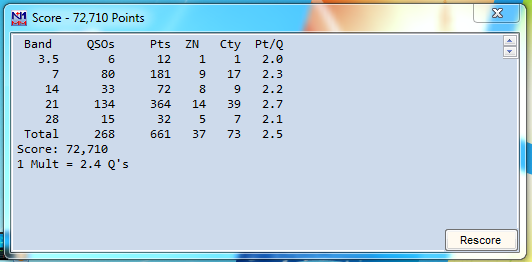
My score for sure is not going to be in the CQ WW CW record books but I really enjoyed this contest and the propagation brought even more joy and really had me staying in the radio chair to make contacts.
Below is the score breakdown:
Contesting at QRPp levels!

Yesterday I dabbled in the OK/OM DX CW contest for about an hour and a half. This time for some fun and interest I entered QRP level but lowered my power to just one watt. Propagation has been surprisingly nice over the past week or so and I wanted to give the new solar flux a test run. My radio is the Icom 7610 and my antenna is a slopped Endfed antenna at about 25 feet. I stayed on 20m as the radio gods seemed to be smiling on me there. I made only 10 contacts as I was not in the contest for scoring just to see how the fishing was with one watt. I was only asked for repeats regarding my exchange twice other than that the 1 watt made it through.
Because I was operating at only 1 watt I also wanted to take the loss of my SWR into account. I checked with my antenna analyzer and the CW portion on 20m my SWR was 2.3:1. According to the power loss at various SWR readings chart at 2.3:1, I was in around 15% so this took my 1 watt down to 850 milliwatts.
Below are the results of my QRPp contest efforts:
Band 20m
QSO 10
Score 300
Contacts and Miles per watt using grid square to grid square for millage
1. OM7M 3720 miles 4376 miles per watt at .850 watts.
2. OM3CGN 3795 miles 4464 miles per watt at .850 watts.
3. OL3Z 3515 miles 4135 miles per watt at .850 watts.
4.OK7K 3503 miles 4121 miles per watt at .850 watts.
5. OK1DOL 3478 miles 4091 miles per watt at .850 watts.
Perfect Straight-Key Morse Code? Can It Be Made Without Machines?
Skunked in the 2020 NJQRP Skeeter Hunt!
 |
| The setup |
 |
| Just in case it rained |
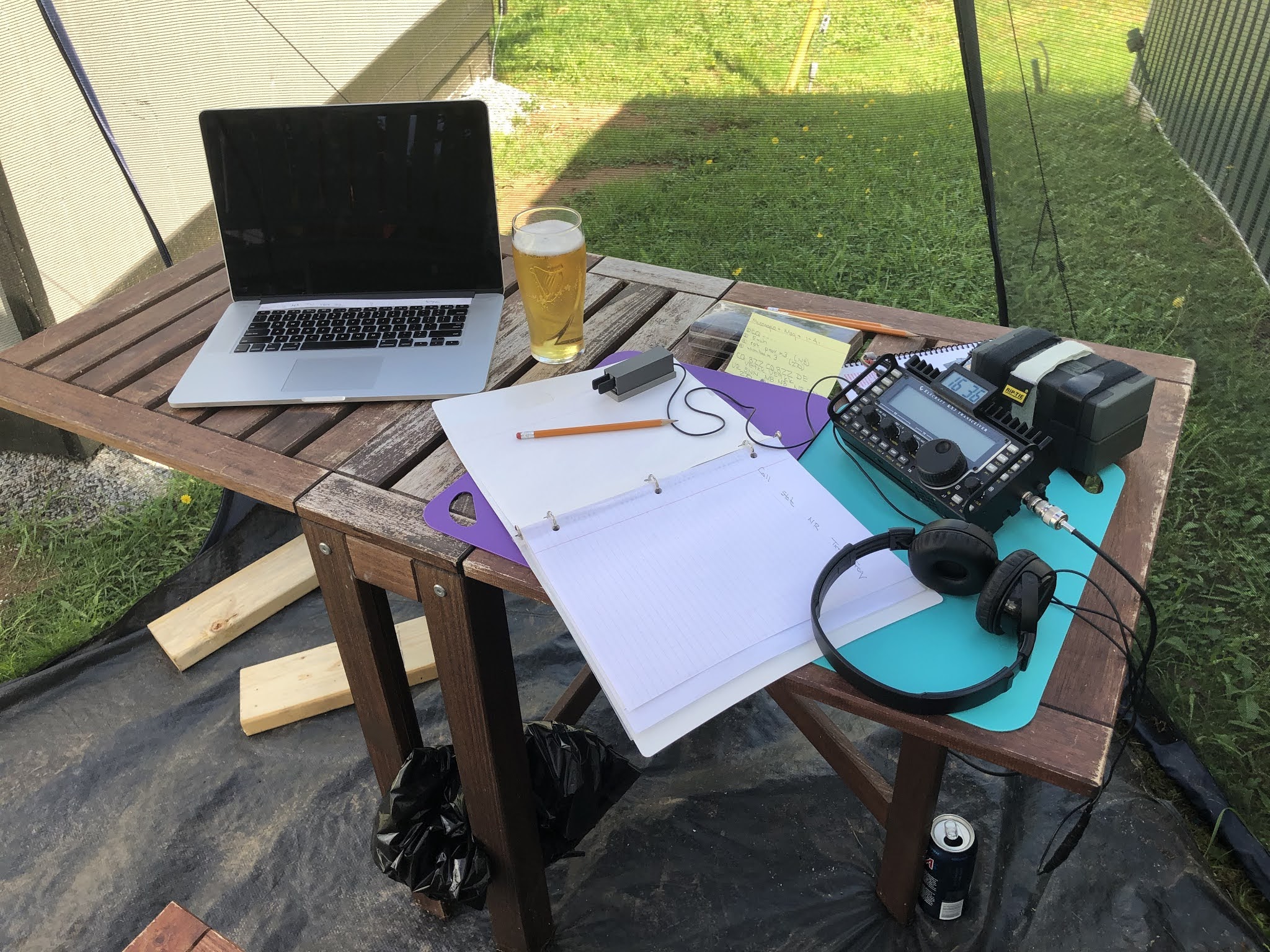
The weather report was correct and the skies cleared and things looked just great for operating outdoor. For my set up I was going to use my Elecraft KX3 that I put together from a kit, battery power, Palm mini paddle and finally the antenna was a mag loop. I was on checking out 20m to see how it was sounding before the contest. It was not all that great but I was coping some station so the only thing to do now was to wait for the contest to start.
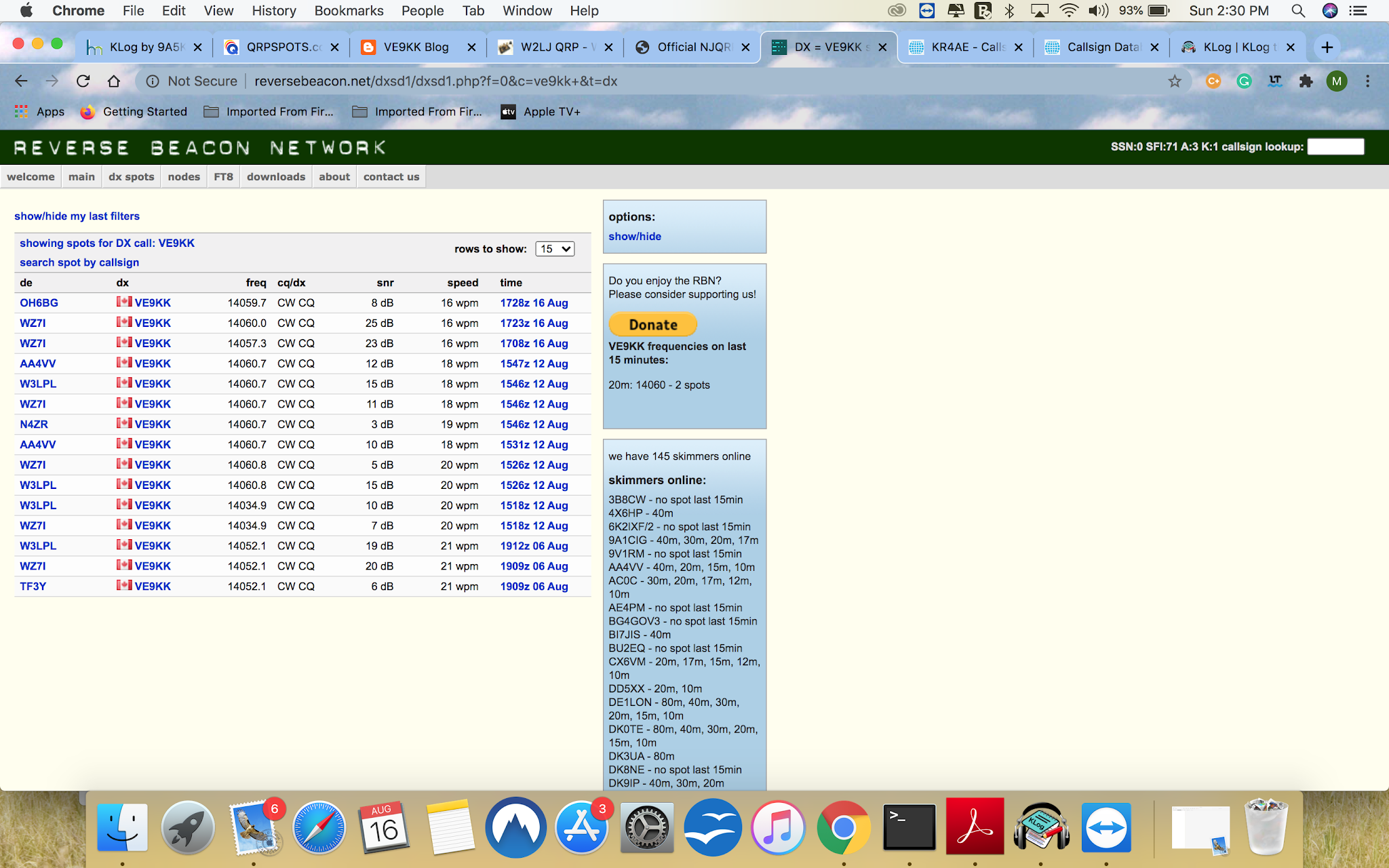 |
| My QRP signal was being heard. |
To make a long story short I was on for over 21/2 hours and I did hear some skeeter station but only at the noise floor and they were soon gone. I had my Mac laptop with me and I was checking and found some spots but I was just not able to hear ANYTHING! I did check the Reverse Beacon Network to see if my QRP CQ was being heard and it was all the way in Finland as OH6GB heard my signal.
My score for the contest was a big fat ZERO but I did get out, had my KX3 running and had a nice time outside.
The annual 13 Colonies special event.
I will be on again this weekend to see if I can get all 13 stations and the bonus stations. Stay safe everyone and thanks very much for taking the time to stop by the blog.













