Posts Tagged ‘Contesting’
 Learning Morse code? Want to increase your skill?
 June 1st, 2014 |
 Author:
Are you looking for some aids on learning Morse code, or to increase speed and skill? Let’s look at some great information and some software aimed at making your efforts successful.
(Note: I am not associated with any of the software. I just want to help you…)
I encourage you to look at the time-proven Koch method of learning Morse code. Below, we’ll look a little closer at this method of learning and honing your Morse code skill. In the meantime, if you just wish to skip the details, here are some software links for learning tools using the Koch method:
+ For the PC, I prefer the G4FON Morse code ‘Koch Trainer‘. It is a slick program that is set up to help you learn and enhance your skills with Morse code: http://nw7us.us/g4fontrainer – and his web site is at: http://www.g4fon.net/

G4FON Koch Trainer – Morse code learning on the PC
+ For the iPad and iPhone: On these devices, I use the ‘Koch Trainer’ by Nick / N3WG, found in the store here: https://itunes.apple.com/us/app/koch-trainer/id405137883?mt=8
+ For the Android: I use the same software as for the iPad and iPhone, the ‘Koch Trainer’ by Nick / N3WG, here: https://play.google.com/store/apps/details?id=com.n3wg.kochtrainer – however, note that it is not compatible on the S4.
+ Some other Android possibilities that I have not tried:
- https://play.google.com/store/apps/details?id=net.iz2uuf.cwkoch
- https://play.google.com/store/apps/details?id=uk.co.bitninja.kmtpro
Again, I have not tried those last few.
Now, let’s talk about the Koch Method of Morse code training!
From my page on the Koch method (text was used by permission from the author):
Koch’s method is a simple, direct way of building reflexes. However, it requires either a computer and Morse software or a personal trainer. That’s why it was overlooked for so many years. Now that computers are commonplace, it should become the standard Morse training method. Here’s how it works:
You start out by setting up your computer (or a microprocessor-based code tutor machine) to send you Morse characters at 20 wpm and at an overall sending speed of at least 15 wpm. You then get out your paper and pencil and have the machine start sending — but only two characters. That’s right, for your first sessions, you’ll only have two choices. Copy on paper for five minutes, then stop the machine and compare what you copied with what the machine sent. Count characters and calculate your percentage of correct copy.
If your score is 90 percent or better — congratulations! You just learned your first two characters, and, importantly, you learned them at full speed. You’ll never have to learn them over again. If you didn’t make 90 percent, practice some more. As soon as you can copy the first two characters with 90 percent accuracy, add a third character to your practice. Your accuracy will drop as you work on assimilating the new character, but it will rise again to 90 percent or better. Then you add the fourth character, and so on.
This method does not allow you to build that lookup table in your brain. To copy at full speed, you must build the reflexes in order to achieve 90 percent accuracy. And that’s what you’re spending your time doing — building reflexes. Think of it as a parallel to perfecting a tennis swing or mastering a gymnastic routine; you’re practicing until you get it right. The Koch method of building code proficiency character-by-character is similar to standard methods of teaching touch typing, another skill that must be reflexive.
…
While the Koch method is the fastest method of Morse training, speed alone is not its principal advantage. Its principal advantage, and a major difference from other methods, is that it provides you with constant positive reinforcement. This begins with your realization, after mastering the first two characters, that you can copy code at 15 or 20 wpm, because you just did it. After that, each new character mastered is further proof of your progress. Contrast that to slowly trying to build speed up from 4 or 5 wpm, then hitting the plateau at 10 wpm and seeing no progress for a long time. With the Koch method, frustration is at a minimum.
Constant testing is necessary to ensure that you maximize the effectiveness of the Koch method. You must copy on paper, so you can grade yourself. Remember, if you score 90 percent accuracy or better, add another character. If you score any less than that, try again. By constantly testing yourself on continuous copying of at least five minutes, you know exactly how you’re doing and exactly when you should add another character. This results in the fastest progress possible.
…
As you proceed toward your goal, remember that some days are just going to be better than others and some characters will take longer to assimilate than others.
(Read the entire article: the Koch method).
Again, here’s the PC software link: http://nw7us.us/g4fontrainer
And, here’s a web-based way to learn Morse code.
Good luck! If you have questions, please share them – I’m @NW7US
There’s a new radio hobby magazine in town!
Recently, a number of hobby radio magazines have either retired, or have merged into a digital mix of several. Filling that void is the new The Spectrum Monitor, a creation of Ken Reitz KS4ZR, managing editor for Monitoring Times since 2012, features editor since 2009, columnist and feature writer for the MT magazine since 1988. Ken offers this digital, radio communications magazine monthly. The web site is at http://www.thespectrummonitor.com/

The Spectrum Monitor magazine – get your’s, today.
Ken, a former feature writer and columnist for Satellite Times, Satellite Entertainment Guide, Satellite Orbit magazine, Dish Entertainment Guide and Direct Guide, is also contributing editor on personal electronics for Consumers Digest (2007 to present). He is the author of the Kindle e-books “How to Listen to the World” and “Profiles in Amateur Radio.”
The Spectrum Monitor Writers’ Group consists of former columnists, editors and writers for Monitoring Times, a monthly print and electronic magazine which ceases publication with the December, 2013 issue. Below, in alphabetical order, are the columnists, their amateur radio call signs, the name of their column in The Spectrum Monitor, a brief bio and their websites:
Keith Baker KB1SF/VA3KSF, “Amateur Radio Satellites”
Past president and currently treasurer of the Radio Amateur Satellite Corporation (AMSAT). Freelance writer and photographer on amateur space telecommunications since 1993. Columnist and feature writer for Monitoring Times, The Canadian Amateur and the AMSAT Journal. Web site: www.kb1sf.com
Kevin O’Hern Carey WB2QMY, “The Longwave Zone”
Reporting on radio’s lower extremes, where wavelengths can be measured in miles, and extending up to the start of the AM broadcast band. Since 1991, editor of “Below 500 kHz” column forMonitoring Times. Author of Listening to Longwave (http://www.universal-radio.com/catalog/books/0024u.html). This link also includes information for ordering his CD, VLF RADIO!, a narrated tour of the longwave band from 0 to 530 kHz, with actual recordings of LW stations.
Mike Chace-Ortiz AB1TZ/G6DHU “Digital HF: Intercept and Analyze”
Author of the Monitoring Times “Digital Digest” column since 1997, which follows the habits of embassies, aid organizations, intelligence and military HF users, the digital data systems they use, and how to decode, breakdown and identify their traffic. Web site: www.chace-ortiz.org/umc
Marc Ellis N9EWJ, “Adventures in Radio Restoration”
Authored a regular monthly column about radio restoration and history since 1986. Originally writing for Gernsback Publications (Hands-On Electronics, Popular Electronics, Electronics Now), he moved his column to Monitoring Times in January 2000. Editor of two publications for the Antique Wireless Association (www.antiquewireless.org): The AWA Journal and the AWA Gateway. The latter is a free on-line magazine targeted at newcomers to the radio collecting and restoration hobbies.
Dan Farber ACØLW, “Antenna Connections”
Monitoring Times antenna columnist 2009-2013. Building ham and SWL antennas for over 40 years.
Tomas Hood NW7US, “Understanding Propagation”
Tomas first discovered radio propagation in the early 1970s as a shortwave listener and, as a member of the Army Signal Corps in 1985, honed his skills in communications, operating and training fellow soldiers. An amateur Extra Class operator, licensed since 1990, you’ll find Tomas on CW (see http://cw.hfradio.org ), digital, and voice modes on any of the HF bands. He is a contributing editor for CQ Amateur Radio (and the late Popular Communications, and CQ VHF magazines), and a contributor to an ARRL publication on QRP communications. He also wrote for Monitoring Times and runs the Space Weather and Radio Propagation Center at http://SunSpotWatch.com. Web site: http://nw7us.us/ Twitter: @NW7US YouTube: https://YouTube.com/NW7US
Kirk Kleinschmidt NTØZ, “Amateur Radio Insight”
Amateur radio operator since 1977 at age 15. Author of Stealth Amateur Radio. Former editor,ARRL Handbook, former QST magazine assistant managing editor, columnist and feature writer for several radio-related magazines, technical editor for Ham Radio for Dummies, wrote “On the Ham Bands” column and numerous feature articles for Monitoring Times since 2009. Web site: www.stealthamateur.com.
Cory Koral K2WV, “Aeronautical Monitoring”
Lifelong air-band monitor, a private pilot since 1968 and a commercial pilot licensee since 1983, amateur radio licensee for more than 40 years. Air-band feature writer for Monitoring Times since 2010.
Stan Nelson KB5VL, “Amateur Radio Astronomy”
Amateur radio operator since 1960. Retired after 40-plus years involved in mobile communications/electronics/computers/automation. Active in radio astronomy for over twenty years, specializing in meteor monitoring. Wrote the “Amateur Radio Astronomy” column for Monitoring Timessince 2010. A member of the Society of Amateur Radio Astronomers (SARA). Web site: www.RoswellMeteor.com.
Chris Parris, “Federal Wavelengths”
Broadcast television engineer, avid scanner and shortwave listener, freelance writer on federal radio communications since 2004, wrote the “Fed Files” column for Monitoring Times.http://thefedfiles.com http://mt-fedfiles.blogspot.com Twitter: @TheFedFiles
Doug Smith W9WI, “The Broadcast Tower”
Broadcast television engineer, casual cyclist and long distance reception enthusiast. “Broadcast Bandscan” columnist for Monitoring Times since 1991. Blog:http://americanbandscan.blogspot.com Web site: http://w9wi.com
Hugh Stegman NV6H, “Utility Planet”
Longtime DXer and writer on non-broadcast shortwave utility radio. Former “Utility World” columnist for Monitoring Times magazine for more than ten years. Web site: www.ominous-valve.com/uteworld.html Blog: http://mt-utility.blogspot.com/ Twitter: @UtilityPlanet YouTube: www.youtube.com/user/UtilityWorld
Dan Veeneman, “Scanning America”
Software developer and satellite communications engineer writing about scanners and public service radio reception for Monitoring Times for 17 years. Web site: www.signalharbor.com
Ron Walsh VE3GO, “Maritime Monitoring”
Retired career teacher, former president of the Canadian Amateur Radio Federation (now the Radio Amateurs of Canada), retired ship’s officer, licensed captain, “Boats” columnist and maritime feature writer for Monitoring Times for eight years. Avid photographer of ships and race cars.
Fred Waterer, “The Shortwave Listener”
Former “Programming Spotlight” columnist for Monitoring Times. Radio addict since 1969, freelance columnist since 1986. Fascinated by radio programming and history. Website: http://www.doghousecharlie.com/
Thomas Witherspoon K4SWL, “World of Shortwave Listening”
Founder and director of the charity Ears To Our World (http://earstoourworld.org), curator of the Shortwave Radio Archive http://shortwavearchive.com and actively blogs about shortwave radio on the SWLing Post (http://swling.com/blog). Former feature writer for Monitoring Times.
Preliminary QRPttF Results Posted
Paul NA5N posted the preliminary results of QRP to the Field 2014 to QRP-L last night. For the whole enchilada, you can go here: http://www.zianet.com/qrp/qrpttf/2014/ttf.htm

As you can see, W2LJ came firmly in the middle of the pack – a mere mosquito (Skeeter – Hi!) on the butt of the esteemed leaders. So, rule of thumb ……. if you ever hear me in a QRP Sprint or any other QRP contest – have no fear! I am a Giver Of Points only, and will most likely never threaten your lead. 😉
Oh, and many, many thanks to Paul Harden NA5N for hosting this really fun QRP event year after year and doing all the hard work that it takes to keep something like this running.
72 de Larry W2LJ
QRP – When you care to send the very least!
Hoot Owl Sprint After Action Report
Disappointingly, there was not a lot of activity last night in the QRP ARCI Hoot Owl Sprint. My guess would be that between the CQ WWPX Contest and Holiday weekend BBQs and other activities, that most folks were probably too pooped to pop.
I was on for approximately 2 and 1/2 hours, from 8:30 PM local time to 11:30 PM local time (0030 – 0300 UTC). I worked a total of 17 stations – mostly up and down the East coast. I did work John N0EVH in Missouri and I did have a nice little QSO with Rumi LZ2R who was calling CQ USA from his QTH in Bulgaria. He was running his K3 at 5 Watts and we were 569 both ways. I think he was looking for counties, but I got the exchange needed for the Sprint, so as far as I’m concerned, it counts and it was by far my best DX for the night.
The last 1/2 hour, from 0230 to 0300 UTC was just me calling CW with no takers. That’s when I decided to pack it in for the night. The KX3 was plugging away calling CQ and I started nodding off a little bit. I’m sure if there was more activity, I would have stayed on until the allotted time was up, which would have been local Midnight (0400 UTC). But the rig automatically calling CQ over and over is kind of like driving down a long highway in the rain with the windshield wipers on. The constant rhythm of CQ with no breaks can kind of lull yout to sleep.
According to Reverse Beacon Network, there is how I was being heard last night.
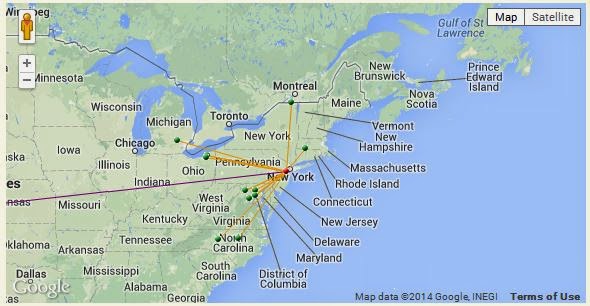
I spent just about all of my time on 40 Meters. I did make one QSO on 80 Meters and three on 20 Meters, featuring the one with LZ2RS. Other than that, everyone seemed to be concentrating on 40 Meters in the 7.030 MHz neighborhood. As far as antennas go, I was using mostly my 88′ EDZ on 40 meters and for my very brief foray into 80 Meters. On 20 Meters, I used the Butternut HF9V.
72 de Larry W2LJ
QRP – When you care to send the very least!
One of my faves!
One of my favorite contest/Sprints is coming up this weekend. The Hoot Owl Sprint, sponsored by QRP ARCI is this coming Sunday evening. I guess I had lost focus, or wasn’t paying attention, as this came as a surprise to me when Jim W4QO announced this on the NoGA Group reflector yesterday.
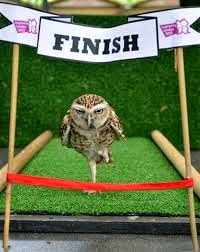
The Hoot Owl Sprint is always held on Memorial Day Weekend, here in the US. The rub is that it doesn’t feel like Memorial Day weekend as far as the thermometer is concerned. It feels more like late April or early May around here. It’s been chilly and wet for the most part, lately. We have had very few days where the temperatures have gone into the mid or upper 70s. And the forecast for the weekend is for basically more of the same. Ugh.
I also believe that Monday evening will be the MI QRP Memorial Day Sprint, but I haven’t seen any announcements regarding that, either. Keep your eyes peeled. (Update: As per the MI QRP Website (should have looked there, first – DUH!) there will only be a Labor Day Sprint this year.)
I am hoping that it will stay dry enough so that I can test out a 53 foot radiator with the 9:1 UNUN at the park at some point this weekend. According to the SWR Chart on the Balun Designs website, a 53 foot radiator will yield decent SWRs on all bands 80 through 10 Meters. If I get an opportunity to play and the results bear out, then this will be one of the antennas that will be used at the SPARC Field Day effort.
72 de Larry W2LJ
QRP – When you care to send the very least!
QRPttF 2014
Today was QRP to the Field for 2014, and it was also my birthday. What a present! Although I didn’t get to spend anywhere near as much time on the air as I would have liked, I got a little air time in and that’s always a good thing.
The theme for today was Tres de Mayo in honor of Cinco de Mayo. Well, here in New Jersey there really aren’t an abundance of locales with a Mexican flair. So I got a little creative.
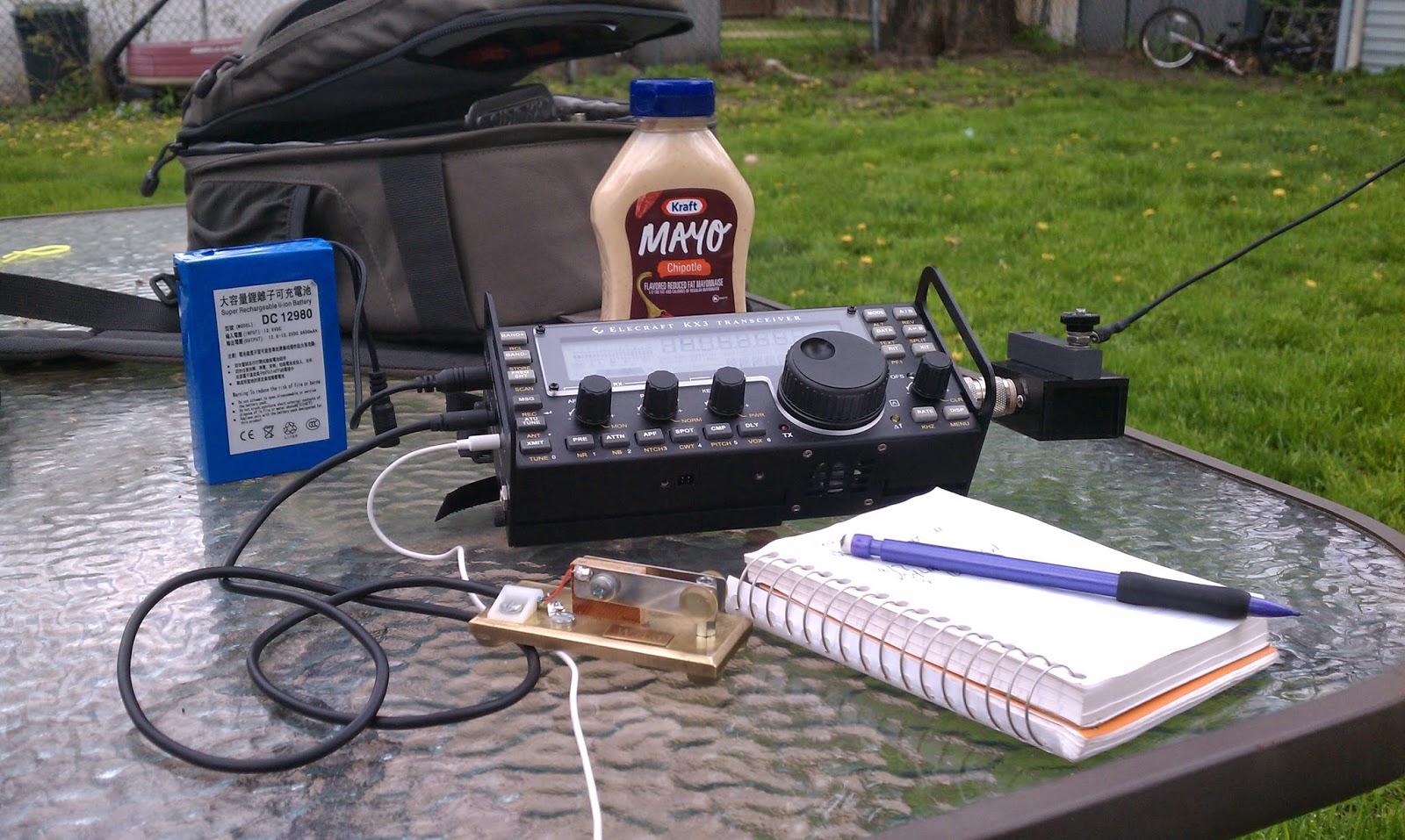
Yes, I placed some Chipotle Mayo next to me while I operated.
I got to experiment a bit too. I used both my Par EndFedz and the EARCHI 9:1 Unun with a 36 foot radiator. The Par EndFedz performed as expected. The EARCHI performed much better than last time. The extra three feet of wire made a big difference. The KX3 handled the wire well on all bands, 40 through 10 Meters with minimal clicking and clacking from the auto tuner.
In the hour or so of operating time that I got in, I worked about a dozen or so stations. Included were some very familiar calls like Mert W0UFO, Jerry N9AW, Rick NK9G, Dave AB9CA, Gene N5GW and Kelly K4UPG among others.
So even though I didn’t get a lot of operating time in, I did learn more about the EARCHI end fed. I think it will serve well as an all around multi band antenna for portable ops.
72 de Larry W2LJ
QRP – When you care to send the very least!
You never know until you submit.
 |
| Boy was I surprised to get this! |