Posts Tagged ‘Contesting’
 The 2019 Novice Rig Roundup (NRR)
 February 26th, 2019 |
  Author:
One of the most enjoyable operating events of the year is fast approaching — the Novice Rig Roundup or ‘NRR‘. Technically, it is a contest, but I have the feeling that most participants think of it as just a lot of fun and a nice opportunity to hear and work some of the great old ‘classics’ of the past — rigs that were used when they were teenage Novices or rigs that they could only drool about owning, back in those formative years when they each discovered the magic of radio.
Once again the bands will be alive with the sounds of Heath AT-1s, DX-20s, DX-35s, DX-40s and DX-60s, Johnson Adventurers, Eico 720s, Drake 2NTs, Knight T-50s and T-60s, Ameco AC-1s and of course, an endless variety of lovingly-constructed homebrew delights and … a full 9 days to celebrate the ‘good old radio days’ of their teen years, as many of us remember them.
The dates to remember are 0000 UTC March 2 to 2359 UTC March 10 and this multi-day opportunity is, for me, what makes the NRR so enjoyable. With a nice diversion from the usual ‘contest frenzy’ associated with standard weekend operating events, the NRR can be enjoyed throughout the week, whenever you choose to participate. If last year’s operating patterns continue, you should find activity at any time of the day … and even more as sunset arrives.
With the fast-approaching solar minimum, we will be hard-pressed to relive the glory days of worldwide 15m propagation, as even last year’s event proved to be tough on this band. With a little luck and, hopefully, a well-timed solar flare, we may get lucky! If you operate during the daylight hours, please get on 15m and give it a shot … and be sure to announce your activity on the NRR’s sked and chat page here, so that others will know where to find you, especially if you are rock bound in true Novice fashion. With our present spotty conditions, we need all the help we can get and the sked page proved a very valuable asset during last year’s affair.
Although technically not required, if you plan to participate it’s best to obtain your own NRR number, which is an easy 30-second process.
Additionally, there is an online logger where participants can post their daily log. The nifty logger also keeps track and figures out your score as it goes and no ‘after contest’ log needs to be submitted. If you plan on submitting a log, the logger is a requirement. The logger will also require you to set up a ‘log-in’ and once again, a simple 30-second process will take care of that from here. If you used the logger last year, you will have to set it up again for this year as the old system has been changed.
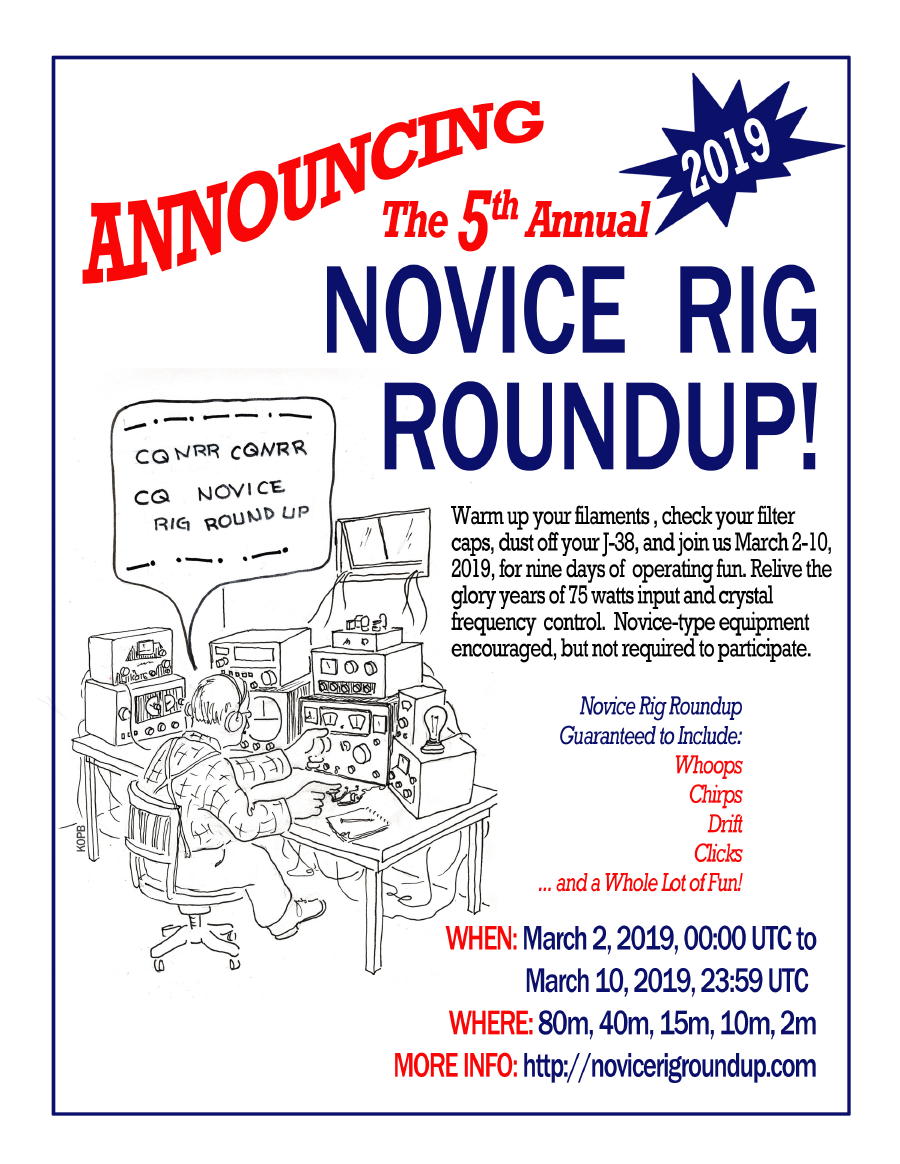
Stations may run either crystal-control or VFO or can switch between either method … the online logger will keep track and score things appropriately.
All of the rules and information can be found on the NRR’s excellent website. As well, the soapbox comments and station pictures from last year’s NRR may provide the inspiration that you need to spark-up your own activity in this year’s event … from what I can tell, this year will be bigger and busier than ever!
There is also a dedicated NRR Yahoo Group, often the source of much valuable discussion but there is a now HUGE group of great NRR chat and activity now on Facebook’s NRR Group here. I avoided Facebook for many years and have now discovered that it is an excellent forum for real time chat and information exchange … one can still choose to maintain a very low profile and avoid unwanted interaction if set up correctly.
In 2017 I ran my homebrew Longfeller in the (now eliminated) QRP category, and had a ton of fun. You can read about it here. Last year, I refurbished a nice Drake 2NT that had been gathering dust in the basement for over 25 years and ran it during the 2018 NRR. You can read about my activity and some of the rigs encountered during last year’s fun here.
If you have access to the web while operating, be sure to bookmark and check into the NRR’s realtime chat page. Many ops that are crystal controlled will announce their operating frequencies, making it easier for you to find them … sometimes way up or down from the normal NRR watering holes of ~ 3550 – 3650 kHz, 7100 -7125 kHz, 21.100 – 21.150 MHz and 28.114, 28.120 MHz … and don’t forget to check the colorburst crystal frequency of 3579!
‘CQ’ers should always remember to tune up and down the watering hole for replies from other NRR stations that may be crystal controlled and not able to answer you on your own frequency!! This is extremely important and a real reminder of what was common practice back in the Novice days.
 |
| courtesy: Harry – VE7AIJ |
Harry’s homebrew 6AQ5 crystal oscillator (Feb ’55 Popular Electronics) and Hallicrafters S-53, pictured above, allowed him to work the world back in the amazing radio days of Cycle 19. Let’s relive some of that excitement in the closing days of Cycle 24 … in the NRR!
You still have time to get that old clunker on the air but if that’s not possible, you can join the fun with your modern rig as well … all are welcome to jump in and have a great week of radio-fun. I think you will be surprised, just as I was last year, how good some of these old classics can sound … and you’ll hear some great bug-fists as well.
As indicated on the NRR website, this is “more of an EVENT than just a typical contest … once again taking our OLD ham radios off the shelf and putting them to use again! “
See you in the 2019 NRR!
The 2019 Winter “Classic Exchange”
 |
| W7OS - Radio Club of Tacoma working the CX |
The "CX" encourages participants to use older vintage gear including any homebrew equipment, both receivers and transmitters. A unique scoring system provides bonus points for various equipment and combinations as well as encouraging 'repeat contacts' when you switch to different equipment.
 |
| W8KM and his wonderful vintage station |
No vintage gear? ... no problem! All amateurs are invited to participate and get in on the fun no matter what they are using and submit their scores.
 |
| K3MD's Heathkit AT-1 and Hallicrafters HT-37 ready for the CX |
The CX is a low-key relaxing affair and the 'extra' Tuesday operating period should encourage a lot of midweek activity from the vast numbers of retired operators who cherish and run older gear.
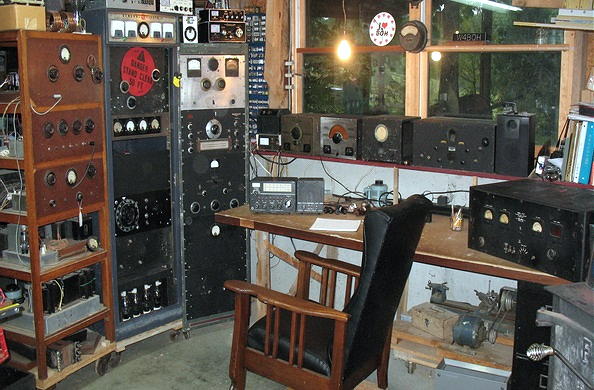 | ||||||||||||||||||||||||
| Lots of combos ready at W4BOH's CX setup |
 |
| K6ZI, Las Vegas - WWII ARC-5s ready to go |
A summary of the Fall 2018 CX and soapbox comments, along with some wonderful vintage-station eye candy, may be found here.
For complete details of the upcoming event, see the web site announcement here.
If you've never entered the Classic Exchange, why not give it a try this year as it truly is a case of 'the more the merrier' ... and eastern operators, make sure to keep the porch light on for those out west!
RAC contest and the new IC7610

 |
| Won't make that mistake agian. |
I was thrilled with the Icom 7610 I didn't as of yet get the time to set up N1MM+ contest software so during the contest I was old school with a paper and pencil. The audio was crisp and clean, I stayed with the 250Hz filter and had not even one issue with very close adjacent stations bothering my contact station. The touch screen is very responsive and an absolute joy to use. I took advantage of the 2 independent receivers, I turned on dual watch and had one VFO on an RAC station such as VE7RAC who was very popular and the other VFO I search and pounced. With one simple button push I muted the VE7RAC station and could unmute to check on the pileup. Once things slowed down I was able to put VE7RAC in the log.
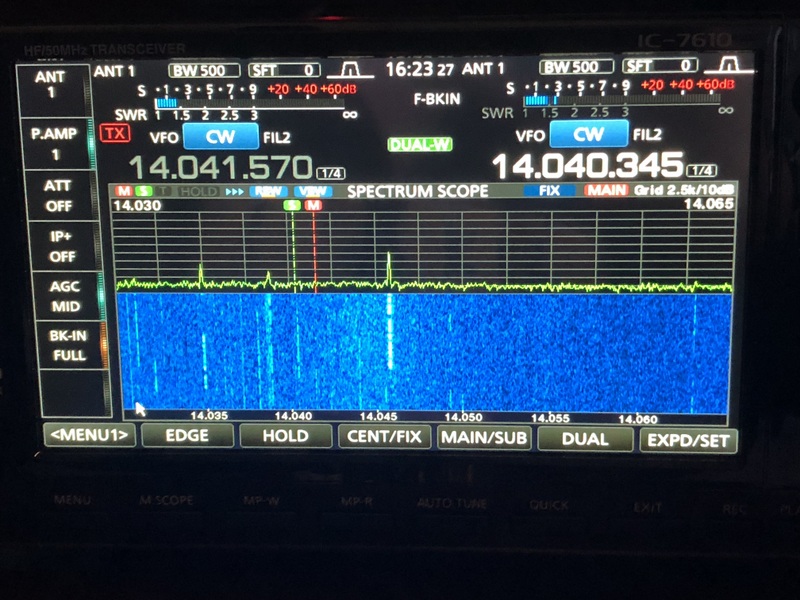 |
| Dual Watch on |
Hunting Foxes With QRP
For those of us that enjoy CW as well as QRP operating, the Winter QRP Fox Hunt nights make for an exciting combination of both interests.
The QRP Fox Hunt is an operating event during which low power (QRP) stations or "Hounds", attempt to make contact with specific QRP stations designated as "The Fox".
Spanning a twenty week period from November to April, each week sees two Fox Hunt events ... one on Tuesday evening and another on Thursday evening. The Tuesday night event sees the Hounds go hunting on 40m, while on Thursdays, the move to 80m, for an even greater challenge.
For each evening, there are two assigned 'Fox stations', usually one in the east and one in the west. The object of the hunt is for the hounds (you and I) to find and work the fox ... both foxes if you can, as bagging both is the ultimate goal. This all sounds pretty easy except for the fact that all foxes and all hounds are limited to 5W output or less, and therein lies the fun! If you have never heard a pileup of QRP stations, it is worth tuning in just to listen ... a multi-station cacophony of QRP signals, all around 559 or weaker ... it's not your typical kilowatt-laden ear crushing pileup!
The 40m foxes will be found between 7030 and 7050, while the ones on 80m will be between 3550 and 3570 kHz. Most foxes make a habit of working split, usually listening 'up 1', so once you find the pileup, the fox is easier to locate.
The hunts begin at 0200Z and run until 0329Z ... early evening here on the west coast and mid-evening out east.
Complete rules and a 'Fox Hunt Primer' may be found on the QRP Fox Hunt home page here. For discussion of the individual events and soapbox comments, join the QFox ioGroup site here or join the chat in Facebook's QFox QRP Foxhunt Group.
If you're in search of some challenging week-night operating fun, you may just find what you are looking for with the bi-weekly QRP Fox Hunts. Working both foxes is not as easy as it might sound and is an excellent test for your antenna system and of your CW operating skills. Come and join the fun this coming Tuesday ... no special hunting permits required!
That ol’ Summertime Classic
OK, so maybe I'm an Amateur Radio and QRP nerd, but what is more sublime than sitting somewhere in a nice shady spot on a hot summer day, making contact after contact with QRP friends around the USA and the rest of the world? The breeze in your face, the Bumblebees buzzing, the bands hooping with CW?
That's right ....... nothing!
This year, the last Sunday in July falls on July 29th and the contest runs from 1700 to 2100 UTC. So grab your radio, a hunka wire and make like a bee and get out to the field and pollinate those frequency bands! Get out of that musty ol' shack and enjoy the beautiful weather and sunshine. These are the things I dream about while I'm shoveling the pile of frozen over, rock hard slush that the snow plow leaves at the end of my driveway after every big snowfall.
For the rules, please go to http://arsqrp.blogspot.com/
For the roster, please go to https://docs.google.com/spreadsheets/d/1OzR8FvgVX9J2U0BsjPPg7uzqbuv4C93IAmf7hr8_5GY/edit#gid=0
72 de Larry W2LJ - Bumblebee # 12
QRP - When you care to send the very least!
ETH096 – School Club Roundup, Hamvention Update and More…Everything Ham Radio
Hello everybody! In this episode of the Everything Ham Radio Podcast, I am stuck by myself talk to yall. I unfortunately didn’t remember that I my next scheduled update was due until 4pm the day before. So I worked all afternoon, while at work, trying to figure out what I was going to talk about. When I got off work at midnight, I ran home and did my couple honey-dos and then went straight to recording the episode.
So what is in this episode?
First off, I made a mistake! Yea, I know, nobody is suppose to make mistakes right? Well, in my last episode I did. In last episode, my semi regular co-host Ian KM4IK and were talking about the big stink that was doing on with some things that the ARRL Board of Directors were going to be voting on. Neither one of us were really up to speed on the whole thing as much as we should be, but we did our best, and we even said that we weren’t. However, after the episode I did receive multiple emails saying that I said something wrong, so I corrected it in this episode.
With that out of the way, I went on to talk about an upcoming event called the School Club Roundup. It is this month only a few days away actually. The event run February 12-16, 2018. It is an event that is geared for school amateur radio clubs to get on the air and make some contacts. Even if you are not in a school club though you can still get on the air and make contact with the school clubs that are on the air and help them make the points.
After that, I moved on to Hamvention. Another correction from last episode. Well I say correction, this time it wasn’t me though. In last episode we talked about how a new building was going to be built and available by this Hamvention. However, this week, the Hamvention committee released that it wouldn’t be started on until later in the year due to a material shortage.
I wrap up the episode reading some emails that I have received over the past few weeks. The last episode of 2017, I told yall what my plans were for 2018 and asked what some of yalls were and also asked some questions about what were yalls opinions on how my show is. I got a few responses, wish I would’ve had more though.
Until Next Time Yall…
73 de Curtis, K5CLM
Everything Ham radio podcast Ep 93 – NASA On The Air(NOTA)

I’m sure that you have heard of NPOTA, National Parks On The Air, and SOTA, Summits On The Air, and probably even POTA, Parks On The Air, The US program for the World Wide Flora and Fauna, but have you heard of the latest event that starts on Sunday, Dec 11, 2017?
Starting at 0000 UTC time on December 11, 2017 the new year long event celebrating multiple anniversaries for the NASA program will start. It is called NOTA or NASA On The Air.
With several NASA clubs doing several special event stations of the coming year, they decided to make a year long event where you, as the end user, can contact the stations to earn points through the year. You can even gets points during other events like Winter Field Day, the ARRL Field Day and others.
Losten to my latest podcast episode where I talk with Rob Suggs about it:













