Posts Tagged ‘Contesting’
 Everything Ham radio podcast Ep 93 – NASA On The Air(NOTA)
 December 8th, 2017 |
  Author:
I’m sure that you have heard of NPOTA, National Parks On The Air, and SOTA, Summits On The Air, and probably even POTA, Parks On The Air, The US program for the World Wide Flora and Fauna, but have you heard of the latest event that starts on Sunday, Dec 11, 2017?
Starting at 0000 UTC time on December 11, 2017 the new year long event celebrating multiple anniversaries for the NASA program will start. It is called NOTA or NASA On The Air.
With several NASA clubs doing several special event stations of the coming year, they decided to make a year long event where you, as the end user, can contact the stations to earn points through the year. You can even gets points during other events like Winter Field Day, the ARRL Field Day and others.
Losten to my latest podcast episode where I talk with Rob Suggs about it:
Update: Propagation Forecasts for CQ WW (SSB and CW) DX Contest Weekends
Are you participating in this year’s CQ World-Wide DX Contest, either the SSB weekend (this coming weekend, October 28-29, 2017), or the CW weekend (November 25-26, 2017)? The CQ WW is the largest Amateur Radio competition in the world. Over 35,000 participants take to the airwaves on the last weekend of October (SSB) and November (CW) with the goal of making as many contacts with as many different DXCC entities and CQ Zones as possible.

Space Weather and Radio Propagation
I have updated my forecast on the expected propagation conditions during both the SSB and CW weekends of the 2017 CQ World-Wide DX Contest. I will publish a new update for the CW weekend, when we get closer to that November weekend.
The link to the latest update is: http://cqnewsroom.blogspot.com/2017/10/cqww-dx-contest-propagation-update.html
Good luck!
73 de NW7US dit dit
Drake 2NT And The Novice Rig Roundup (NRR)
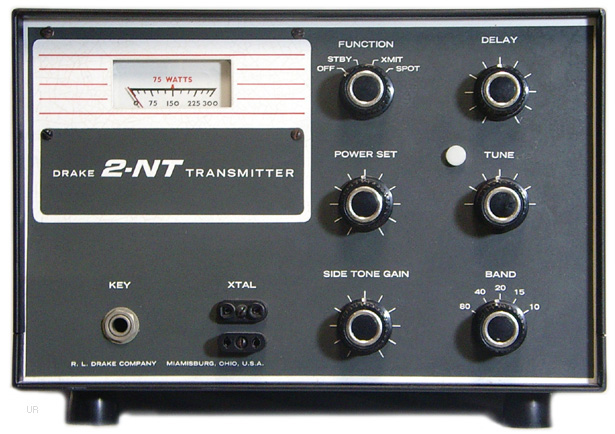
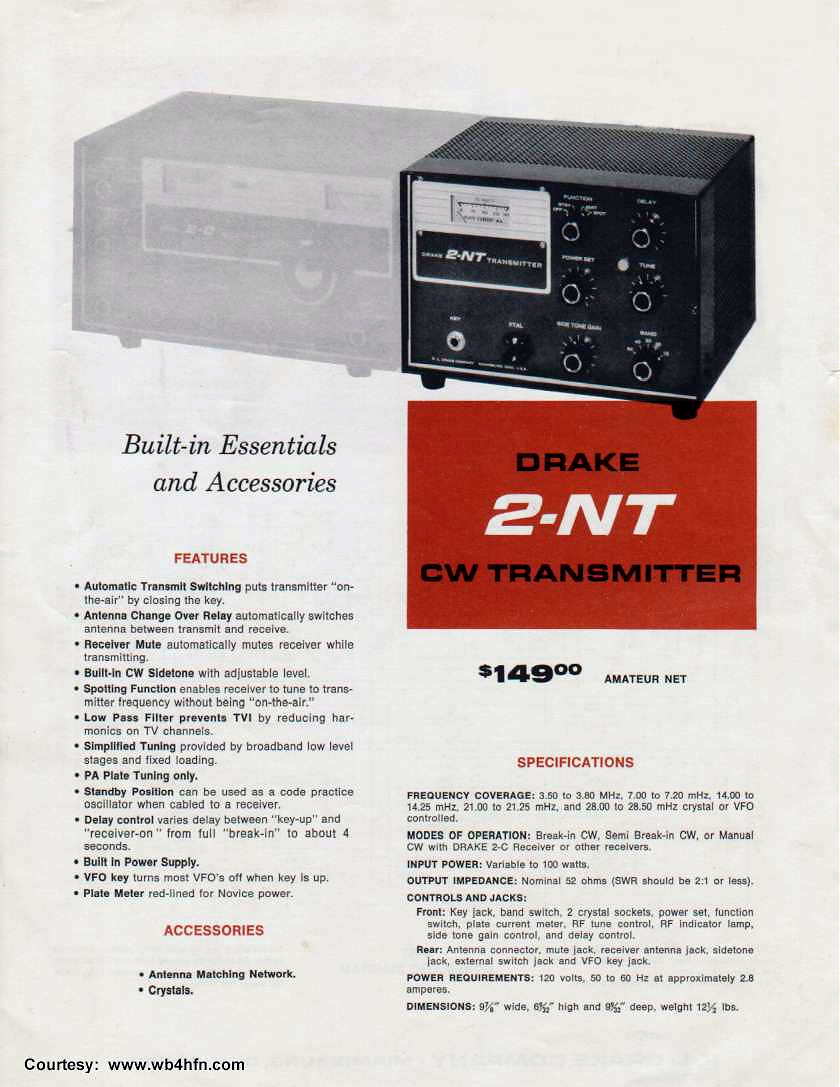
One of this summer's radio workbench projects was to refurbish my Drake 2NT transmitter for this winter's NRR event. The 2NT was introduced in 1966 with the 'novice' ticket-holder in mind, selling for $129. It was the first and only CW-only transmitter produced by R.L. Drake.
As novice transmitters go, the 2NT was a cut above some of the others out there, boasting interesting features such as a built-in antenna changeover relay, sidetone oscillator, grid-block keying and built-in low pass filter.
The tune-up procedure was simplified as well and with Drake's reputation for quality construction, the 2NT became a popular choice for Novices and Generals alike.
My own 2NT was purchased, along with the matching 2C receiver and speaker/Q-multiplier combo over 25 years ago at a Washington state ham fleamarket. Ever since then they have been patiently sitting on the shelf, trying to catch my attention.
The motivation and much-deserved attention finally arrived this year after enjoying last winter's NRR and hearing several great-sounding 2NT's on 80, 40 and 15m CW. I operated the week-long Roundup with my homebrew 'Longfeller' at 5W output, in order to qualify for the QRP category.
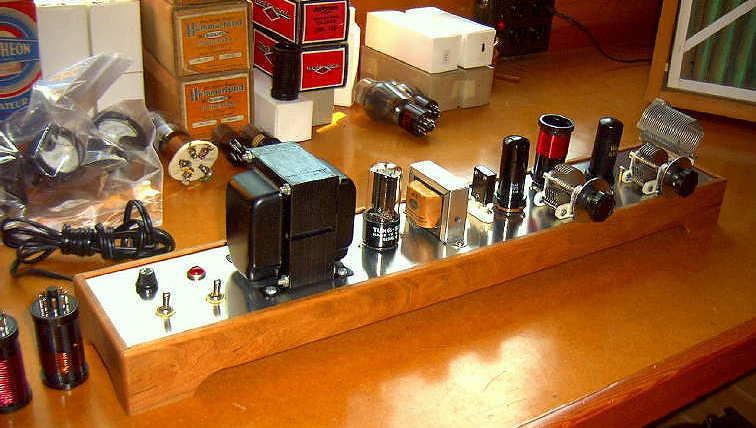 |
| 6AG7 - 6V6 'Longfeller' |
I eventually ended up with 68 contacts, but at 5W, it was a challenge ... most of my many 'CQ NRR' offerings were unanswered, so it was mostly a 'search and pounce' operation. With this in mind, I soon decided that next time, I'll get the 2NT ready to go and hopefully, with a little more oomph, can attract some callers.
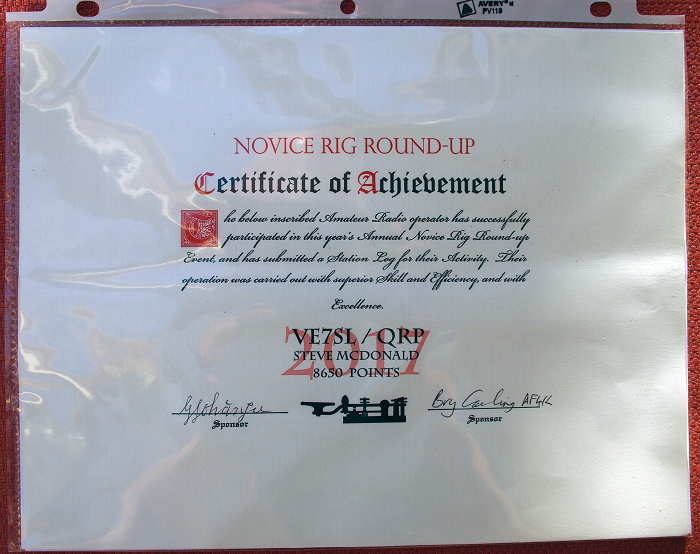 |
| Each entrant received an NRR certificate - a nice touch |
Rather than hunt down and purchase the individual replacement electrolytics, especially the multi-unit can capacitor which was impossible to source, I ordered the '2NT re-cap kit' from Hayseed Electronics. They supply replacement kits for several boatanchors and are able to make and stuff multi-section can capacitors to match the original size and specs ... and all at affordable prices.
After cleaning the chassis and all of the switches, re-tubing with new tubes and removing / replacing all of the electrolytics, the 2NT was ready to go. Using a crystal for excitation, the following results were obtained:
80m 103W input 75W output efficiency = 73%
40m 92W input 65W output efficiency = 71%
20m 92W input 65W output efficiency = 71%
15m 92W input 55W output efficiency = 58%
10m 92W input 50W output efficiency = 54%
Keydown voltages averaged ~520V while plate current ranged from 170-200ma. All-in-all, right on target and not bad for a 51 year old transmitter!
The 6EA8 modified Pierce oscillator in the 2NT seems particularly 'crystal-friendly', as every old style FT-243 style crystal that I tried sounded great. Even the newer ones from AF4K using a modern HC-49 crystal slab mounted inside a vintage FT-243 holder sounded great and worked perfectly.
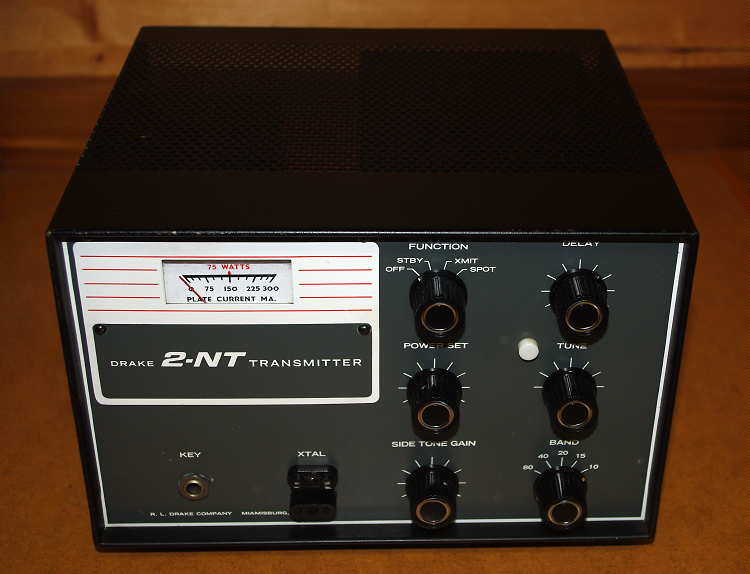 |
| My newly refurbished 2NT - ready to go |
A couple of days later, I returned to the bench to take some blog photos of the rig delivering power into the wattmeter. When I turned the 'stby' switch to 'transmit', the plate current suddenly shot up (with no keying) and the meter on my Variac supply indicated over an amp being drawn by the power transformer ... all with zero output and no crystal plugged-in!
A look at the schematic diagram revealed that with the grid-block keying system, the final amplifier's cathode is always grounded and a low voltage negative bias applied to the grid keeps the plate current cut-off until being keyed ... with cut-off bias missing, plate current will soar, along with transformer primary current. I suspected that something had gone haywire with the bias supply.
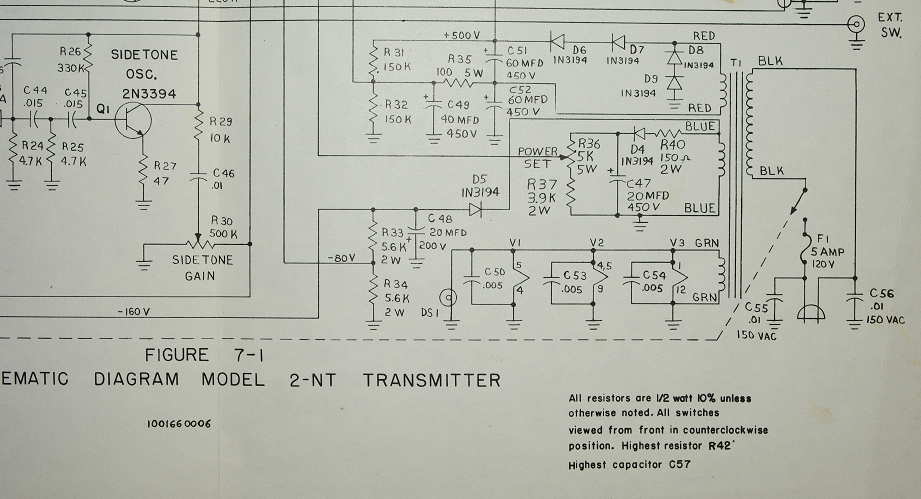
A quick check of the 2NT's printed circuit board containing the bias system components among others, indicated a discolored silicon rectifier (D5) in the bias supply. An in-circuit measurement revealed that it was indeed shorted, basically supplying raw AC across the filter capacitor and shorting out the transformer winding, quickly elevating the transformer's temperature in the bargain ... not good.
Although the diode only has to handle a small amount of current, it was mounted with a heat-producing 2W resistor straddling its top surface. As well, the phenolic circuit board was noticeably discoloured from the heat. I suspect this was the main reason that D5 eventually failed.
My 2NT was an early one, serial #670, so perhaps this parts-arrangement was re-engineered in later models. Once the diode was replaced with a much smaller modern one, of twice the rating, everything returned to normal. The last thing I would want to do at this stage is to burn out the transmitter's unique power transformer, undoubtedly impossible to replace nowadays.
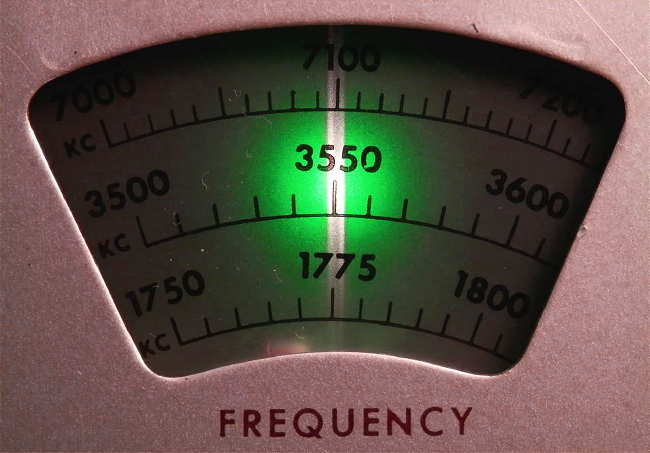
The next bench project will be to refurbish and improve the stability of my Heathkit VF-1 VFO and to mate it with the 2NT.
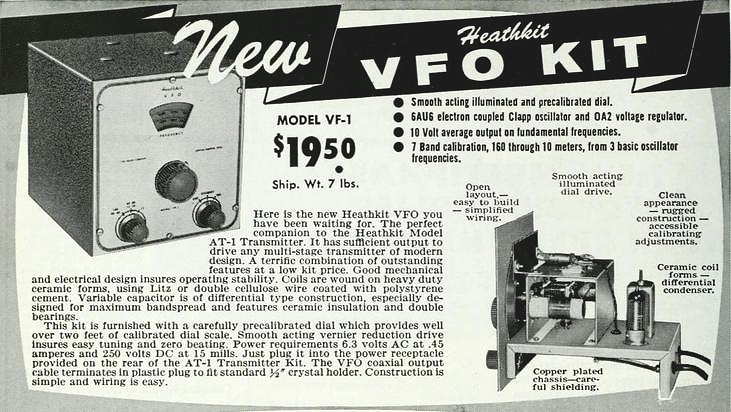 |
| '55 QST VF-1 ad |
Another small quirk noticed on my 2NT is the meter mount. My early model has the meter mounted so low that the silk-screened 'PLATE CURRENT MA.' label is not clearly visible when looking straight-on.
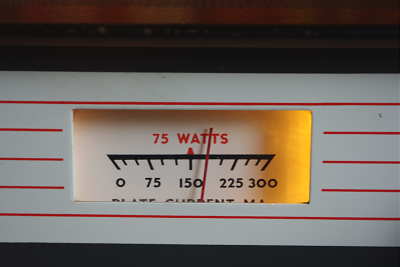 |
| My #670 |
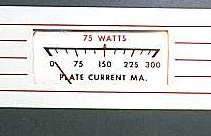 |
| Later models |
You can read many interesting soapbox comments and see some nice NRR station photos from the previous two events here and here, but read with caution as you could easily get hooked. I find pages like this very inspiring and they remind me of the days when QST would publish photos, soapbox comments and exacting equipment descriptions used by each section winner in the annual November Sweepstakes contest.
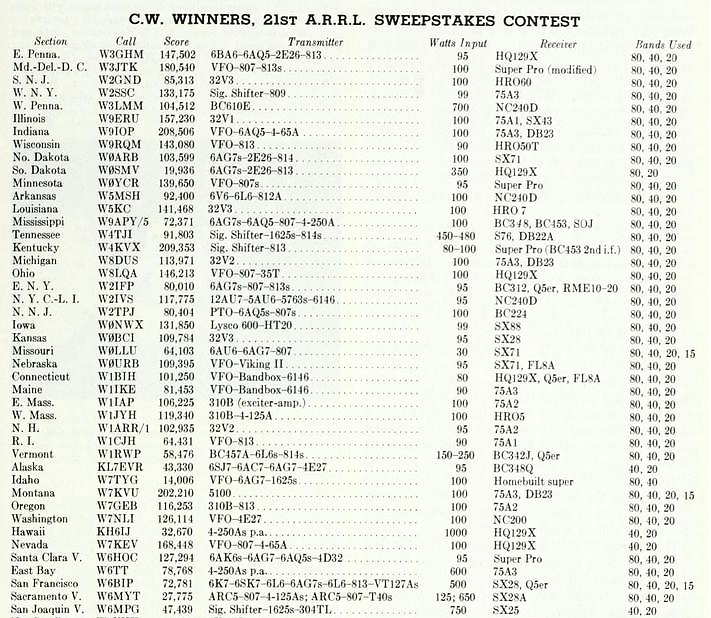 |
| Winner's gear in '55 CW SS - remember these? |
LHS Episode #198: Jingle Bells
 It's time for Episode 198. Thank you for turning in. In this episode, we discuss earthquakes and hurricanes, WSJT-X and FT8, contesting and sweeps, Synergy and Wayland, caveats for open-source coders, the latest Linux kernel, CloudShack, Mexican food and a Scotch of a different color. There is also much, much more. All the best.
73 de The LHS Crew
Talking JT Modes with Ria Jairam, N2RJ – ETH085

In this episode of the Everything Ham Radio Podcast, we talk again with Ria Jairam, N2RJ. This time we are talking about the different JT Modes, JT65, JT9 and the new FT8!
We talk about its uses, how to operate and what you need to operate the different modes.
Check out the show notes to listen to the episode as well as get links to all the different things that we talk about at:
NAQP CW contest.
NAQP CW contest.














