Posts Tagged ‘Contest’
 Young operators in All Asian contest
 June 17th, 2013 |
  Author:
The All Asian DX Contest is one of the more fun ones to participate in. One thing is the DX aspect of it, but I like it also because of the exchange of the age of the operators. In other contests one exchanges boring stuff like serial number 1, 2, 3, … ; the CQ or IARU zone (14 and 18 for me); or the power output. But exchanging the age of the operators gives a little glimpse of the person behind the radio on the other side.
It also makes it possible to make a graph of the distribution of age. I had 62 contacts this weekend, of which 55 were unique. They were mainly in Asiatic Russia and Japan. The average age of the operators was 51.6 years – 7 years younger than me – and the graph shows the distribution. The bar for e.g. 54 is the percentage, 20 in this case, of operators in the bracket 50-54 years and so on.
The graph actually makes me quite optimistic concerning the future of ham radio. There are many young contest operators out there, at least in Asia. This resonates well with what others are saying also. Never before has there been so large activity on the bands as during contests these days.
Show Notes #096
Introduction:
- Welcome to another edition of the Super Happy Crappy Hour!
Announcements:
- The Black Sparrow Media mobile app is again hosted thanks to listener donations. Visit the BSM website to download the app and enjoy all of the BSM affiliated shows.
- CafeNinja and the Tin Foil Hat Show have joined the Black Sparrow Media network.
- If you’d like to participate in the chat room, point your IRC client at the irc.freenode.net server, and join the #lhspodcast channel.
- You can listen to the live show by pointing your media player (VLC, Totem, or whatever) to http://stream.blacksparrow.net:8008/lhslive.
- Our live recording night will be moving to Wednesday evenings (CST) beginning with Episode 97, scheduled for December 12th, 2012.
- Welcome Gnorman to the LHS staff.
Topics:
- TLF Contest Logger.
- Our hosts then embark on several digressions about Gnorman, Lua, and other podcasters.
Feedback:
- Torsten, DL1THM, sends an email describing his use of a Raspberry Pi as an APRS digi using aprx software and as a D-Star repeater using a DV-RPTR board. Thanks, Torsten.
- Greg responded to episode 94 about uses for the Raspberry Pi, including a media PC with Raspbmc and perhaps as a weather station. Thanks, Greg.
- Russ and Richard also talk about D-Star stuff, and D-RATS. (D-RATS has been mentioned in LHS episodes 17, 32, 56, 71 and 90.)
- Comment from the Web site from Leif, KC8RWR, in response to episode 91 where Russ rants about the lack of speakers in the head units of mobile radios. Thanks, Leif.
- Fred, DH5FS, sent a suggestion to consider TLF as a Linux contest logger. Thanks, Fred. Your email inspired tonight’s topic.
- Bill, KJ4KNI, on Facebook expressed his appreciation for help getting Linux Mint 13 with the MATE desktop running on his main computer. He also provides several reasons a ham might wish to use RG6 (75 ohm coax) in radio applications. Thanks, Bill.
Contact Info:
- Contact Richard at [email protected], Russ at [email protected], or both at the same time at [email protected].
- Listen to the live stream every other Tuesday at 8:00pm Central time. Check the LHS web site for dates.
- Leave us a voice mail at 1-909-LHS-SHOW (1-909-547-7469), or record an introduction to the podcast.
- Sign up for the LHS mailing list.
- Sign up for the MAGNetcon mailing list.
- LHS merchandise is available at the Merch link on Web site. Check out the Badgerwear or buy one of the other LHS-branded items at PrintFection.com/lhs or Cafe Press. Thanks!
- Thanks to Dave from Gamma Leonis for the theme music.
Music:
- “Crooked Smile Girl” by Heather Pierson, from her album Make It Mine.
- “Agnostic” by Daniel Bautista from the album 15, courtesy of Jamendo.
The most interesting contact in the CQ WW Contest

Sometimes looking up remote stations on QRZ.com or other sites gives a glimpse of the person behind the callsign. I did this for the Chinese station BY5CD which I contacted on 40 m during the CQ Worldwide contest this weekend.
It turned out to be a club station called “YinZhou Middle School Amateur Radio Club Station” which is located just south of Shanghai.
It is interesting to consider the age of the operators as one can see from the picture. More pictures and some information can be found on their QRZ.com website. With this many young people entering ham radio in China, maybe we will see more stations there in the future. The number of stations is unreasonably low compared to the enormous population of China.
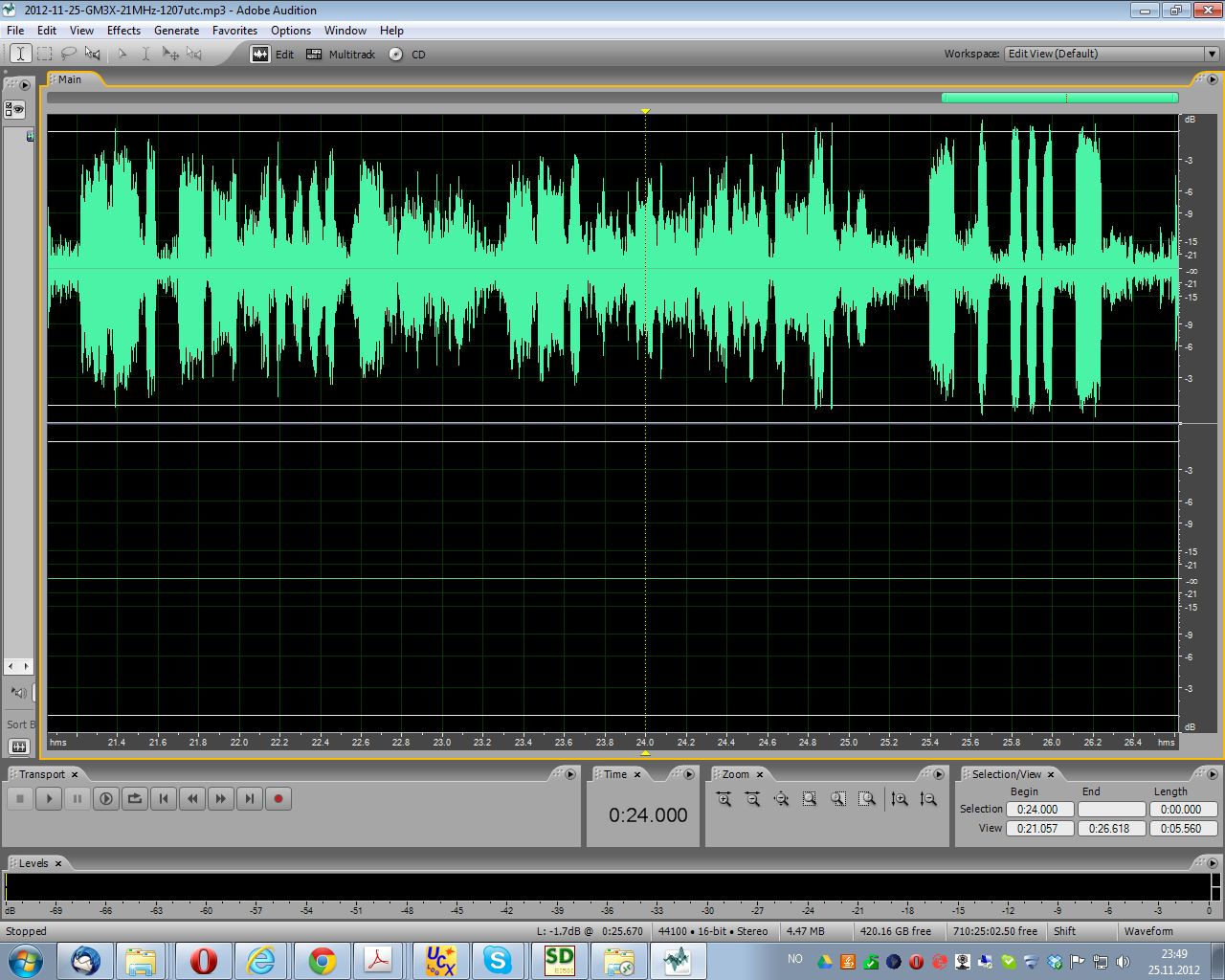 And the most interesting signal was that of GM5X on 21 MHz at 1207 UTC on 25. November. It had a distinct echo which seems to indicate that the signal travelled both on the direct path of about 800 km and the long path of about 39200 km.
The image shows “GM5X GM5X Test”. The long path signal seems to fade in and out as there is much less of it in the last part, the word “test”, than in the second “GM5X”.
QRP To The Field + SOTA = Contest
 Here’s a great opportunity for both chasers and activators. The QRP To The Field (QRPTTF) is an annual QRP CW contest taking place on Saturday, 28 April. This year the organizers of QRPTTF have joined forces with the Summits On The Air program. The theme for the 2012 event is “Get High on QRP”.
As I previously stated, this is a great opportunity for both chasers and activators. While this is a CW contest, I also feel this is a great opportunity even for non-CW enthusiasts to still activate and chase. You can read more about the specifics of the contest, including the rules below. Keep in mind that while QRPTTF rules state “any old hill or lump of dirt”, SOTA rules will apply if claiming for activation or chase points through the SOTA program.
I have this on my calendar and will try very hard to activate a Colorado SOTA summit for a portion of the contest period. Stay tuned for more info.
Until next time,
73 de KDØBIK
QRP TO THE FIELD (QRPTTF)
“Get High on QRP”
SATURDAY, APRIL 28, 2012
1500Z April 28 thru 0300Z April 29
East Coast Time: 1100 – 2300 EDT (UTC –4 hrs)
Mid-west Time: 1000 – 2200 CDT (UTC –5 hrs)
Mountain Time: 0900 – 2100 MDT (UTC –6 hrs)
Left Coast Time: 0800 – 2000 PDT (UTC –7 hrs)
QRPTTF is an annual event to encourage QRPers to operate portable “from the field,” and of course, have fun. This year, we are joining forces with others who also like to operate from the field – Summits On The Air, or SOTA. This will not change the QRPTTF event – just gives us all more stations to work.
SOTA stations operate from designated summits for points and awards. Out of necessity, most are QRPers. This year some SOTA stations will activate summits for their purposes, AND to participate in QRPTTF. For QRPTTF stations, you work fellow TTF stations or SOTA stations … they all go in the log and add to the score. Plus, each SOTA station worked will count as an SPC – like working a DX station – boosting your multiplier.
Therefore, the theme this year is to “get high with QRP” and operate from a hill. Any old hill or lump of dirt near your QTH, or as high as you want to go. Even a SOTA summit if you feel so inclined. To find the designated SOTA summits near you, go here: http://www.sotawatch.org/summits.php and look under your call area. Not all states have SOTA summits.
NOTE: You do not have to operate from a SOTA summit to participate in QRPTTF. Again, any old nearby hill.
Exchange:
QRPTTF Station: RST SPC Name example: 599 OH Jake
SOTA Station: RST SPC SOTA ID example: 599 CO W0/FR-004
SOTA ID = call area plus summit ID; example W0/FR-004 (Pike’s Peak, CO)
Scoring:
Per band: Number of QSOs times SPCs times SOTA stations worked
ADD scores for each band for QSO points
Total Score: QSO points TIMES Multiplier
Multipliers:
x1 home station
x2 TTF hill field station
x3 SOTA summit location
Show Notes #078
Introduction:
- Richard says life has been good, lately, except for Linux Mint, but we’ll get into that in a moment. Announcements and feedback are at the end of the show.
Topics:
- Linux Mint Sux!!! (At least, for Richard.)
- Richard’s never-ending quest for a Linux distro that works for him. In the past few days, he’s tried various Debian-based distributions:
- Linux Mint 12, with Gnome 3, MATE, and Cinnamon, but he didn’t like any of them. Too few configuration options for the desktop and gtkpod didn’t work, and that was a deal-breaker.
- Linux Mint Debian Edition (LMDE): one of the CPU cores wasn’t running; fixed that, installed software and updates, but gtkpod didn’t work there, either.
- Crunchbang Linux: too minimalist and too much configuration.
- XFCE on LMDE was close. Richard replaced the Thunar file manager with Nautilus.
- Xubuntu which is Ubuntu with XFCE. It looked good, was configurable, but lacked a few features.
- Kubuntu, which is Ubuntu with KDE. He tried installing it from the live CD, which took 25 minutes to complete. After the reboot, it generated all sorts of hard drive errors. While it’s possible that the hard drive did fail, but Richard blames Kubuntu for causing the problem.
- Richard’s never-ending quest for a Linux distro that works for him. In the past few days, he’s tried various Debian-based distributions:
- Russ discusses OpenMediaVault, an open network attached storage solution.
- It’s an alternative to FreeNAS.
- Debian-based with a simple install process, while FreeNAS is based on FreeBSD.
- Supports many features of FreeNAS, including CIFS/Samba, NFS, FTP, SSH, BitTorrent (via plugin), TFTP, and DAAP (via plugin).
- Russ tried it in a virtual machine, and it installed easily. Once installed, all configuration occurs through the web browser.
- While it’s perhaps not as mature as FreeNAS, it’s also a newer project, so it’s likely to improve. At the moment, Russ prefers FreeNAS, especially v0.7, but OpenMediaVault may very well catch up and surpass FreeNAS.
- Linux Contesting Software revisited. We covered a few in Episode 70, and here are a couple more.
- Bill, W9YA, one of the maintainers of YFKtest, contacted Richard to inform him that YFKtest has had a major facelift, as well as adding a few features and fixing some bugs. It’s available as v 0.0.10 from the subversion repository. Russ downloaded the compiled version. He picked a contest, filename for the log, entered his call sign, mode, and some other information, but he had trouble entering a contact.
- Minos Contest Logging Software is a contest logging suite for VHF and UHF Amateur Radio Contests. The current version is 1.5.4, and is available as a download or via the Subversion repository. It’s a Windows application, and there are directions on the Web site for running the application using WINE. If only they’d simply re-release with Linux-native code. Russ tried it and it does run quite well under WINE. It’s an open source project under the BSD license.
- Allstar Link Node Update: Russ now has an Allstar Link node number assigned, 28357. Allstar Link offers several packages: Limey Linux, ACID CentOS or Pickle Linux (for the BeagleBoard). Russ has been trying to get the ACiD version running on his LMDE machine so he can use it with his existing Asterisk installation. Meanwhile, Russ has his Echolink station working, node 54711.
Feedback:
- We received a voice comment from Ed, KB4VWA, who’s having trouble with some MFJ TNCs he recently bought at the Dalton, GA hamfest. Richard responds, though he’s had the least experience with MFJ TNCs. There are several possibilities: wrong on-air baud rate, bad connection, wrong dip switch settings, or poor or filtered audio into the TNC. Try using the jack on the back of the radio for the audio. Maybe the radio is not exactly on frequency?
Announcements:
- The OGG and MP3 feeds for the LHS Music and LHS Up All Night audio streams from the LHS web site have new links, so check your settings. The live streaming feed is mp3, so it works everywhere.
- The wAVEgUIDES podcast joins the Black Sparrow Media network! Visit blacksparrowmedia.net/join/ if you’d like to add your podcast to the Black Sparrow Media network.
- Episode renumbering: Ever since naming episodes 18a and 19a, it’s been bugging Russ, so they were renumbered to eliminate the letter suffixes.
- LHS hopes to attend the 2012 Dayton Hamvention in May. Please donate to the cause to help make that happen!
Contact Info:
- Contact Richard at [email protected], Russ at [email protected], or both at the same time at [email protected].
- Listen to the live stream every other Tuesday at 8:00pm Central time. Check the LHS web site for dates.
- Leave us a voice mail at 1-909-LHS-SHOW (1-909-547-7469), or record an introduction to the podcast.
- Sign up for the LHS mailing list.
- Sign up for the MAGNetcon mailing list.
- LHS merchandise is available at the Merch link on Web site. Check out the Badgerwear or buy one of the other LHS-branded items at PrintFection.com/lhs or Cafe Press. Thanks!
- Thanks to Dave from Gamma Leonis for the theme music.
Music:
- “Requiem For A Fish” by The Freak Fandango Orchestra from their album Tales Of A Dead Fish, courtesy of Jamendo.
- “Boats (Swept Away)” by I Am Not Left Handed, from their album Time To Leave, courtesy of Jamendo.
LHS Episode #078: Kubuntu is Bloodthirsty
 In this episode of Linux in the Ham Shack, our intrepid hosts put aside idle banter, childish meandering and silly stories in favor of true content, both ham radio and Linux related. All right, that doesn’t happen even a little bit. Instead, Richard has a lot of fun telling you all the trouble he has with Linux Mint Debian Edition, all the while mentioning a bunch of other operating systems he’s tried recently including Ubuntu, Kubuntu, Crunchbang among others–letting you know what’s wrong with all of them.
Then there’s some discussion of svxlink, an Echolink client and server application for native Linux environments, Allstar Link, Open Media Vault, contest loggers and a whole bunch of other stuff besides. Ahh, perhaps there is some content here after all. Hope everyone enjoys this episode and can perhaps contribute a dollar or two towards the Hamvention fund. It’s coming up soon and we hope to see you all there.
73 de The LHS Guys
QSO Party Texas Style
 Just a few weeks ago I blogged about QSO Party Colorado Style, being that Texas is my birth state and where I lived until around the age of 32 (I’m a few days away from 45) I decided I would spend some time operating in the contest. While I do realize after operating in two QSO parties in less than four weeks, what I’m going to say next may not make sense, but I don’t consider myself a serious contester. In the four years I’ve been licensed, I’ve only ever operated in a handful of contests and have only submitted logs two or three times. Perhaps I’m more of a casual contester.
The reasons for my lack of contest involvement could be the same as anyone else’s. I don’t always have hours and hours to dedicate to operating a contest and when I do I may not want to spend all the time operating in a specific mode or band. But both the Colorado and Texas QSO parties occurred when I had several hours to devote and I enjoyed operating in both to represent my home state and birth state proudly.
Unlike the Colorado QSO party, the Texas QSO party is two days long (12 hours on Saturday and 6 hours Sunday). Of the total 18 hours, I estimate I operated about 5-6 with the majority of that time spent on Saturday.
Being the casual contester that I am, I eased into my Saturday morning just like any other Saturday. I grabbed my first cup of coffee and followed up on the news. Of course the BIG news was where did the bus sized satellite crash? Since I didn’t hear anything crash through my roof I assumed it was not anywhere near Colorado. I quickly read through my Facebook, Twitter and Google+ threads and by that time it was time for cup-o-coffee #2 and a more suitable time to turn on the HF rig and get the computers fired up.
Over the past few weeks, HF conditions have been extraordinary and the week leading up to the Texas QSO party weekend was no exception. I’ve read tweets and other blog postings talking about openings on 10, 12 and 15 meters. This is great news for those US technician class hams who have an HF rig. Remember you have HF phone privileges on 10m from 28.300 to 28.500. Listen around the 10m calling frequency of 28.400. In addition to phone, you also have RTTY and data privileges from 28.000 up to 28.300 including the JT65 frequency of 28.076. There is no reason you can’t get in on the fun as well. Want to know more about JT65? Check out my practical amateur radio podcast episode #46 you’ll find tips and links for this awesome mode.
Anyway, as I said HF conditions have been amazing and fingers crossed I would have no trouble working Texas from Colorado. As I was applying my second cup of coffee, I tuned around 20m listening for other Texas stations. I figured I would start off by using the “search and pounce” method and then find an open frequency and “run” for a while. As I tuned up the band and then back down all I heard was static and the occasional high powered net controller running whatever net happened to be taking place at the time. I checked Twitter and even tweeted that it appeared band conditions were really poor and the contacts were just trickling into the log book. Keith, G6NHU shared with me a blog article he had written earlier explaining why the HF bands weren’t playing well. By the way, if you don’t follow Keith’s blog….you should. Keith has an ongoing project called QSO 365, as he strives to have at least one QSO per day in 2011.
After stepping away for a few hours to get a few projects done around the house, I returned to find the afternoon conditions much improved. I quickly worked the stations up and down 20m and then found me a spot around 14.280 and began calling CQ Texas. I found I could get brief runs going, but it was mostly still slow going. At the end of Saturday evening I had managed to work 40 Texas stations in 28 unique counties. The stations I worked all commented on my strong signal. I was running 100w into my hamstick dipole. I must also admit their signals were all fairly strong as well with true 59+ readings. I only had trouble with a couple of mobile stations, but worked them in the end.
My two most memorable stations worked on Saturday would have to be NA5DV and NU5DE but of course for two different reasons. NA5DV was operating from the Battleship Texas which is anchored just beside the busy Houston ship channel and near the San Jacinto Monument. As a child we would visit the Battleship Texas every few years and I have very fond and dear memories of climbing on and exploring around this incredible ship. The Battleship Texas was commissioned in 1914 and served proudly defending the United States of America and representing the great State of Texas in both WWI and WWII. Working a ham station on board this beautiful lady and eventually getting the QSL card for my collection was the highlight of the day.
Yes, I said I had two memorable moments on Saturday, NU5DE (yes that is a vanity call sign) is a naturist amateur radio club near Austin, Texas. After working this station, I tweeted “Just worked NU5DE. This is a naturist ham club. I’m not sure how they were dressed, but I kept my clothes on”. Hey…amateur radio is for anyone and everyone. If this is the lifestyle they enjoy…then I’ll only take my hat off to them. ha ha

After a somewhat sleepless night and getting up/staying up from midnight to about 3:30 AM, I worked some RTTY stations and then got started with the Texas QSO party again on Sunday mid morning. I worked another 15 stations to top out at 55 total stations worked and earning a total score of 3,740. My total Texas county count was 32 of 254. I did manage to work my birth county (Henderson) and the county where I grew up (Anderson) along with counties I’ve lived in including Smith, Dallas, Travis and Williamson. But I’m not really a county chaser. 
I’ll have to check the contest calendar to see what future contests catch my eye and match my available time. But the Colorado and Texas QSO Parties are a must for 2012.
Until next time…
73 de KD0BIK













