Posts Tagged ‘cheap VHF’
 Super-sizing the “cheap Yagi” (Part 1)
 August 4th, 2010 |
  Author:
 One of the frustrations of doing VHF on the cheap is getting enough gain to make your low-power signal loud (or simply being heard) at the other end. I had a couple of options with my 6-element WA5VJB “cheap Yagi” on 2 meters:
- Increase the height of the antenna. This is impractical at the present QTH without installing a tower. Actually, the tower would have been possible but I wasn’t ready shoot first and ask questions later with it. Nor was I ready to have my folks spring some Rohn 25G out of storage in their garage for the trip here when I had the opportunity (a truck bringing some furniture from them).
- Run lower-loss cable. I have regular old RG-8 (PE dielectric) running up to the antenna. It’s only about a 50-ft run. So, I’d be hard-pressed to do a lot better. I did figure out how to recycle improperly-installed N-connectors for LMR-600 from a dumpster-diving excursion. Although I have twenty-some connectors, I haven’t yet secured any scraps of LMR-600 to use. This is a future consideration. At $1.50/ft, LMR-600 would still cost $75. No deal.
- Stack multiple 6-element antennas. This is actually a good idea that I’m keeping in the back of my head for the future. It would be nice to do something like this. Maybe some day.
- Launch a rocket to do a chemical release whenever/wherever I needed a sporadic-E layer. Unfortunately, you can’t launch rockets over land. (Update: I was reminded later that this is not 100% correct.) Furthermore, at a megabuck per shot, it’s not cost-effective.
- Dispense with the 6-element design and go for something bigger.
I elected option #5.
The first step was to consider suitable designs. I tried scaling the 11-element 432-MHz cheap Yagi to 144-MHz. Fail. A NEC model showed that the pattern stunk and the input impedance was pretty far from 50 ohms. Knowing that W5UN had built an array of wood-boom antennas for his EME setup, I looked into readily-designed options.
The ARRL Handbook (1993 edition for reference) and ARRL Antenna book (18th edition) have the K1FO optimized Yagi designs in them. This antenna has been around for a number of years (clearly) and is available commercially from Directive Systems. It seemed like a relatively good choice. So, I moved forward with it…
Feeding the WA5VJB cheap Yagis
The WA5VJB cheap Yagis are a great way to get on VHF/UHF without spending a fortune on commercial antennas. While it is practical on the UHF/microwave bands to use a copper driven element, it is less practical on the 144 and 222 MHz bands. I know that McMaster carries copper and brass rods, too. But, I also like to have a coax connector at the feedpoint. Since I am in the process of building what amounts to a “super cheap Yagi” (note that’s not a “super-cheap Yagi,” the hyphen matters; will report on this in the future), I figured I would share my feedpoint for aluminum driven elements.
While wandering through the electrical aisle of the local big box hardware retailer about six months ago, I discovered the Thomas and Betts ADR6-B2 (try the ADR6 for a drawing of a similar part) grounding lug. This looked like a good candidate for the cheap Yagi feedpoint, especially costing only $1 for a pair. In order to fit an SO-239 flange-mount connector to the ADR6-B2, I cut off the portion of the lug with the bolt hole and drilled my own hole (#43) and tapped it 4-40. I did the same to the other piece. I did not cut off the lug on the second one, but I should. Then, I soldered a short piece of wire to the center conductor of the SO-239 jack and added a lug to it. Here are the parts so far:
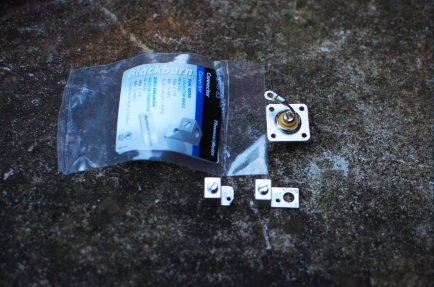
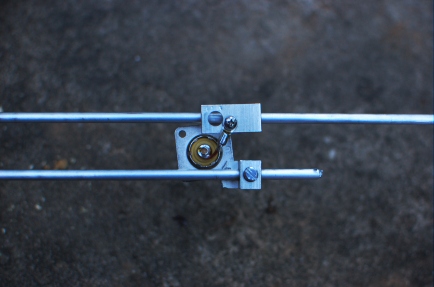
Then, I assembled the whole mess on the J-shaped driven element (dummy used for photos) using two 3/8″ 4-40 screws and a lock washer. Note that the ADR6 lugs are installed on opposite sides of the element.
And, after installing on the wooden boom, it looks like this:
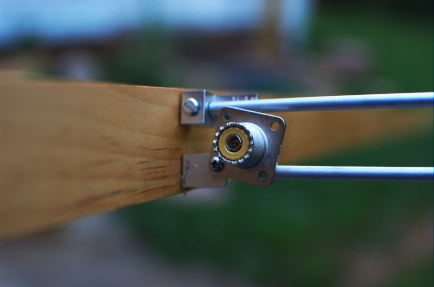
It’s not quite square and some mechanical strengthening is in order before it goes up in the air. But, this is a considerable improvement over what I’m using now. Ty-wraping the coax to the boom will provide considerable relief to the connector and it’s attachment. More details will be forthcoming on the antenna, if it works. Stay tuned!
IC-290H dial frequency offset
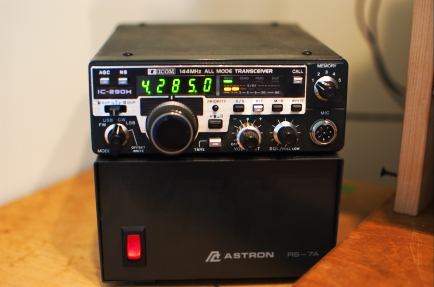
Some time back, I had the good fortune to stumble across a broken IC-290H at an attractive price. The IC-290H is a synthesized mid-1980s 25-watt 2-meter all-mode transceiver. Since I had been contemplating a radio to use as the IF to my W1GHZ transverters for 903 through 3456 (yeah, still need to build/integrate all of these), I jumped. The problem was described as an offset of some tens of kHz between the dial frequency and the actual transmit and receive frequencies. Since the IC-290 lacks a user community like the TS-600 and TS-700 (my other 2-meter all-mode radio), I went to Google and then posted a quick inquiry on the Stanford VHF e-mail list to see if this was a common problem. Google produced nothing and the VHF list produced the usual “get the Service Manual” response. Since I already had the Service Manual thanks to the previous owner, I was set.
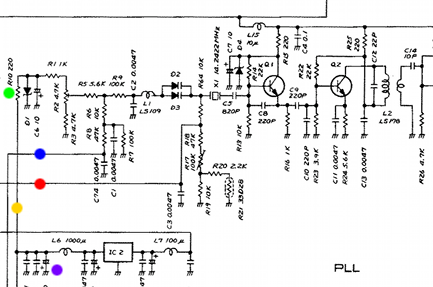
The synthesizer (“PLL”) in the IC-290H has at its heart a VCXO (shown above). The control voltage biases varactor diodes D2 and D3 in a tank circuit with crystal X1 operated between the series and parallel resonant frequencies (as a very high-Q inductor). Contributions to the control voltage come from the microprocessor (red dot), the receive incremental tuning (RIT, blue dot), and an overall bias of -9 V derived from 5 V using DC-DC converter IC2.
In the “PLL Adjustments” section of the Service Manual, the VCXO adjustments are outlined, checking the synthesizer output with a frequency counter. I noted that as I changed rotated the VFO encoder on the front of the radio and the digits changed on the display, the output frequency of the synthesizer changed accordingly. Similarly, the RIT caused the frequency to shift. Neither of these things were surprising since I could tune in different stations before. In USB mode at 145.998.5 MHz, the synthesizer should output at 134.250.0 MHz. I read it at 134.230.21 MHz, clearly the source of the almost 20-kHz offset. I nudged potentiometer R2 (against the vehement warnings of the Service Manual) and the output didn’t change. For good measure, I swept R2 over its entire extent with no change.
R2, it seems, controls amount of the available -9 V bias applied to the varactors. I checked the -9 volts line. Zero. Who stole the bias from the cookie jar? The 5 V line was sagging down to 4.23 V.
I removed IC2, which is in a metal can that resembles an overgrown Mini-Circuits mixer and has only “DP-1″ stamped on the cover in black ink. For kicks, I drove this little guy with 5 volts into no load and got well over -100 V out. Did this punk destroy other parts in my synthesizer? I put this question to Dad, who happened to be here over the weekend. He suggested that it might require a load to produce a regulated output. Good thinking. Nothing on the synthesizer board appeared to be charred. So, my theory was unlikely and I proceeded.
Without IC2, the 5 V line bounced up to 4.95 V. And, the output side (connected to L6) showed a DC short to ground. If you trace the circuit from the output of IC2 to one of the legs of R2, nothing should show a DC short. I looked for bridged solder traces. None. Taking the divide an conquer approach, I removed R10 (green dot), to isolate the entire RF portion of the circuit. Still shorted. So, this left the following three suspects: two 0.1 uF ceramic disk capacitors and a 10 V, 100 uF electrolytic. Since electrolytic capacitors, especially older ones, have a bad reputation for causing problems, I interrogated it first (C20, purple dot). Bingo.
The only 100 uF capactor I had on hand that even came close to fitting was a 50 V unit from a previous repair. I squeezed it in—it’s the big brown one against the edge of the case in the center of the photo below. Note IC2 “DP-1″ in the lower right corner.
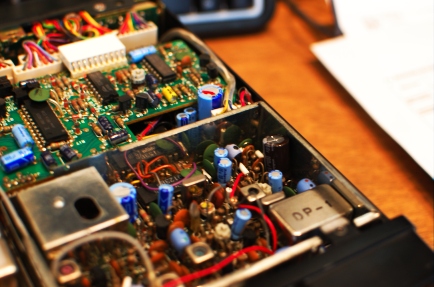
So, I plugged the radio into a power supply and antenna. And, low and behold…it was about back on frequency. So, I completed the synthesizer and RIT adjustments in the Service Manual and put it back together. It actually receives WA1ZMS/B on 145.285.0, which, Doppler notwithstanding, is GPS-locked at 145.285.000… Stay tuned for the low-drive transverter IF modification in the next few months once I start building them again.
50-MHz Progress
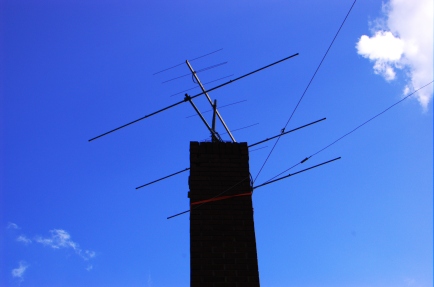
As I mentioned in the previous post, I’ve made some strides toward getting on 6 meters over the weekend. I assembled the 3-element Yagi last weekend. It was leaning against a post in our back yard pointing skyward for a few days. I told Sarah that I was thinking of adding 18,431 more of these antennas so I could compete with the 50-MHz radar at Jicamarca. She was not amused. I hadn’t even mentioned anything about megawatts. Yes, Virginia, the mast in the photo is not square. The top portion of the mast is a little skewed in the rotor and it’s attached with rusty U-bolts that I’ve never loosened. I’m still turning the antenna with the TR-2, even though I have a T2X out here now. I will do that swap eventually. But, for right now, the TR-2 is doing fine.
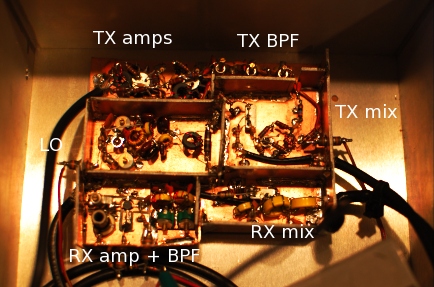
In order to start moving the transverter toward its new home in a beautiful rack-mount enclosure that previously housed a 900-MHz digital repeater (not included when I obtained the box, unfortunately), I had to “re-arrange its internal organs”, as a menacing extraterrestrial used to say in Space Quest. Sarah wonders why I schlep all of this crap from place to place with us. I’ve had that rack-mount box longer than we’ve been married! It was just waiting for a chance to serve in my shack. Anyhow. You can see the layout above. Sarah says it looks like a doll house. Pretty sweet house, if I say so myself.
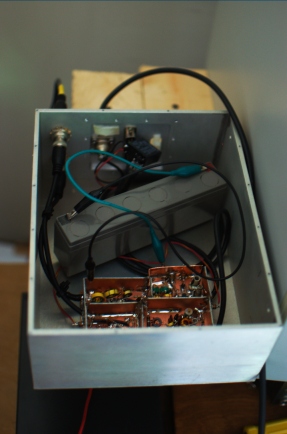
Here’s another view of the partially-integrated box. I’m running it off a battery because I don’t have the power supply subsystem installed in the box, yet. It’s really just a PA and some control circuitry away from operational. Although, I would like to align the TX side with a spectrum analyzer at some point.
I heard quite a few signals in the ARRL contest over the weekend. W5ZN comes to mind, as well as a couple of locals like N4QQ, who lives just a stone’s throw away on the other side of the Beltway (aka the wrong side of the tracks). I suspect that the locals would move the S-meter a little more (like past S9) if I put an IF amplifier in after the RX mixer. But, I’m not really keen to do that unless I have to.
Schematics will come once I’m finished. But, nothing about this so far has been rocket science (or brain surgery, as the rocket scientists say). I’ve just been following the Handbook.
Magic: right place, right time
I put the 3-element 50-MHz Yagi (Cushcraft A50-3S) up yesterday morning with the 6-element 144-MHz Yagi (WA5VJB design) above it—just in time for the ARRL June VHF contest! The 50-MHz transverter is not yet complete, although I have the RX side done and the TX side makes about 250 mW. It’s not integrated and I haven’t started building the PA. Bummer because yesterday was a pretty good Es day from what N3OX told me last night.
With 10 watts from a TS-700S to a 6-element Yagi at 30 feet, there’s not a whole lot you can work on 144 MHz. Plus, everybody was on 50 MHz, so I could only hear the multi-operator and serious single-operator stations on 144 MHz locally. Around 21:00 local time, Sarah and I had just returned from a walk. I had pointed the beams WSW (my best shot from here is SW) and was slowly tuning up and down the band hoping for some tropo enhancement or something…and after a few passes, I heard on 144.210 MHz…
“CQ contest, CQ contest, looking for sporadic-E on two meters, CQ contest, Kilo Five Quebec Echo…”
That’s something alright! I figured the beam was in approximately the right place and gave him a call. He came right back and we exchanged grids. He was there for a few minutes and then disappeared as suddenly as he had appeared. I know he made at least one other QSO, but he was starting to fade by that point and I couldn’t hear the other side. Cool!
My logging software calculated the great circle distance as 1037 miles (1669 km) between FM19 (me) and EM31 (him). Either it was one heck of big meteor or (more likely) one heck of a sporadic-E opening. Either way, I’m pleased. Want more of that!
Odds and Ends
Yesterday, I revisited this post listing on-going projects from December 2009. Some things have changed, some remain the same.
The computer stuff has all been crossed-off the list, except that the home server is off-line with a dead power supply (or motherboard). I’m somewhat loathe to spend any money on it, but I should be able to pick something up.
While it would probably have been cheaper to buy one of the HF/VHF/UHF combo radios, I’ve set off stupidly down the trail of building (and interfacing) transverters. I am just three amplifier stages away from having 3-5 watts on 50 MHz! …plus the interfacing. I’ve decided that interfacing transverters to radios is more difficult than actually designing and building the transverters themselves. I built the 903-MHz W1GHZ transverter during the Winter, but haven’t tried it on the air just yet. W8ISS announced recently that he had some leftovers from the group buy of W1GHZ transverter parts, including boards for 2304 and 3456 as well as some G6Y relay kits. I bought the lot. I have enough MMICs and chip caps in the shop to build these and since I’ll need to order a couple of mixers for the other transverters, I can hit the Mini-Circuits minimum order. Sometime. Microwaves may all get pushed off to Fall and Winter.
Through a strange coincidence, my wife and I independently decided that it would be a good idea to move my ham shack. The new location is closer to the center of activity in the house, which means I’ll operate more radio and be more accessible to her while I’m doing it. But, the feedline and rotator cable no longer reach my 144-MHz Yagi. Fortunately, I’ll be able to raid the K8GU coax stash shortly. In the mean time, I’ve been missing what appear from the Hepburn maps to be epic tropo conditions. Stuff happens.
QSLing, notably my favorite QSL topic—bureau cards. All bureau requests for KP4/K8GU have been processed. I ran out of CE/K8GU cards with 10 to go. I will run some more of these from a photo printer in the next couple of days. Piles of PJ2/K8GU, K8GU, and (go figure) AA8UP cards remain. I will get the PJ2 cards done this weekend since I have a box of cards on-hand. K8GU and AA8UP cards are awaiting a redesign.
Although it sounds like a lot, relatively little is getting done on any of these things thanks to an outdoor project at home. More on this in the future.













