Posts Tagged ‘amateur’
 News: Olivia Digital Modes on HF
 July 25th, 2026 |
  Author:
 Greetings Olivia and digital mode operators,
GREAT NEWS! WEBSITE UPDATE!
Here are the big three new features:

Live spotting is now available!
- Live Olivia spotting. Just like on POTA and other sites, this is a live show and tell of your activity either by self spotting, or spotting stations you copy. Dedicated live spot page, you can view even on a cell phone.
We are excited to announce a major new feature now live on OliviaDigitalMode.org: an interactive Live Station Spotting tool designed specifically for our digital HF community. Inspired by popular spotting platforms like DXWatch and POTA.app, this system makes it easier than ever to see who is active on the bands, find open Olivia QSOs, and share your own station reports in real time.
Come Join the Live Spotting of Olivia Digital Mode
Whether you are hunting for a contact or tracking band openings across different bandwidths and tone counts, the new spotting tool brings several powerful capabilities straight to your browser:
- Real-Time Live Feed: The spotting page automatically refreshes every 15 seconds, ensuring you always see the latest on-air activity without needing to manually refresh the page.
- Smart Spot Grouping: When multiple operators spot the same station, the system automatically groups those reports together into a single clean line. Instead of duplicate entries cluttering your view, you will see the station, frequency, mode, and a list of all operators who spotted them.
- Timeframe Visual Highlighting: You can easily filter for fresh activity. By selecting a window of 5 minutes, 15 minutes, 30 minutes, or 1 hour, brand-new spots are visually highlighted so you can jump on active signals immediately.
- Flexible Display Options: On the dedicated spotting page, you can choose how many spots to display at once (from 10 up to 250 rows) and toggle between a grouped callsign layout or a detailed chronological log.
- At-a-Glance Homepage Widget: A lightweight summary widget on the main homepage shows the top 5 to 10 most recent spots the moment you arrive on the site.
- Fast Performance and Historical Archives: Active spots stay on the main board for 12 hours to keep queries ultra-fast. After 12 hours, spots automatically move to a historical archive where they remain available for band activity research and propagation analysis.
To keep the spotting board reliable and free of spam, posting new spots will require a simple, free operator account. When you register, you will just need to include a short note for the site administrators to verify your callsign and approve your posting access. Once approved, you can log in anytime and share spots whenever you are on the air.
- Live Calendar of Olivia Events. I have now put live the active calendar functionality on the site, and seeded it with possible calendar events. I will start planning our upcoming events – which require YOUR input on such things as, monthly sprints, special events that you want to do, and, our quarterly QSO parties.
- Feedback form. This is a community website. Now, you can leave feedback; what would you like on the website. What should be different? What is not working? What is working? Please leave us feedback.
Come be a part of this conversational digital mode!
Echoes of CW: A Signal Corps Tribute to Virginia L. Scott and the WAVES of WWII
Looking at this historic photograph brings back a flood of memories from my own time in the Signal Corps. It shows WAVE operator Virginia L. Scott in March 1943, sitting in the Code Room of the U.S. Navy Radio School in Madison, Wisconsin.
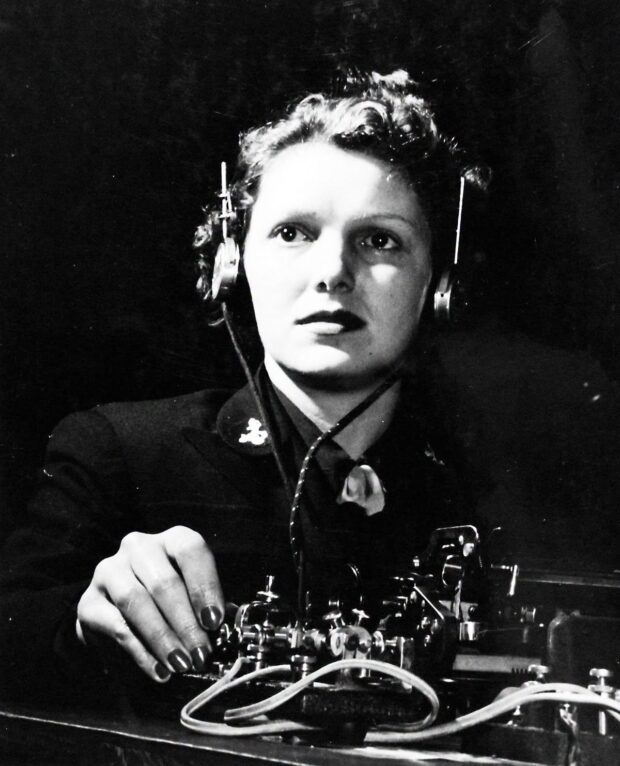
WAVE operator Virginia L. Scott in March 1943, sitting in the Code Room of the U.S. Navy Radio School in Madison, Wisconsin.
The photograph, catalogued in the National Archives as 80-G-431533, captures an ordinary phase of the highly technical work carried out by the WAVES during the Second World War. Seeing her at that workstation with her telegraph key, headphones, and operating table under the glare of direct lighting, I can almost hear the familiar rhythm of CW ringing in my own ears. It is a language of its own, and as an amateur radio operator who loves sending and receiving Morse code, I know exactly the kind of deep focus she is holding in that frame.
During World War II, the Women Accepted for Volunteer Emergency Service stepped up to fill critical roles so that men could be sent to combat zones. Virginia Scott was part of that groundbreaking wave of female personnel who took on demanding technical jobs in the Navy. As someone who has served in military communications, I have immense respect for the structured training and standardized procedures these women had to master.
Radiotelegraphy was the primary transmission tool of the era, the absolute lifeline of naval operations across vast and unforgiving oceans. Long before digital uplinks, it was the sheer skill of the operator that pushed the message through the static.
Her hand rests on that bug key in a way any seasoned Morse code operator would recognize immediately. Sending messages via CW is an art form that requires strict physical and mental discipline. You have to maintain a fluid, consistent rhythm so the operator on the other end, perhaps dealing with heavy interference on a ship thousands of miles away, can copy the signal without error. Scott is entirely focused on executing her message while maintaining the standard posture required by her training. It reminds me so much of the pride we took in the Signal Corps, ensuring every dit and dah was sent with perfect clarity. Dealing with secure information meant there was absolutely no room for sloppy sending.
This specific photograph was originally taken by the U.S. Navy for internal use, but it captured something so profound that painter John Philip Falter used it as a direct reference for a Navy recruitment poster. His painting faithfully reproduced the layout of the scene, turning a moment of routine operational work into a powerful piece of public communication. For anyone involved in the history of communications, and certainly for a fellow CW enthusiast like me, this photo represents a concrete example of how vital these women were. They kept the frequencies alive and proved that the steady hand of a skilled operator was an essential weapon in winning the war.
Here is one of the paintings based on this photograph, and served as a recruitment poster for the WAVES program.

This “It’s a Woman’s War Too! Join the WAVES” poster by John Falter was produced around 1942 as a World War II recruitment tool for the United States Naval Reserve.
This “It’s a Woman’s War Too! Join the WAVES” poster by John Falter was produced around 1942 as a World War II recruitment tool for the United States Naval Reserve. The WAVES (Women Accepted for Volunteer Emergency Service) was established in July 1942, allowing women to serve in the Navy in non-combat roles, such as radio operators and clerical staff. Artist John Philip Falter was a well-known American painter who created numerous propaganda posters and Saturday Evening Post covers, often featuring realistic portraits.
A Pileup? What It Is And How To Work One
Welcome to the chaotic, thrilling world of the HF pileup. Whether you are the one calling CQ from a park in Nebraska or the one hunting a rare DX station, success relies on rhythm, frequency management, and a deep understanding of human behavior.
Here is a proper look at how a pileup appears on a modern display, followed by a complete guide on how to survive it.

A “pileup” on shortwave amateur radio frequencies. The main station is at the low frequency, and stays put. The hunters spread out, above, and call on a single frequency somewhere in the calling window of frequencies (I.e., up five to ten).
Over my decades of working Morse code (CW on amateur radio), I have learned a few critical things about how to navigate the chaotic, thrilling world of the HF pileup. When a rare station or a Parks On The Air (POTA) activator goes on the air, dozens or even hundreds of operators might try to make contact at the exact same time. Working a pileup is an art that takes time to master. Whether you are the one calling CQ from a park in Nebraska or the one hunting a rare DX station, success relies on rhythm, frequency management, and a deep understanding of human behavior.
One of the most important strategies is to determine the operating style of the DX station, specifically discerning how that operator scans the pileup for the next station to work. With modern waterfall displays, that process is MUCH easier. As an example, I worked the Temotu DXpedition (H40RH) that had just started a few hours prior to my attempt. I broke through with only five calls into the pileup, and it took me a mere 60 seconds to call and get an answer. Of course, I first listened and watched the waterfall for about five minutes to get a hang of the operating style of H40RH. This was on 10 Meters where 28.026 MHz was the DX frequency. We callers spread out five to 15 kHz UP in frequency from the DX station because we never want to cover up the DX station with our own signals. Even with a long carrier of intentional interference visible on the waterfall, the visual aid of the SDR made the catch possible. Temotu was a new country for my DXCC, so I am incredibly pleased to have made the contact!
When You Are the Hunted (The Activator)
A Guide To Survive The Pileup
When you are the station that everyone wants in their logbook, you are the conductor of the orchestra. If the pileup senses hesitation, chaos ensues. You must dictate the pace, for both CW and SSB operations.
Controlling the Pileup on CW
Establish a Predictable Rhythm: Your CQ, your exchange, and your QRZ should follow a strict pattern. Consistency allows hunters to time their calls perfectly. If you change your cadence, the pileup gets messy.
Run Split for Large Piles: If the pileup merges into a single continuous drone, go split immediately. You might send “UP 1” to tell callers to transmit one kilohertz above your listening frequency. This spreads the callers out. Send your “UP” frequently enough that the self-appointed pileup police do not take over your transmit frequency. I suggest sending “UP” after each successful logged contact (QSO).
Own the Partials: If you only pull “NW7” out of the noise, send “NW7?”. Do not send “QRZ?” immediately. Stick to that partial call until that specific station finishes the exchange. If they fade out, clearly send “QRZ?” to reset the pile.
Adjust Speed to Control Volume: A slight speed increase (bumping up 3 to 5 WPM) will naturally thin the pileup down to the more experienced operators. Dropping your speed will invite the newer operators back in.
Receiver Management: Back off your RF gain and use a wider filter than you might expect (around 400 to 500 Hz). A filter that is too narrow will cause you to miss the operators who are smartly calling slightly off-frequency.
Controlling the Pileup on SSB
Command with Your Voice: Speak clearly and maintain a steady, authoritative tone. Avoid shouting. Just like in CW, a predictable rhythm helps callers know exactly when to key their microphones.
Use Standard Phonetics: Stick strictly to the standard NATO phonetic alphabet (Alpha, Bravo, Charlie). Cute or custom phonetics confuse operators who do not speak English as their first language.
Acknowledge and Isolate: When multiple voices blur together, listen for the last phonetic letter you can understand. If you hear “Sierra,” say “The station ending in Sierra, go ahead.” Ignore everyone else until that station completes the contact.

My POTA / Portable HF station (a low-power, or, QRP, station).
When You Are the Hunter (The Chaser)
When you are trying to break through a massive wall of sound, raw output power is secondary to timing and sharp observation.
Breaking the Pileup on CW
Listen First, Key Second: Before touching the paddle, listen to three or four complete exchanges. If the activator is working split, figure out their pattern. Are they tuning from the bottom up? Top down? Find where they listened last, and place your transmit frequency just above it.
Use XIT (The Golden Rule): Never perfectly zero-beat the DX station if others are calling. To the activator, three zero-beat stations merge into a single tone. Use your Transmitter Incremental Tuning (XIT) to shift your transmit frequency by 30 to 50 Hz. This slight difference in pitch makes your signal pop out of the receiver passband.
Time the Tail-End: Wait for the massive wall of sound to begin fading, and send your call exactly as the main group finishes. A perfectly timed tail-end call lets your suffix ring out in the clear.
Send Once: When the DX sends “QRZ?”, send your callsign exactly once and listen. Sending your call multiple times just causes interference and slows down the entire operation.
Follow Instructions: If the DX sends “NW7?”, and that is not you, keep your hand off the key. Transmitting over the station they are trying to work only prolongs the pileup for everyone.
Breaking the Pileup on SSB
Study the Cadence: Just like with Morse code, listen to the activator to find the rhythm. Wait for the exact moment the activator stops speaking before you key up.
Drop Your Call and Wait: Say your full callsign once using standard phonetics, then unkey and listen. If you are tail-ending, you might just drop the last two letters of your callsign precisely as the noise floor drops.
Adjust Your Pitch: If you have equalization controls on your radio, boost the mid-to-high frequencies on your microphone audio. A slightly punchy and higher-pitched voice will cut through the bass-heavy rumble of a dozen other stations calling at once.
Working a pileup tests your patience and your ear. Whether you are tapping out Morse code or speaking into a microphone, the operator who listens more than they transmit almost always makes the contact first.
Propagation and the Pile-Up
As many of you know, I was the space weather and radio propagation columnist in CQ Amateur Radio Magazine from 2001 through its demise. I strongly advocate for all HF radio operators to understand the basics of radio wave propagation on shortwave frequencies. There are a lot of myths and frankly, horrific theories on how radio waves propagate.
Understanding how the ionosphere refracts radio waves is a crucial tactical advantage. The behavior of a pile-up changes dramatically based on the frequency band you choose and the current mood of our sun.
The Sun Dictates the Rules
The ionosphere is charged by solar radiation. When solar activity is high, higher frequencies become usable for long distances.
Solar Flux Index: The SFI is a great indicator of overall ionization. A higher SFI means better conditions for the higher HF bands. When the SFI climbs, bands like 15, 12, and 10 meters open up globally.
Geomagnetic Storms: Measured by the K-index, these storms can disrupt communications entirely. A high K-index often absorbs signals crossing the polar regions. This can suddenly mute a massive European pile-up for North American operators.
Fading: The ionosphere is always shifting. Signals will constantly rise and fall in strength, which is known as QSB. A smart chaser listens for the rhythm of this fade and throws their callsign into the pile-up exactly when the band peaks for their specific location.
How Bands Shape the Pile-Up
Every amateur radio band has its own personality. The pile-ups you encounter will reflect these differences perfectly.
10, 12, and 15 Meters: These high bands are daytime frequencies that thrive on high solar activity. When 10 meters opens up, signals can be astonishingly loud with very low atmospheric noise. Pile-ups here can ignite suddenly and stretch very wide across the frequency spectrum.
20 Meters: This is the traditional workhorse band for global communication. Pile-ups on 20 meters are massive, sustained, and densely packed. You will often compete with high-power stations and massive beam antennas on this frequency day or night.
40 and 80 Meters: These low bands come alive at night. They are heavily affected by atmospheric noise and static crashes. Breaking a pile-up here requires an exceptionally well-tuned ear and the ability to pull faint CW tones or muffled voices out of a very high noise floor.
The Skip Zone Effect

The propagation of radio waves.
One of the most confusing aspects of a pile-up for a new operator is the skip zone. Radio waves bounce off the ionosphere and return to earth far away, which means they skip right over the geographic areas in between. You might hear the DX station perfectly, but you might not hear the hundreds of other operators calling them because those callers are inside your skip zone. This phenomenon is exactly why you must rely on the DX station’s cadence rather than waiting to hear the pile-up clear.
While raw power is often cited as the key to breaking a pile-up, your antenna system plays a far more decisive role in your overall effectiveness. A directional antenna, like a Yagi or a hexbeam, not only focuses your transmitted energy directly toward the DX station but also actively rejects interfering signals from other directions. However, do not be discouraged if you are running a simple wire antenna. A well-placed dipole or end-fed half-wave can still break monumental pile-ups if you leverage good timing, exploit the skip zone, and listen closely to the DX operator. Ultimately, the best antenna in the world cannot compensate for poor operating habits.
Over to You
Working a pile-up is one of the most rewarding challenges in amateur radio. It tests your patience, refines your ear, and forces you to understand both the science of radio wave propagation and the psychology of your fellow operators. Every massive wall of sound is a puzzle waiting to be solved.
Now, I would love to hear from you. What was your most memorable pile-up experience? Do you have a specific tactic that consistently helps you break through the noise, or perhaps a frustrating moment that taught you a valuable lesson? Drop your stories and questions in the comments below, and let us keep the conversation going.
From my shack to yours, 73 de NW7US.
What was your first major receiver?
I started in the ham radio and shortwave listening hobby in 1972. By 1975, this was my first real receiver. It heard very well, and ignited my lifelong passion for radio.

The R-366/TRR-5 military receiver.
This old radio, the R-366/TRR-5, which is clearly identified on the faceplate in this picture of the military rig, had great ears. It was what I used to hone my Morse code copying skills and to get the hang of how amateur radio operators conducted communications with each other, with CW, AM, or SSB. I hope someday to own one once again.
The R-366
The R-366/TRR-5 is a significant piece of military history manufactured for the Navy Department Bureau of Ships by the Espey Manufacturing Company. Built during an era when the United States Navy required absolute reliability for ship to shore and ship to ship communications, the unit is a testament to the rugged industrial design of the mid-twentieth century. Often referred to as part of the TRR-5 receiving set, this equipment frequently incorporated high quality components and precision engineering including the gold standard Collins Radio Company designs of that period. These internal components were vital in providing the remarkable stability and selectivity needed to pull weak signals out of the dense electronic noise environment found on a crowded naval vessel. It did have heterodyne squeals on a select few frequencies, which any old tube receiver was prone to have, but those did not detract from the excellent capability of the radio.
The Service
For the sailors and radio operators serving aboard ships in the 1950s and 1960s these receivers were far more than just tools for duty. In the often cramped and isolated conditions of life at sea these radios served as a critical psychological anchor. Access to the bands meant hearing the familiar sounds of home or tuning into MARS stations where amateur radio operators facilitated phone patches that reconnected sailors with their families. This bridge to the outside world was essential for maintaining morale and supporting the mental health of military personnel who were otherwise cut off from the rhythms of civilian life for months at a time. Sitting in the radio shack and slowly tuning that large central dial while listening to the crackle of the ionosphere was a meditative escape from the constant hum of shipboard operations. Many ships would pipe ball games and news shows, or music programs, over the ships intercomms, providing health and morale to the personnel.
Operating the Radio
The tactile experience of operating this specific receiver remains vivid in my memory. The layout with its distinct knobs for selectivity phasing and BFO control was designed for the hands of a professional radio operator who needed to manipulate the signal in real time. It required a disciplined ear and a steady hand to copy Morse code through heavy atmospheric conditions but that struggle made every successful reception feel deeply rewarding. It taught me the patience and technical appreciation that have defined my amateur radio hobby for decades. Owning and using a piece of history like this represented a connection to the generations of operators who stood the watch before me.
Traveling the World…
With this historic military receiver, I discovered an entire world as a child in the mid 1970s. I spent countless nights in the quiet darkness of my room with only the warm orange and yellow glow from the vacuum tubes leaking out of the back and top grills and slots of the radio enclosure, as those hot tubes cast soft light on the ceiling and walls. That radio allowed me to travel the globe from my listening position often sitting cross-legged on the floor in front of this big rig. Those late night listening sessions, when I should have been sleeping, ignited a lifelong passion for understanding the vast and interconnected world of shortwave radio as well as medium-wave DXing. I heard International Shortwave Broadcast stations as well as AM broadcast stations from Europe, Asia, the South Pacific, the Atlantic regions, South America, Central America, and North America–all over the world! I listened to amateur radio operators on Morse code, SSB, and AM modes. Ships at sea, aircraft doing transoceanic flights, fishing vessels comms where fishing captains would chat with other boat captains, and even military communications were all at my fingertips on the dial of the radio as I listened to these exotic places by headphones. I even picked up a station from Peru, South America late one night, on the mediumwave broadcast band. That is how great that receiver could hear. Of course, I had a very excellent outdoor dipole antenna that was cut for 160 meters.
What Receiver Was Your First?
What was your first major receiver? Was it just a receiver, or was it a transceiver? When was that? What did you hear that captured your imagination? Do you still have that radio?
I hope to someday have this R-366/TRR-5, once again.
~ Happy DX!
NW7US
Senator Ted Cruz Highlights Amateur Radio Public Service (Memorial Weekend 2026)
Senator Ted Cruz, in this pre-Memorial-Day message, thanks amateur (ham) radio volunteers who serve the public through emergency communications, readiness to meet public communications needs, and are ever-ready technical assets.
Senator Ted Cruz Highlights Amateur Radio Public Service (Memorial Weekend 2026)
Sen. Cruz highlights the role these amateur radio FCC-licensed volunteers have in providing essential communications when violent storms knock out communications in local and regional areas, when power is out, cellular communications limited or overwhelmed, and communications services are stressed beyond capacity. Senator Cruz notes that these ham radio operators step forward to provide first-response communications in many situations, and gives examples of such in recent years, such as the 2017 Hurricane Harvey emergency when the catastrophic flooding across Texas took so many lives, and ham radio was there providing critical emergency communications. This was again demonstrated in the horrible Camp Mystic floods. He emphasized that as the United States of America prepares for yet another Summer Season, ham radio volunteers are ready to step up and provide these essential amateur emergency communications services. His comments also reflect growing Congressional recognition of the value Amateur Radio Operators bring to communities across the country.
Senator Cruz is Chairman of the Senate Committee on Commerce, Science, and Transportation. His comments align with the ARRL’s ongoing efforts to strengthen and protect Amateur Radio’s role in emergency preparedness and public service communications. As a member of ARRL, I applaud the Senator’s acknowledgement of the service we amateur radio operators provide our communities.
1946: Thousands of Hams Allowed Back on the Air
I have been spending time reflecting on the history of our wonderful hobby, and this April 1946 issue of Radio News really grabbed my attention. It is such a fascinating time capsule because it highlights the exact moment when thousands of hams were finally allowed back on the air after the long, forced silence of World War II. During the war, the United States government issued a total moratorium on all amateur radio activity, fearing that transmissions could be used by enemy agents to relay information. For four and a half years, our equipment sat idle and our antennas were taken down.

Radio News, April 1946, Cover
This is Bill Shaw, W9UIG, in this photo. He was among the first back on the air, and his station setup was really something else for the time. He was running a capable 500-watt station with a 3-element beam antenna, which was quite a powerhouse back then. His receiver was the legendary Hammarlund HQ 120X, which was a dream for many operators, and it was prized for its stability and sensitivity. Because early receivers often struggled with noise and image rejection, he used an RME DB20 preselector. This unit sat between his antenna and the receiver to provide additional gain and help pull weak signals out of the background noise. He also used a Meissner Signal Shifter, which was essentially a variable frequency exciter that allowed him to shift his frequency to find an empty spot or avoid interference, rather than being stuck on one fixed crystal frequency.
I look at those glowing vacuum tubes in his equipment, and those on display on his desk, and it reminds me of why I love this craft so much… there is just something special about the warmth and the technical artistry of those older rigs, with all their high voltage requirements and intense heat. And of course, I could not help but notice the wall behind him absolutely covered in QSL cards from all over the world. That really is the heart of why we do this, is it not… that thrill of reaching out across the globe and collecting those cards as a badge of honor? He had cards from places like Australia, the United Kingdom, and New Zealand, which shows he was an active DXer who specialized in long distance communication. In 1946, there was no internet or satellite communication, so amateur radio was truly the only way for a private citizen to speak directly to someone on the other side of the planet. It really makes you appreciate the history behind the call signs we use today. Does anyone else get nostalgic looking at these old shack photos… I would love to hear your thoughts on these classic setups and the history of our craft!
Regarding the magazine: While the magazine, Radio News, had its roots as, Radio Amateur News, when Hugo Gernsback founded it in 1919, it quickly evolved into something much broader as the radio industry itself exploded. By the 1940s, Radio News was far more than just a ham radio publication, it was a comprehensive technology magazine that covered the entire spectrum of radio and emerging electronics.
During that era, these magazines played an absolutely massive role in the amateur radio hobby. They were essentially the internet, the local club meeting, and the technical manual all rolled into one. For the average ham, a monthly arrival of Radio News or its contemporaries like QST or CQ Amateur Radio Magazine, was an essential lifeline. Side note: I wrote the propagation column in CQ Amateur Radio Magazine (and in CQ VHF, Popular Communications Magazine, Monitoring Times, and The Spectrum Monitor). For CQ, I wrote every month from 2001 to its demise at the passing of its publisher, Dick Ross, K2MGA (sk).
These magazines provided the blueprints and technical schematics that allowed hams to build their own transmitters and receivers from scratch. Because commercial gear was expensive and often hard to come by, the homebrew culture was the backbone of the hobby. Magazines provided the detailed instructions for these projects, teaching a generation of radio enthusiasts how to solder, how to wind coils, and how to understand the complex circuitry of vacuum tubes.
Beyond the technical side, these magazines served as a vital community connector. In a time when the hobby was geographically isolated, they fostered a sense of belonging to an international fraternity. They published operating news, shared tips on DXing (long-distance communication), and established the behavioral expectations and operating standards that defined what it meant to be a true amateur. They taught us how to be gentlemanly, how to handle interference, and how to take pride in our operating technique.
For a young operator in the 1940s, these magazines were the doorway to the world. They documented the rapid technological shifts happening at the time, such as the transition from crystal control to VFOs, the introduction of television, and the post-war availability of surplus military equipment. They did not just tell you how to operate; they inspired you to learn more, to push your technical boundaries, and to see your shack as a part of a global, scientific endeavor. It is that spirit of constant learning and curiosity that kept us all coming back to our keys and microphones, decade after decade.
What other vintage radio publications do you remember fondly from those early days in the hobby?
Long Duration M-Class Flare, and More (Livestream)
This livestream recording is from September 1, 2024 – the NW7US Radio Communications Channel Livestream. We do this livestream every Sunday at 21:15 UTC. Here is the link to the livestream from this past Sunday:
The livestream list is here:
https://www.youtube.com/@nw7us/streams
I hope to see you in our livestream live chat, during the next session on Sunday, at 21:15 UTC. See you there!













