 |
 FCC Considers Encryption on Amateur Bands
 27 June 2013 | by
  Just when things were terminally boring on the amateur radio regulatory front, the ARRL reports that “The FCC is inviting public comments on a proposal from a Massachusetts ham to amend the Part 97 Amateur Service rules to permit the encryption of certain amateur communications during emergency operations or related training exercises.” The FCC is seeking comments on the Petition for Rulemaking RM-11699, submitted by Don Rolph (AB1PH). My email and twitter feed started filling up with passionate pleas to either support this petition or to kill it.
This idea has been around for a while but I don’t recall the FCC considering action on it. The issue is that “messages encoded for the purpose of obscuring their meaning” are prohibited by Part 97 rules for the Amateur Radio Service. (Actually, that is not completely true since an exception exists for control of stations in space and radio-controlled models.) This rule has a very important role in enabling the “self policing nature” of the amateur radio service. That is, everyone can listen to the content of all radio communications, allowing improper use of the spectrum to be exposed. (Note to self: file a petition to require encryption when using 14.313 MHz.)
This rule can be a barrier when ham radio Emcomm organizations are providing communications for served agencies (e.g., the Red Cross, fire departments, medical response, law enforcement, etc.) These served agencies do not want sensitive information passed over the radio “in the clear.” Sensitive information includes items such as medical/patient information, location of emergency responders and supplies, damage assessments, door or gate access codes, etc.
A few weeks ago, I volunteered my time to help with communications for the Black Forest wildfire here in Colorado. So count me as someone that sees emergency communications as a key part of amateur radio. (Gosh, I think Part 97 even mentions this. See Part 97.1a) I also see that the prohibition against encryption is a does get in the way during some incidents.
But I am also worried about opening the door to significant use of encryption on the ham bands. The problem with encrypted messages is that…wait for it…you can’t decode the messages. So how do we maintain that self-policing thing? The fear seems to be that if we open the door at all to encryption, it will enable virtually anyone (amateur license or not) to transmit encrypted messages for unknown and inappropriate purposes.
The challenge is to figure out what limits could be put on encrypted operation to retain the self-policing nature of ham radio while enabling more effective emergency communications. Here are some ideas:
- Limit the use of encryption to actual emergencies and training exercises. (This is already in RM-11699.)
- Require that radio transmissions are properly identified “in the clear”, with no encryption. That way if encryption is used on a regular basis, steps can be taken to investigate further. (This may already be assumed by RM-11699 but I did not see an explicit statement.)
- Require additional information to be sent in the clear with the station ID when sending encrypted messages. For example, the name of the served agency, the nature of the emergency or drill, or anything else that would help a random listener to judge whether it is an appropriate use of encryption.
- Require archiving of encrypted messages (in unencrypted form) for some period time, available for FCC inspection.
- [Added 28 June]: Avoid international regulation issues by limiting encrypted messages to US stations only.
- <insert your idea here>
Still pondering this issue…what do you think?
73, Bob K0NR
Update 1 July 2013: See the article by Bruce Perens K6BP
Update 8 July 2013: See comments by N5FDL
The ARRL says “no”.
Bob Witte, KØNR, is a regular contributor to AmateurRadio.com and writes from Colorado, USA. Contact him at [email protected].
Some thoughts
Argh! If my head wasn’t screwed on, I would probably forget that, too!
Rem K6BBQ wanted me to mention that he has added a SOTA category to this year’s inaugural Scorch Your Butt Off contest, coming this July. If you activate a SOTA summit, you can claim an additional 100 points to your SYBO score. Please keep in mind that this has NOTHING to do with your SOTA activation points, this is for your SYBO score only.
I had my last Pastoral Council meeting tonight, so I didn’t get the chance to put any more radials down this evening. I have served on the Parish Pastoral Council for the last four years. Two meetings a month, all year around. That may not sound like much, but there are always many peripheral duties involved, as well as peripheral events where attendance was not mandatory, but desired. The normal term of service is three years, but I was asked to, and served for four. Now that these are going to be over, I will be able to attend Amateur Radio club meetings again. I hesitated to in the past, as I always tried to keep away from being out of the house multiple nights a week. To say my attendance of club meetings was sporadic is being generous. It was, for all intent and purpose, non-existant.
This Friday evening is an Electronic Testing Society of NJ meeting. Fancy name for a repeater club meeting, eh? The group is better known as the Greenbrook repeater group, and the meetings are always the last Friday of the month. Even though this would mean being out two evenings this week, I am going to make a best effort to attend, so as to get back into the swing of things.
I also hope to attend a lot more VE sessions when license exam season starts up again in earnest this September. I have always enjoyed being a VE, going back to the days when I regularly attended and volunteered at the sessions that were offered by the Raritan Bay Radio Amateurs.
I had to go to a remote site at work today, so I didn’t get in my lunchtime QRP session, so no photos today, maybe tomorrow, weather permitting (but alas, it seems there’s a 75% chance of rain for tomorrow).
72 de Larry W2LJ
QRP – When you care to send the very least!
Larry Makoski, W2LJ, is a regular contributor to AmateurRadio.com and writes from New Jersey, USA. Contact him at [email protected].
Milestone at the end of the road
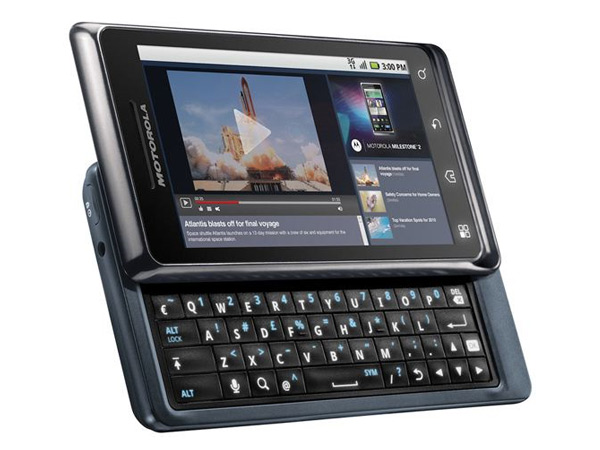
My Motorola Milestone 2 smartphone, which I bought nearly two years ago, has gone kaput. When I slide out the keyboard, the display goes blank. The device is usable, but only as an ordinary phone. I can imagine what has happened. There is probably a flexible ribbon cable like in the KX3 connecting the two halves, and a trace has broken. (A good job I’ve got the charger for the KX3 so I don’t have to keep opening it up to change the batteries.)
Of course, it is out of warranty. The question is, is it repairable at a reasonable cost? Motorola’s support site won’t give an estimated cost of repair. “Send it to us and we’ll give you a quote” they say. I’d really like a ballpark figure for what it is going to cost before doing that.
I guess I’ll just have to spring for a new phone. But there weren’t many alternatives with a real hardware keyboard and I expect there are even fewer now. I wish I could type using the software keyboard (which I’ll have to for now) but I have a 50% error rate. I don’t think my fingers are much fatter than normal. How do you guys manage? Perhaps you don’t text much and don’t do email on the phone.
Julian Moss, G4ILO, is a regular contributor to AmateurRadio.com and writes from Cumbria, England. Contact him at [email protected].
Another Android APRS client
Good news for APRS enthusiasts with Android devices. Lynn Deffenbaugh, KJ4ERJ, is embarking on a port of his popular and successful APRSISCE to the Android platform, called APRSISDR.
I use the words “embarking on” advisedly. Although there is a Yahoo group and a collection of testers (including yours truly) the software is in an embryo stage at the moment. You can see the beginnings of an APRS client starting to form but Lynn is really just testing the Android platform at the moment to see how various key things can be accomplished. I would hazard a guess that it will take several months before something usable appears, though those who were in at the start of APRSISCE development will recall that it advanced in leaps and bounds. It’s going to be a fun ride, but for most I think it will be best to wait patiently for more news to emerge. Watch this space!
Julian Moss, G4ILO, is a regular contributor to AmateurRadio.com and writes from Cumbria, England. Contact him at [email protected].
Asbotively tropical
Again today, I headed out at lunch time to the car. It was hot …. 90F again, but this time before I left the building, I checked into WeatherUnderground and saw that the humidity was at 77%. It was tropical to say the least. I had a very pleasant QSO on 20 Meters with my good friend and fellow Polar Bear Ken WA8REI. He was at home on his Mosley, so he was a solid 599+. Fortunately, the beam was able to rope in my signal and I got a 579 in return.
Ken was enduring the sogginess in Michigan too, and was telling me that he is going to head on up to his trailer “in the country” soon to escape the heat and humidity. Can’t say I blame him. When I got back to my desk, I felt a bit soggy myself.
Tomorrow, I will bring a camera along with me to snap a few quick photos of the set up in the back of the Jeep. A few have asked, curious to see exactly how I have the Buddistick set up.
With that much humidity, you know that sooner or later, something has to give. Around 4:00 PM, we had a prototypical summer afternoon thunderstorm and downpour. Sad thing is, it really hasn’t changed anything, and it feels just as soggy after, as it did before. No cool fronts will be running through for several days at least.
After dinner, I got the first two radials down. The lawn was all soggy and while that made things a bit messier than they would be otherwise, at least the gardening pins that I am using to hold down the wires went into the soil like a warm knife through butter.

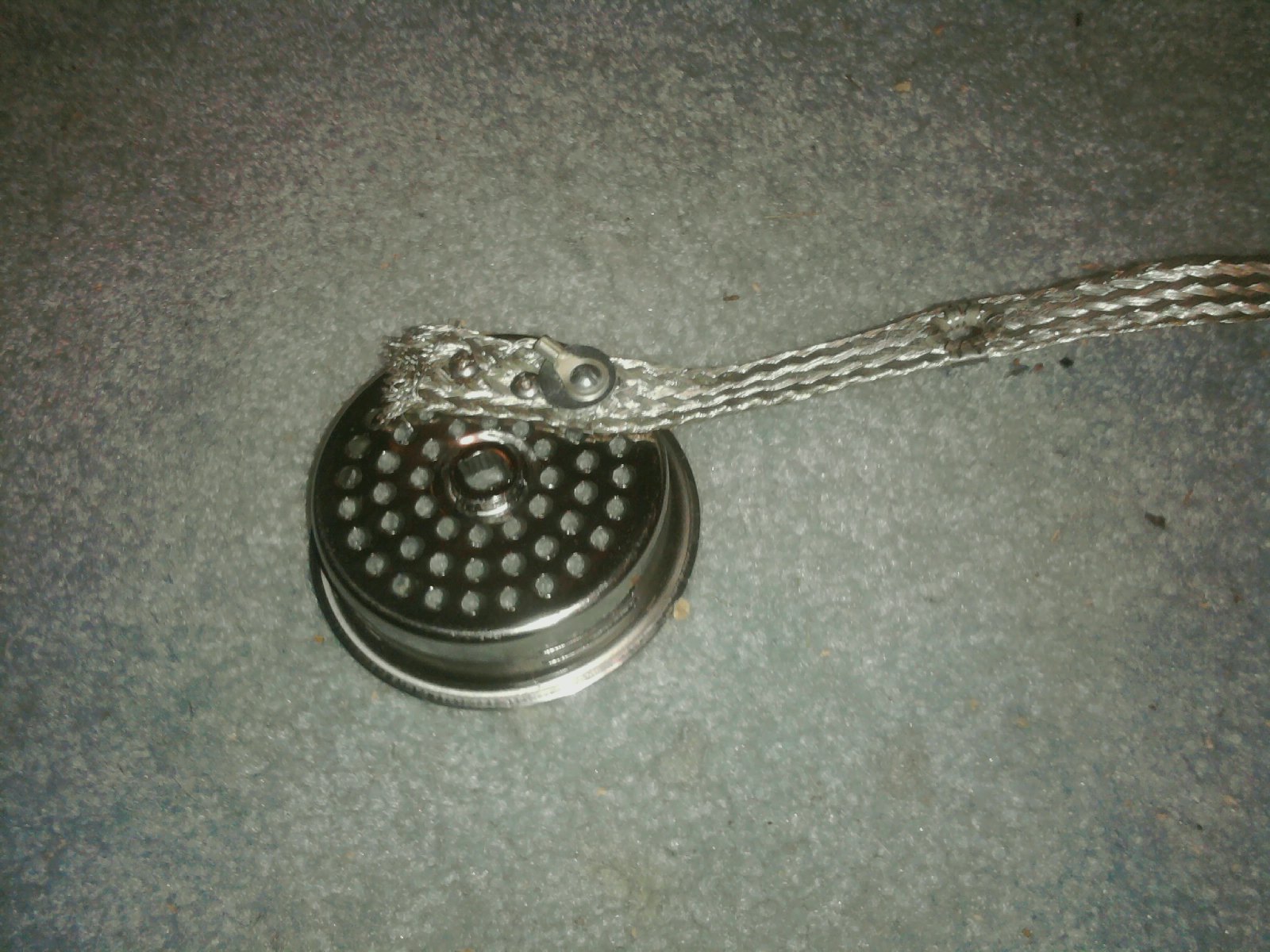
The wires are screwed down onto to the sink strainer using crimped eyelets, which have been dipped in anti-oxidant paste. I am using De-Oxit’s paste which is the same thing as Butternut’s “Butter it’s Not” as far as I can tell. Each is also secured with a star washer.
When all is said and done, I hope to have another 20 radials down which will put me very close to 50 total if count the original 25 I put down years ago.
Oh, I worked Crete for the first time in 13 years this evening. I heard SV9/SV2FPU calling CQ on 30 Meters (88′ EDZ antenna) and I threw out my call. Out of all the stations calling, I was amazed to hear him come back to me! This also makes the first time I have worked Crete via CW. Last time, all the way back in 2000, I actually used that mikeyphoney thing. Don’t tell anybody!
72 de Larry W2LJ
QRP – When you care to send the very least!
Larry Makoski, W2LJ, is a regular contributor to AmateurRadio.com and writes from New Jersey, USA. Contact him at [email protected].
Got started
Larry Makoski, W2LJ, is a regular contributor to AmateurRadio.com and writes from New Jersey, USA. Contact him at [email protected].
It’s a good thing…..
It’s a good thing that I have my lunchtime QRP opportunities, as lately, I seem to get more “on the air” time from work than I do from home! The weekends seem to be filled with nonstop chores and house responsibilities. Time for Ham Radio is scarce and at a premium.
But during the work week, I get that one hour break for lunch. If I’m lucky, I’ll get out to the parking lot to find the bands hopping. This afternoon, I got lucky again.
I started my lunchtime session on 17 Meters, as has become my custom. I was fortunate enough to work two DX stations, S573DX in Slovenia and F5NTV in France.
After finishing with those two, I headed on over to the QRP Watering hole on 20 Meters. Once there, I called CQ for a bit, to be answered by John KG9HV, in Lafayette, IN. We had a nice 2X QRP QSO. I was on the KX3 and Buddistick, while John was using his Kenwood TS-570S to a dipole at 5 Watts. Even though the QSO was plagued by QSB at both ends, we were able to have a very nice conversation. And in fact, when the QSB let up, at times John was actually as good as 589!
The one bad thing about operating from the parking lot is dealing with the weather, kind of like a mini Field Day. It was hot (close to 90F – 32C), and it was the Noon hour, so the sun was at its peak. I didn’t feel like wasting gas to run the AC, though, so I just lifted the tail gate (rear door) of the Jeep and allowed it to provide some needed shade. The nice thing was that the building’s AC provided a nice refresher …… after a nice radio session.
Hamlog for Android is perfect for my portable logging needs. It’s super easy to use and has so many neat added on tools. I don’t even bother with plain paper, anymore. I recommend it highly.
As luck would have it, there’s not much to do at home tonight. While it would seem like it would be the perfect opportunity to get on the air, unfortunately there’s also a severe thunderstorm watch on until 10:00 PM. I may get on for a bit; but I’ll have to be ready to pull “The Big Switch” at a moment’s notice.
72 de Larry W2LJ
QRP – When you care to send the very least!
Larry Makoski, W2LJ, is a regular contributor to AmateurRadio.com and writes from New Jersey, USA. Contact him at [email protected].
 Ham Radio Deluxe |
 W5SWL Electronics |
 Ham Radio Prep |
 KB3IFH QSL Cards  Hip Ham Shirts  HamRadioAuctions HamRadioAuctions Reliance Antennas Reliance Antennas Enigma Shop Enigma Shop |  morseDX  Ni4L Antennas  R&L Electronics R&L Electronics antennas.us antennas.us QRV QRV |
- Matt W1MST, Managing Editor
