 |
 Breakfast, Bacon and Eggs, and Radio
 13 November 2013 | by


John Smithson, Jr., N8ZYA, is a regular contributor to AmateurRadio.com and writes from West Virginia, USA. Contact him at [email protected].
3rd Annual Worked All Twitter (#WATwitter) US Thanksgiving Weekend QSO Party
Please allow me to direct your attention to the blog site of my friend Connie, NR4CB with complete information on the 3rd Annual Worked All Twitter QSO Party.
I hope to see you on Twitter and hear you on the HF bands!
73 de KD0BIK (Jerry)
Jerry Taylor, KD0BIK, is a regular contributor to AmateurRadio.com and writes from Colorado, USA. He is the host of the Practical Amateur Radio Podcast. Contact him at [email protected].
QSO with Russian Research Ship at Sea
I just worked the Russian Research Vessel, Akademik Fedorov, at sea.

It’s always a thrill for me to work ships at sea. This was an ordinary QSO on 12 meters… but not ordinary for me. RW1AI/MM was calling CQ. I answered and we exchanged 599s. Then I asked Mik for the name of his vessel. I looked it up on “ship track” and found its current location off Portugal with a destination of Cape Town. My guess is it will re-supply there and head to the Antarctic.

The vessel is 463 feet long and was traveling at 14 knots. I think I was traveling a lot faster than that! Even though I was sitting in my warm shack, a maritime QSO just brings adventure and the thrill of remote radio contacts to me. Thanks Mik for the nice QSO. Good sailing OM.
Jim Cluett, W1PID, is a regular contributor to AmateurRadio.com and writes from New Hampshire, USA. Contact him at [email protected].
LHS Episode #117: On Point (For Once)
 Hello, podcast listeners! It's getting cold outside. Now would be a good time to curl up in your favorite chair with your media player, a warm fire and an episode of Linux in the Ham Shack. As it happens, we have a new one for you right now. Your hosts discuss some newly updated ham radio software for Linux, including a lightweight logging application, CW decoder and VHF propagation modeler. Then they give you an in-depth peek at the distribution known as Point Linux. All of that is followed by feedback and a few announcements that you really should stay tuned for. Please enjoy, and thanks for being a valued member of the Linux in the Ham Shack community.
73 de The LHS Guys
Russ Woodman, K5TUX, co-hosts the Linux in the Ham Shack podcast which is available for download in both MP3 and OGG audio format. Contact him at [email protected].
When All Else Fails or SHTF?
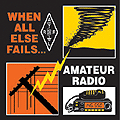 A while back, Dan KB6NU noted the increasing number of preppers getting involved in ham radio. Preppers are people who are actively preparing for emergencies, natural disasters and disruption of social order. In our Technician license course, we’ve noticed an increase in the number of people identifying themselves as preppers.
Of course, amateur (ham) radio has a long history of emergency service and disaster preparedness. FCC Rules Part 97 says this is one of the purposes of the Amateur Radio Service: Recognition and enhancement of the value of the amateur service to the public as a voluntary noncommercial communication service, particularly with respect to providing emergency communications.
Historically, most radio amateurs approach the hobby from a technical or radio operating point of view, then find ways to apply it to emergency preparedness. The prepper tends to work the equation the other way…starting with the desire to have emergency communication capability and then working to get an amateur radio license.
Many prepper sites just give a quick overview of ham radio, positioning it with GMRS, FRS and CB radio. See Prepper Communications. Articles like this one give a more complete introduction to ham radio: The Skinny On Ham: Getting Licensed. This one, too: Every Prepper Should Be A Ham.
You may run into some creative acronyms on these prepper sites:
SHTF = ”Stuff” Hits The Fan
EOTW = End Of The World
TEOTWAWKI = The End Of The World As We Know It
YOYO – You’re On Your Own
There are web sites devoted to prepping with radio communications:
Prepared Ham
RadioSurvivalist.com
RadioMaster Reports
Many of these sites have useful information that may stretch your thinking on “being prepared.” Of course, some of these prepper sites (not the ones listed above) are a bit over the top and may have resulted from people going off their meds. Draw your own conclusions.
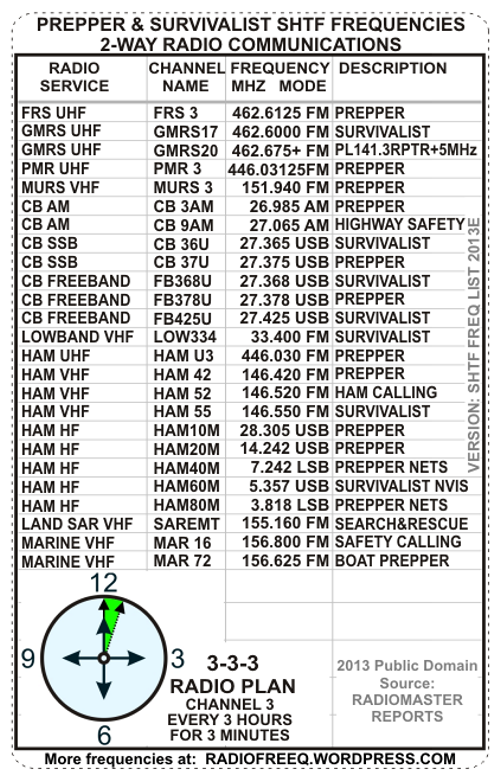
I’ve noticed a pattern of people creating prepper frequency lists, such as the one shown below. (Note that some of the ham frequencies listed do not conform to generally accepted band plans.) I can see the usefulness of having some assigned frequencies but its not clear to me how they’ll actually get used. I think the challenge for new prepper hams is to think through who they are going to communicate with and for what purpose. It’s also important to get familiar with the equipment and gain experience on the air, so when the EOTW happens you aren’t sitting there reading the radio manual.
Whether you think of emergency communications as “When All Else Fails” or when SHTF, amateur radio is a resilient communication tool.
73, Bob K0NR
Added 7 Dec 2013: I came across this video that does a good job of introducing ham radio to the prepper crowd: So you want a ham radio for emergency communications!
Bob Witte, KØNR, is a regular contributor to AmateurRadio.com and writes from Colorado, USA. Contact him at [email protected].
Interesting articles
and
http://online.wsj.com/news/articles/SB10001424052702304672404579183940409194498
No luck today at lunchtime. One of those rare days where I got skunked.
72 de Larry W2LJ
QRP – When you care to send the very least!
Larry Makoski, W2LJ, is a regular contributor to AmateurRadio.com and writes from New Jersey, USA. Contact him at [email protected].
A personal challenge
I went out to the car during lunchtime today. Temperatures here in New Jersey have cooled down. It was only in the upper 40s here (about 9C), so instead of standing outside and operating from the rear hatch of the Jeep, I sat inside to keep out of the breeze. Activity on 10 Meters seems to have gotten sparse. I still hear signals, mind you, but they are not as loud and not as “wall to wall” as they were just a few weeks ago. I don’t know if it’s that the band has changed a bit, or perhaps the novelty of 10 Meters coming back to life has worn off. In any event, I found myself on 17 Meters today, tuning around the band to hear what I could hear.
I worked EI13CLAN, whom I worked last month on 10 Meters. He was very strong, a very legitimate 599.
The tuning around some more, I heard XF1P calling “CQ DX UP”. OK …….. Mexico. But the pileup was huge …… HUGE! I wasn’t exactly sure why. Mexico is not exactly what you’d consider to be the rarest of rare DX. I reasoned that with a pileup that big, something that I was unaware of must be “up”. Additionally, I took it as a personal challenge. Could a QRP station running 5 Watts to a Buddistick possibly bust that pileup? XF1P was 599, but just barely. There was QSB to boot. I was reasonably sure that my signal would be audible on his end, but with that pileup, would I get lost in the sauce?

I sat there for about 20 minutes, listening and sending out my call. The KX3, with it’s Dual Watch feature, almost makes it unfair. I was able to follow XF1P along the band as he would move slightly after answering each station, XF1P in my right earbud and the station he was working in my left earbud. It just became a matter of sensing his pattern and setting the transmit VFO just a tiny bit higher after each call. Also, I had to time the sending of my call – not transmitting immediately, but waiting for the pileup to fade “just” enough where my call would be heard among the cacophony of all the true 599s that he must have undoubtedly been hearing. Finally, I heard him send back “W2L?”. Wouldn’t you know it? True to form, all kinds of stations without a “W”,” 2″ or an “L” anywhere in their calls began blindly transmitting. Not deterred, I stayed with it and threw “W2LJ” out there just a couple of more times and was rewarded with a confirmation.

Coming back from lunch, a quick peek on the computer before resuming work informed me that XF1P is an IOTA DXpedition to Partida Island – NA-124 located in the Gulf of California off the coast of Baja, Mexico. It is an uninhabited island, so I guess that makes it rare as IOTA goes. The pileup of IOTA devotees was intense, but I accepted the challenge with 5 Watts, took advantage of XF1P’s exceptional ears, and got through! That’s always a good feeling. And it also goes to show, that if I can do this, then YOU can do it too. It just takes some persistence and a lot of listening.
72 de Larry W2LJ
QRP – When you care to send the very least!
Larry Makoski, W2LJ, is a regular contributor to AmateurRadio.com and writes from New Jersey, USA. Contact him at [email protected].
 Ham Radio Deluxe |
 W5SWL Electronics |
 Ham Radio Prep |
 KB3IFH QSL Cards  Hip Ham Shirts  HamRadioAuctions HamRadioAuctions Reliance Antennas Reliance Antennas Enigma Shop Enigma Shop |  morseDX  Ni4L Antennas  R&L Electronics R&L Electronics antennas.us antennas.us QRV QRV |
- Matt W1MST, Managing Editor
