 |
 Contest Results Are In
 23 November 2013 | by
  In the past two weeks, the results of several ham radio contests from last summer were posted. The typical contest takes months for the official results to be finalized and I have usually forgotten about the contest by then. The more serious contesters share their results via the 3830 web site so they can get an early read on how they did relative to their peers. But you need to be patient for the official results.
In the ARRL June VHF Contest, I placed in the top ten for the new Single Operator 3 Band category. This category is restricted to 50, 144 and 432 MHz, which is a good match to my radio interests. We had good 50 MHz conditions in Colorado (relative to other parts of the country), so CO stations seemed to score well.
Speaking of Colorado, in the Colorado QSO Party I finished first in the Phone – Low Power – Single-Op category. I was actually not that pleased with my score this year (45,500), which was considerably less than my score from last year (76,464). Oh well, I will invoke the Universal Purpose of Amateur Radio and say I had a great time in the contest, regardless of the score. Thanks to the Pikes Peak Radio Amateur Association for sponsoring this event.
The ARRL Field Day results are also posted. Joyce K0JJW and I did a one transmitter (1B) operation from the cabin using the club call KVØCO, resulting in a modest score (454). We mostly made phone contacts on 20m, 15m and 6m. We had some nice sporadic-e on 50 MHz, which is always a treat. Remember, the key to a fun Field Day is: Season To Taste.
73, Bob K0NR
Bob Witte, KØNR, is a regular contributor to AmateurRadio.com and writes from Colorado, USA. Contact him at [email protected].
Receiving telemetry from the new Funcube-1 (AO-73) satellite
Following the launch of the eagerly awaited Funcube-1 (now also known by it’s official AMSAT designation of AO-73), I thought it would be fun to try and receive some telemetry from it.
During local daylight hours, the satellite will send telemetry, with the intention that it will be available for schools to receive and decode and then at local dusk, the satellite will switch into Amateur Radio mode, with a 435/145MHz inverting transponder (SSB/CW).
At the time of writing, the satellite has just been switched into autonomous mode when it will switch between telemetry and the transponder automatically as described above. If that works out ok, it will stay in that mode.
To decode the telemetry, you need the Funcube Dashboard software, which you can download here
Setup is fairly easy, although is only currently available for the Windows platform and you’ll need the .Net 4 framework available on your PC. As I don’t have a Funcube Dongle Plus, I needed to use my Windows soundcard, connected to the FT847 via the usual G4ZLP interface. I had a slight false start when it didn’t seem to be selecting the soundcard, but that was easily resolved in File/Settings.
Then it’s just a question of setting Capture from Soundcard in the software and waiting for the satellite. My best antenna (given that I did not want to be outside waving the Elk antenna in the cold) was the V2000 collinear.
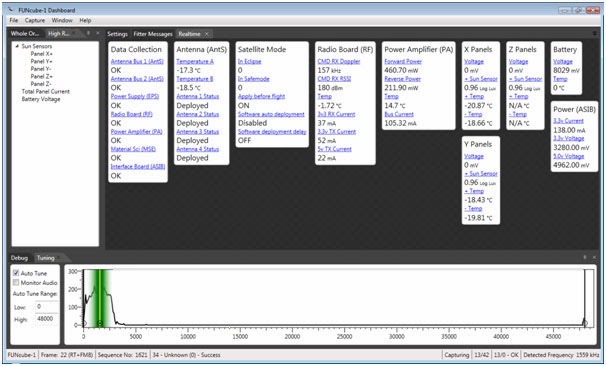
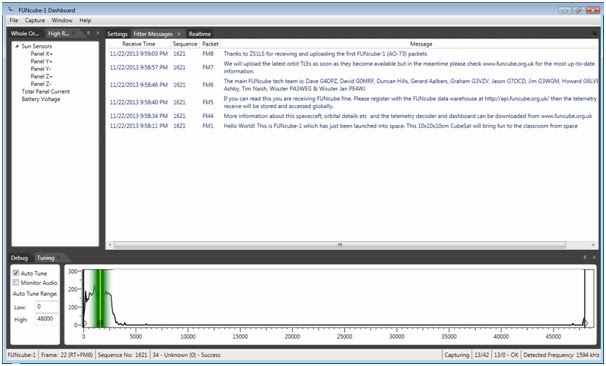
Fortunately, the first pass that I tried was quite a high one and I was able to receive quite a few good frames – some screenshots of which are shown below
Tim Kirby, G4VXE, is a regular contributor to AmateurRadio.com and writes from Oxfordshire, England. Contact him at [email protected].
Amateur Radio Newsline Report 1893 November 22 2013
- Ham radio emcomm efforts continue in the Philippines
- Amateur Radio responds to mid-west tornado outbreak
- ARRL files symbol rate petition with the FCC
- International Space Station celebrates 15 years on-orbit
- Wake Island operation ends with over 100,000 QSO's
- Mega launch puts 29 new satellites into space
My Special Event Station
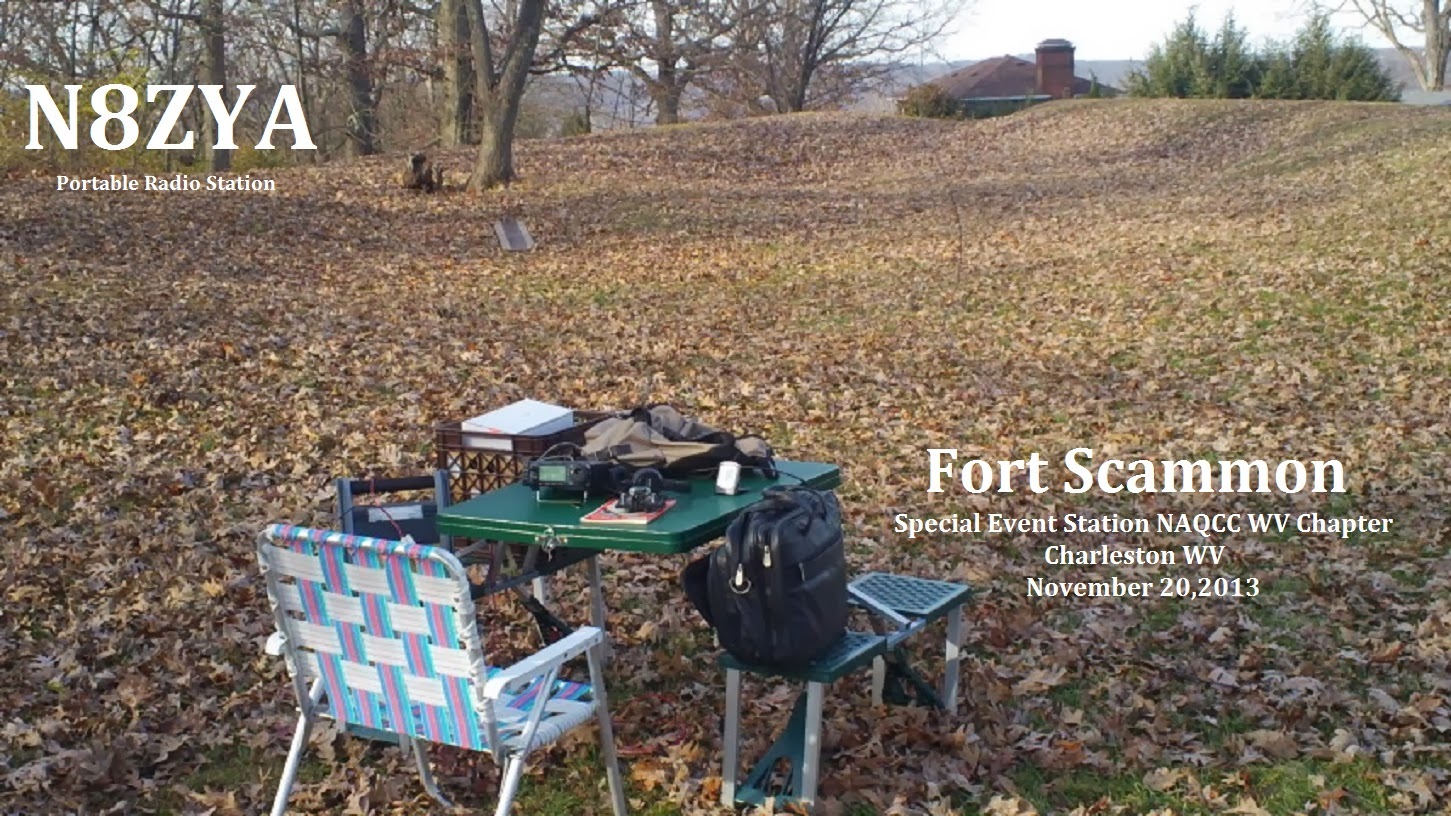
I worked seventeen stations with this “Special Event Station” of the West Virginia Chapter of the NAQCC club on Wednesday afternoon and sent an E-QSL Card to those who worked me. Fort Scammon isn’t well known to those living in my city, but during the Civil War, this artillery site was critical to controlling the river traffic on both the Kanawha and the Elk Rivers.
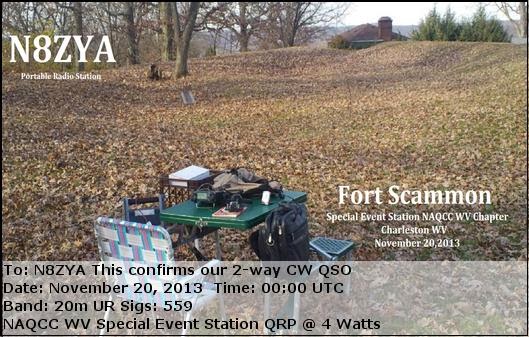
I created the above (sample) card with the simple “paint” program which comes with the Microsoft products on my windows computer. When I upload the card to my E-QSL account and enter the contact information of the stations I work, they’re displayed nicely along the bottom of the card.
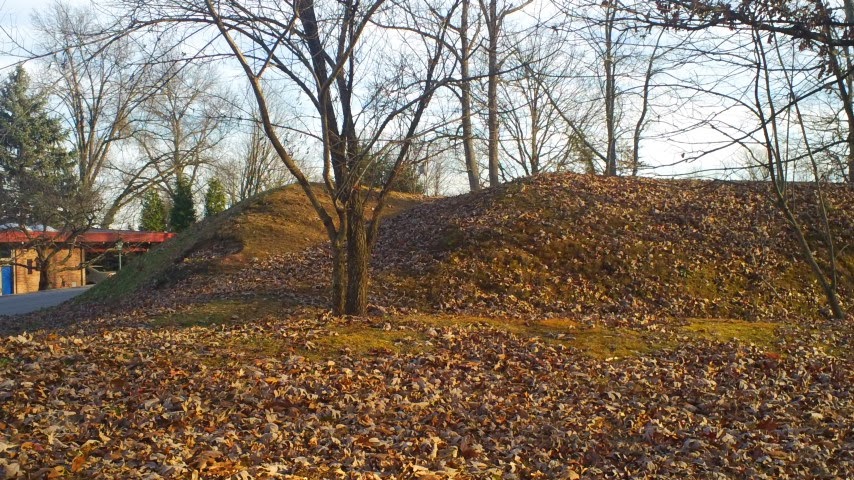
The 19th and 25th Presidents of the United States (Rutherford B. Hayes and William McKinley) directed a dozen cannons from this high spot in Charleston where “flatboats” floated precious “salt” downstream to the Ohio River. Salt was a very valuable commodity in those days for the preservation of fresh meat. The production of high quality “salt” was one of the founding industries of the Kanawha Valley.
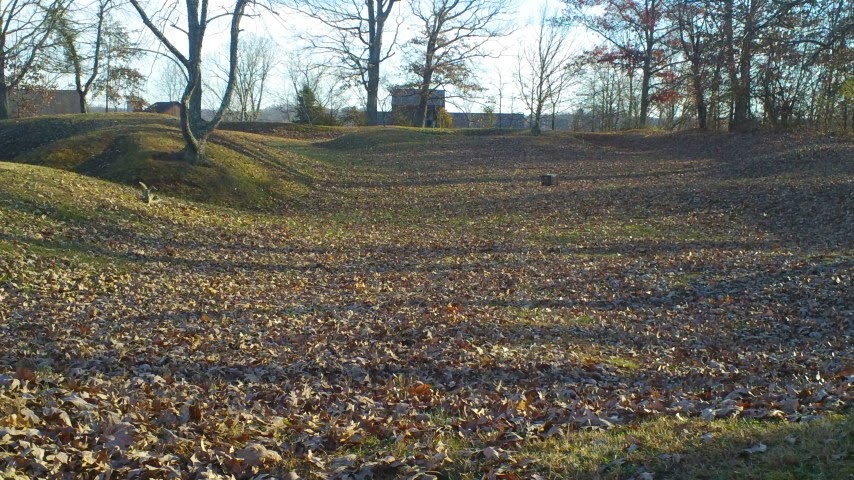
It took me a little over an hour to get set up and on the air but I felt this was one of only a few good days left before snow flurries begin to start flying this weekend. I used my PAR “end fed” Zepp antenna which was cut for 40-20-and 10 meters with my Icom 703 at about four watts to work stations in eleven different states.
I was able to work North Carolina, Virginia, Ohio, Pennsylvania, Indiana, Massachusetts, Kansas, New York, Illinois, Maine, and Canada.
The most distant station I worked this day was N1NUA (Joan) in Maine at 812 miles.
John Smithson, Jr., N8ZYA, is a regular contributor to AmateurRadio.com and writes from West Virginia, USA. Contact him at [email protected].
A good week for QRP DX
I should have posted this earlier, as now it’s Thursday …….
This weekend is the CQ WWDX Contest, one of the “Big’uns”. This is one where a lot of folks travel to distant destinations, just for participation in the contest. So all during the week, visitors as well as indigenous Hams have been tweaking their equipment, and have been getting on the air to try things out. As a QRPer, this is a good thing to take advantage of. The bands are full of DX and now is your chance to work it. Pickings are good and I have worked Cape Verde Island, Peru, Ecuador, Nicaragua, Dominica, Morocco, and the Turks and Caicos Islands, and Bermuda – all with 5 Watts in just within the last few days.
The bands are expected to be in good shape for this weekend. So if you have the time, you can get on and you can net a lot of DX. If you’ve never started your QRP DXCC, now is the time to begin! If you go all out, I am willing to bet that you could conceivably earn it this weekend.
For the new QRPer, there are some things to keep in mind. At the beginning of the contest, code speeds are going to be fast. Some of these guys will sound like a buzz saw! Don’t get discouraged. The DX will keep on sending their calls a lot, so if it takes multiple attempts for you to copy, you’ll get plenty of them. Towards Saturday night into Sunday, when some of these guys get tired, they tend to slow up a bit, too. A tip to keep in mind is that the slower speed DX stations tend to congregate UP, towards the top edges of the CW bands, so that’s a good place to start. However, if you make a good effort to copy code that is faster than what you are used to, I can pretty much guarantee a 10% or better improvement on your copy speed by the time the contest is over.
The loudest stations are probably running the most power, but they probably also have the best antennas. Cherry pick those, and they’ll probably have an easier time hearing you, rather than the guy half way around the world who is running 100 Watts to a dipole only 25 feet up. You may work him too, but it will probably be a bit harder. Another thing to keep in mind, is that as the contest winds down on Sunday afternoon into Sunday night, the hard core contesters will be desperate for points. It’s more likely they will take their time with you, if you happen to have a weak signal on their end . REMEMBER – QRP does NOT necessarily mean weak signal! If propagation is favorable, and your antenna is decent, there’s no reason that your signal can’t be 579 or better on their end.
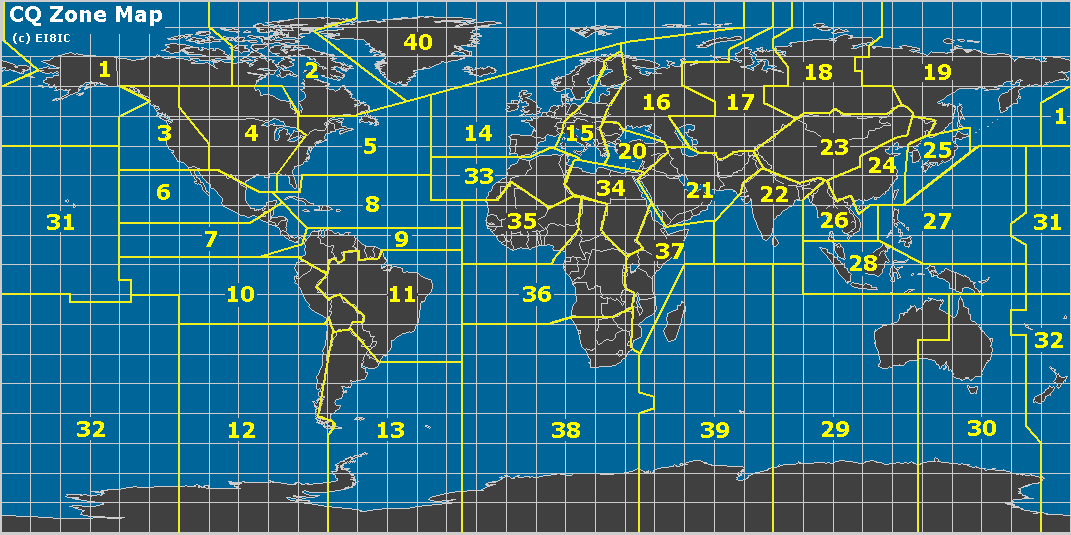
The exchange is super easy – RST and your CQ Zone. For those of us on the East Coast, I believe that is 5. Most Amateur Radio maps and/or logging programs will provide that for you. I’ll provide one here:
Don’t get hung up on not being able to work someone. If you’re trying to work a loud station, and he can’t hear you, don’t be afraid to turn the dial and move on. Maybe props aren’t the best between you and him at that moment. Go work someone else and come back to him in a bit if you can. With enough experience, in no time you’ll be able to tell who you have a reasonable shot at working and who you don’t.
The most important thing is to have fun! Don’t get discouraged or frustrated. If you end up working 100 DX entities, that’s great! If you only end up working 5 – so what? The bottom line is to enjoy yourself.
72 de Larry W2LJ
QRP – When you care to send the very least!
Larry Makoski, W2LJ, is a regular contributor to AmateurRadio.com and writes from New Jersey, USA. Contact him at [email protected].
The Pond is Frozen – The DX is Hot
Hanz W1JSB and I hiked to Knox Mountain this afternoon. There was ice on the pond, but we worked St. Martin, Cape Verde Island and Curacao.
We were lucky to cross the first bridge. After crossing it, we noticed that one of three main supporting logs had collapsed. This was no surprise because we’ve seen holes developing in several places, and we were always careful where we stepped.

The owners tore down the second bridge a couple of years ago. Hanz and I placed a board across some rocks last spring. It’s served us well for a crossing, but today we notice ice hanging down from the board.

We knew this was treacherous… and we were right. The top of the board was slick with smooth ice. We quickly thought to spread some dirt across the surface and that worked like a charm. We crossed with no trouble.
At the pond, we were a bit surprised to find it completely covered with ice.

Today it was in the mid-thirties but the sun kept us from feeling the chill. I set up under some tall pines behind the cabin. I chose the spot because even though the sun was low in the sky the shadows hadn’t reached there yet.
I threw the line nearly 40 feet over a branch and pulled up a wire. I operated exclusively on 15 meters and the band was full of DX. I had to work split on two of the stations, but the KX3 was up to the challenge.

I worked three quick stations in barely five minutes. First I heard FS/K9EL in St. Martin calling CQ and I answered. I received a quick response and we exchanged 599 signal reports. The second was D44AC in Cape Verde Island off the coast of Senegal in East Africa. Again the exchange was 599. Finally, I worked PJ2/N7WA in Curacao just north of Venezuela. Again we exchanged 599s. Hanz didn’t feel like operating, so we packed up and headed back down the trail.
The forecast is calling for rain or snow tomorrow. The warm days are probably past.
Jim Cluett, W1PID, is a regular contributor to AmateurRadio.com and writes from New Hampshire, USA. Contact him at [email protected].
Did I make ICube-1’s first signal report?
Well this morning saw the launch of the numerous satellites from the Dnepr rocket including Funcube-1, and this morning saw the first passes over the UK. Like many others I eagerly sat in front of my computer awaiting the chance to decode the telemetry. However I was doing it remotely using a VNC connection as I was in work...
Sure enough at 10:21 the pass started and a nice strong signal appeared on the waterfall and the FUNCube dashboard sprang to life. I managed 29 packets on the first pass!
 |
| The upload ranking at the FUNcube data warehouse |
However I noticed another CW signal further up the spectrum which seemed to be on the edge of the FUNCube transponder allocation (145.950MHz) I went to twitter and asked if FUNCube-1 was transmitting a CW beacon? Peter 2E0SQL thought it might be another satellite.
At start of earlier FUNCube-1 pass, what looks like CW on transponder downlink frequency? #funcube pic.twitter.com/yLvgzYzZRJ
— Andrew Garratt (@nerdsville) November 21, 2013

I had captured the pass as an IQ file, and set about trying to decode the CW. I had several attempt using fl-digi remotely but chasing a fast moving doppler on a laggy remote connection wasn't good but I seemed to repeatedly get ***ISTAN.
On the next pass the same thing happened, this time I got the word CUBESAT several times..
The signal had the same doppler shift as FUNCube-1 so was from the same launch constellation and a quick check and I spotted ICube-1 the first cubesat launched by Institute of Space Technology in Pakistan.. which was listed as broadcasting on 145.947MHz using AFSK.
It must be.. ***ISTAN... CUBESAT.... So I sent them a message on their Facebook page and they confirmed that at this stage of the mission they were indeed supposedly broadcasting a CW beacon and what I decoded was part of the message!
Khurram project manager of ICube-1 said "Thanx Andrew ... your message was a great relief for us"
and on their facebook page
First Signal has been received from ICUBE-1 in UK ... Alhamdulillah the ICUBE-1 mission is successful ... Congrats everyone. Satellite will pass over IST around 9:30 pm today
So it seems lowly M6GTG may have made the first signal report confirming Pakistan's first successful cubesat deployment!
I am grinning madly at the moment!
Andrew Garratt, MØNRD, is a regular contributor to AmateurRadio.com and writes from East Midlands, England. Contact him at [email protected].
 Ham Radio Deluxe |
 W5SWL Electronics |
 Ham Radio Prep |
 KB3IFH QSL Cards  Hip Ham Shirts  HamRadioAuctions HamRadioAuctions Reliance Antennas Reliance Antennas Enigma Shop Enigma Shop |  morseDX  Ni4L Antennas  R&L Electronics R&L Electronics antennas.us antennas.us QRV QRV |
- Matt W1MST, Managing Editor
