 |
 Now something else
 14 January 2014 | by
 Oh man! Wonder if he'll ever know
He's in the best-selling show
Is there life on Mars? (David Bowie)
I will keep this blog running. You can follow me wherever I am. When the propagation is good, and the time is right, you can hear me on air.
Paul Stam, PC4T, is a regular contributor to AmateurRadio.com and writes from the Netherlands. Contact him at [email protected].
The trend is clear
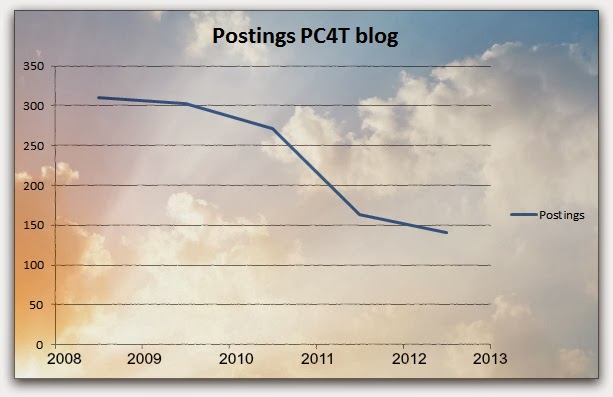
The trend is clear. The number of posts decreases. I think blogging has come to an end. Jeff Davis KE9V stopped blogging as well and uses Google+ for news updates.
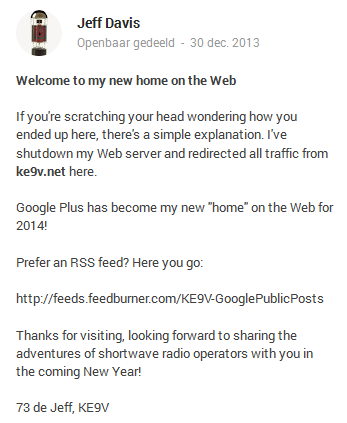
I use Twitter @PC4T Facebook and Google+ All my internet activities are shown in Google + so there is no need for blogging. I'm considering stopping blogging, again. A lot of my fellow bloggers are on Google+ as well. Why should I spend time with making blog posts? I had to get used to google+, it took some time, but now I get it. I am a slow follower of trends. Maybe you recognize it; any change at my age takes time. So my blog will soon close. Make the switch to google+ if you want. I'll hope to see you there.
I'm more than just a radio amateur.
Paul Stam, PC4T, is a regular contributor to AmateurRadio.com and writes from the Netherlands. Contact him at [email protected].
Three Summits in the Wichita Mountains
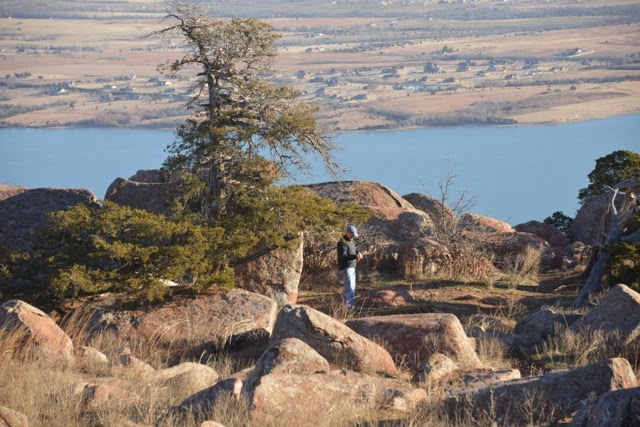
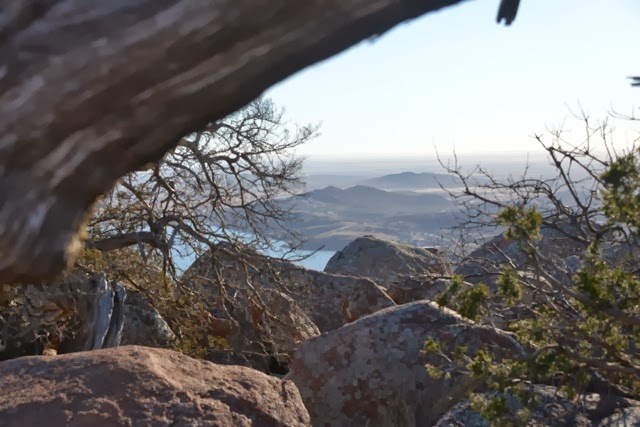
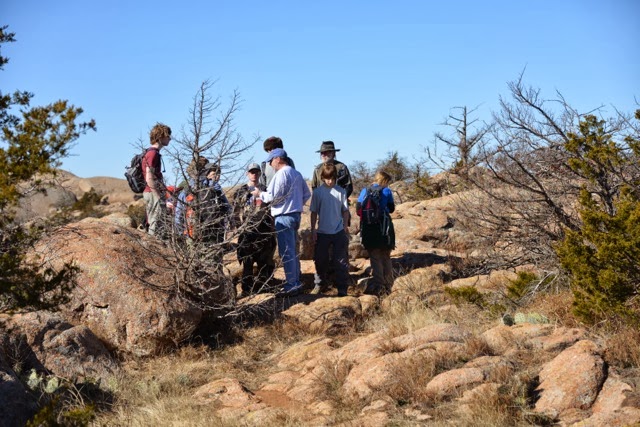
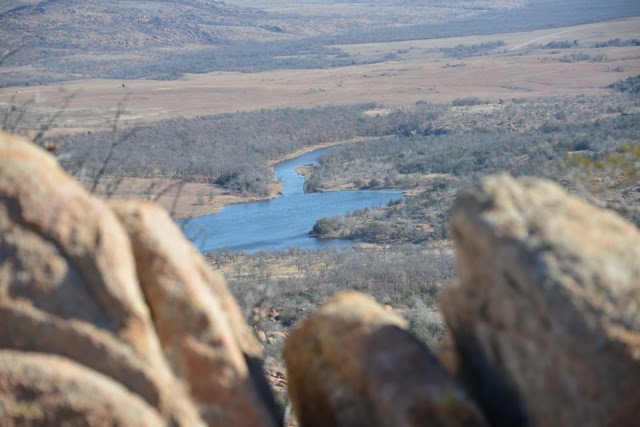
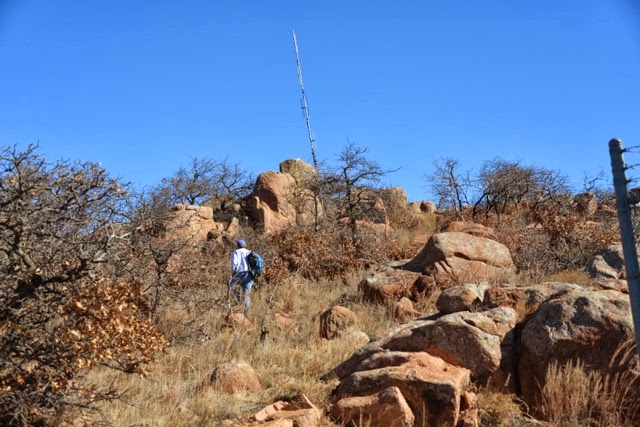
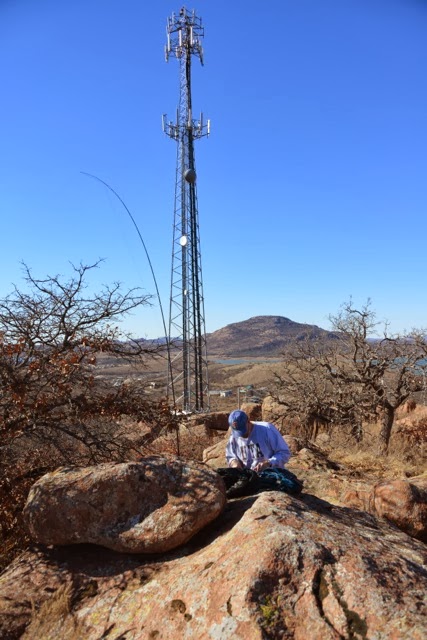
I had lived in Duncan, Oklahoma for eight years in the '80's and early '90's and had visited the Wichita Mountains multiple times with my family and our Boy Scout Troop, but never with summits in mind. So the must do summits in the Wichitas are Mt. Scott and Elk Mountain. Mt. Scott is a drive up and Elk Mountain is a nice 1.1 mile hike, one way. I knew if I started early, three summits were doable, maybe even four. But which one would be the third? I remembered KC5CW and KD5ZZK operating from a four point summit not far from Mt. Scott, so after a little research, Mount Cummins was added to the list. Below is a report on the trip.
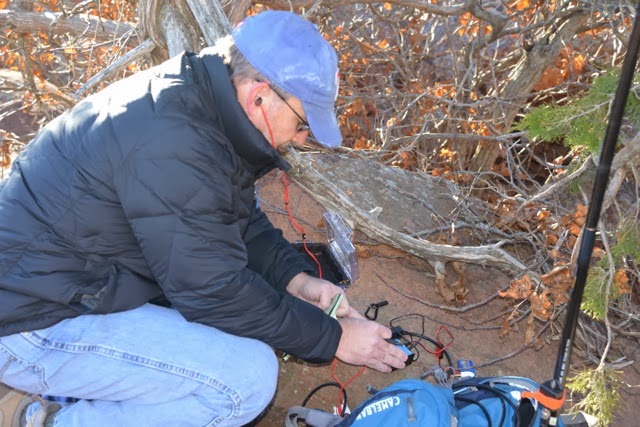
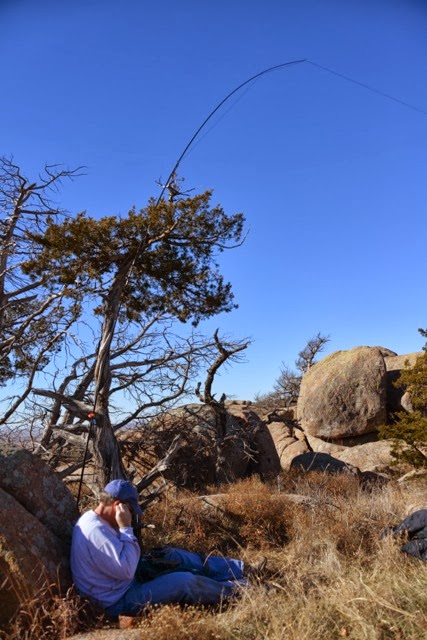
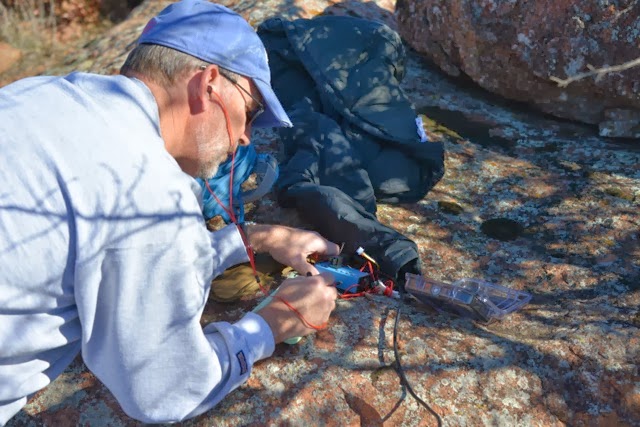
For this trip I used an MTR 20/40, 500 mah Lipo battery, 21 foot collapsible carbon fiber pole and a LNR 10-20-40 "trail friendly" End Fed Half Wave antenna.
Mount Scott W5O/WI-002
This is an easy summit. The weather was on the chilly side with temps in the mid-30's when we started out. Upon arriving on the base of the mountain, there was a squad of army soldiers getting ready for a run up the mountain, something that would appeal to Fred, KT5X, but I was happy to drive up this one. At the summit, there was only one other car, so I had a pick of operating sites. I elected to get out of the wind and down a ways from the summit.
Mike Crownover, AD5A, is a regular contributor to AmateurRadio.com and writes from Texas, USA. Contact him at [email protected].
Just checking!
I got curious and sent an e-mail to Elecraft asking them when I might expect my KXPA100 kit, that I ordered in October.
Good news! Only about another month or so!
To be honest with you, I wasn’t expecting such a quick response. I got my e-mail answer in less than 24 hours. Kudos to Dean and the Elecraft Sales Team.
72 de Larry W2LJ
QRP – When you care to send the very least!
Larry Makoski, W2LJ, is a regular contributor to AmateurRadio.com and writes from New Jersey, USA. Contact him at [email protected].
QRP Kit News
As announced by the Four States QRP Group today:
The Four State QRP Group is very pleased to announce that Dave Benson’s, Freq-Mite kit has been added to the lineup of Four State kits. Upon retirement, Dave, K1SWL, graciously offered the kit to us to continue production. Along with his SW+ transceiver series, the Freq-Mite is one of his signature designs. The Freq-Mite provides audio frequency annunciation, and is intended to be installed as a frequency counter inside a rig. Thus providing an inexpensive alternative to an LCD display. It is easily installed in new or existing rigs and easy to understand installation notes for many rigs are included on the web site.
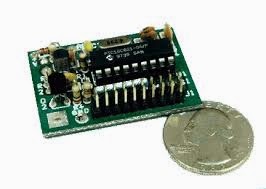
The kit sells for only $22 US, which includes shipping, and may be ordered from it’s home page http://www.4sqrp.com/freq-mite.php All of the Four State kit offerings may be found on this page http://www.4sqrp.com/kitIndex.php Additional kits are in the pipeline and will be made available as soon as possible.
As always, thank you for supporting Four State. All proceeds go to funding OzarkCon, the largest and best QRP conference in the Central Time Zone. Hope to cu in Branson on April 4t and 5th.
de Terry WAØITP
Between the Four States Group and QRPMe, it’s good to see Dave Benson’s designs not being lost to oblivion. On a side note, K1SWL posted on QRP-L that he participated in the North American QSO Party this weekend – first time he’s been on the air in about 10 years. Good for him! Personally, I am glad to see Dave enjoying Amateur Radio and QRPing again – he deserves as much for all his dedicated service to the QRP community over the years.
72 de Larry W2LJ
QRP – When you care to send the very least!
Larry Makoski, W2LJ, is a regular contributor to AmateurRadio.com and writes from New Jersey, USA. Contact him at [email protected].
Day Four
After four days without potable water in the neighborhood, it was worth every penny we spent to get a shower and do the laundry. Unfortunately, we had to drive eighty miles (round trip) to achieve the goal of cleanliness and civility. We spent the night in the closest town we could find with a hotel and a nearby laundry.
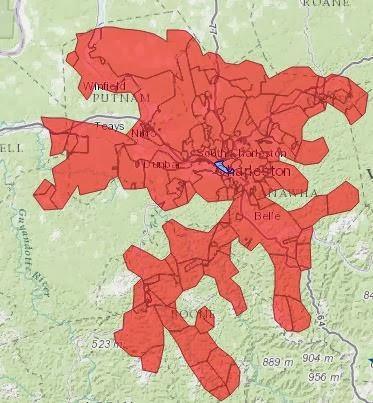
Today is the fourth day without water for nearly 300,000 people in the immediate area of Charleston.

Our dog traveled with us on this trip. To him it was like going to an amusement park but to us it was something quite different. When we arrived in the town of Barboursville, the 24 hour laundromat was “overwhelmed” with people from Charleston, who were doing like us, and making the best of a bad situation.
In addition to my dual band HT, I took my “tablet” with me which I found very useful. I keep an app (IARL) on it which shows all the ham repeaters which are centered on my “current” location. The map features were very useful too. I also carry a small SWL (Tecsun PL-380) radio with me which is really nice for hearing foreign broadcast and local AM and FM broadcasts.
We drove back early this morning, spent most of the day with friends, and this evening, happily, we got the “OK” to start flushing out the water lines in our home.
This amounted to depleting all the hot water from our water tank for 15 minutes, and running the cold water for an additional 5 minutes. Then we ran both the washing machine and the dishwasher for a complete cycle with clean water.
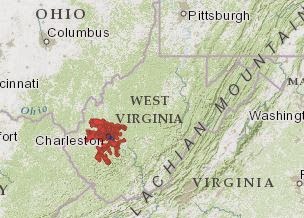
I can’t express how happy I am to again use something (H2O) most people in the world take so much for granted. Contamination levels are now tolerable in the small area where I live. We live the closest to the immediate spill. Three hospitals, the largest shopping mall, and the state capitol are in this area.
As you can see in the above picture, there’s still a large area which needs to be flushed with clean water. Only then can the process of household purging begin. For us this trial has finally ended; but it will take even longer for the entire area to finally be purged of this coal cleaning compound.
I’ve always been a strong advocate for clean water, clean air, and a clean environment in this state. I’ve known for years the dangers of depleting our natural resources. This state, and I might add, this entire tri-state area, has an ugly history of human and environmental catastrophes. I can’t imagine the amount of water than has been wasted in this event.
Fortunately this latest catastrophe only caused an inconvenience for most (not all) of these 300,000 people. We’re on the way to recovery now, but not entirely there yet!
John Smithson, Jr., N8ZYA, is a regular contributor to AmateurRadio.com and writes from West Virginia, USA. Contact him at [email protected].
More WSPR with 20mW
I’ve been WSPRing on 30m today, still with a power of 0.2W. I think WSPR is more interesting when you use low power: it’s always interesting to see how far you can get.
20mW is not the lowest power you can use, though, it’s just the lowest power the K3 will comfortably produce. (You can set the output power to 0.0W but I’m not sure how accurately the rig will maintain the power at such a low level – something to check.
Today my 0,02W into the MFJ magnetic loop in my attic was received by 30 different stations. Here’s the list:
| Timestamp | Call | MHz | SNR | Drift | Grid | Pwr | Reporter | RGrid | km | az |
|---|---|---|---|---|---|---|---|---|---|---|
| 2014-01-13 11:52 | G4ILO | 10.140243 | -11 | 0 | IO84hp | 0.02 | ON7KO | JO21ce | 637 | 124 |
| 2014-01-13 11:52 | G4ILO | 10.140209 | -23 | 0 | IO84hp | 0.02 | DL8HAF/P | JO53dm | 899 | 92 |
| 2014-01-13 12:32 | G4ILO | 10.140206 | -26 | 0 | IO84hp | 0.02 | DK6UG | JN49cm | 973 | 121 |
| 2014-01-13 12:54 | G4ILO | 10.140217 | -22 | 0 | IO84hp | 0.02 | DC5EO | JO31ed | 760 | 117 |
| 2014-01-13 12:54 | G4ILO | 10.140210 | -18 | 0 | IO84hp | 0.02 | G8CRB | JO02bf | 355 | 138 |
| 2014-01-13 13:18 | G4ILO | 10.140195 | -19 | 1 | IO84hp | 0.02 | G0GSJ | IO84jc | 61 | 170 |
| 2014-01-13 14:20 | G4ILO | 10.140199 | -19 | 0 | IO84hp | 0.02 | G4ILR | JO02pp | 379 | 124 |
| 2014-01-13 14:20 | G4ILO | 10.140224 | -29 | 0 | IO84hp | 0.02 | M0BLP | JO02ad | 359 | 139 |
| 2014-01-13 14:30 | G4ILO | 10.140210 | -20 | 0 | IO84hp | 0.02 | OH8GKP | KP24rt | 1945 | 43 |
| 2014-01-13 14:30 | G4ILO | 10.140203 | -19 | 0 | IO84hp | 0.02 | GM4SFW | IO77sn | 331 | 349 |
| 2014-01-13 14:30 | G4ILO | 10.140199 | -11 | 2 | IO84hp | 0.02 | OH3HTI | KP21ag | 1760 | 54 |
| 2014-01-13 14:30 | G4ILO | 10.140182 | -13 | 0 | IO84hp | 0.02 | LA5GOA | JO29oi | 737 | 41 |
| 2014-01-13 14:38 | G4ILO | 10.140197 | -23 | 0 | IO84hp | 0.02 | OZ7IT | JO65df | 1001 | 80 |
| 2014-01-13 14:38 | G4ILO | 10.140194 | -13 | 0 | IO84hp | 0.02 | SA6BSS | JO68 | 1084 | 60 |
| 2014-01-13 14:48 | G4ILO | 10.140189 | -21 | 0 | IO84hp | 0.02 | SM6WZI | JO67mp | 1067 | 65 |
| 2014-01-13 14:56 | G4ILO | 10.140208 | -21 | 0 | IO84hp | 0.02 | DC8SE | JN48xi | 1155 | 122 |
| 2014-01-13 14:56 | G4ILO | 10.140180 | -7 | 0 | IO84hp | 0.02 | ON7KB | JO21ei | 634 | 122 |
| 2014-01-13 15:04 | G4ILO | 10.140204 | -11 | 0 | IO84hp | 0.02 | DK4TJ | JO31fc | 768 | 117 |
| 2014-01-13 15:04 | G4ILO | 10.140236 | -25 | 0 | IO84hp | 0.02 | PA1GSJ | JO22da | 586 | 117 |
| 2014-01-13 15:14 | G4ILO | 10.140238 | -21 | 0 | IO84hp | 0.02 | DL1WER | JN58dd | 1189 | 122 |
| 2014-01-13 15:24 | G4ILO | 10.140195 | -13 | 0 | IO84hp | 0.02 | DL1KCQ | JO33uc | 746 | 99 |
| 2014-01-13 15:36 | G4ILO | 10.140188 | -25 | -1 | IO84hp | 0.02 | M5LMY | IO91oi | 405 | 154 |
| 2014-01-13 15:36 | G4ILO | 10.140197 | -12 | 0 | IO84hp | 0.02 | PI4THT | JO32kf | 729 | 107 |
| 2014-01-13 15:36 | G4ILO | 10.140196 | -15 | 0 | IO84hp | 0.02 | LA9JO | JP99gb | 1949 | 26 |
| 2014-01-13 15:36 | G4ILO | 10.140191 | -20 | 0 | IO84hp | 0.02 | SM0FGT | JO89xg | 1384 | 60 |
| 2014-01-13 15:36 | G4ILO | 10.140182 | -12 | 0 | IO84hp | 0.02 | LA5GOA/RX2 | JO29oi | 737 | 41 |
| 2014-01-13 15:46 | G4ILO | 10.140222 | -12 | 0 | IO84hp | 0.02 | DC0DX | JO31lk | 776 | 113 |
| 2014-01-13 15:46 | G4ILO | 10.140215 | -17 | 0 | IO84hp | 0.02 | DC4LC | JN48np | 1088 | 123 |
| 2014-01-13 16:22 | G4ILO | 10.140208 | -17 | 0 | IO84hp | 0.02 | DK4LA | JO54ae | 868 | 88 |
| 2014-01-13 16:48 | G4ILO | 10.140196 | -23 | 0 | IO84hp | 0.02 | HB9FGQ | JN36kk | 1163 | 137 |
Julian Moss, G4ILO, is a regular contributor to AmateurRadio.com and writes from Cumbria, England. Contact him at [email protected].
 Ham Radio Deluxe |
 W5SWL Electronics |
 Ham Radio Prep |
 KB3IFH QSL Cards  Hip Ham Shirts  QRV QRV Reliance Antennas Reliance Antennas |  morseDX  Ni4L Antennas  R&L Electronics R&L Electronics antennas.us antennas.us |
- Matt W1MST, Managing Editor
