 |
 Last Activation of the Year
 30 December 2013 | by
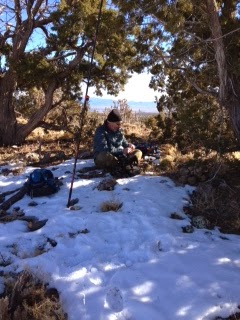
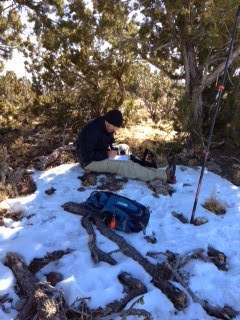
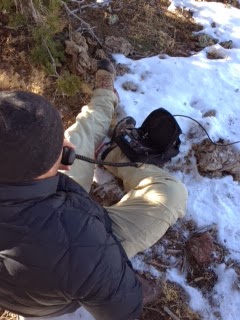
 The Summit we chose was 7472. In the SOTA world, peaks without names are assigned their elevation as a name, so as you might guess the elevation of this peak was 7,472 feet ASL. The peak is located in the Caja del Rio area that I described in my previous post. the summit is actually half of an extinct volcano. As you would expect, there was lots of volcanic rock and cactus on the mountain.
The GPS route estimated that it would take us an hour get to the summit. However, because of deep ruts in the 4WD roads it took us about an hour and a half to get to the base of the mountain. This summit, like Montoso Peak, had no trail to the top, we would have to bushwhack our way up. Also, because the approach to the summit was from the north side of the mountain, there was much more snow than we planned for. However, Jake and I made relatively good time up the mountain, scaling the 500 foot ascent over .8 of a mile in about 30 minutes.



Mike Crownover, AD5A, is a regular contributor to AmateurRadio.com and writes from Texas, USA. Contact him at [email protected].
88′ EDZ Problems
In addition to the fall that my 88′ EDZ took, there now seem to be other problems. While connecting it to the KX3 this afternoon, I noticed that depending on how I handled the coax, the antenna would either “hear” or not. I immediately suspected a fault at the PL-259, so I replaced it. Unfortunately, it didn’t make a difference. That means there is most likely a fault in the coax a bit further back.
Larry Makoski, W2LJ, is a regular contributor to AmateurRadio.com and writes from New Jersey, USA. Contact him at [email protected].
Packet signals through the ISS digipeater – success!
I posted a few days ago that I was hoping to have a go at digipeating my 145MHz packet signal through the digipeater on the International Space Station. I got all the gear and software set up and then the digipeater seemed to be switched off.
In fact, I think it was switched off for very good reason, whilst the astronauts were space walking; repairing the pump and deploying the cameras (and then undeploying them again).
I set it all up yesterday, before we went out family visiting. Apart from the fact that I didn’t connect the aerial!
Today I was slightly better organised and left things running whilst Julie and I went out for a chilly, but sunny walk. I was pleased to find that I had copied a frame from IW3RGK when I got back.
The next pass looked promising, being pretty much directly overhead. I started to hear the signals as the spacecraft approached, around 300 miles away and got some decodes so I decided to press the transmit button. To my delight, I saw the digipeater repeat my position: you can see on the screenshot below from the UISS program.
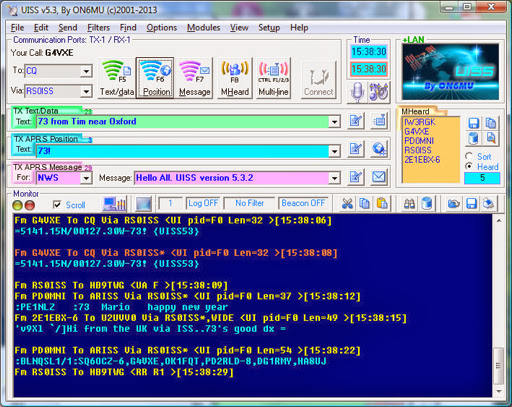
On transmit I was using the FT8900 to the V2000 collinear, so nothing too special. Although I am hearing quite a few packets on the pass, I only seem to be decoding the ones when the spacecraft is almost overhead – I suspect it’s the signal strength – or perhaps the doppler shift is messing with the Soundmodem decodes.
Great fun!
Tim Kirby, G4VXE, is a regular contributor to AmateurRadio.com and writes from Oxfordshire, England. Contact him at [email protected].
Series Six Episode Twenty-Six – Dip Meters and Absorption Wavemeters (29 December 2013)
Series Six Episode Twenty-Six of the ICQ Amateur / Ham Radio Podcast has been released. The latest news and Martin reviews Dip Meters and Absorption Wavemeters.
New Technician Class question pool released
Ham radio operator dials help
FM fans reject digital radio
Start the year off by getting a friend into the Amateur Radio Hobby
0-30 MHz Band Planning Committee announcement
Studies of ionograms show supremacy of 5 MHz band
Amateur Radio Antennas and Masts in NSW
SO-50's eleventh birthday
Spain gets experimental permission for 5 MHz
Youngsters On The Air Finland 2014
Colin Butler, M6BOY, is the host of the ICQ Podcast, a weekly radio show about Amateur Radio. Contact him at [email protected].
When you least expect it – expect it!
As the old joke goes …….
First, a little background. We have put up a baby gate in the doorway between the kitchen and the living room since Harold, our Beagle, came to live with us. Even though he has passed the one year mark, he still has a lot of puppy in him. By that, I mean to say that he chews ….. a lot! He has the run of the back yard, the family room and the kitchen. The living room and the rest of the house will become available to him as he grows older and becomes less of a chewer. In Jesse’s case, that came around about his second birthday, so I am expecting that Harold will become calmer as October 2014 approaches.
Anyway, earlier this week, I was taking dinner plates from the kitchen to the dining room, and I snagged my right leg on the baby gate. I mildly twisted it, but really didn’t feel anything at the time. The next day it was fine. Two days later? Whoa, Baby! My knee was sore, then that got better, then my hamstring was sore and that got better, and now my calf is the sore spot. I sure don’t heal like I used to when I was younger! I gave in and bought a heating pad on Thursday on my way home from work. That has helped a lot and today has been the first day since Christmas Eve that I have been walking without a noticeable limp.
I had planned to spend today on my fanny and not do much of anything – just rest the muscles in my right leg and apply some heat on and off throughout the day. Then this afternoon, my little eye spied out the rec room window and I saw the wire from my 88 foot EDZ was all kinds of droopy. What the hey?!?
I went outside to discover that the Dacron antenna rope holding up the center insulator had broken. The antenna was still in the tree, but had dropped about 10 feet. Not a good thing, especially as I am scheduled for 40 Meter QRP Fox duty this coming Tuesday night – New Year’s Eve. It seems you can always expect trouble when you least expect it.
The weather was nice here today – sunny and in the low 50’s (about 11C), so I began looking for my antenna stuff. I found the pneumatic launcher, and the mason’s twine that I use to pull up rope – but where’s my Dacron antenna rope? I searched the shack high and low for almost a half hour and couldn’t locate it. I know it’s hiding somewhere here in plain sight – but I still can’t find it. All I was able to locate was some Nylon rope that I use for tying various things. This rope is not ideal for antennas as it stretches over time, but with daylight starting to wane, it’s any port in a storm.
After one or two failed attempts, I got my line through the tree. The pneumatic launcher worked like a charm. One time I forgot to open the bale on the fishing reel, so the projectile launched just fine, but the fishing line broke and stayed put, while the little projectile soared like an eagle. Once I remembered all the steps, I got the line up and through how I wanted it.
At this point, I have to give big kudos to my son, Joey. He gave me a hand with this project today, and if it weren’t for him, this repair job would definitely have taken longer, and perhaps have not been accomplished at all. Thanks, Joey – I owe you a big one!
So my 88′ EDZ is now back in the air, with temporary rope support, a few feet higher than it was. I will have to purchase some bonafide Dacron antenna rope (if I can’t find what I thought I had) and re-do this some weekend in the near future. Of course, all the weekends from here on out until April with probably be sub-freezing and snowy!
I did get on the air tonight to hand out points to the Stew Perry contesters on 160 Meters. The W3EDP loads just fine on 160 Meters and with 5 Watts, I have been working up and down the East Coast and out towards Ohio and Michigan. Not bad for 5 Watts and about what I expected from last year’s contest.
But I think I’ll head upstairs now and apply some more heat to this old, aching calf muscle. And to think how I used to chuckle when my Mom used to tell me, “Don’t get old!”
72 de Larry W2LJ
QRP – When you care to send the very least!
Larry Makoski, W2LJ, is a regular contributor to AmateurRadio.com and writes from New Jersey, USA. Contact him at [email protected].
Ice storm 12 hour work days means no time for blogging.

 |
| Making the best of things |
 |
| Some of the damage trees |
Mike Weir, VE9KK, is a regular contributor to AmateurRadio.com and writes from New Brunswick, Canada. Contact him at [email protected].
Clever K3 macro trick

Tonight I sat down to fiddle with the macros of my Elecraft K3. As I already use M1-M4 for CW memories, I only had the PF1 and PF2 buttons available.
It was the blog post “K-3 Rotating Macros” of W8TN that made me aware of a clever trick for using a macro to reprogram itself. This gives the possibility to have two rather than one function in the PF2 button. My need is for a button that can toggle between the typical pile-up functions Split+1 and Cleanup. In addition I have another macro that toggles speakers on and off.
The two first macros resemble those of W8TN, but are not quite the same:
- Split+1: SWT13;SWT13;FT1;UPB4;RT0;XT0;SWT11;BW0045;SWT11; MN110;SWT12;SWH47;SWT14;
- 0 Split: FT0;RT0;XT0;LN0;SB0;SQ000;DV0;LK0; MN110;SWT11;SWH47;SWT14;
The Split macro in memory 1 means:
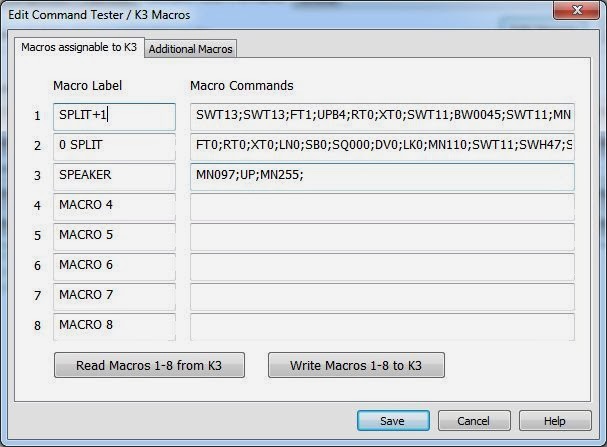
- SWT13; taps A>B once to copy VFO A frequency to VFO B
- SWT13; taps A>B again to copy all other settings to VFO B
- FT1; enters Split mode.
- UPB4; moves VFO B up according to setting 4, which is 1 kHz
- RT0; turns RIT off
- XT0; turns XIT off
- SWT11; taps A/B to go to VFO B
- BW0045; sets bandwidth B to 0.45 kHz
- SWT11; taps A/B to go to VFO A
- MN110; enters Config, Function, Macro
- SWT12; taps the (2) button to choose Macro 2
- SWH47; holds the PF2 button to assign it to PF2
- SWT14; taps the Menu button
Entries 10-13 are the reprogramming steps where the PF2 button is reassigned to the cleanup macro in memory slot 2. The contents of that macro is:
- FT0; turns Split off
- RT0; turns RIT off
- XT0; turns XIT off
- LN0; unlinks the VFOs
- SB0; turns subreceiver off
- SQ000; turns squelch off
- DV0; turns diversity mode off
- LK0; unlocks VFO A
- MN110; enters Config, Function, Macro
- SWT11; taps the (1) button to choose Macro 1
- SWH47; holds the PF2 button to assign it to PF2
- SWT14; taps the Menu button
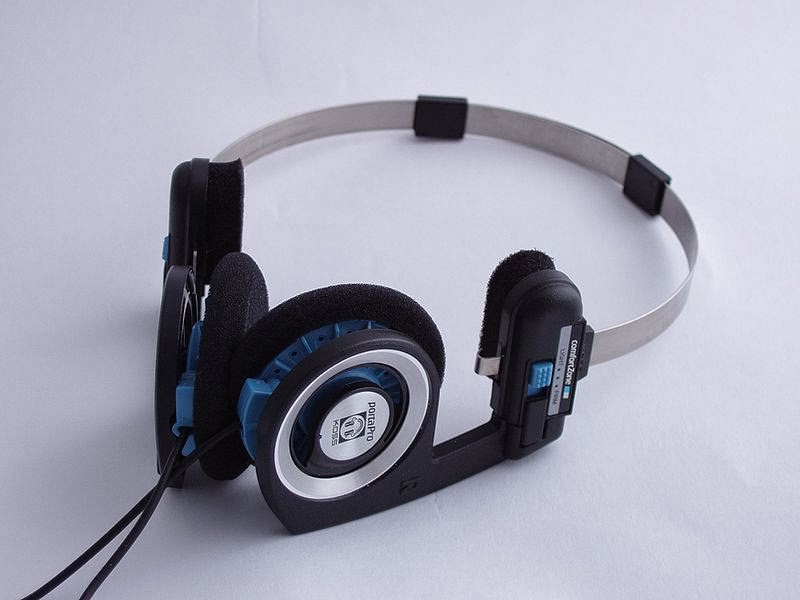 |
| Picture of Koss PortaPro from Wikipedia (Malcolm Tyrrell) |

Since I often toggle between speakers and my Koss PortaPro headphones (connected to the back of the K3), I liked what I just found on the Elecraft list where the command for speakers on/off was reposted. I have assigned that to the PF1 button which is also the RIT (Receiver Incremental Tuning) reminding me that this affects reception.
Macro 3 is MN097;UP;MN255; meaning:
- MN097; Access Menu, Speaker+phone
- UP; Change parameter
- MN255; Access Menu, Exit
After the macros have been loaded into the K3 with the K3 Utility Program, the macros are assigned to the PF1 and PF2 buttons by first entering Config, Macro 3, and then hold PF1, and then Config, Macro 1, and then hold PF2.
Sverre Holm, LA3ZA, is a regular contributor to AmateurRadio.com and writes from Norway. Contact him at [email protected].
 Ham Radio Deluxe |
 W5SWL Electronics |
 Ham Radio Prep |
 KB3IFH QSL Cards  Hip Ham Shirts  HamRadioAuctions HamRadioAuctions Reliance Antennas Reliance Antennas Enigma Shop Enigma Shop |  morseDX  Ni4L Antennas  R&L Electronics R&L Electronics antennas.us antennas.us QRV QRV |
- Matt W1MST, Managing Editor
