 |
 Your LF Station’s Best Friend – The Scopematch PT.II
 6 August 2014 | by
  As mentioned in Part I, my construction of the MØBMU-designed Scopematch has proven to be the most valuable piece
of test gear in my LF station. If you plan to become active on our new 630m
band, it is well worth taking a few hours to build as it will make antenna
tuning much, much easier than trying to get your antenna tweaked using other
methods.
As mentioned in Part I, my construction of the MØBMU-designed Scopematch has proven to be the most valuable piece
of test gear in my LF station. If you plan to become active on our new 630m
band, it is well worth taking a few hours to build as it will make antenna
tuning much, much easier than trying to get your antenna tweaked using other
methods.After building and installing the new Scopematch, a quick check of what I thought had been a properly-tuned system, surprisingly revealed that my 2200m antenna was neither matched correctly nor tuned to resonance! In spite of my poor-tuning (using the system shown in my last post), I had still received a number of encouraging reception reports from VE6, Washington and Oregon, giving me false and undeserved confidence in my earlier tuning attempts. The Scopematch soon changed all that.
The complete building instructions and operating description for the Scopematch may be found in "Tuning Aids for the 136kHz and 500kHz Bands" by Jim Moritz, MØBMU.
 |
| Source: Tuning Aids for the 136kHz and 500kHz Bands by Jim Moritz, MØMBU |
As can be seen, a small RF sample taken by the Scopematch is coupled to the inputs of a dual-trace oscilloscope...one channel displaying the antenna current waveform and the other displaying the voltage waveform. When the antenna system has been tuned to resonance and matched to 50 ohms, both sine waves will be equal, in both phase and magnitude as shown below.
Such a condition is ideal and virtually guarantees that your transmitter is looking into a non-reactive 50 ohm load. Many transmitter designs utilized on LF employ inexpensive switching MOSFETs operating in either class-D or class-E modes that cannot tolerate any reactance in their output load. The end result of such a condition quickly produces a growing pile of dead MOSFETs!
 | |||
| Source: Tuning Aids for the 136kHz and 500kHz Bands by Jim Moritz, MØMBU |
If the system is not tuned to resonance, the phase of the waveforms will not be the same and one waveform will lead the other. Whichever waveform is doing the leading indicates whether the antenna is tuned above or below the desired frequency so that proper corrective measures can be taken to achieve resonance.

| Source: Tuning Aids for the 136kHz and 500kHz Bands by Jim Moritz, MØMBU |
The condition shown above illustrates the smaller waveform (V) lagging the larger current waveform (I) which indicates the antenna is capacitive or too high in frequency.With 'I' being greater than 'V', the resistive component of the load measures about 20 ohms.
The condition shown below indicates resonance but with 'V' being greater than 'I', the resistive component of the load measures about 80 ohms.
 |
| Source: Tuning Aids for the 136kHz and 500kHz Bands by Jim Moritz, MØMBU |
The impedance match will be indicated by the amplitude of the two waveforms. Depending on which waveform is higher or lower indicates if the resistive impedance component is higher or lower than 50 ohms. Actual impedance values can be calculated from Ohm's Law using the sampled
waveform values.
It is fascinating to watch the scope patterns during windy conditions when the antenna's large tophat section is being blown around, causing slight changes in impedance and resonance. The two waveforms will expand and contract as well as shift phase slightly...almost as if the system is alive and breathing!
 |
| My 2200m antenna - resonant and matched & a thing of beauty! |
Jim's article goes into much more depth as well as showing alternative methods of construction and is very much worth studying. Over the last few years I have suggested the Scopematch to several LFers who, like me, now wonder how they ever lived without it!
Steve McDonald, VE7SL, is a regular contributor to AmateurRadio.com and writes from British Columbia, Canada. Contact him at [email protected].
As if I needed
to remind anyone, but I will, anyway. THIS coming Sunday is the NJQRP Skeeter Hunt! And there is still time to sign up for a Skeeter number – all the way until 0400 UTC on Sunday morning.
We have 140 Skeeter’s so far, warming up their wings and ready to take flight. Please consider joining in on the fun.
All the rules can be found at www.QSL.net/w2lj or, you can just click on the Skeeter Hunt page tab above.
72 de Larry W2LJ
QRP – When you care to send the very least!
Larry Makoski, W2LJ, is a regular contributor to AmateurRadio.com and writes from New Jersey, USA. Contact him at [email protected].
Early close again tonight on 10m WSPR
Tonight is the last night my shack is being used as a bedroom. Hopefully I shall be able to operate beyond 1745z tomorrow if I want to. I am also unable to come on for the UKAC session on 2m this evening for the same reason: my shack is a bedroom for the third night.
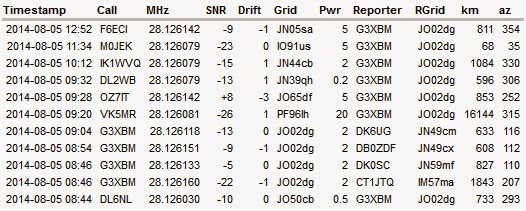 |
| 10m WSPR unique spots until QRT at teatime |
These last few days have been exceedingly fatiguing (stroke). Not sure if this just a bad week or whether it is extra tiring having the little ones around: although I enjoy having them it is at least twice as tiring for me: I worry about them but am too feeble to sort out things. This makes me feel SO tired. We’ll see if I feel less tired when they go home.

Roger Lapthorn, G3XBM, is a regular contributor to AmateurRadio.com and writes from Cambridge, England.
Noises Off – WiMo QRM Eliminator
In desperation I had been looking at some of the noise cancellers available from MFJ and others. I had heard conflicting options on their effectiveness but was willing to try one if I could obtain one cheaply. The MFJ units are in my opinion expensive to purchase new so I bid on several that came up second hand on eBay but they invariably also went for silly money. I was even contemplating building an home-brew one from the numerous designs available.
Then I discovered the WiMo QRM Eliminator, made by the German company WiMo Antennas and Electronics. Several online reviews and numerous YouTube videos seemed to indicate its effectiveness and taking up the then summer discount offer I ordered one for the princely sum of €147 including postage, around £116.
Due to heavy demand and low stock levels following the International Ham Radio Exhibition at Friedrichshafen I was told the unit wouldn't be available till the middle of August, so I was pleasantly surprised when the unit turned up last Friday morning.
New toy in time for the weekend ;-) Thank you @wimo_de pic.twitter.com/4Xfuv5ccHB
— Andrew Garratt (@nerdsville) August 1, 2014 I have connected it up and briefly tried it out and am impressed, as this video illustrates.Even using one for a short time I would agree that they are something of a black art to set up and use and can understand why people might consider them useless, but this may be due to lack of understanding of how they work.

I have created a diagram showing a typical scenario.
The operators main antenna is designed to pick up distant signals, not necessarily DX but signals not emanating from the immediate vicinity, however they will also pick up locally produced QRM as shown, perhaps generated by a neighbours TV or PLT device.
The QRM eliminator has a second antenna which isn't as efficient as the main antenna and ideally just receives the local QRM at a similar level to the main antenna. The device then takes this second signal and inverts the phase so when it is mixed with the main antenna signal the QRM is cancelled out.
The principal is quite simple, if you take two in phase signals and combine them you will end up with a signal with a larger amplitude. However if the signal is 180 degrees out of phase, the positive and negatives of the waveform cancel each other, producing a null signal.
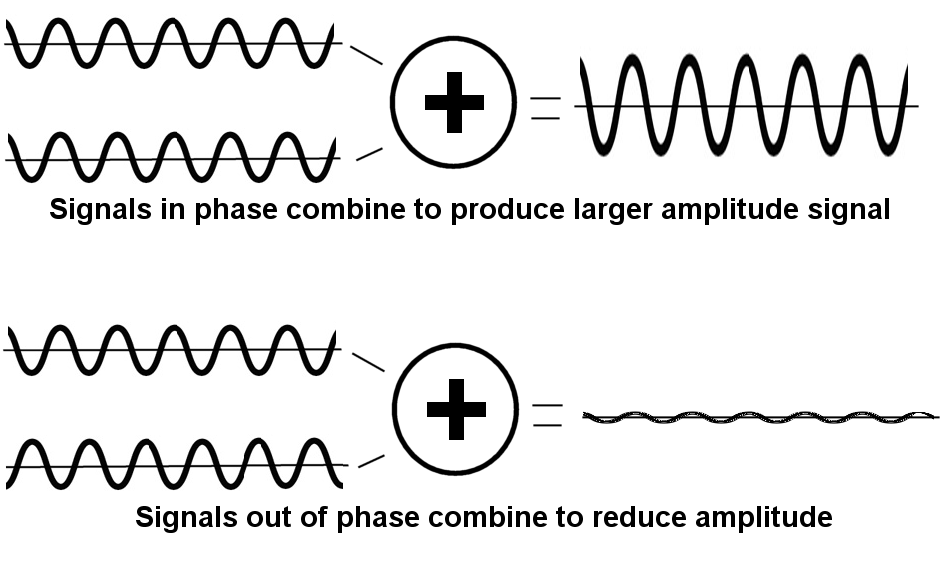
At present I just have several meters of wire running as the noise antenna along the side of the shack and this seems to fairly effective.
The unit is powered from 12V and can be left in line, but requires the PTT/TX-GND signal from the CAT/Linear socket from the transceiver to activate a bypass when transmitting and I don't have the appropriate 8-pin plug at present. If the unit is powered off the bypass is automatically engaged.
All in all, first impressions are good and looks like a worthwhile purchase.
Andrew Garratt, MØNRD, is a regular contributor to AmateurRadio.com and writes from East Midlands, England. Contact him at [email protected].
SOTA Summit W0C/SP-042 Activation
For the 2014 Colorado 14er Event, Joyce K0JJW and I decided to try a summit close to our cabin near Trout Creek Pass. The basic idea was to activate a non-14er SOTA peak with good VHF paths to all of the Colorado mountains. We also wanted to demonstrate the idea of activating Summits On The Air peaks during the 14er event.
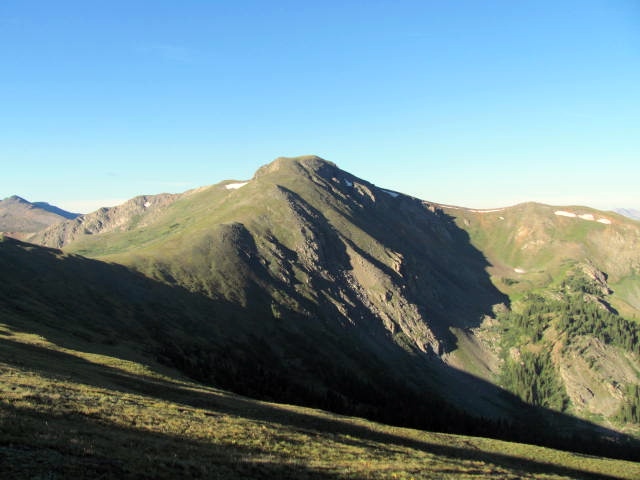
SOTA summit W0C/SP-042
We chose an unnamed peak (W0C/SP-042) that rises to 12,792 feet near Cottonwood Pass . This summit was already on my list of SOTA peaks to activate, so that was another plus. The trail starts at Cottonwood Pass, right on the continental divide and runs along the divide for about 2 miles.

Joyce (K0JJW) at the trail head, Cottonwood Pass.
In fact, we followed the Continental Divide Trail (CTD) to get to this SOTA peak. I’ve done several backpack trips on the CTD and its always a blast to be walking along the top of the continent enjoying the awesome views.
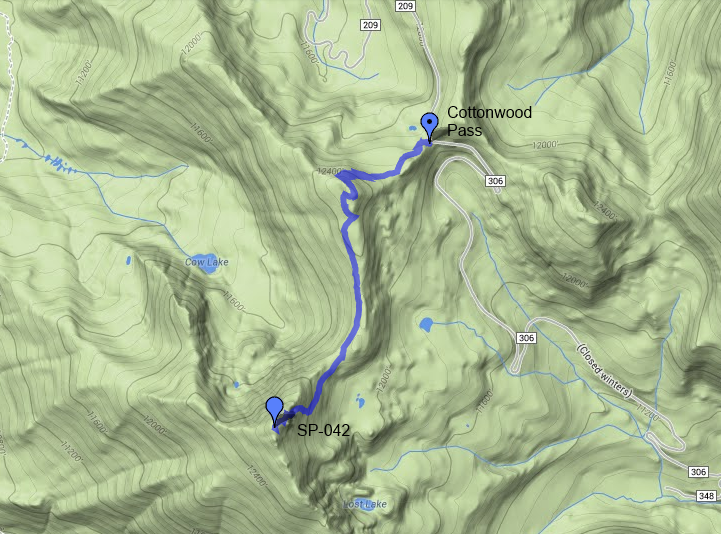
The trail starts at Cottonwood Pass and runs along the Continental Divide.
The main trail passes over the top of another summit at 12,400 feet before continuing on to SP-042. The trail does not go to the top of SP-042, passing it on the east side. We just stayed on the trail until we were due east of the summit, then climbed up the east side which turned out to be a bit steeper than it looked. On the way down, we left the summit by following the ridge a bit to the south and found a gentler route back to the trail. Also on the way back, we followed a side trail to the east of the 12,400 foot summit, saving some vertical gain and loss. My GPS app on the iPhone logged the one-way distance as 2.2 miles (including going over the first summit). It looks shorter on the map but the switchbacks add some distance.

Bob (K0NR) on the trail.
After we reached the summit around 9 am, I quickly assembled the 2m/70cm Arrow antenna and mounted it on my hiking stick. Once I had the FT-817 up and running, I spotted myself on Sotawatch.org using the SOTA Goat app. Logging was done with HamLog on my iPhone.
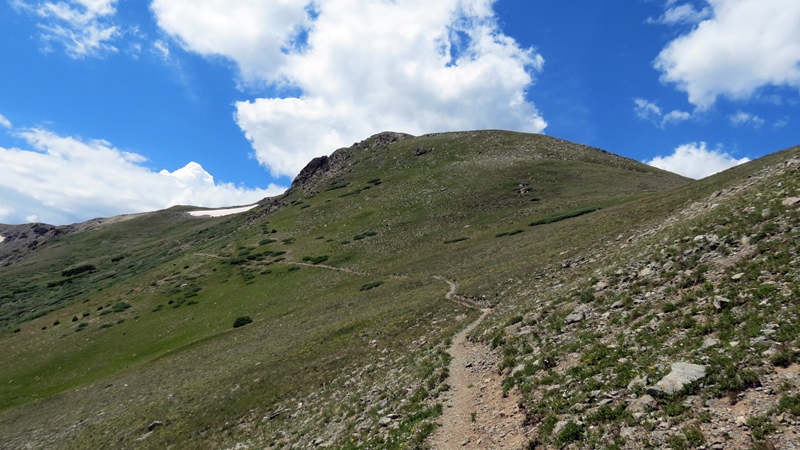
Typical trail conditions on the CTD.
I worked a number of mountaintop stations on 2m fm (147.42 and adjacent simplex frequencies) with the best DX being N4MMI on Redcloud Peak, about 80 miles away. I tried calling on 2m and 70 cm SSB without any luck. Joyce made a few contacts on 446.0 MHz using an HT with a vertical antenna.
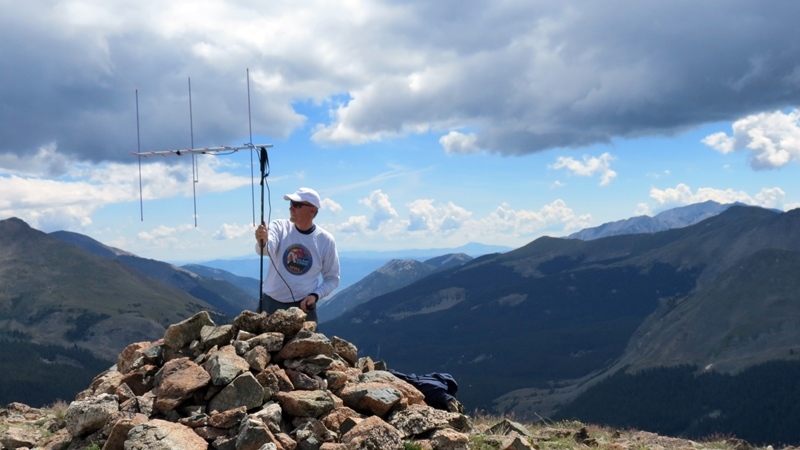
Bob (K0NR) pointing the 2m yagi (vertically polarized) for maximum signal strength.
The weather cooperated all morning with mostly white fluffy clouds. We stayed on the summit until noon and then hit the trail back to the pass. This hike is now one of our favorites, really good for visitors that want a taste of hiking above treeline with great views.
73, Bob K0NR
Bob Witte, KØNR, is a regular contributor to AmateurRadio.com and writes from Colorado, USA. Contact him at [email protected].
Signal and Noise
“One man’s signal is another man’s noise,” began Dr. Kudeki as he derived incoherent scatter radar theory from Nyquist’s noise theorem in ECE458. I think of that statement often, whether it be QRM on the ham bands or sifting through the pocket litter of web users looking for their consumption preferences.
This morning, I admired just such an example of signal and noise while watching the NOAA Doppler weather radar. Undesired targets of a radar that return echoes are termed “clutter” in the radar parlance and one simplistic way of eliminating clutter, especially when you expect the desired scatterers (“targets”) to move, is to assume that all of the stationary returns are clutter. In the weather radar, we get clutter from all sorts of stationary things like trees, hills, and buildings. Of course, what causes the clutter to move?
You see, it was one of those humid August mornings when a ham’s mind wanders to…tropospheric ducting. Yes, indeed the clutter returns were moving, intensifying before and after sunrise. I was fixated on this and watched the loop over and over again before noticing an even more interesting bit of clutter!
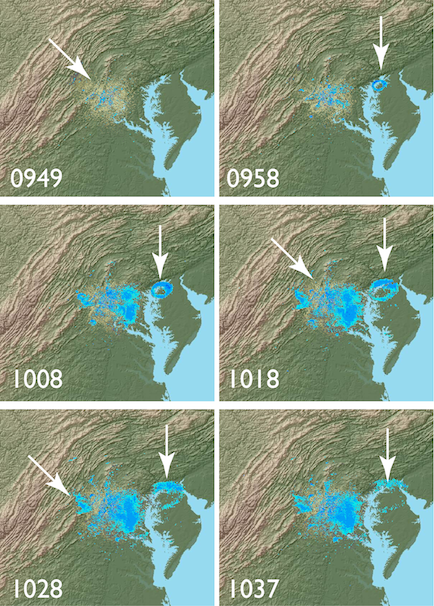
Beginning at 0958 UT on 4 August 2014, there is a small ring forming out over the Elk River area. The ring, which is indicated by the downward-pointing vertical arrows, expanded over the next >40 minutes. I was puzzled and watched the loop over and over. I considered and discarded a number of theories before resorting to Google. Apparently, it’s very likely a flock of birds. Sure enough, the epicenter of the ring is Elk Neck State Park. Fascinating.
The slanted arrows in the figure above indicates the ground clutter that I was originally noticing as a signature of tropo ducting, obviously now of secondary interest in this sequence of images!
Epilogue: I sent these frames to my father, who is an avid observer of the natural world. He passed them along to two friends back home who are birders. At press time, one reported that he had learned of these “bird circles” from Greg Miller, another birder from the area who got famous as one of the subjects of the book (and movie of the same title) The Big Year. I haven’t read/seen it, but I guess they went to Adak, which has a special place in my heart. Anyhow, it’s a funny small and interesting world in which we live.
Ethan Miller, K8GU, is a regular contributor to AmateurRadio.com and writes from Maryland, USA. Contact him at [email protected].
MRI scan results
A week ago I had another MRI scan to see how my brain bleed is repairing. Today I had to go back to get the results. I was extremely relieved to hear all is repaired, my boys will not inherit the problem and all is well.
My relief was visible. This had been a real worry to my wife and I. I dreaded further brain surgery, fearing some long-term damage might be done. I have now been “signed off” by the neurosurgeons and should not need to see them in their clinic again.
My main problems remaining are swallow of some liquids, giddiness when walking, some stomach discomfort and profound fatigue: most days the least physical exertion totally exhausts me. I find it hard to describe just how tired I feel most of my waking day. All these remaining issues should improve, but this could be a long time. Apparently the neurosurgeon told the DLVA in June that I am fit to drive, although their OK could take months to reach me. A few months ago there was no way I could have driven, but now I feel ready to do so. It will be good to drive the car again.
Today has been an emotional day. I am profoundly grateful it is drawing to a close.

Roger Lapthorn, G3XBM, is a regular contributor to AmateurRadio.com and writes from Cambridge, England.
 Ham Radio Deluxe |
 W5SWL Electronics |
 Ham Radio Prep |
 KB3IFH QSL Cards  Hip Ham Shirts  HamRadioAuctions HamRadioAuctions Reliance Antennas Reliance Antennas Enigma Shop Enigma Shop |  morseDX  Ni4L Antennas  R&L Electronics R&L Electronics antennas.us antennas.us QRV QRV |
- Matt W1MST, Managing Editor
