 |
 Ham Talk LIVE! Episode 2 – Don Wilbanks, AE5DW
 26 February 2016 | by
Ham Talk LIVE! Episode 2
w/ Don Wilbanks, AE5DW
Amateur Radio Newsline and Ham Nation
Thursday, 25 February 2016
9:00 PM Eastern Time (02:00 UTC)
Listen to this episode LIVE (and to all previous episodes) in the player below:
[spreaker type=standard width=620px autoplay=false show_id=1607081]
Matt Thomas, W1MST, is the managing editor of AmateurRadio.com. Contact him at [email protected].
Some Radio Antics
Thankfully things calmed down and was able to put the antenna back up but I seemed a little deaf on VHF/UHF dropping several S-points on local repeaters and then started to see high VSWR readings. The incessant rain had somehow got into the connector under the collinear despite being generously wrapped in self amalgamating tape. I replaced the connector and removed a couple of feet of coax in case any had seeped into the cable.
Like much of the UK amateur community I have been trying to listen in to British Astronaut Major Tim Peake during a number of ARISS UK school contacts during the Principia mission on the International Space Station. It is pleasing to see the enthusiasm, interest and publicity it has generated for the hobby.
There is another contact tomorrow (Friday 26th February 2016 at 1440UTC) with the City of Norwich School. While reception of the first two contacts proved a little disappointing for me, the one last week was much better and I made a video during the pass.
The Astronauts are certainly busy on the space station and there was an ARISS contact this morning with an Italian school. It was a low pass here only reaching 7 degrees above the horizon but was pleased to capture Tim Kopra conversing. I was using just the X-50 collinear on the FT857-D
The repaired ATU and a new balun on the OCFD has made a big difference to HF. It is much less noisy and I am now able to match the antenna to 80m something I could never do before. While it will be very inefficient on such a short antenna I did run a little over 2W last night on WSPR as a test, and was pleasantly surprised.
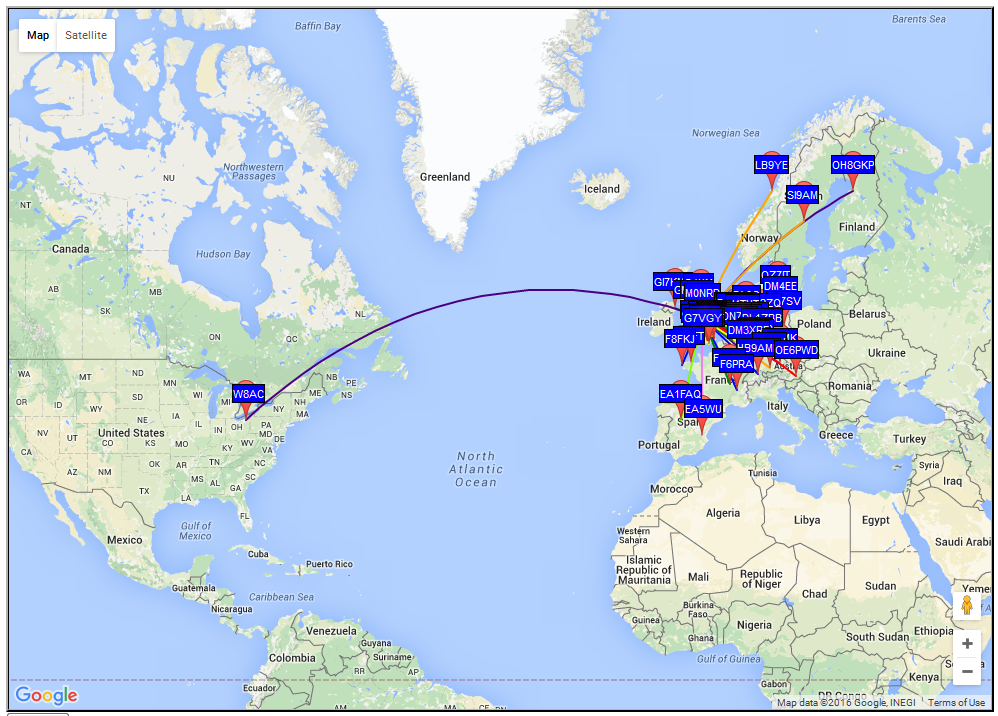
I have also been doing some JT65 and for the first time some JT9 inspired by a demonstration at SKARS and I was pleased to make a JT9 QSO with JA5BDZ on 15m using 10W.
A big help to HF has been tracking down the source of my recent QRM, which wasn't as many suggested my evil PLT devices but in fact the now redundant wireless router. While the WiFi was switched off it was still being used as a network switch and for some reason had suddenly become RF noisy, it wasn't the switching PSU but the actual unit and would happen a few hours after being switched on. Funny thing it is not the first time I've had an access point suddenly emit QRM.
A couple of weeks ago I went out with Stewart (M0SDM) to assist him flying his kite antenna and we operated under the club callsign MX0SKR, for a couple of hours, it was great fun.

Last weekend I also helped my brother David (M6GTD) install a couple of antennas at the family home. He can finally use the radio he brought at the Hamfest back in September, a Diamond X-50 dual band collinear and a home brewed 33ft long OCFD should get him on the air!

David helped me at the Hamfest with the balloon launch

My apologies if this blog post sounds like a bit like an excited child recanting his holiday "I did this, and then I did this and I also did that" I hope to post something a little more coherent and structured soon!
Andrew Garratt, MØNRD, is a regular contributor to AmateurRadio.com and writes from East Midlands, England. Contact him at [email protected].
Some Radio Antics
Thankfully things calmed down and was able to put the antenna back up but I seemed a little deaf on VHF/UHF dropping several S-points on local repeaters and then started to see high VSWR readings. The incessant rain had somehow got into the connector under the collinear despite being generously wrapped in self amalgamating tape. I replaced the connector and removed a couple of feet of coax in case any had seeped into the cable.
Like much of the UK amateur community I have been trying to listen in to British Astronaut Major Tim Peake during a number of ARISS UK school contacts during the Principia mission on the International Space Station. It is pleasing to see the enthusiasm, interest and publicity it has generated for the hobby.
There is another contact tomorrow (Friday 26th February 2016 at 1440UTC) with the City of Norwich School. While reception of the first two contacts proved a little disappointing for me, the one last week was much better and I made a video during the pass.
The Astronauts are certainly busy on the space station and there was an ARISS contact this morning with an Italian school. It was a low pass here only reaching 7 degrees above the horizon but was pleased to capture Tim Kopra conversing. I was using just the X-50 collinear on the FT857-D
The repaired ATU and a new balun on the OCFD has made a big difference to HF. It is much less noisy and I am now able to match the antenna to 80m something I could never do before. While it will be very inefficient on such a short antenna I did run a little over 2W last night on WSPR as a test, and was pleasantly surprised.
I have also been doing some JT65 and for the first time some JT9 inspired by a demonstration at SKARS and I was pleased to make a JT9 QSO with JA5BDZ on 15m using 10W.
A big help to HF has been tracking down the source of my recent QRM, which wasn't as many suggested my evil PLT devices but in fact the now redundant wireless router. While the WiFi was switched off it was still being used as a network switch and for some reason had suddenly become RF noisy, it wasn't the switching PSU but the actual unit and would happen a few hours after being switched on. Funny thing it is not the first time I've had an access point suddenly emit QRM.
A couple of weeks ago I went out with Stewart (M0SDM) to assist him flying his kite antenna and we operated under the club callsign MX0SKR, for a couple of hours, it was great fun.
Last weekend I also helped my brother David (M6GTD) install a couple of antennas at the family home. He can finally use the radio he brought at the Hamfest back in September, a Diamond X-50 dual band collinear and a home brewed 33ft long OCFD should get him on the air!
David helped me at the Hamfest with the balloon launch
My apologies if this blog post sounds like a bit like an excited child recanting his holiday "I did this, and then I did this and I also did that" I hope to post something a little more coherent and structured soon!
Andrew Garratt, MØNRD, is a regular contributor to AmateurRadio.com and writes from East Midlands, England. Contact him at [email protected].
Useful propagation charts
This series of charts (change months and bands as required) is a useful guide to HF propagation. Like all such forecasts, caveat emptor as they said in Rome. I think this comes from G0KYA. See http://www.infotechcomms.net/propcharts/february/ .
Another source for solar data was http://www.solan.info/solar , but when I last checked this page had gone. I am not sure what happened. All I get now is a link for hotels!
Another source (which works) is http://www.solarham.net/ .
As you know, I try to add current data on my blog most days. This comes from http://www.hamqsl.com/solar.html .
Somewhere in this lot you should find the data you need.

Roger Lapthorn, G3XBM, is a regular contributor to AmateurRadio.com and writes from Cambridge, England.
Lifetime ham radio licenses?

The ARRL reported today that the FCC is seeking comments on a Petition for Rule Making that asks the FCC to grant lifetime Amateur Radio licenses. Mark Krotz, N7MK, of Mesa, Arizona, submitted the petition in November, 2015.
The petition, RM 11760, notes that the FCC currently issues lifetime General Radiotelephone Operator License. The petition also notes that the Federal Aviation Administration issues permanent airmen certificates.
Here is an excerpt from the petition:

Amateur radio operators wishing to make a comment on the petition may do so here.
Matt Thomas, W1MST, is the managing editor of AmateurRadio.com. Contact him at [email protected].
Amateur Radio Newsline Headlines – February 24, 2016

From this week’s Amateur Radio Newsline Headlines:
- We look back at this month’s Orlando Hamcation, the second largest gathering of amateurs after Dayton Hamvention. It wasn’t just the 70th such Hamcation; it was also the 2016 ARRL National Convention.
- The amateur community is mourning the death of David Lefavour, W7GOX, of Los Lunas, New Mexico, who was a member of the Hurricane Watch Net for more than 20 years, and who served as its net manager between 2006 and 2009. He had also served as a net controller for the Maritime Mobile Service Network.
- The only thing real about the earthquake in Utah earlier this month was the response it got from hams and other emergency team members. But that’s what made the mock drill such a success.
Don Wilbanks, AE5DW, is an anchor for Amateur Radio Newsline and co-host of TWiT's Ham Nation.
Portable Goals and NPOTA!
I can’t believe it has been almost a year since I have posted here! I have lots of interests and tend to bounce around between them.
But for 2016 I want to be more consistently in ham radio. So I have set a goal…
There are about 45 weeks left in 2016, so my goal is to complete 45 portable activities this year and document them here on my blog!
Also, tomorrow, February 25th, 2016 I will be activating NPOTA TR07,TR11,TR14 (Oregon NHT + Santa Fe NHT + California NHT) from Lone Elm park in Olathe, KS.
I will be operating my KX3 5 watts CW (maybe SSB if time allows) into a vertical. 14.060+/- and 7.030 +/-. I plan to arrive about 19:00 UTC (1:00 pm local) and operate for a couple of hours.
If you hear me please spot me. This will be my first activation, and my CW is a bit rusty, so the sending speed will be slow! Be patient with me!
This park has historical significance because it was used as a major campground along these 3 trails. Originally it was about 80 acres, and so many trees were cut down by the campers it became known as “Lone Elm”.
That’s all for today, I will report back after the NPOTA activation tomorrow!
Burke Jones, NØHYD, is a regular contributor to AmateurRadio.com and writes from Kansas, USA. Contact him at [email protected].
 Ham Radio Deluxe |
 W5SWL Electronics |
 Ham Radio Prep |
 KB3IFH QSL Cards  Hip Ham Shirts  HamRadioAuctions HamRadioAuctions Reliance Antennas Reliance Antennas Enigma Shop Enigma Shop |  morseDX  Ni4L Antennas  R&L Electronics R&L Electronics antennas.us antennas.us QRV QRV |
- Matt W1MST, Managing Editor
