 |
 The First DMR-station in Taiwan
 29 August 2016 | by
 Playing around with DMR in Holland was fun. But back in Taiwan my brand new Tytera MD-390 would be totally useless. There is no DMR activity here (yet) and up till recently I was the first and only ham in Taiwan with a DMR ID (4661001).
Luckily there are little devices called “hotspots” and one of the most popular one right now is the DV4mini, designed by DG8FAC (Stefan Reimann), DG1HT (Torsten Schultze) and DJ0ABR (Kurt Moraw). The DV4mini is a tiny USB stick that can turn any PC into a hotspot for all the amateur digital modes: C4FM, D-Star and of course DMR. It does P25 and dPMR, too. Basically it is a router for your DMR transceiver. Ham radio purists will undoubtedly cringe at the thought of RF being routed via the internet, but this is 2016 and everything is connected to the internet, so let’s get over it.
Still in Holland Cor (PD0GHF) was again very helpful and invited me into his shack for me to check out his DV4mini setups. Yes, setups, because Cor is a man with a lot of radio equipment, especially in his trusty Volvo. For the DV4mini to work you need to hook it up to a computer, install the software, configure it and off you go. The computer can be your laptop, PC, but also one of those mini computers, like the Raspberry Pi. With a tiny 3.5 inch TFT screen you can make a very portable hotspot. Cor already made two of them.
 Unfortunately for me Cor didn’t want to part with one of his hotspots, but luckily I had already bought my own DV4mini. Now some of you may know I am not a big fan of the Raspberry Pi, but Cor’s setup looked very appealing. And then Dave (PD5DOF) gave me a 3.5″ TFT screen as a parting gift at the last VERON meeting I attended. So I sighed and ordered a Rpi from RS, which arrived in a couple of days. I ordered the Rpi3 because it is the first Pi with on-board WiFi, so no need to buy a separate WiFi adapter.
There are many ready-made images, with the DV4mini software already installed, available to download on the net. You burn an image on a micro SD card, insert it in the Rpi and your Pi will come alive. But of the 10+ images I tried not one worked on my Pi3, probably because they were made for the Pi2. The plain vanilla Raspbian image did work with my Pi3 and the 3.5″ TFT screen, but the DV4mini software wouldn’t work. The Ubuntu MATE image would work with the DV4mini software, but not with my 3.5″ TFT screen.
So after a week of fiddling around I took the latest Raspian image, installed the latest version of Mono (open source version of MS.NET) from scratch and then the special version of the DV4mini software for small screens. And because I did all that I can now present you with……
THE FIRST EVER DMR AMATEUR RADIO STATION IN TAIWAN….. As you can see I am connected to the reflector connecting all of Holland (4500). I can now take my MD-390, walk out of the shack, sit on the couch and be able to talk with all my fine friends back home, while being in Taiwan!
In Holland most repeaters are connected to the Brandmeister network. In fact, if you look at this map it is becoming the most popular network to connect DMR repeaters to in the world. The Brandmeister network has a dashboard at https://brandmeister.network/ and the good thing about this dashboard is that you can actually see if you connected to the network. Not only that, your most recent transmissions are also logged.
 Apart from QSOs with Dutch hams I have also had QSOs with the US, Sweden and Australia and they were real QSOs as well. Not much use exchanging a “59” when using DMR, is it now? For me this is most important as it allows me to break my isolation here in Taiwan by being able to have QSOs with ham friends from back home and also make new friends all over the world. I always thought that that was the essence of amateur radio. Am I right?
Hans "Fong" van den Boogert, BX2ABT, is a regular contributor to AmateurRadio.com and writes from Taiwan. Contact him at [email protected].
General License Class (Black Forest, CO)
 Ham Radio General License
Two-day Class
Black Forest, Colorado
Two class sessions on Sat Sept 24 and Sat Oct 1 (8 AM to 5 PM) FCC Exam session on Oct 8th
Location: Black Forest Fire Station
Intersection of Burgess Rd. & Teachout Rd.
The General License provides access to regional and worldwide communications on the HF bands via ionospheric skip, greatly expanding operational capabilities!
- Upgrade from Technician to General Class radio privileges
- Pass your FCC General Class amateur license exam Oct 8 *
- Live equipment demonstrations and activities
- Learn to operate on the HF bands, 10 Meters to 160 Meters
- Gain a deeper understanding of radio electronics and theory
- Take the next step with antennas, amplifiers, digital modes
Registration fee: $30
(No FCC exam fee required at Oct 8 exam session)
In addition, students must have the required study guide:
HamRadioSchool.com General License Course
Second Edition, effective 2015 – 2019, $22.95
Current FCC Technician License required for registration. Advanced registration is required by Sept 10th or earlier. First-come registration acceptance until class is full.
To register for the class, contact: Bob Witte KØNR
Email: [email protected] or Phone: 719/659-3727
Sponsored by the Tri-Lakes Monument Radio Association.
The post General License Class (Black Forest, CO) appeared first on The KØNR Radio Site.
Bob Witte, KØNR, is a regular contributor to AmateurRadio.com and writes from Colorado, USA. Contact him at [email protected].
Episode 71 Practical Amateur Radio Podcast
Episode 71 of the Practical Amateur Radio Podcast has been released and is available for download either through iTunes, Android, any other RSS podcatcher software or direct via the PARP website.

The general discussion theme of episode 71 borrows the motto from the Worldwide Floral and Fauna Program “Make Nature your Shack”. While I won’t complain about the warmth of my ham shack on a cold January day, as fall approaches we have many reasons to take our gear outdoors. I discuss the 2016 ARRL National Parks on the Air, Summits on the Air and the Worldwide Floral and Fauna programs.
During the featured website segment I introduce PARP listeners to the FieldRadio.org group and also share a new US amateur radio license preparation site called Ham-Cram.com.
Remember, this Saturday is the Colorado QSO Party. I hope you’ll hear me calling CQ. Thank you for listening to the Practical Amateur Radio Podcast and reading my blog.
Until next time…
73 de KDØBIK (Jerry)
Jerry Taylor, KD0BIK, is a regular contributor to AmateurRadio.com and writes from Colorado, USA. He is the host of the Practical Amateur Radio Podcast. Contact him at [email protected].
Episode 71 Practical Amateur Radio Podcast
Episode 71 of the Practical Amateur Radio Podcast has been released and is available for download either through iTunes, Android, any other RSS podcatcher software or direct via the PARP website.

The general discussion theme of episode 71 borrows the motto from the Worldwide Floral and Fauna Program “Make Nature your Shack”. While I won’t complain about the warmth of my ham shack on a cold January day, as fall approaches we have many reasons to take our gear outdoors. I discuss the 2016 ARRL National Parks on the Air, Summits on the Air and the Worldwide Floral and Fauna programs.
During the featured website segment I introduce PARP listeners to the FieldRadio.org group and also share a new US amateur radio license preparation site called Ham-Cram.com.
Remember, this Saturday is the Colorado QSO Party. I hope you’ll hear me calling CQ. Thank you for listening to the Practical Amateur Radio Podcast and reading my blog.
Until next time…
73 de KDØBIK (Jerry)
Jerry Taylor, KD0BIK, is a regular contributor to AmateurRadio.com and writes from Colorado, USA. He is the host of the Practical Amateur Radio Podcast. Contact him at [email protected].
Summer SMT Project
Over the past week, I've been playing with my 630m transverter summer project.
It's not the normal type of transverter that would produce a signal on 630m (~475kHz) but rather, one that will produce a signal on twice this frequency. My630m amplifier, using switching FETs, was designed and built with a 'divide-by-two' input circuit, to allow for greater frequency resolution when first constructed as a 2200m system. I really don't want to modify the transmitter and prefer just to be able to unplug my DDS and plug-in the transverter, allowing me to run WSPR, JT9 and several other digital modes when needed.
So far I've not been able to get the transverter to produce the desired low voltage 950kHz squarewave output, although I'm closer than when I began the troubleshooting.
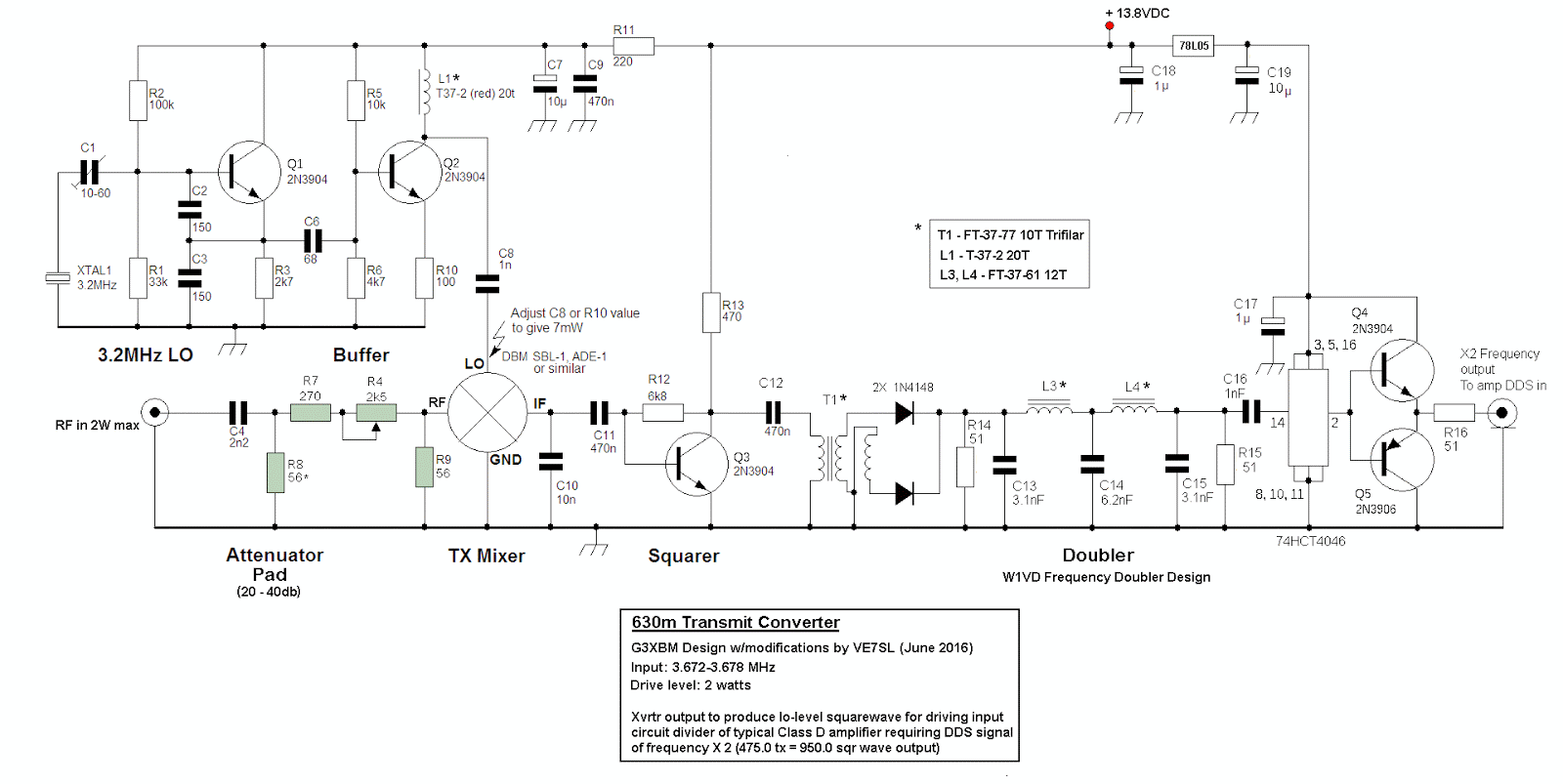
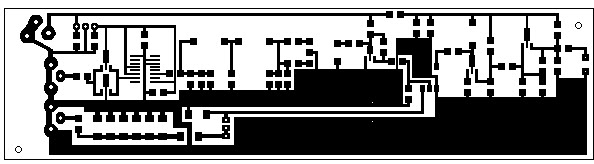
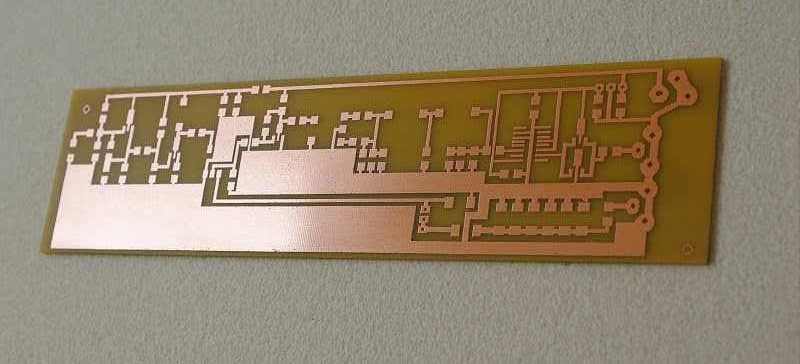
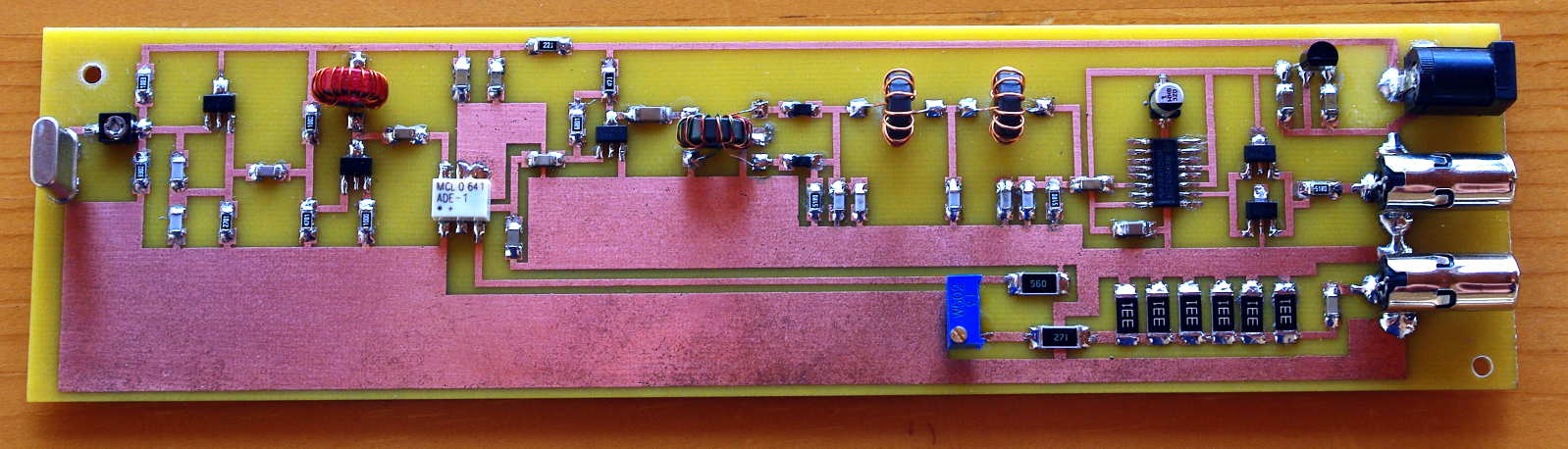
My circuit is basically a G3XBM 630m transverter, without the FET final amplifier. Instead, the driver feeds a full-wave rectifier frequency doubler for 630m, designed and published a few years ago by Jay, W1VD. Although I can get a squarewave end result, I think harmonics creeping into the process earlier down the mixing chain are causing non-symmetry in the output.
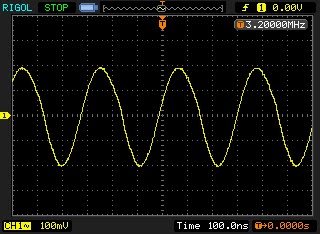 |
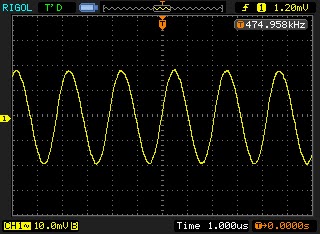
| 3.2MHz signal out of oscillator buffer stage |
 | |||
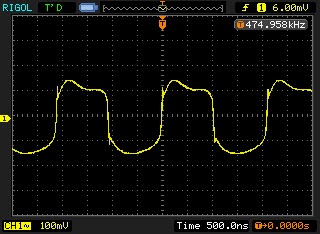
| 475 kHz signal out of mixer stage |
 |
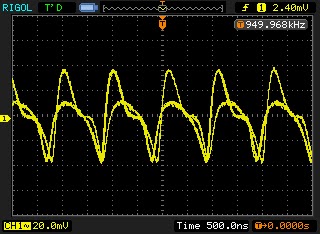
| Signal out of 'squarer' stage |
 |
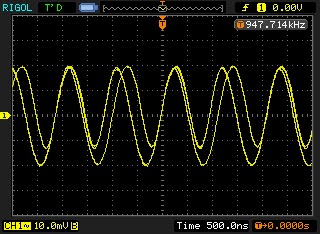
| Signal out of full-wave bridge |
 |
| Signal out of LPF |
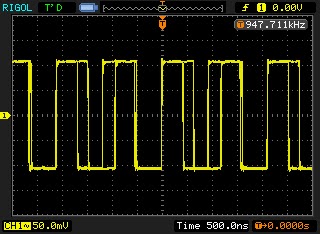 |
| Asymmetrical squarewave from 4046 output |
I've tried a 3-section LPF with a cutoff of ~600kHz between the mixer output and the next stage, trying to knock down the 'sum' frequency of 6.875MHz and any crystal harmonics but have since replaced this with a 630m diplexer at the mixer output to pass anything below 1MHz to the squarer and anything above 1.5MHz to ground. I'll keep playing with it ... until it works as it should or I have no hair left to pull out. I may also just rebuild the circuit, Manhattan-style, with normal sized parts, making it much easier to change or modify as I need. The scope grabs shown above are with the diplexer in place at the mixer output. It seems like something in the full-wave frequency doubler is amiss. I've looked at T1, the bifilar transformer several times but don't see anything odd but that's the stage where things seem to go south. Maybe it's an impedance matching-thing, something I'm yet uncomfortable with when it comes to properly matching various stages.
I also now realize that the section of transverter I have chosen will require post-mixer filtering, not shown in the schematic. Not using the last stage (FET PA) and its associated filtering, has no doubt caused more harmonics to appear in the output than anticipated. If I redesign and rebuild, I will add an LPF after the crystal oscillator as well as at the RF input port and pay more attention to post-mixer filtering.
Another route to try, rather than the W1VD doubler, may be this 4069 IC doubler or a similar 4011 doubler.
Although the project outcomes have not yet been achieved, the process has been a positive one in a couple of respects and well worth the time spent so far.
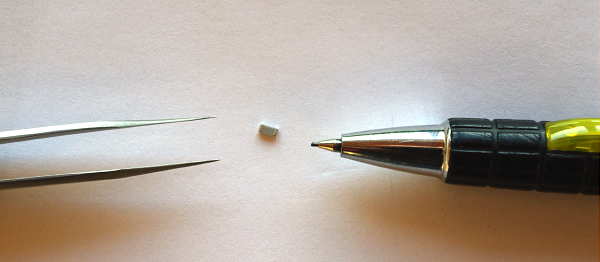
I have learned that working with the 1206-sized SMT parts is much easier than suspected and in fact, populating the board with these tiny parts was a lot of fun. The 1206-sized parts are at the 'large' end of the SMT size-spectrum ... rest assured I won't be going any smaller, at least for now.
The other positive outcome was knowing that my PCB design process can work well with the narrower lines, pads and much smaller IC footprints. I still design my boards using MS Paint and have always been happy with the ease at which it works. I know many might scoff at MS Paint but it really is a very versatile little program, with a short learning curve, unlike many of the more sophisticated PCB design programs.
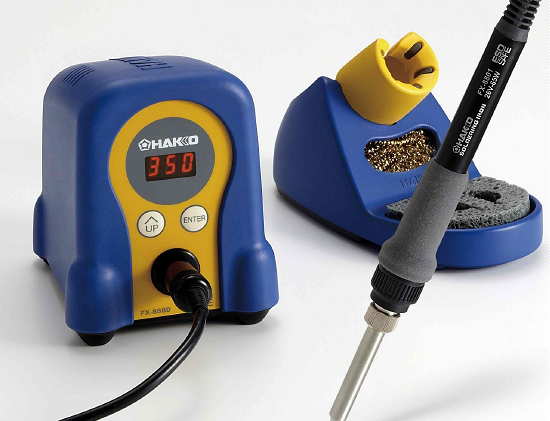
And one more positive outcome. I used the project as an excuse to purchase a new soldering station ... one that I had been lusting over for a few years as it is very SMT-friendly compared to my old Weller clunker. It also has an electrically isolated tip, unlike my Weller. The Hakko FX-888D turned out to be everything I had hoped and was no doubt part of the reason that I found the SMT process so enjoyable.
 |
| Add caption |
Steve McDonald, VE7SL, is a regular contributor to AmateurRadio.com and writes from British Columbia, Canada. Contact him at [email protected].
DX from Swain’s Field
I went for a quick hike this morning before lunch to some remote farm fields not far from home. I worked France, Serbia, Kansas, Canary Islands and Russia. It was a beautiful, beautiful morning.

I started out on Hunkins Pond Road and hiked north up an old farm lane. Then I turned east on the old range road. This old road cuts straight through the woods for probably 8 miles. But just a short way up this road I came to David Swain’s hay fields on top of the hill. It’s a beautiful place. This view is looking east toward the Belknap Mountain range.
I set up the KX3 at the edge of the field and tossed my wire over a huge maple. I started out on 20 meters. The first station I heard was Bert F6HKA in France. He was working the Romanian DX contest. We exchanged 599s and a serial number. Next I worked a Serbian station YT1A also working the contest.
My third QSO was up the band a little with W0L. Jerry was working the Kansas QSO party and I sent 599 and NH. Then I listened around a bit to see how the other bands were doing. I finally settled on 17 meters where I heard a couple of strong DX stations.

EA8TL in the Canary Islands was calling CQ right at the bottom of the band. Jorge was very strong and we made a quick exchange. Up the band I heard Alex RK3ER also calling CQ. “Hello Jim,” he sent as he gave me a 559. He was 599 to me.
Now the sun was almost overhead and it was getting pretty hot in the field. I packed up and headed home for lunch after a final glance to the south.

Jim Cluett, W1PID, is a regular contributor to AmateurRadio.com and writes from New Hampshire, USA. Contact him at [email protected].
Don’t Pound My Octothorpe
 If you want to spark a conversation at your next social event, ask everyone the proper name for this symbol: #. Most North Americans will probably say pound sign or perhaps number sign. It helps to have an international audience, since a person from the UK will likely call it the hash symbol. Lately, the world of Twitter (and other social media) has made extensive use of # to tag keywords, referring to it as the hash mark used to create hashtags. A musician might claim that it is the sharp symbol from musical notation but closer examination reveals that the sharp symbol is quite different.
The AT&T engineers working on the original DTMF system adopted the name Octothorpe for this symbol. There are various explanations and anecdotes that have developed over the years concerning how this happened. Various forms of spelling show up in the literature (octatherp, octothorp, etc.). Doug Kerr’s story is particularly interesting and available on the internet (see below). There are US Patents that use the word “octothorp” to refer to the # symbol. Patent number 3920926 uses “octothorp” for # and “sextile or asterisk” for the * symbol. The term sextile never caught on at all.
For amateur radio usage (North America bias), I hear mostly pound for # and star for *. I suspect that will not change any time soon.
– Bob K0NR
Wikipedia entry for the number sign (#): http://en.wikipedia.org/wiki/Number_sign
The Symbol on the “Pound” or “Number” Key (#) is Also Called an Octothorpe
The ASCII Character “Octatherp”, by Doug Kerr
The post Don’t Pound My Octothorpe appeared first on The KØNR Radio Site.
Bob Witte, KØNR, is a regular contributor to AmateurRadio.com and writes from Colorado, USA. Contact him at [email protected].
 Ham Radio Deluxe |
 W5SWL Electronics |
 Ham Radio Prep |
 KB3IFH QSL Cards  Hip Ham Shirts  HamRadioAuctions HamRadioAuctions Reliance Antennas Reliance Antennas Enigma Shop Enigma Shop |  morseDX  Ni4L Antennas  R&L Electronics R&L Electronics antennas.us antennas.us QRV QRV |
- Matt W1MST, Managing Editor
