 |
 Weekly Propagation Summary – 2019 Dec 09 16:10 UTC
 9 December 2019 | by
Here is this week’s space weather and geophysical report, issued 2019 Dec 02 0130 UTC.
Highlights of Solar and Geomagnetic Activity 25 November – 01 December 2019
Solar activity was very low. No sunspots were observed on the visible disk. No Earth-directed CMEs were observed in available coronagraph imagery.
No proton events were observed at geosynchronous orbit.
The greater than 2 MeV electron flux at geosynchronous orbit reached high levels on 25-28 Nov and decreased to moderate levels on 29 Nov – 01 Dec.
Geomagnetic field activity was mostly quiet. A single isolated period of unsettled was observed late on 29 Nov in response to a prolonged period of southward Bz.
Forecast of Solar and Geomagnetic Activity 02 December – 28 December 2019
Solar activity is expected to be at very low levels throughout the outlook period.
No proton events are expected at geosynchronous orbit.
The greater than 2 MeV electron flux at geosynchronous orbit is expected to range from moderate to high levels. High levels are expected to be reached on 20-25 Dec in response to CH HSS influence; moderate levels are expected for the remainder of the outlook period.
Geomagnetic field activity is expected to be at quiet to active levels. Active levels are expected on 18-19 Dec due to interaction with a positive polarity CH HSS; unsettled levels are expected on 03 Dec and 20-21 Dec; quiet levels are expected for the remainder of the outlook period.
Don’t forget to visit our live space weather and radio propagation web site, at: http://SunSpotWatch.com/
Live Aurora mapping is at http://aurora.sunspotwatch.com/
If you are on Twitter, please follow these two users: 1. https://Twitter.com/NW7US 2. https://Twitter.com/hfradiospacewx
– – – – – – – – – – – – –
Be sure to subscribe to our space weather and propagation email group, on Groups.io
https://groups.io/g/propagation-and-space-weather
Spread the word!
– – – – – – – – – – – – –
Links of interest:
+ Amazon space weather books: http://g.nw7us.us/fbssw-aSWSC
+ https://Twitter.com/NW7US
+ https://Twitter.com/hfradiospacewx
Space Weather and Ham Radio YouTube Channel News:
I am working on launching a YouTube channel overhaul, that includes series of videos about space weather, radio signal propagation, and more.
Additionally, I am working on improving the educational efforts via the email, Facebook, YouTube, Tumblr, and other activities.
You can help!
Please consider becoming a Patron of these space weather and radio communications services, beginning with the YouTube channel:
https://www.patreon.com/NW7US
The YouTube channel:
https://YouTube.com/NW7US
..
Visit, subscribe: NW7US Radio Communications and Propagation YouTube Channel
Technician License Class – Black Forest, CO

Black Forest, Colorado
Sat Feb 22 and 29
8 AM to 5 PM
Black Forest Fire Station
intersection Burgess Rd. & Teachout Rd.
The Technician license is your gateway to the world-wide excitement of Amateur Radio, and the very best emergency communications capability available!
• Earn your ham radio Technician class radio privileges
• Pass your FCC amateur radio license exam right in class on the second day
• Multiple-choice exam, No Morse Code Required
• Live equipment demonstrations
• Learn to operate on the ham bands, 10 Meters and higher
• Learn to use the many VHF/UHF FM repeaters in Colorado
• Find out how to participate in emergency communications
Registration fee: $30 adults, $20 under age 18
In addition, students must have the required study guide: HamRadioSchool.com Technician License Course Third Edition, effective 2018 – 2022, $22.95 print, $19.99 Kindle
Advance registration is required (No later than one week before the first session, earlier is better, first-come sign-up basis until the class is full.)
To register for the class, contact:
Bob Witte KØNR
Email: [email protected] or Phone: 719/659-3727
Sponsored by the Tri-Lakes Monument Radio Association
For more information on amateur (ham) radio visit www.arrl.org
Download: Tech License Class Flyer – Feb 2020
The post Technician License Class – Black Forest, CO appeared first on The KØNR Radio Site.
Bob Witte, KØNR, is a regular contributor to AmateurRadio.com and writes from Colorado, USA. Contact him at [email protected].
ICQ Podcast Episode 313 – CW Invaders Game / Training Aid
In this episode, Martin M1MRB is joined by Edmund Spicer M0MNG, Matthew Nassau M0NJX, Dan Romanchik KB6NU and Ruth Willet KM4LAO to discuss the latest Amateur / Ham Radio news. Colin M6BOY rounds up the news in brief and this episode’s feature is - CW Invaders Game / Training Aid
ICQ AMATEUR/HAM RADIO PODCAST DONORS
We would like to thank Peter Caffery, Daniel Sullivan (KC3NKF) and our monthly and annual subscription donors for keeping the podcast advert free. To donate, please visit - http://www.icqpodcast.com/donate
- New Ham Radio Antenna Bill being Drafted - Happy Birthday FUNcube-1 (AO73) - Halfords Make Radio Signals Travel 'Super-Fast' - Proposed FCC Auction of C-Band Increases Competition for Allocation - Clearing Radio Amateurs out of 3.4 GHz - UK Beginners licence - KB6NU - M17 DMR - KB6NU - SARL Novice Award - Ham Radio Day Aboard the RMS Queen Mary - Hamvention Admission, Fees to Increase
Colin Butler, M6BOY, is the host of the ICQ Podcast, a weekly radio show about Amateur Radio. Contact him at [email protected].
DXing The Utilities (Part 2)
**************************************
Unlike the growing scarcity of good HF maritime DX targets, there is still a large amount of HF aero activity to enjoy! Even with the move to satellite comms, there is still, at any given time of the day or night, hundreds of aircraft using HF radio to communicate with controllers, companies and home bases. Both commercial aviation and the military, as well as many privately owned aircraft, use the HF communication networks to keep them flying safely. From trans-oceanic 777s' and military transports to single engine float planes in the Canadian Arctic and Alaska, the sky is alive with DXing opportunities!
A huge percentage of commercial aircraft are delegated to moving freight and many of them can be heard on HF radio. Many of the planes in use are retired passenger planes that have been reconfigured for moving cargo. Back when I did this type of listening, older DC-8s seemed to be particularly popular, especially on the nightly South / Central America to Florida routes. I suspect that nowadays, these have been replaced with older DC-10's and 747's.
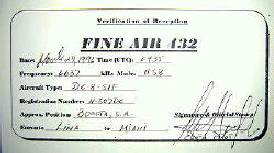
'FINE AIR 432' was logged on March 24,1996 at 0435Z while working Miami Radio on 6637kHz. The DC8-51F (Freighter) was over Bogota while enroute from Lima to Miami.
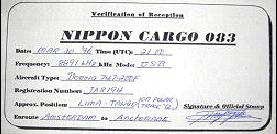 'NIPPON CARGO 083', a 747-200F, was logged
on 8891kHz working Baffin Radio. They were reporting position "LT", a waypoint above Alert, at 82-31N / 62-12W, westbound on Polar Track "Quebec".
The freighter was enroute Amsterdam to Anchorage.
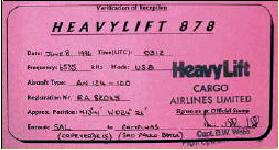
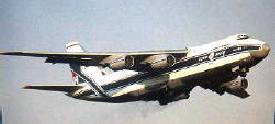
The Antonov 124-100 is a gigantic Russian built freighter - capable of transporting in excess of
120 tons. This is aircraft "RA-82045" which was logged as 'HEAVYLIFT 878' in June, 1996.
Operated by Volga-Dnepr, 'HEAVYLIFT 878' was working Dakar (Senegal) Aeradio on 6535kHz reporting FL240 and position 13-14N / 24-26W enroute Cape Verde Islands to Sao Paulo, Brazil.
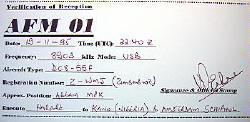
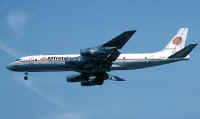
'AFM 01' was a DC8-55F logged while working Brazzaville Radio (Congo) on 8903kHz. It was at FL350, enroute Harare, Zimbabwe to Kano, Nigeria at the "MPK" waypoint, 250 miles east of Kinshasha, Zaire. Brazzavile was advising of 'crossing traffic, same level...please say intentions'... Yikes!
On another evening I heard the Dakar (Senegal) controller advise a British Speedbird 747 to 'go to flight level 330 ... please go now ... go very very fast'.
'AFM01' (Affretair) was Z-WMJ, shown here on final approach to Gatwick.
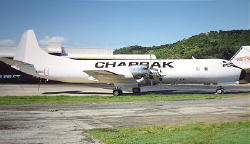 'PACIFIC AIR EXPRESS 3517' was heard on 8867kHz working Brisbane Radio while over the Coral Sea. The Lockheed L-188C four-engine turbo prop was enroute Honiara to Brisbane with a load of fresh tuna destined for the Japanese market. N360Q, shown on the ground at Honiara, was leased from the states and operated by Charrak Air.
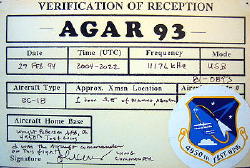 The U.S. military is still active on HF radio and some interesting catches can be had. During the testing phase of the 'cruise' missile, the missile navigation systems were tested over the Northern Territories and Alberta. Once dropped from their B-52 launch platforms, the missiles were tracked across Alberta by Advanced Range Instrumentation Aircraft (ARIA). 'AGAR 93' was heard on one such mission on 11176kHz. 'AGAR 93' was # 81-0893, an EC-18 (modified Boeing 707) out of Wright Patterson' 4950th Test Wing. According to the aircraft commander who signed my verification, the aircraft was approximately 1 hour S.E. of Namao, Alberta. One can easily see why # 81-0893, shown here, was affectionately known as "The Beast".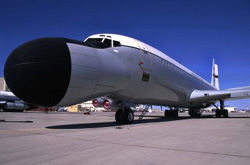
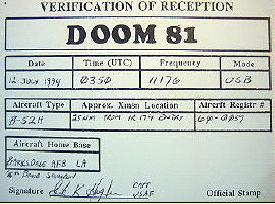
'DOOM 81' was a gigantic B-52H from the 96th Bomb Squadron, stationed at Barksdale AFB, LA. The appropriately named big bomber was heard on 11176kHz while working Ascension Radio and was just about to rendezvous with their mid-air refueler when the mission was aborted. This was the first and only B-52 that I was ever able to confirm.
 'ROMA 99' was logged on 17975kHz while working Thule Radio. They were taxiing for takeoff at Dulles International in Washington D.C. and reporting a minor fuel-pump problem. 'ROMA 99' was a KC-135R Stratotanker, # 62-003512, from the 509th Air Refueling Squadron at Griffis AFB, NY.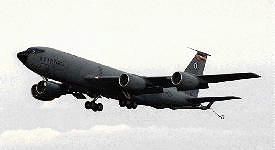
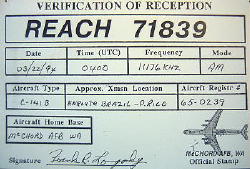
'REACH 71839' was heard on 11176kHz while working Albrook AFB, Alaska. Tail # 65-0239, this 'REACH' flight was an aging C-141B Starlifter, at one point, the Air Force's major transporter. 'REACH 71839', out of McChord AFB, was enroute Brazil to Puerto Rico.
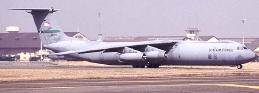
There's still plenty to be heard on HF, outside of the amateur bands and a quick internet search on 'Utility DX' will turn up several interesting and informative sites ... each one having an abundance of related links to follow. Here are some that will be helpful:
**************************************
A freshly updated list of all active HF aero frequencies. Also check their list of active aero 'callsigns'
http://monitor-post.blogspot.ca/p/this-international-hf-aero-frequency.html
If you can catch an aircraft's four-letter SELCAL code, often given during waypoint checks, you can search here for more info on the actual aircraft itself:
http://www.airframes.org/reg/b18305
The Milcom Blogspot:
http://mt-milcom.blogspot.ca/
Steve McDonald, VE7SL, is a regular contributor to AmateurRadio.com and writes from British Columbia, Canada. Contact him at [email protected].
Ham College 59
Ham College episode 59 is now available for download.
General Amateur Radio Exam part 30. General questions pool updates 2 of 3.
01:03:49
George Thomas, W5JDX, is co-host of AmateurLogic.TV, an original amateur radio video program hosted by George Thomas (W5JDX), Tommy Martin (N5ZNO), Peter Berrett (VK3PB), and Emile Diodene (KE5QKR). Contact him at [email protected].
Is the ARRL Listening About Shipping? Or is it just me…
A few months ago, I challenged the ARRL’s new mission to serve members in a more effective way by bringing “value” to members. I suggested that one quick “win” would be to stop selling through Amazon (at a 55% discount) and use that money-per-book to fund “free shipping” for members who purchase books. Many readers just didn’t read beyond the title of “free shipping” before raining down the it-will-just-be-passed-along-to-members rhetoric. This does not understand that the League would make a greater profit margin by selling at the 100% retail price (even with whatever discount the member may receive by being a Certified Instructor, etc.), charging no shipping, and still recouping a higher profit than the automatic 55% “loss” through the standard wholesale discount.
In one of my interviews with Howard Michel ARRL CEO on the ICQ Podcast, he said he ran the numbers and that it wouldn’t work out. I did not directly challenge him on that issue since it’s clearly his call. My thought was that it was a pure and simple strategy to demonstrate his new vision of “increasing value.” But enough with my recommendations, already!

However, perhaps it’s just me, but has the ARRL increased their free or discounted shipping stance in marketing publications? Like other League members, I’m sure, I received the above coupon code for Cyber Monday (after Thanksgiving). It’s FREE SHIPPING on $50 or more. That’s an incentive, especially with the new Handbook out and discounted temporarily at $40. So, I thought I’d grab another discounted book to reach $50 or more and get a FREE SHIPPING discount. On my daily driver desktop, I run Linux Mint on a Dell T-5500 8-core CPU with 72GB of RAM and a gigbit Internet service via ethernet to my commercial class switch. I rarely ever have buffering of websites from my end. Ever. But, boy, did I on this Cyber Monday order at ARRL.org! It took several HOURS for me to get the order through to checkout. I tried several different machines, in addition, just to ensure it wasn’t on my end. It wasn’t as I did a network speed operation test on getting packets to and from the ARRL.org server. It was on that end…because, no doubt, there was a boatload of customers ordering. So that’s the point of marketing offers, no? And I’m very happy to see evidence of it drawing a crowd at the virtual checkout page at the League’s website.
And, here are several more adverts e-mailed to members, all with $5 discounted shipping. So, has the ARRL been rolling out a version of this “free shipping” strategy? Well, only some offers reflect actually free shipping but a cap at $5 shipping is also a winning offer, too. I’m delighted at this marketing move by ARRL Product Development Manager Bob Inderbitzen, NQ1R. Keep it up, Bob! This increases value to members who receive the code coupons.


Frank Howell, K4FMH, is a regular contributor to AmateurRadio.com and writes from Mississippi, USA. Contact him at [email protected].
Not Getting It
ARRL announced today that they have filed comments with the FCC requesting a dismissal of the Petition for Declaratory Ruling filed by New York University (NYU) regarding digital encoding and encryption. This petition basically claims that proprietary and closed protocols like PACTOR violate current FCC rules, an opinion I’ve had for several years. I think the AMBI vocoder used in D-STAR and other digital voice modes falls into the same category as well as it’s not openly documented, like the rules require. Due to the lack of documentation and openness, such encoding is de facto encryption, which is prohibited.
ARRL’s filing has me smacking my head. Rather than openly addressing the issue of protocols in amateur radio that are closed and proprietary, they attack the language proposed by the Petition. Furthermore, they pull CW into this, stating,
“The proposed prohibition arguably could include, presumably unintentionally, CW (Morse Code), which is a longstanding means of encoding transmissions. The very fact that messages sent in CW are “encoded” by any definition of the term starkly demonstrates the problem with this proposal.“
I’m not sure if ARRL is intentionally being obtuse or just doesn’t understand the crux of the issue with “un-openly” documented digital protocols. CW, while technically encoding, is 100% openly documented, and has been for a century or more. It doesn’t require proprietary hardware, software, or algorithms to decode. PACTOR until most recently could only be decrypted with proprietary hardware. AMBI and others continual to be closed protocols. That’s the problem, not semantics over the proposed language in the petition snagging CW as encoding, and encryption.
A few weeks ago I started writing comments to file with the FCC, but I quite honestly lost interest. I don’t have a horse in this race, other than wanting to see amateur radio continue on well into the future. I’m just disappointed ARRL doesn’t get what the real problem is, doesn’t make an effort to correct it, and fails to even acknowledge that closed digital protocols are antithetical to the openness and historical foundation of amateur radio.
This article originally appeared on Radio Artisan.
Anthony, K3NG, is a regular contributor to AmateurRadio.com.
 Ham Radio Deluxe |
 W5SWL Electronics |
 Ham Radio Prep |
 KB3IFH QSL Cards  Hip Ham Shirts  HamRadioAuctions HamRadioAuctions Reliance Antennas Reliance Antennas Enigma Shop Enigma Shop |  morseDX  Ni4L Antennas  R&L Electronics R&L Electronics antennas.us antennas.us Ears to Our World Ears to Our World |
- Matt W1MST, Managing Editor
