 |
 Weekly Propagation Summary – 2020 Jan 13 16:10 UTC
 13 January 2020 | by
Here is this week’s space weather and geophysical report, issued 2020 Jan 13 0408 UTC.
Highlights of Solar and Geomagnetic Activity 06 – 12 January 2020
Solar activity was very low. Region 2755 (S34, L=355, class/area Bxo/020 on 03 Jan) decayed to plage on 07 January and was absent of significant flare activity during the period. New Region 2756 (N22, L=017, class/area Cro/030 on 09 Jan) produced dual B1 flares at 10/1159 UTC and 10/1445 UTC before decaying to plage on 11 January. Both regions, one in the northern hemisphere and one in the southern hemisphere, presented in satellite imagery with reverse polarity magnetic field structure. No Earth-directed CMEs were observed.
No proton events were observed at geosynchronous orbit.
The greater than 2 MeV electron flux at geosynchronous orbit reached moderate levels on 09-12 Jan due to coronal hole influence. Normal levels were observed on 06-08 Jan.
Geomagnetic field activity reached active levels on 06 and 09 Jan, unsettled levels on 08 and 10 Jan due to influence from negative polarity CH HSS activity. Quiet conditions prevailed throughout the remainder of the reporting period.
Forecast of Solar and Geomagnetic Activity 13 January – 08 February 2020
Solar activity is expected to remain at very low levels.
No proton events are expected at geosynchronous orbit.
The greater than 2 MeV electron flux at geosynchronous orbit is expected to reach moderate levels on 13-22 Jan and 05-08 Feb due to recurrent CH HSS influence. Normal levels are expected throughout the remainder of the outlook period.
Geomagnetic field activity is expected to reach active levels on 14-15 Jan and 02-04 Feb, with unsettled conditions on 13, 16 Jan and 01, 05 Feb due to recurrent CH HSS activity. Quiet conditions are expected throughout the remainder of the period.
Don’t forget to visit our live space weather and radio propagation web site, at: http://SunSpotWatch.com/
Live Aurora mapping is at http://aurora.sunspotwatch.com/
If you are on Twitter, please follow these two users: 1. https://Twitter.com/NW7US 2. https://Twitter.com/hfradiospacewx
– – – – – – – – – – – – –
Be sure to subscribe to our space weather and propagation email group, on Groups.io
https://groups.io/g/propagation-and-space-weather
Spread the word!
– – – – – – – – – – – – –
Links of interest:
+ Amazon space weather books: http://g.nw7us.us/fbssw-aSWSC
+ https://Twitter.com/NW7US
+ https://Twitter.com/hfradiospacewx
Space Weather and Ham Radio YouTube Channel News:
I am working on launching a YouTube channel overhaul, that includes series of videos about space weather, radio signal propagation, and more.
Additionally, I am working on improving the educational efforts via the email, Facebook, YouTube, Tumblr, and other activities.
You can help!
Please consider becoming a Patron of these space weather and radio communications services, beginning with the YouTube channel:
https://www.patreon.com/NW7US
The YouTube channel:
https://YouTube.com/NW7US
..
Visit, subscribe: NW7US Radio Communications and Propagation YouTube Channel
A Notable 2m Radio Contact
For the 2019 CQ Worldwide VHF Contest, I did a modest effort on 6 meters and 2 meters using mostly SSB and FT8. I operated from our cabin (DM78av). We had some good sporadic-E propagation on 6m which enabled some long-distance contacts to the east. Then I noticed that 2 meters was also open so I quickly turned my attention to that band. While it’s common to have some sporadic E on 6 meters during July, having it on 2 meters is a lot less common. I was thrilled to snag 5 contacts to the eastern US on 2 meters.
 One of the 2m contacts was with Jay/W1VD in Connecticut. Shortly after the contest, I got an email from Jay asking about my exact location for the contact, which I supplied using the 6-character grid locator (DM78av). He told me that it is very difficult to work Colorado on e-skip from Connecticut…the general belief among VHF enthusiasts is that they have to use another propagation mode to work the state. Well, apparently that is not true!
Jay also worked Ken/W0ETT in Parker, CO so this turned into a three-way email discussion. Ken is located about 80 miles to the east of our cabin, so my QSO with W1VD was at a greater distance. Jay investigated the ARRL records and found that these two 2m contacts were notable enough to “make the list” at the ARRL but they are not new distance records. See the ARRL records list here.
Here’s a snippet from the ARRL list, with my W1VD QSO shown as 2793 km (1735 miles). The W0ETT QSO is also shown on the list as 2674 km (1662 miles).

You can see W1VD’s station information on the QSL card above. Obviously, a nice setup. I was using a Yaesu FT-991 driving a Mirage amplifier with 150W output to a 2M9SSB Yagi antenna. My antenna mast is only 25 feet above the ground but I benefit from an excellent radio horizon to the east from 9630 feet in elevation.
73 Bob K0NR
The post A Notable 2m Radio Contact appeared first on The KØNR Radio Site.
Bob Witte, KØNR, is a regular contributor to AmateurRadio.com and writes from Colorado, USA. Contact him at [email protected].
PAØRDT Miniwhip Shakedown
***********************************
A recent posting to the 'ndblist group' by Mike, an ardent NDB DXer in the UK (Sussex), announced the recent completion of his four-part video series describing the installation and testing of a new PAØRDT active antenna.
 If you may be contemplating the installation of an active antenna such as this, or perhaps making a start at DXing the NDB band or listening on 630m, then you might enjoy following Mike's journey as he demonstrates that living in the noisy suburbs need not keep you from enjoying the LF/MF bands. Mike includes some interesting tests involving his grounding system versus noise ingress and the results of keeping the electrical main's ground isolated (or not) from the antenna cable's ground.
 The PAØRDT active whip is available from PAØRDT himself or if you are handy with a soldering iron, you might choose to build the same antenna in your workshop. These simple yet highly effective receiving antennas are being used successfully by hundreds of listeners all over the world and for their size provide some pretty amazing performance.
Much more information on the PAØRDT e-probe antenna may be found here in a previous blog posting. To see more of Mike's videos, you can visit his interesting Youtube Channel here.
Steve McDonald, VE7SL, is a regular contributor to AmateurRadio.com and writes from British Columbia, Canada. Contact him at [email protected].
Arrival of new antenna
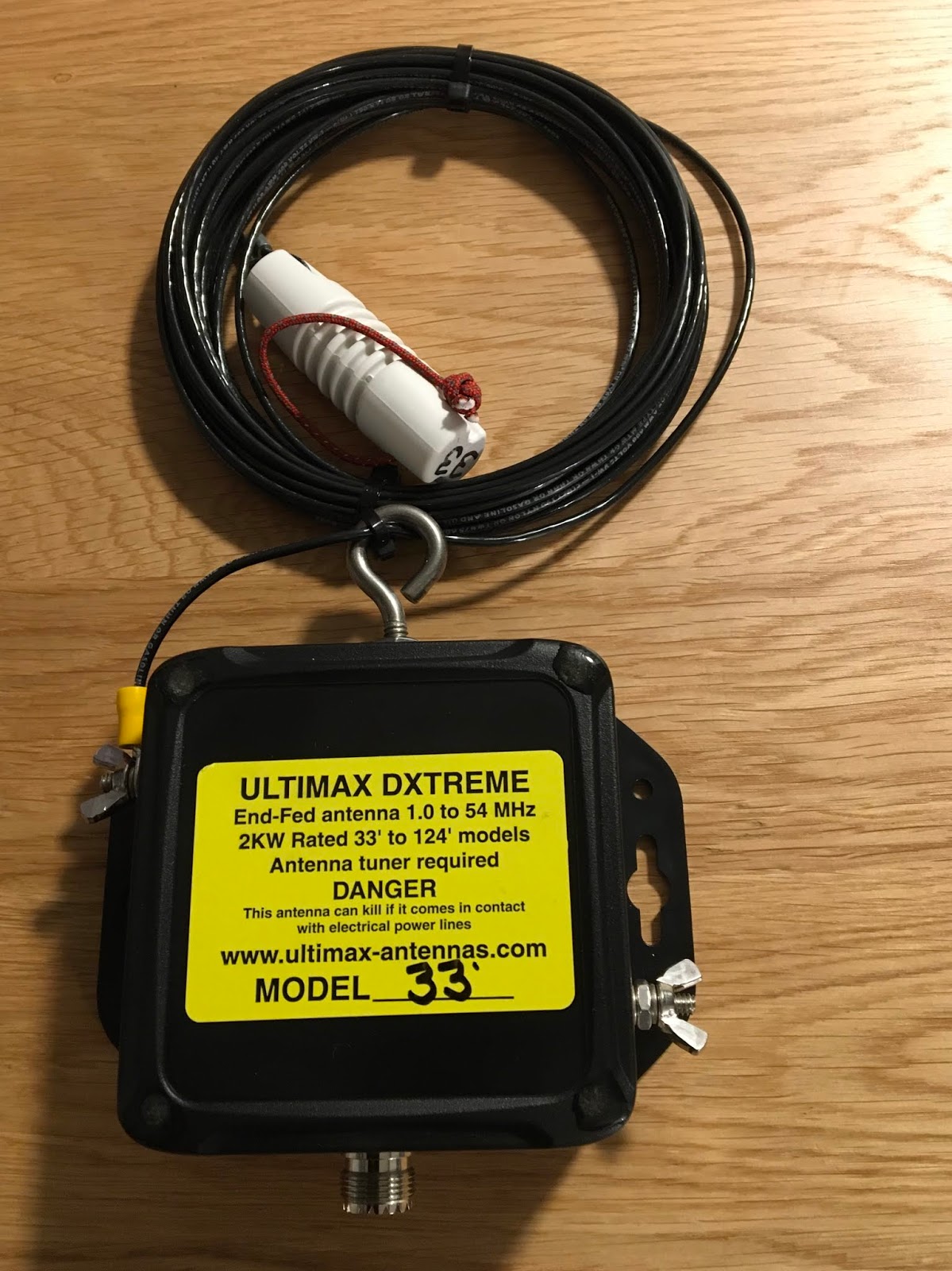
On the Ultimax site it says that the DXtreme antenna covers 6m to 160m and that ALL DXtreme models are of a different design that work most efficiently with the length of wire it is sold with. This End-fed antenna has a rating of 2kw which is more than enough of a buffer for me. Unlike the W1SFR End-fed antenna the DXtreme has provision for a counterpoise. I ordered the counterpoise that Ultimax offers for their antennas. As with most End-fed antennas an antenna tuner in needed and I have my new LDG AT200proII. I will be interested to see if I can get the antenna to tune on 80m! I would imagine the bandwidth may be narrow but that is where the AT-200proII tuner comes into the picture with its ability to call up a memory tune in no time.
The DXtreme antenna arrived here last week but the weather has not been co-operative for me to install the antenna. I don't want to rush the installation as some heights are involved and at my age, I don't bounce very well anymore!
Mike Weir, VE9KK, is a regular contributor to AmateurRadio.com and writes from New Brunswick, Canada. Contact him at [email protected].
LHS Episode #319: HF Homebrew Antennas Deep Dive
Welcome to Episode 319 of Linux in the Ham Shack, the first episode of the new decade. In this episode, the hosts discuss what you might need in terms of money, knowledge, supplies and elbow grease to build a number of different effective HF antennas, both single- and multi-band. If you were wondering if you should put up a commercial mega-tenna or build something out of copper pipe and spare insulators, check out this episode. It is the first in several deep dive episodes concerning antennas and antenna theory. Hope you enjoy.
73 de The LHS Crew
Russ Woodman, K5TUX, co-hosts the Linux in the Ham Shack podcast which is available for download in both MP3 and OGG audio format. Contact him at [email protected].
Weekly Propagation Summary – 2020 Jan 06 16:10 UTC
Here is this week’s space weather and geophysical report, issued 2020 Jan 06 0724 UTC.
Highlights of Solar and Geomagnetic Activity 30 December – 05 January 2020
Solar activity was very low. New Region 2755 (S34, L=355, class/area Bxo/020 on 03 Jan) developed on the SE limb on 01 Jan but was in decay by 04 Jan. No Earth-directed CMEs were observed.
No proton events were observed at geosynchronous orbit.
The greater than 2 MeV electron flux at geosynchronous orbit was at normal levels on 30 Dec-04 Jan. Moderate levels were reached on 05 Jan with a maximum flux of 245 pfu observed at 05/1800 UTC.
Geomagnetic field activity was at quiet levels on 30 Dec-02 Jan under nominal solar wind conditions. On 03 Jan, total field increased to 10 nT at 03/0505 UTC with solar wind speed increasing to around 410 km/s. On 04 Jan, a prolonged period of southward Bz was observed reaching a maximum southward deflection of -4 nT. On 05 Jan, total field increased once again to 15 nT at 05/1743 UTC followed by an increase in solar wind speed to near 550 km/s as a negative polarity coronal hole high speed stream (CH HSS) became geoeffective. The geomagnetic field responded with isolated unsettled periods on 03-04 Jan and quiet to active levels on 05 Jan.
Forecast of Solar and Geomagnetic Activity 06 January – 01 February 2020
Solar activity is expected to continue at very low levels.
No proton events are expected at geosynchronous orbit.
The greater than 2 MeV electron flux at geosynchronous orbit is expected to be at normal levels on 08-14 Jan and 23 Jan-01 Feb. Moderate levels are expected on 06-07 Jan and again on 15-22 Jan.
Geomagnetic field activity is expected to reach unsettled levels on 08-10 Jan and 01 Feb. Unsettled to active levels are expected on 06 Jan and14-15 Jan due to recurrent CH HSS effects.
Don’t forget to visit our live space weather and radio propagation web site, at: http://SunSpotWatch.com/
Live Aurora mapping is at http://aurora.sunspotwatch.com/
If you are on Twitter, please follow these two users: 1. https://Twitter.com/NW7US 2. https://Twitter.com/hfradiospacewx
– – – – – – – – – – – – –
Be sure to subscribe to our space weather and propagation email group, on Groups.io
https://groups.io/g/propagation-and-space-weather
Spread the word!
– – – – – – – – – – – – –
Links of interest:
+ Amazon space weather books: http://g.nw7us.us/fbssw-aSWSC
+ https://Twitter.com/NW7US
+ https://Twitter.com/hfradiospacewx
Space Weather and Ham Radio YouTube Channel News:
I am working on launching a YouTube channel overhaul, that includes series of videos about space weather, radio signal propagation, and more.
Additionally, I am working on improving the educational efforts via the email, Facebook, YouTube, Tumblr, and other activities.
You can help!
Please consider becoming a Patron of these space weather and radio communications services, beginning with the YouTube channel:
https://www.patreon.com/NW7US
The YouTube channel:
https://YouTube.com/NW7US
..
Visit, subscribe: NW7US Radio Communications and Propagation YouTube Channel
Kazakhstan in the log.
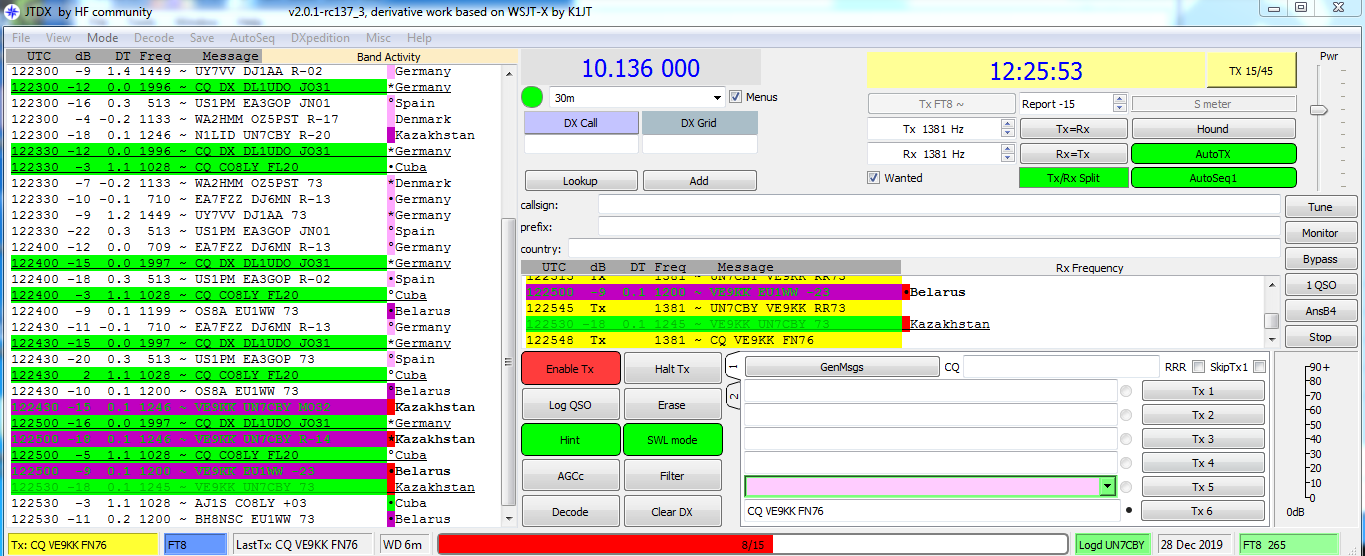
Mike Weir, VE9KK, is a regular contributor to AmateurRadio.com and writes from New Brunswick, Canada. Contact him at [email protected].
 Ham Radio Deluxe |
 W5SWL Electronics |
 Ham Radio Prep |
 KB3IFH QSL Cards  Hip Ham Shirts  HamRadioAuctions HamRadioAuctions Reliance Antennas Reliance Antennas Enigma Shop Enigma Shop |  morseDX  Ni4L Antennas  R&L Electronics R&L Electronics antennas.us antennas.us Ears to Our World Ears to Our World |
- Matt W1MST, Managing Editor
