 |
 Hello Everyone!
 8 April 2020 | by
 WOW! It’s been a while. Almost four years have passed since I last posted any content to my blog site. Also, according to my blog site it appears the last thing I posted about was announcing the 71st episode of PARP. PARP of course was my Practical Amateur Radio Podcast. Anyway….I’m not dead…at least not yet!
Extraordinary Times
We’re truly living through and in, extraordinary times at the moment. I’m currently at the half-way point (hump day) of my 4th week of self-isolation, work from home. Thankfully both my wife and I have jobs which allow us to work from home. My role, occasionally requires me to venture into the office (generally twice a week). Of course the office is mostly empty. Just a few security guards and on a rare occasion I might see, from a socially acceptable distance, another employee. I guess with almost four weeks of self-isolation under my belt, I can easily do another 4-6, perhaps more. Who knows?
Radio Activities
There hasn’t been much. I seriously burned myself out between the podcast, the blog, attending (or trying) multiple club meetings per month etc. I found myself truly not interested in amateur radio anymore. I’m starting to come around to the point where I’m enjoying the hobby again. I’m enjoying working the digital modes and even have been dabbling with D-STAR just a little bit. I think I’ll save my D-STAR topic to another blog post (coming soon). For now, my HF operations have been limited to 20 meters. I pulled down the 6BTV last year as we were having some work done on the house and I didn’t want it to get damaged. Before it goes back up, it needs a good bit of TLC work done. I need to replace the plastic coil caps (I have them already)
Until next time….I hope you stay safe and healthy.
73 de KDØBIK (Jerry)
Jerry Taylor, KD0BIK, is a regular contributor to AmateurRadio.com and writes from Colorado, USA. He is the host of the Practical Amateur Radio Podcast. Contact him at [email protected].
Hello Everyone!
WOW! It’s been a while. Almost four years have passed since I last posted any content to my blog site. Also, according to my blog site it appears the last thing I posted about was announcing the 71st episode of PARP. PARP of course was my Practical Amateur Radio Podcast. Anyway….I’m not dead…at least not yet!
Extraordinary Times
We’re truly living through and in, extraordinary times at the moment. I’m currently at the half-way point (hump day) of my 4th week of self-isolation, work from home. Thankfully both my wife and I have jobs which allow us to work from home. My role, occasionally requires me to venture into the office (generally twice a week). Of course the office is mostly empty. Just a few security guards and on a rare occasion I might see, from a socially acceptable distance, another employee. I guess with almost four weeks of self-isolation under my belt, I can easily do another 4-6, perhaps more. Who knows?
Radio Activities
There hasn’t been much. I seriously burned myself out between the podcast, the blog, attending (or trying) multiple club meetings per month etc. I found myself truly not interested in amateur radio anymore. I’m starting to come around to the point where I’m enjoying the hobby again. I’m enjoying working the digital modes and even have been dabbling with D-STAR just a little bit. I think I’ll save my D-STAR topic to another blog post (coming soon). For now, my HF operations have been limited to 20 meters. I pulled down the 6BTV last year as we were having some work done on the house and I didn’t want it to get damaged. Before it goes back up, it needs a good bit of TLC work done. I need to replace the plastic coil caps (I have them already)
Until next time….I hope you stay safe and healthy.
73 de KDØBIK (Jerry)
Jerry Taylor, KD0BIK, is a regular contributor to AmateurRadio.com and writes from Colorado, USA. He is the host of the Practical Amateur Radio Podcast. Contact him at [email protected].
LHS Episode #337: SDRAngel Deep Dive

Hello and welcome to Episode 337 of Linux in the Ham Shack. In this episode, the hosts take a deep dive into the shallow end of SDRAngel. The project is a GPLv3 licensed, modular front end and headless server for connecting to and operating SDR receivers and transceivers. Discussion includes where to find the software, how to build it, basic operation with broadcast FM stations, DMR, SSB, CW and more. Take a look. Try it out. Have fun with SDR. Hope you enjoy!
73 de The LHS Crew
Russ Woodman, K5TUX, co-hosts the Linux in the Ham Shack podcast which is available for download in both MP3 and OGG audio format. Contact him at [email protected].
Software can bring you joy or grey hair…….
 |
| Not what you want to see after a program restart! |
This weekend contained some QSO parties to partake in. Almost every weekend there has been a QSO party I wanted to take part as I have a personal goal to see if I can make some contacts in all the QSO parties. I am not officially enrolled in the QSO party challenge as I have no hope of placing anywhere other than close to the bottom of the pile. It is just a thing for me to do during the COVID 19 stay at home order. I have managed to make at least one successful contact in each of the QSO parties up to this point in time (I have a feeling that may end once the Hawaii QSO party happens) But this weekend I thought the streek was going to come to an end. I was having huge issues with hearing anyone in the Nebraska QSO party! BUT I then remembered reading they also accept FT8 QSO"s and not many QSO parties do. So it was off to FT8 to see what I could find. The contest software I use is N!MM+ and it does integrate with both WSJT-X or JTDX software. The issue here was I had not as of yet made the integration. I found online a very nice video of a step by step process and as Picard would say "make it so". Before I ever venture into making program and radio changes I always back up both my PC (system restore) and my radio settings.
I following the setting changes that needed to be made in N1MM+ and JTDX software I then did the smoke test and restarted the programs. I was greeted with an error message and the program stopped working altogether. To save the day I restored the JTDX settings and rig settings back to their previous settings. I then was able to make 2 Nebraska contacts on FT8 using the "old" settings in JTDX. My next step was to figure out how to convert the ADIF file that JTDX gave me into a Cab file which the Nebraska QSO party needed for submission. I went online and found SP7DQR's program called ADIF2CABR program and it did the trick.
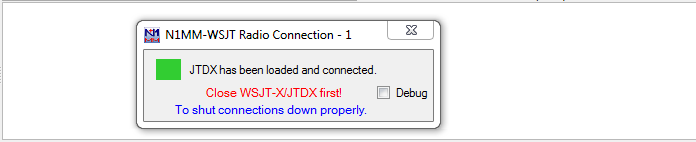
The next day it was time to tackle the JTDX integration with N1MM+ so I went back to the video and figuring the issue was I was rushing the day before. Since everything was backed up from the day before I got right down to it. Once done I tried a restart and low and behold all worked fine. I reviewed what I did and it came down to the file location of JTDX I had to enter into N1MM+ I don't believe I enter the exe file last time.
 |
| A much better message. |
it wants!
Mike Weir, VE9KK, is a regular contributor to AmateurRadio.com and writes from New Brunswick, Canada. Contact him at [email protected].
Don’t Mess With The Field Day Rules
 Given the Chinese/Wuhan/COVID virus situation, many hams are anticipating a change to their ARRL Field Day operation. I’ve also seen a number of proposals to modify the FD rules to allow for a different kind of operation. I appreciate that kind of thinking outside the box but I think it is misguided. One of the strengths of FD is it already has a set of flexible rules and operating classes, so you can adapt it to what you or your club wants it to be. See my post: ARRL Field Day – Season to Taste
Some Ideas
What are some of the proposals? The first one I noticed is a proposal to allow all Class D stations (home station with commercial power) to work other Class D stations for points. The FD rules do not currently allow this. Class E stations (home station with emergency power) are allowed to any class station. Obviously, this rule is to encourage people to develop emergency power capability (and use it) for their home station. This is perfectly aligned with the emcomm focus of Field Day.
Another proposal is to allow a “backyard operating” class, where you set up a portable station in your backyard. Of course, this is already allowed under the rules as a Class B station.
One of the more innovative ideas I’ve heard is to allow multiple stations (not colocated) to operate under one club callsign, coordinating their operation via the internet. This approach emulates a “normal” Class A FD operation, while everyone is locked down at home. This is not allowed as a Class A station: “All equipment (including antennas) must lie within a circle whose diameter does not exceed 300 meters (1000 feet).” This is roughly equivalent to a group of Class D or E stations working together towards a common score. Why not just operate as independent Class D and E stations, which is more like a real emergency situation?
Adapt and Innovate
Our local radio club is considering different ways to adapt, seeing this as a training and learning opportunity. We will probably encourage our members to get on the air individually, with emergency power. We will likely encourage members to work other members, providing some kind of incentive or award. So our FD may look more like a local operating event, in addition to working distant stations. VHF/UHF will probably play an important role so that we include Technician licensees. Not sure just yet.
We are all experiencing some serious challenges this year and Field Day is not going to be the same. I am a bit surprised that the first thought about Field Day is to change the rules to make it easier or somehow better. I think we just need to adapt and innovate within the existing format. Existing Field Day Rules have plenty of flexibility.
That’s what I say. What do you think?
73 Bob K0NR
The post Don’t Mess With The Field Day Rules appeared first on The KØNR Radio Site.
Bob Witte, KØNR, is a regular contributor to AmateurRadio.com and writes from Colorado, USA. Contact him at [email protected].
Weekly Propagation Summary – 2020 Apr 06 16:10 UTC
Here is this week’s space weather and geophysical report, issued 2020 Mar 30 0104 UTC.
Highlights of Solar and Geomagnetic Activity 23 – 29 March 2020
Solar activity was very low throughout the period. No active regions with sunspots were observed and no earth-directed CMEs were detected.
No proton events were observed at geosynchronous orbit.
The greater than 2 MeV electron flux at geosynchronous orbit reached high levels on 23-26 Mar and moderate levels were observed on 27-29 Mar.
Geomagnetic field activity was at quiet or quiet to unsettled levels throughout the period.
Forecast of Solar and Geomagnetic Activity 30 March – 25 April 2020
Solar activity is expected to be very low throughout the outlook period.
No proton events are expected at geosynchronous orbit.
The greater than 2 MeV electron flux at geosynchronous orbit is expected to reach high levels on 19-22 Apr, and normal to moderate levels are expected to prevail throughout the remainder of the outlook period.
Geomagnetic field activity is expected to reach active levels on 30-31 Mar due to CH HSS influence. Generally quiet or quiet to unsettled conditions are expected to prevail throughout the remainder of the outlook period.
Don’t forget to visit our live space weather and radio propagation web site, at: http://SunSpotWatch.com/
Live Aurora mapping is at http://aurora.sunspotwatch.com/
If you are on Twitter, please follow these two users: 1. https://Twitter.com/NW7US 2. https://Twitter.com/hfradiospacewx
– – – – – – – – – – – – –
Be sure to subscribe to our space weather and propagation email group, on Groups.io
https://groups.io/g/propagation-and-space-weather
Spread the word!
– – – – – – – – – – – – –
Links of interest:
+ Amazon space weather books: http://g.nw7us.us/fbssw-aSWSC
+ https://Twitter.com/NW7US
+ https://Twitter.com/hfradiospacewx
Space Weather and Ham Radio YouTube Channel News:
I am working on launching a YouTube channel overhaul, that includes series of videos about space weather, radio signal propagation, and more.
Additionally, I am working on improving the educational efforts via the email, Facebook, YouTube, Tumblr, and other activities.
You can help!
Please consider becoming a Patron of these space weather and radio communications services, beginning with the YouTube channel:
https://www.patreon.com/NW7US
The YouTube channel:
https://YouTube.com/NW7US
..
Visit, subscribe: NW7US Radio Communications and Propagation YouTube Channel
LED Lights In The Shack
 |
| Utilitech Pro Soft White LED Bulb |
A recent posting by Phil, KO6BB, to Yahoo Group's ndblist, described his recent search for some LED lamps to replace the CFL's in his shack / radio workbench area. If you have been wondering how much RFI that LED lamps might be producing, you may find Phil's findings of some value.
"Recap
I had a 60W equivalent CFL in the floor lamp directly over my operating position. I'd tried a 100W equiv one but it was extremely noisy! Also a couple CFLs in the ceiling lamp.
This is a floor lamp with a crookneck at the top and a triangular metal
shade reminiscent of the old style desk lamps, bulb is horiz to the
floor. I've used it for years and like it because it places the light
directly over the operating position work area (keyboard, radios etc).
The actual bulb was about 4.5 inches from the front of the Softrock SDR
receiver (in a plastic case), with the base of the lamp (where the
electronics are) about 7.5 inches (somebody asked about the distances).
This coupled a LOT of RFI directly into the SDR, visible on the
waterfall. For best results when recording and having the light on I'd
slip a 60W incandescent lamp in place of the CFL. The lamp is also
about 16 inches above the operating table, and when listening to ANY
portable radio on the table, if it was in the AM or Longwave band and
using the built in loopstick antenna, got a LOT of RFI from the lamp
(unless the lamp was off ;-)
So today I went down to Lowes (we have a Costco, but I don't have a
card) and looked at their LED lamp offerings. As I expected they had a
large variety of them, from a low cost 3 pack for ~$9.00 for 60W units
to about $18.00 or so each (Sylvania). From what I read here I wanted
to avoid the REALLY cheap ones as some reported them to be 'noisy'.
Also, I wanted to put a 75W equivalent unit in the one over the
operating position, and a pair of 100W equivalent units in the ceiling
lamp. All three had CFLs, and if I walked around the radio room with a
portable radio and the ceiling lamp on I could hear it's 'hash' anywhere
in the room. . .
The ones I settled on were a brand I'd never heard of, "UtiliTech Pro"
soft white, 75W for the bench and 2 100W ones for the ceiling. They
were what I'd call "mid-priced", $8.98 for the 75W and $9.98 for the
100W ones.
Specs:
75 W one draws 12W and gives 1100 Lumens.
100W one draws 16.5W and gives 1600 Lumens (the pair in the ceiling
should then be 3200 Lumens if I calculated right).
How low is the RFI to my Radios?
75W one over the bench:
NO trace from the lamp electronics visible in the SDR waterfall at
all. With a portable radio on the bench-top, NO audible RFI. Put a
portable radio up to the "bulb" part (light area) and with no station
tuned in can't hear ANY RFI. Move the portable to the base area of the
lamps there is SOME RFI, but I won't be putting the radio that close to
the lamp, move it a couple inches away and the noise disappears.
100W ones in the ceiling lamp, NO audible RFI in the portable when
walking around the room, RFI just barely perceptible right next to the
light wall switch that turns the lamp on, again, audible IF I put the
radio right up to the base of the lamps, not a likely real-world scenario!
Upshot?
Based on the sample of three that I bought and the almost
non-existent RFI from them I'd consider the UtiliTech Pro lamps to be a
good product and suitable for use in the radio room. I consider them
good value for the ~$30.00 I spent for three."
If you have tested anything similar (other brands / models), please let me know and I will add it to Phil's helpful information.
KO6BB's website can be found here, along with some of his homebrew equipment.
Steve McDonald, VE7SL, is a regular contributor to AmateurRadio.com and writes from British Columbia, Canada. Contact him at [email protected].
 Ham Radio Deluxe |
 W5SWL Electronics |
 Ham Radio Prep |
 KB3IFH QSL Cards  Hip Ham Shirts  HamRadioAuctions HamRadioAuctions Reliance Antennas Reliance Antennas Enigma Shop Enigma Shop |  morseDX  Ni4L Antennas  R&L Electronics R&L Electronics antennas.us antennas.us Ears to Our World Ears to Our World |
- Matt W1MST, Managing Editor
