 |
 D-Star & Pi-Star
 10 April 2020 | by
 I was first introduced to D-Star some twelve years or so ago. I purchased the ICOM IC-92AD hand-held and managed to get setup on one of the local D-Star repeaters. Being one who (at the time) preferred all things HF, my D-Star activities were almost non-existent. But it was fun to tinker and learn.
Some time passed and I experimented with various DVAP type devices that came onto the market. I preferred using these to the local repeater, since I could connect into reflectors around the world and share in all the fun of digital radio.
Around the early 2016 timeframe, I purchased the Hardened Power DHAP Mini Mega Self Powered Enclosure along with a Raspberry Pi 3 and the DVMEGA Dualband add-on for the Pi. The DHAP case is a 3-D printed plastic.

Inside there’s plenty of room for the Raspberry Pi, the DVMEGA and four rechargeable batteries.

I setup the Raspberry Pi with a popular image at the time from the Maryland D-Star group. As I have never claimed to be a Raspberry Pi expert, even though I do own three devices. One being an ADS-B aircraft tracker and second which has been running SETI@home and then the third running the Maryland D-Star setup.
Anyway, the Maryland D-Star image was easy to setup and at the time (2016) the group was active. They had a website which contained more knowledge needed to setup the Pi and a very helpful forum community. I could fire up my DHAP and via my radio connect/disconnect reflectors all around the world, reboot or shutdown the Pi. It was all very cool.
Burnout
When the burnout occurred in late 2016, I wasn’t doing any form of operating and as a result I shut down the D-Star Pi and placed it (along with the IC-92) in a closet. It sat there until just about two weeks ago when (like many of you) found myself bored out of my skull from the self-isolation COVID-19 routine. I decided this was a project that might take my mind off the events of the world and might even help rekindle some of my amateur radio interests.
Power Up
After being sat idle for over three years, everything needed a good charge. Surprisingly my ICOM batteries all came back to life and even the DHAP powered on just fine. Everything worked (just as it did when I shut it down) but I figured at the very least I needed to update the software. That’s when I realized the Maryland D-Star Pi was no more.
Pi-Star
While everything worked (best I could tell), in my hunt for what happened to the Maryland group, I discovered Pi-Star. The Pi-Star group is an active group and appears to be the best thing since sliced bread when it comes to all things D-Star hotspots. So I downloaded their latest and greatest image (4.1.0), installed it onto an empty SD card and began noodling around.
Of course “Noodling” around is much like driving around trying to find something without actually stopping to ask for directions. The end result left me sort of frustrated and wondering if I should just go back to using the old Maryland setup. At least it worked…for now. But it’s not like I don’t have time or the mental capacity to figure this out. So, diving head first into the forums I began to find the answers I needed and more importantly, I knew once I had everything working…it would be a much better setup.
All the Pre-requisites
As my DVMEGA was several years old, one of the first things required was to update the firmware so it could take advantage of all the features in Pi-Star. This wasn’t as straight forward as I had hoped it would be. It required some risky soldering of a short wire so the firmware of the DVMEGA could be updated. I found all the documentation required for performing this risky step located here. Well…almost!

With soldering iron, wire and some solder in hand, I completed the risky step and proceeded to update the firmware. However, each time I attempted to perform the update it failed. What have I done? Did I ruin the DVMEGA? I decided to go to bed and then take another stab at it the next day.
With a strong cup of coffee in hand, I proceeded to double-check all my work. I felt confident in the soldering job, so hardware was all GO! I then looked at it from the software perspective. I decided to try using an older version of Pi-Star to rule out some issue with the latest version.
BINGO!
Once I rolled back to version 3.4.17 (from earlier this year), the process of updating the DVMEGA firmware worked just as it should. In just a few minutes I had managed to update the firmware of my DVMEGA board from 2.19 to the latest 3.26.
More Frustration
With the DVMEGA updated to 3.26 and my Pi running Pi-Star 4.1.0, I began digging into the programming requirements of my radio. For the life of me, I couldn’t figure out how I needed to setup the radio so I could still control the system from my handheld. After a bit of swearing and more digging in the forums, I discovered a fairly significant difference between how the radio needed to be setup from what was required with the Maryland D-Star setup.
I got there in the end
Yep, all appears to be working perfect. I can easily connect and disconnect from any reflector I have programmed into my IC-92 from anywhere in the house. While I tend to leave the setup in my shack (basement man cave) connected via Ethernet cable, I also can move the device around the house and use wi-fi.
From within my QTH the device is fully self-contained. I can run it off the batteries and wi-fi and have coverage anywhere within the house (or even from back deck) should I choose.
Next Steps
I do have a few additional setup steps which I plan to experiment with in the coming days. With the old Maryland setup I had my smartphone hotspot configured which would allow me to take this mobile. Pending I had good broadband coverage, I could activate my hotspot, turn on the DHAP and place it all in the car for mobile ops.
Want more info on Pi-Star?
Your first stop needs to be the Pi-Star homepage. From there you can join the forums, download the software and learn everything you need to know about Pi-Star. I also found another great source of information on the Amateur Radio Notes blog site which is managed by Toshen, KEOFHS. He’s a fellow Coloradoan living in Lyons.
Well I think that just about does it for this posting. I wish you and your family a very Blessed Easter weekend (if you celebrate). I’ll return soon with another update.
73 de KDØBIK (Jerry)
Jerry Taylor, KD0BIK, is a regular contributor to AmateurRadio.com and writes from Colorado, USA. He is the host of the Practical Amateur Radio Podcast. Contact him at [email protected].
D-Star & Pi-Star
I was first introduced to D-Star some twelve years or so ago. I purchased the ICOM IC-92AD hand-held and managed to get setup on one of the local D-Star repeaters. Being one who (at the time) preferred all things HF, my D-Star activities were almost non-existent. But it was fun to tinker and learn.
Some time passed and I experimented with various DVAP type devices that came onto the market. I preferred using these to the local repeater, since I could connect into reflectors around the world and share in all the fun of digital radio.
Around the early 2016 timeframe, I purchased the Hardened Power DHAP Mini Mega Self Powered Enclosure along with a Raspberry Pi 3 and the DVMEGA Dualband add-on for the Pi. The DHAP case is a 3-D printed plastic.

Inside there’s plenty of room for the Raspberry Pi, the DVMEGA and four rechargeable batteries.

I setup the Raspberry Pi with a popular image at the time from the Maryland D-Star group. As I have never claimed to be a Raspberry Pi expert, even though I do own three devices. One being an ADS-B aircraft tracker and second which has been running SETI@home and then the third running the Maryland D-Star setup.
Anyway, the Maryland D-Star image was easy to setup and at the time (2016) the group was active. They had a website which contained more knowledge needed to setup the Pi and a very helpful forum community. I could fire up my DHAP and via my radio connect/disconnect reflectors all around the world, reboot or shutdown the Pi. It was all very cool.
Burnout
When the burnout occurred in late 2016, I wasn’t doing any form of operating and as a result I shut down the D-Star Pi and placed it (along with the IC-92) in a closet. It sat there until just about two weeks ago when (like many of you) found myself bored out of my skull from the self-isolation COVID-19 routine. I decided this was a project that might take my mind off the events of the world and might even help rekindle some of my amateur radio interests.
Power Up
After being sat idle for over three years, everything needed a good charge. Surprisingly my ICOM batteries all came back to life and even the DHAP powered on just fine. Everything worked (just as it did when I shut it down) but I figured at the very least I needed to update the software. That’s when I realized the Maryland D-Star Pi was no more.
Pi-Star
While everything worked (best I could tell), in my hunt for what happened to the Maryland group, I discovered Pi-Star. The Pi-Star group is an active group and appears to be the best thing since sliced bread when it comes to all things D-Star hotspots. So I downloaded their latest and greatest image (4.1.0), installed it onto an empty SD card and began noodling around.
Of course “Noodling” around is much like driving around trying to find something without actually stopping to ask for directions. The end result left me sort of frustrated and wondering if I should just go back to using the old Maryland setup. At least it worked…for now. But it’s not like I don’t have time or the mental capacity to figure this out. So, diving head first into the forums I began to find the answers I needed and more importantly, I knew once I had everything working…it would be a much better setup.
All the Pre-requisites
As my DVMEGA was several years old, one of the first things required was to update the firmware so it could take advantage of all the features in Pi-Star. This wasn’t as straight forward as I had hoped it would be. It required some risky soldering of a short wire so the firmware of the DVMEGA could be updated. I found all the documentation required for performing this risky step located here. Well…almost!

With soldering iron, wire and some solder in hand, I completed the risky step and proceeded to update the firmware. However, each time I attempted to perform the update it failed. What have I done? Did I ruin the DVMEGA? I decided to go to bed and then take another stab at it the next day.
With a strong cup of coffee in hand, I proceeded to double-check all my work. I felt confident in the soldering job, so hardware was all GO! I then looked at it from the software perspective. I decided to try using an older version of Pi-Star to rule out some issue with the latest version.
BINGO!
Once I rolled back to version 3.4.17 (from earlier this year), the process of updating the DVMEGA firmware worked just as it should. In just a few minutes I had managed to update the firmware of my DVMEGA board from 2.19 to the latest 3.26.
More Frustration
With the DVMEGA updated to 3.26 and my Pi running Pi-Star 4.1.0, I began digging into the programming requirements of my radio. For the life of me, I couldn’t figure out how I needed to setup the radio so I could still control the system from my handheld. After a bit of swearing and more digging in the forums, I discovered a fairly significant difference between how the radio needed to be setup from what was required with the Maryland D-Star setup.
I got there in the end
Yep, all appears to be working perfect. I can easily connect and disconnect from any reflector I have programmed into my IC-92 from anywhere in the house. While I tend to leave the setup in my shack (basement man cave) connected via Ethernet cable, I also can move the device around the house and use wi-fi.
From within my QTH the device is fully self-contained. I can run it off the batteries and wi-fi and have coverage anywhere within the house (or even from back deck) should I choose.
Next Steps
I do have a few additional setup steps which I plan to experiment with in the coming days. With the old Maryland setup I had my smartphone hotspot configured which would allow me to take this mobile. Pending I had good broadband coverage, I could activate my hotspot, turn on the DHAP and place it all in the car for mobile ops.
Want more info on Pi-Star?
Your first stop needs to be the Pi-Star homepage. From there you can join the forums, download the software and learn everything you need to know about Pi-Star. I also found another great source of information on the Amateur Radio Notes blog site which is managed by Toshen, KEOFHS. He’s a fellow Coloradoan living in Lyons.
Well I think that just about does it for this posting. I wish you and your family a very Blessed Easter weekend (if you celebrate). I’ll return soon with another update.
73 de KDØBIK (Jerry)
Jerry Taylor, KD0BIK, is a regular contributor to AmateurRadio.com and writes from Colorado, USA. He is the host of the Practical Amateur Radio Podcast. Contact him at [email protected].
Hello Everyone!
WOW! It’s been a while. Almost four years have passed since I last posted any content to my blog site. Also, according to my blog site it appears the last thing I posted about was announcing the 71st episode of PARP. PARP of course was my Practical Amateur Radio Podcast. Anyway….I’m not dead…at least not yet!
Extraordinary Times
We’re truly living through and in, extraordinary times at the moment. I’m currently at the half-way point (hump day) of my 4th week of self-isolation, work from home. Thankfully both my wife and I have jobs which allow us to work from home. My role, occasionally requires me to venture into the office (generally twice a week). Of course the office is mostly empty. Just a few security guards and on a rare occasion I might see, from a socially acceptable distance, another employee. I guess with almost four weeks of self-isolation under my belt, I can easily do another 4-6, perhaps more. Who knows?
Radio Activities
There hasn’t been much. I seriously burned myself out between the podcast, the blog, attending (or trying) multiple club meetings per month etc. I found myself truly not interested in amateur radio anymore. I’m starting to come around to the point where I’m enjoying the hobby again. I’m enjoying working the digital modes and even have been dabbling with D-STAR just a little bit. I think I’ll save my D-STAR topic to another blog post (coming soon). For now, my HF operations have been limited to 20 meters. I pulled down the 6BTV last year as we were having some work done on the house and I didn’t want it to get damaged. Before it goes back up, it needs a good bit of TLC work done. I need to replace the plastic coil caps (I have them already)
Until next time….I hope you stay safe and healthy.
73 de KDØBIK (Jerry)
Jerry Taylor, KD0BIK, is a regular contributor to AmateurRadio.com and writes from Colorado, USA. He is the host of the Practical Amateur Radio Podcast. Contact him at [email protected].
Hello Everyone!
WOW! It’s been a while. Almost four years have passed since I last posted any content to my blog site. Also, according to my blog site it appears the last thing I posted about was announcing the 71st episode of PARP. PARP of course was my Practical Amateur Radio Podcast. Anyway….I’m not dead…at least not yet!
Extraordinary Times
We’re truly living through and in, extraordinary times at the moment. I’m currently at the half-way point (hump day) of my 4th week of self-isolation, work from home. Thankfully both my wife and I have jobs which allow us to work from home. My role, occasionally requires me to venture into the office (generally twice a week). Of course the office is mostly empty. Just a few security guards and on a rare occasion I might see, from a socially acceptable distance, another employee. I guess with almost four weeks of self-isolation under my belt, I can easily do another 4-6, perhaps more. Who knows?
Radio Activities
There hasn’t been much. I seriously burned myself out between the podcast, the blog, attending (or trying) multiple club meetings per month etc. I found myself truly not interested in amateur radio anymore. I’m starting to come around to the point where I’m enjoying the hobby again. I’m enjoying working the digital modes and even have been dabbling with D-STAR just a little bit. I think I’ll save my D-STAR topic to another blog post (coming soon). For now, my HF operations have been limited to 20 meters. I pulled down the 6BTV last year as we were having some work done on the house and I didn’t want it to get damaged. Before it goes back up, it needs a good bit of TLC work done. I need to replace the plastic coil caps (I have them already)
Until next time….I hope you stay safe and healthy.
73 de KDØBIK (Jerry)
Jerry Taylor, KD0BIK, is a regular contributor to AmateurRadio.com and writes from Colorado, USA. He is the host of the Practical Amateur Radio Podcast. Contact him at [email protected].
LHS Episode #337: SDRAngel Deep Dive

Hello and welcome to Episode 337 of Linux in the Ham Shack. In this episode, the hosts take a deep dive into the shallow end of SDRAngel. The project is a GPLv3 licensed, modular front end and headless server for connecting to and operating SDR receivers and transceivers. Discussion includes where to find the software, how to build it, basic operation with broadcast FM stations, DMR, SSB, CW and more. Take a look. Try it out. Have fun with SDR. Hope you enjoy!
73 de The LHS Crew
Russ Woodman, K5TUX, co-hosts the Linux in the Ham Shack podcast which is available for download in both MP3 and OGG audio format. Contact him at [email protected].
Software can bring you joy or grey hair…….
 |
| Not what you want to see after a program restart! |
This weekend contained some QSO parties to partake in. Almost every weekend there has been a QSO party I wanted to take part as I have a personal goal to see if I can make some contacts in all the QSO parties. I am not officially enrolled in the QSO party challenge as I have no hope of placing anywhere other than close to the bottom of the pile. It is just a thing for me to do during the COVID 19 stay at home order. I have managed to make at least one successful contact in each of the QSO parties up to this point in time (I have a feeling that may end once the Hawaii QSO party happens) But this weekend I thought the streek was going to come to an end. I was having huge issues with hearing anyone in the Nebraska QSO party! BUT I then remembered reading they also accept FT8 QSO"s and not many QSO parties do. So it was off to FT8 to see what I could find. The contest software I use is N!MM+ and it does integrate with both WSJT-X or JTDX software. The issue here was I had not as of yet made the integration. I found online a very nice video of a step by step process and as Picard would say "make it so". Before I ever venture into making program and radio changes I always back up both my PC (system restore) and my radio settings.
I following the setting changes that needed to be made in N1MM+ and JTDX software I then did the smoke test and restarted the programs. I was greeted with an error message and the program stopped working altogether. To save the day I restored the JTDX settings and rig settings back to their previous settings. I then was able to make 2 Nebraska contacts on FT8 using the "old" settings in JTDX. My next step was to figure out how to convert the ADIF file that JTDX gave me into a Cab file which the Nebraska QSO party needed for submission. I went online and found SP7DQR's program called ADIF2CABR program and it did the trick.
The next day it was time to tackle the JTDX integration with N1MM+ so I went back to the video and figuring the issue was I was rushing the day before. Since everything was backed up from the day before I got right down to it. Once done I tried a restart and low and behold all worked fine. I reviewed what I did and it came down to the file location of JTDX I had to enter into N1MM+ I don't believe I enter the exe file last time.
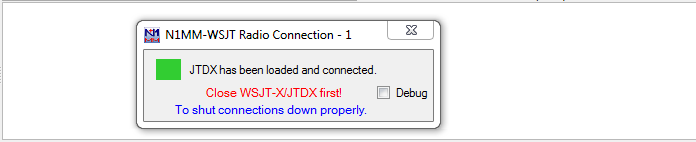 |
| A much better message. |
it wants!
Mike Weir, VE9KK, is a regular contributor to AmateurRadio.com and writes from New Brunswick, Canada. Contact him at [email protected].
Don’t Mess With The Field Day Rules
 Given the Chinese/Wuhan/COVID virus situation, many hams are anticipating a change to their ARRL Field Day operation. I’ve also seen a number of proposals to modify the FD rules to allow for a different kind of operation. I appreciate that kind of thinking outside the box but I think it is misguided. One of the strengths of FD is it already has a set of flexible rules and operating classes, so you can adapt it to what you or your club wants it to be. See my post: ARRL Field Day – Season to Taste
Some Ideas
What are some of the proposals? The first one I noticed is a proposal to allow all Class D stations (home station with commercial power) to work other Class D stations for points. The FD rules do not currently allow this. Class E stations (home station with emergency power) are allowed to any class station. Obviously, this rule is to encourage people to develop emergency power capability (and use it) for their home station. This is perfectly aligned with the emcomm focus of Field Day.
Another proposal is to allow a “backyard operating” class, where you set up a portable station in your backyard. Of course, this is already allowed under the rules as a Class B station.
One of the more innovative ideas I’ve heard is to allow multiple stations (not colocated) to operate under one club callsign, coordinating their operation via the internet. This approach emulates a “normal” Class A FD operation, while everyone is locked down at home. This is not allowed as a Class A station: “All equipment (including antennas) must lie within a circle whose diameter does not exceed 300 meters (1000 feet).” This is roughly equivalent to a group of Class D or E stations working together towards a common score. Why not just operate as independent Class D and E stations, which is more like a real emergency situation?
Adapt and Innovate
Our local radio club is considering different ways to adapt, seeing this as a training and learning opportunity. We will probably encourage our members to get on the air individually, with emergency power. We will likely encourage members to work other members, providing some kind of incentive or award. So our FD may look more like a local operating event, in addition to working distant stations. VHF/UHF will probably play an important role so that we include Technician licensees. Not sure just yet.
We are all experiencing some serious challenges this year and Field Day is not going to be the same. I am a bit surprised that the first thought about Field Day is to change the rules to make it easier or somehow better. I think we just need to adapt and innovate within the existing format. Existing Field Day Rules have plenty of flexibility.
That’s what I say. What do you think?
73 Bob K0NR
The post Don’t Mess With The Field Day Rules appeared first on The KØNR Radio Site.
Bob Witte, KØNR, is a regular contributor to AmateurRadio.com and writes from Colorado, USA. Contact him at [email protected].
 Ham Radio Deluxe |
 W5SWL Electronics |
 Ham Radio Prep |
 KB3IFH QSL Cards  Hip Ham Shirts  HamRadioAuctions HamRadioAuctions Reliance Antennas Reliance Antennas Enigma Shop Enigma Shop |  morseDX  Ni4L Antennas  R&L Electronics R&L Electronics antennas.us antennas.us Ears to Our World Ears to Our World |
- Matt W1MST, Managing Editor
