 |
 Company Offers Biodegradable QRP Kits
 10 March 2010 | by
 Dick Rich, founder of GreenKits said "We discovered that most QRP kit builders build kits not because they want or need another QRP rig. Far from it. In our initial market feasibility study we found several hams that had 20 or more monoband rock-bound 40 meter QRP rigs, but were eager to build more 40 meter rigs. The primary motivators for buying and building QRP rigs was to be part of a fad and impress other QRP rig builders. Most hams only have one or two or even no QSOs on newly built rigs before they are tossed into a desk drawer."
Rich has designed a rig that lasts just long enough after powered up to make a few contacts and then the rig nonviolently self-destructs into a pile of harmless biodegradable ash, with a slight emission of hydrogen. The ash can be dumped into a garden or houseplant pot and the QRPer doesn't have to worry about storing or hiding the unused rig so his wife doesn't ask why he spent money on a rig he'll never use regularly.
GreekKits has created email reflectors for support of the rigs and also to give builders a place to brag about the contacts they made, or even didn't make. Each kit comes with a one time usable password that gives the builder ten days of access to the reflector. Once the password expires, the builder is banished from the reflector forever. Rich says this prevents flame wars about what serial number kits are better than others. GreenKits has an online virtual shrine where customers can worship company founders and kit designers. Virtual flowers can be purchased and placed at the feet of an online statue of founder Rich. Rich says, "We didn't think of the shrine, one of our customers did. We weren't really excited about the idea but several customers really bugged us to do it, so we did."
Rich noted that business is doing well, despite the recession. "We've even released a transceiver called the ESP that doesn't actually transmit any RF. It's selling like hotcakes. Surprisingly, we have customers who have announced on the rig reflector that they have made contacts. One guy has even achieved Worked All States with it and one ham worked Russia with the rig using a three foot loaded whip antenna in a basement apartment. I think this speaks volumes about the quality and performance of our kits."

Anthony Good, K3NG, is a regular contributor to AmateurRadio.com and writes from Pennsylvania, USA. Contact him at [email protected].
RadioSport History | CQ World Wide DX CW 1978
 How did the titans of RadioSport in the 70s score inside the Box or achieve a world record score without our modern version of spotting networks? How did they manage without the availability of today’s technology such as software controlled radios, switching boxes for single operator 2 radios, or CW Skimmer capable computers?
Perhaps, hours and hours, of skill development in front of the radio, continually improving antenna systems, melting solder on the workbench, and listening to the airwaves for nearly the same amount of time.
Spotting Networks.
Brockman and Cox (1979) stated, “All of a sudden the adrenaline is flowing. The eyes are now bright and intense. In a flash our hero has his VFO zeroed in on the prize. There, on 40 CW, is zone 23! But who? Not to be denied, our hero plunges in with his call. As he comes up for air, he hears the prize once more. JT1AN.” (p 43)
Today, the art of listening before taking on the flash swarm generated by spotting networks, is in need of serious re-purposing. The proliferation of junk data is reaching epic proportions as described in various RadioSport reflectors. The utility of the networks, at least in my estimation, is in slow decline. One that, if, left on its own in its present configuration, may harm Box scores and world record attempts.
In 1978, OH2BH piloted CT3BZ in the Madeira Islands, to a new single operator all band world record held only for a year by Dick Norton, N6AA who operated 9Y4AA. Additionally, according to Brockman and Cox, for the first time ever a single band entrant broke the one million point barrier (1979). Jorge, LU8DQ accomplished the impossible.
It was a tremendous year for those seeking world or continental records.
599 Never Dies.
Are we still having this conversation? Apparently, we are, because in 1978 many operators according to the article lobbied the committee asking them to jettison the report. It was suggested that the committee would look into the matter.
RadioSport Ethics.
Computerized logging begins its slow march toward dominating RadioSport. However, in its infancy, an alphabetized cross check reference list was required. Padded logging plagued log checkers then like the unsavory method of rubber clocking in the 21st Century.
On the other hand, one entrant miscopied JA callsigns to the tune of 20 percent of the log total, according to Brockman and Cox (1979); it was unacceptable. The voice of history suggested everyone concentrate on accuracy and not as much on speed.
Conclusion.
They managed to compete and win without the aid of flash swarms generated by spotting networks. Perhaps, back in the day, data traveled slowly weaving itself through VHF/UHF links while a team of spotters carefully listened on high frequency. One’s reputation was on the line while waiting for an opportunity in the pilot’s seat.
I’m convinced a new spotting platform is needed for the longevity of the sport. One that will correct errant oft times malicious data which may lead to irreparable damage when chasing a world or continental score.
My take away in a sport that cherishes speed is one can be accurate and speedy however accuracy trumps speed ever time.
Lastly, will we ever retire 599?
73 from the shackadelic on the beach.
Reference: Brockman, L. N6AR, Cox, B. K3EST (October, 1979). CQ Magazine: 1978 CQ World Wide DX Contest: C.W. Results. pp. 43 – 53.

Scot Morrison, KA3DRR, is a regular contributor to AmateurRadio.com and writes from California, USA.
NCJ: What’s the Best Contest Rig?
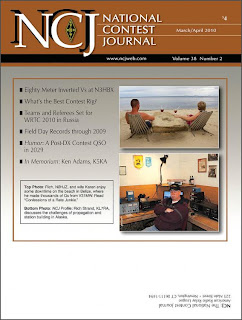 The March/April 2010 National Contest Journal arrived yesterday, torn and tattered as always (thanks again, US Postal Service!), and with it the results of K3MD’s informal poll of top contesters asking, “What’s the best contest rig?” It’s by no means a scientific survey, nor all-inclusive, but many of the Big Guns you’d expect participated.
Nano-40 schematic
I didn’t plan to produce a schematic of the Nano-40, the tiny 40m CW transceiver I built based on Roger G3XBM’s 80m XBM80-2 design as modified by Alan VK2ZAY as I don’t claim any originality for the circuit. I provided the original sources and discussed the changes I made to the circuit and thought that other builders would follow the same path.
 However I have been asked by a couple of people already if I could provide a schematic so I have patched a copy of the circuit diagram produced by Alan to show what I ended up with. I hope that will keep everyone happy, but please remember that without Roger G3XBM’s genius and Alan VK2ZAY’s improvements the Nano-40 would never have happened.

Julian Moss, G4ILO, is a regular contributor to AmateurRadio.com and writes from Cumbria, England. Contact him at [email protected].
No shame, no pride
A few weeks ago fellow blogger Dominic M1KTA wrote that he was selling off some unwanted projects from his shack, including some unbuilt or part-completed kits. A little while ago he wrote: “I have decided to stop selling off project builds now and I am keeping hold of everything until a rally when I can sell them in person as I have had a complete nightmare after selling one of the projects over the internet to someone I believed was capable of finishing it and has demanded I rebuild and re-align it after they hacked about with it themselves to the point where it no longer functions, they melted the pcb connectors and filed away part of the pcb and at least one track in the process to attempt to squeeze it into a box that was too small and demanded a paypal refund. I am never again selling a ‘built’ project over the internet it is too risky for me.”
I have bought things before, either at rallies (hamfests) or from ads in RadCom, that were found not to work and sometimes revealed some astonishingly ham-fisted handiwork inside. The purpose of some modifications defied understanding. I either fixed them myself or wrote it off to experience.
The idea that someone could buy an unfinished kit and then try to make the seller liable for their inability to complete it just beggars belief. It seems some members of this hobby have no shame and no pride.
I told Dom he should publish the callsign of this so-called amateur as a warning to other sellers to steer clear. I know I would.

Julian Moss, G4ILO, is a regular contributor to AmateurRadio.com and writes from Cumbria, England. Contact him at [email protected].
LHS Episode #035: Soylent Green is Bad Apples
 Last week in the Linux in the HAM Shack chat room, we had a lot of participation from our listeners. It was so great to see everyone there. We hope that in the future, more people will get a chance to check out the live show. Check back here on the web site for the schedule of live recordings.
This episode of Linux in the Ham Shack is jam-packed with content. We have a special guest from around the Interwebs that you will likely know if you listen to other podcasts about Linux. The show did run a bit longer than usual, but there is just so much in it I couldn't begin to tell you everything you're going to hear. I do hope that you'll stick around for the entire episode because there are some goodies near the end that you will not want to miss out on, including how you can win significant cold, hard cash.
Thanks to our special guest, our live participants and to everyone who listens to the show. PLEASE, tell everyone you know about us, and that we're not just for amateur radio enthusiasts. Technofiles, geeks, Linux and FOSS addicts and just about everyone will gain something from the podcast. Oh, and due to a couple of technical problems, the audio quality in this episode is poor in a few places. I did the best I could. Next time it'll be better. Have a great week!
73 de Russ and Richard
Russ Woodman, K5TUX, co-hosts the Linux in the Ham Shack podcast which is available for download in both MP3 and OGG audio format. Contact him at [email protected].
The Nano-40
Today I finally completed the little 40m CW transceiver based on Roger G3XBM’s 80m XBM80-2 design as modified by Alan VK2ZAY and further modified by me to work on 40m. I tried to think of a name for it that would acknowledge both these sources of inspiration, but I couldn’t come up with anything snappy, so in the end I named it the Nano-40 because it is very small and works on 40 metres.
 The circuit is essentially the same as the one given by Alan VK2ZAY with a few component changes determined empirically while the rig was on the breadboard to allow for the fact that it is working on 40m instead of 80m. There is only one stage of low pass filtering instead of two, as I described in an earlier post. This seems to be quite adequate. I checked the output waveform using my new oscilloscope and it looks nicely sinusoidal. I also used an MPSA13 Darlington transistor instead of a 2N3904 in the audio stage for a bit more sensitivity and gain.
With the component values I chose the little rig gives 150mW output on a 12V supply or about 75mW using a 9V PP3-style rechargeable battery. There is no sidetone, but it has full QSK. Using my Elecraft XG1 test oscillator I found that a 1uV signal is just about audible. However, bearing in mind that you can receive all activity around 7.030MHz plus and minus the limits of your hearing, a workable signal would need to be a bit stronger to stand out from the crowd!
 The circuit was built on to a small piece of Veroboard and the result is shown above. In case anyone wants to try to replicate it, the reverse side of the Veroboard showing the breaks in the copper is shown below.
 The rig was built into a small translucent blue project box. The box I ordered for the project turned out to be just a bit too small for comfort. It was not quite high enough for the crystal, so I had to cut away part of the circuit board so the crystal could be mounted with its base below the board itself. The space was also a bit too tight for the connectors. Consequently final assembly took much longer than it would have done using a larger enclosure.
 A fair bit of “fine tuning” with a file was needed to adjust clearances which were down to the last millimetre. With the lid on there is not enough room for the spring loaded contacts of the two 3.5mm jack sockets to fully open so the key and earpiece plugs are a tight fit. There was not enough space for a power socket to be fitted internally so after a lot of thought that was eventually resolved by super-glueing a PCB-mounted power socket to the side of the case.
Although I had tested the circuit prior to assembling it into the case there was a heart sinking moment when I applied power and heard no signals at all. Close inspection showed that I had a solder bridge across the antenna socket. This was quickly removed and then the transceiver was found to perform as well as it always did.
I have put out a number of CQs with the little rig but have yet to make a contact with it. Because I don’t live in a densely populated area I don’t have any nearby hams to make a sked with to prove that it really works. You don’t build a rig like this to make a lot of contacts, of course, you do it to prove that it is possible to make a fully functional transceiver this simple and this small. Nevertheless I do hope to make a QSO with my little Nano-40 one day.

Julian Moss, G4ILO, is a regular contributor to AmateurRadio.com and writes from Cumbria, England. Contact him at [email protected].
 Ham Radio Deluxe |
 W5SWL Electronics |
 Ham Radio Prep |
 KB3IFH QSL Cards  Hip Ham Shirts  HamRadioAuctions HamRadioAuctions Reliance Antennas Reliance Antennas Enigma Shop Enigma Shop |  morseDX  Ni4L Antennas  R&L Electronics R&L Electronics antennas.us antennas.us QRV QRV |
- Matt W1MST, Managing Editor
