 |
 Sporadic-E action
 11 May 2010 | by
 The screengrab below, from WSPR at 0815 this morning, shows just how selective Sporadic-E propagation can be. For a change, G4ILO is hearing and being heard by all the European stations while those in the south of England aren’t getting anything.
 Look, too, at all those lines going off the top of the map to OY1OF. I wish I could understand the propagation. It appears that if you like the 10m band, the best place to live is the Faroe Islands!

Julian Moss, G4ILO, is a regular contributor to AmateurRadio.com and writes from Cumbria, England. Contact him at [email protected].
Ash scatter?
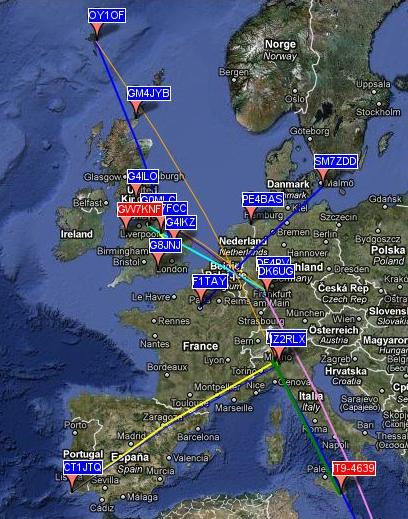 For the last week or so I have been using the K3 for WSPR on 10m to detect the signs of any Sporadic-E openings. Since the opening of May 3rd there has been nothing very exciting to report, though it has been interesting to see spots of stations previously never heard suddenly appear, often at good strength, as a patch of ionization materializes in just the right place.
What has been intriguing over the last few days is the consistent appearance of spots involving OY1OF throughout the day, often with stations in the UK but also with those in Holland, France or Germany.
The distance is too far, obviously, for the ground wave propagation that is often the only propagation reported between closely located stations. The spots are too frequent and too widespread to be Sporadic-E. And they surely cannot be regular F2 layer reflections, as the MUF in this part of the world at this point in the solar cycle is still far too low (the F2 critical frequency is around 4MHz according to the IPS Radiowave Propagation Center.)

Could it be scatter from the ash of the Icelandic volcano?

Julian Moss, G4ILO, is a regular contributor to AmateurRadio.com and writes from Cumbria, England. Contact him at [email protected].
RadioSport Webinar
 Thank you Potomac Valley Radio Club for sponsoring Contesting 101: Maximize Your Score and Your Fun webinar. The schedule time was right on and, for this mid-40 something, ideal for a Friday night.
Kirk, K4RO hit all the function buttons with his informative presentation. Well done!
I especially enjoyed his insight into station construction, component selection, brief yet important mention of antenna systems, and calling CQ even when one is low power, low profile like myself.
Calling CQ more often is a target going into CQ WPX CW at the end of the month.
Contest on.
P.S. Ham radio has moved to a new level of passion with Ham Radio Deluxe and Digital Mode 780 in the shack relaxation zone. Wow factor nine point nine!

Scot Morrison, KA3DRR, is a regular contributor to AmateurRadio.com and writes from California, USA.
Fellbarrow
The objective of today’s walk was Fellbarrow, a minor Wainwright fell WOTA number LDW-199 in the North Western Fells. It had never been activated before and I thought it would be an easy walk, so off I went.
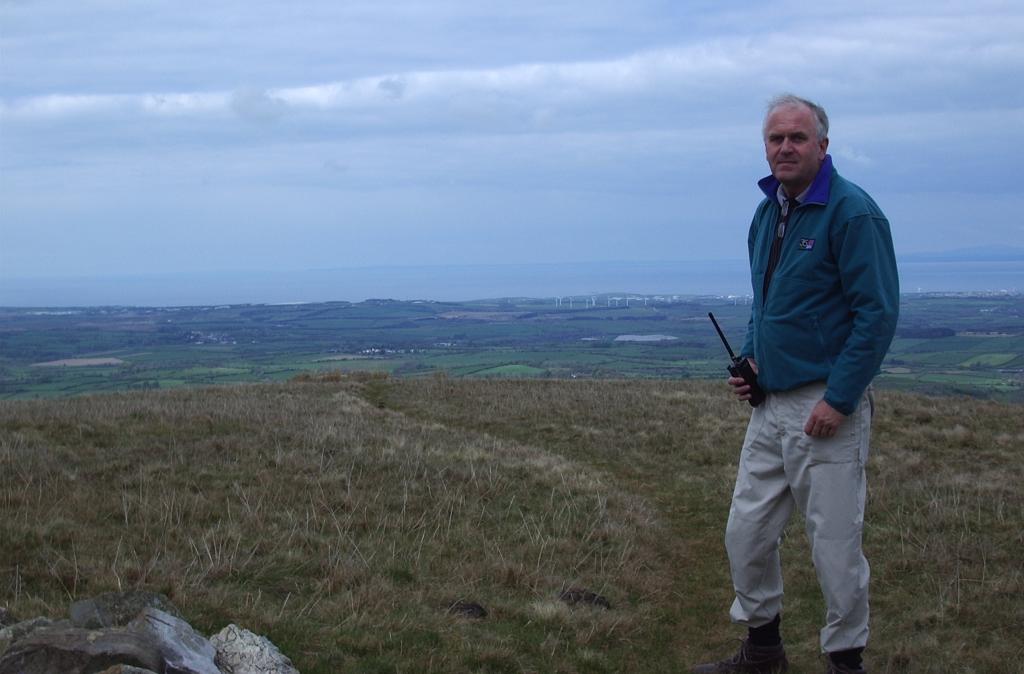 I set off along the lane that goes behind Whin Fell. By a field gate I was checking the map to see if this was where I turned off the lane to go up on to the fells, and someone walked by and asked if I was lost. I said I was just checking to see if this was the way to Fellbarrow and he said yes, you can go that way, so I did. After about 15 or 20 minutes of walking I found that I was at the far end of a large field surrounded by a dry stone wall with barbed wire on either side and no way I could see to go any further.
Eventually I did find a place where the wall had fallen down and it was possible to negotiate the barbed wire, only tearing my walking trousers a little bit. I carried on but found the directions I thought I needed to go blocked by walls and gates.
The trouble with these grassy minor fells is that they don’t look very distinctive so they aren’t obvious targets to aim for, and they are infrequently walked so there is no obvious path to follow. Basically, I was lost. APRSISCE on my mobile phone was no help as the mapping it uses contains no topographical detail at all. I tried Google Maps but it informed me that there was no network coverage so it couldn’t download any maps. I plodded on until I saw a path that descended into the valley and I decided to stop, have my lunch and go back.
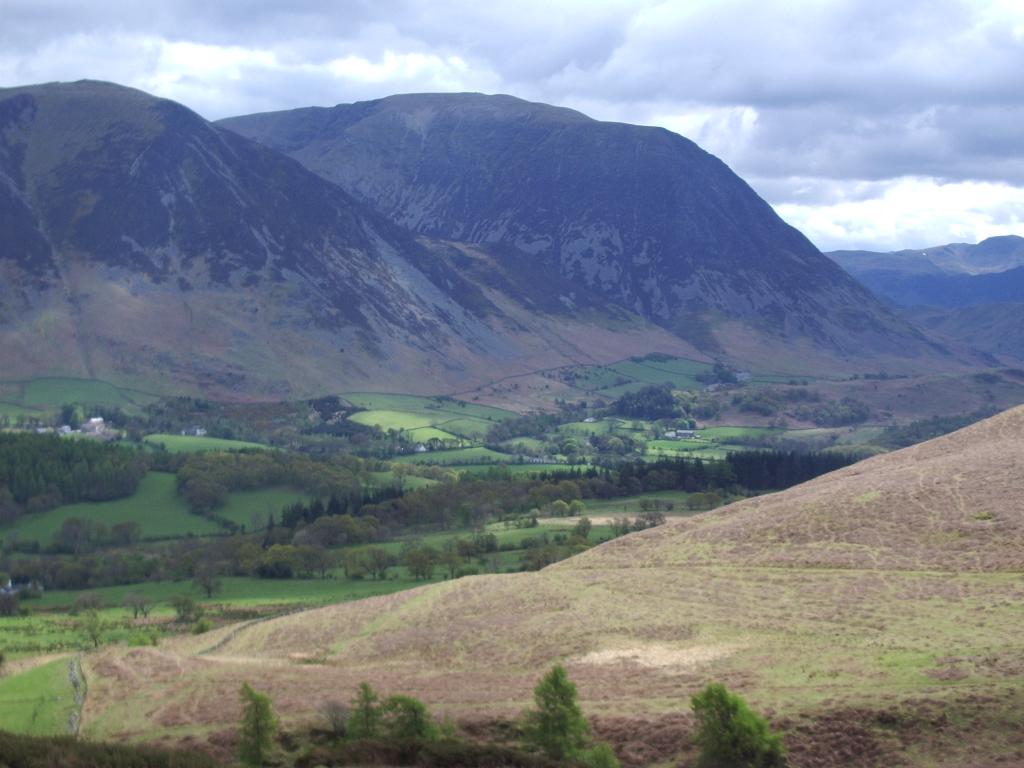 After lunch I decided I would follow some tyre tracks up hill just to see where they went. After about 5 minutes I saw a stile in the fence and a path. I followed this and after a couple more stiles found myself on the top of Fellbarrow with its Ordnance Survey trig point.
I got out the Motorola GP300, made a couple of calls on 145.500 FM and was answered by Colin 2E0XSD. However despite a take-off that covered Whitehaven, the Isle of Man, Workington, Cockermouth and the Dumfries and Galloway area of Scotland I got no other responses. I checked the repeaters and heard Richard MI6BJG/P putting a call into the GB3GI repeater. He was walking into Belfast with a hand held radio and we had a chat for a few minutes until he started dropping out of the repeater. I also heard a repeater GB3BT on the channel marked for GB3EV, which I later found is at Berwick on the north-east coast.
I still couldn’t raise anyone on FM simplex, so I decided to come back. The return route was a bit easier and used the path I should have taken if I had walked for another 5 minutes beyond the point that I was misdirected. I think I need GPS software with OS maps on my HTC Touch.

Julian Moss, G4ILO, is a regular contributor to AmateurRadio.com and writes from Cumbria, England. Contact him at [email protected].
ICQ Podcast Series Three Episode Ten (9 May 2010) – Holiday Emergency Antenna
Series Three Episode Ten of the ICQ Amateur / Ham Radio Podcast. News Stories include:
- Caister Marconi station contacts 29 countries
- Government will kill off FM
- Radio Kuwait cleared from amateur band
- Morse practice via Echolink
- WebSDR Remote Radio in Virginia
- Hamvention D-STAR linking announcement
- Gigabit Powerline Adaptor interference video
- GB3YR now live on internet
- The future of amateur radio is youth
- Global Simulated Emergency Tests 2010
- Retro 75 AM Transceiver kit group formed
- Caiguaran - low-cost Cuban transceiver
- GB3VHF back on the air
- Tyco offers free electronics courses
Your feedback, upcoming events and Martin (M1MRB) tells us about Holiday Emergency Antenna.
Colin Butler, M6BOY, is the host of the ICQ Podcast, a weekly radio show about Amateur Radio. Contact him at [email protected].
Whispered contacts?
A recent discussion on the WSPRnet website concerns whether one should log WSPR contacts. It was pointed out that normal WSPR “spots” are not contacts. However it appears that some operators consider that if two stations spot each others’ signals within a short interval of time then they treat it as a contact and QSL it.
In my opinion WSPR spots, even if they occur both ways within a short time, are not contacts because you have no way of knowing if someone else received your transmission (or what signal report you got) without using the internet. It would be nice if the WSPR protocol provided a way to discover who is hearing your signals without using the internet but it doesn’t. I have no issue with QSLing WSPR “spots” as SWL reports. But they are not contacts, and if anyone uses eQSL to send a QSL to me for a WSPR spot it will be rejected as “not in log.”

Julian Moss, G4ILO, is a regular contributor to AmateurRadio.com and writes from Cumbria, England. Contact him at [email protected].
Our Social Media Revolution
The message is clear and it is social media. A cluster of ham radio operators understood a few years ago that a wave, no more like a tsunami, would crash against the shores of culture and it is here. It is not a fad. Social media is transforming our daily lives from inter-personal relationships to business-to-business transactions.
Perhaps, one might say as Alvin Toffler did, this is a power shift.
Failure to realize this transformation, most likely, will leave institutions, organizations, and individuals on the boondocks of the 20th Century.
73 from the shack relaxation zone and thank you FRRL for the content.

Scot Morrison, KA3DRR, is a regular contributor to AmateurRadio.com and writes from California, USA.
 Ham Radio Deluxe |
 W5SWL Electronics |
 Ham Radio Prep |
 KB3IFH QSL Cards  Hip Ham Shirts  HamRadioAuctions HamRadioAuctions Reliance Antennas Reliance Antennas Enigma Shop Enigma Shop |  morseDX  Ni4L Antennas  R&L Electronics R&L Electronics antennas.us antennas.us QRV QRV |
- Matt W1MST, Managing Editor
