 |
 Ham Radio Youth Net Every Saturday at 21:00 GMT
 4 May 2010 | by
 Ryan, K3SFG, asked us to pass this along to our readers:
CQ young hams…CQ young hams…
The Youth Net takes place every Saturday @ 2 pm (CA Time, PDST)
It is on the N6NFI Repeater, 145.230 -100. Young hams, 18 or younger, can also check-in through Echolink, using KR6DD-R (271122) or N6WN-R (477737).
Please help us get the word out, and if you have any questions, suggestion, etc., please contact K3SFG at [email protected].
Note: Only hams 18 and younger can check-in to this net. Unlicensed youth can check-in under the supervision of a control operator.
Please visit http://www.sbara.org/index.html and click on Youth Group in the left side bar.
Thanks and 73!
– Ryan, K3SFG
Matt Thomas, W1MST, is the managing editor of AmateurRadio.com. Contact him at [email protected].
3830 Claimed Scores | 2010 7th Call Area QSO Party (7QP) | Low Power
 In State County Expedition Multi/Multi.
- KE7DX | 87 CW | 25 SSB | 25 Mults | 10.5hrs | 7,775 Points [Arizona Outlaws Contest Club].
n = 1 score submitted in this category.
In State Multi/Multi.
- KB7QND | 281 SSB | 54 Mults | 17hrs | 30,348 Points [Arizona Outlaws Contest Club].
n = 1 score submitted in this category.
In State Multi-Single.
- K7LED | 286 CW | 120 SSB | 52 Mults | 12hrs | 56,940 Points.
n = 1 score submitted in this category.
In State Single Operator CW.
- KK7S | 595 | 62 Mults | 18hrs 110,670 Points.
- AB7R | 640 | 53 Mults | 11hrs | 101,760 Points [WWDXC].
- W7Z (W7ZR) | 500 | 53 Mults | 12hrs | 79,500 Points [Arizona Outlaws Contest Club].
n = 11 scores submitted in this category.
Out of State Single Operator CW.
- N6MU | 191 | 98 Mults | 56,154 Points [SCCC].
- K0IO | 134 | 59 Mults | 23,718 Points [Newton ARA].
- K1TN | 99 | 49 Mults | 6hrs | 14,553 Points.
n = 14 scores submitted in this category.
A tough weekend inside the cans given changing ionospheric conditions although KK7S captured a 3830 top slot position prior to log adjudication. Out of state participant, N6MU, battled tough conditions on 20m leading the Southern California Contest Club to its banner position in the low power category.
It was not easy with near flat conditions however KK7S and N6MU get the honors! Well done.
Contest on.

Scot Morrison, KA3DRR, is a regular contributor to AmateurRadio.com and writes from California, USA.
LHS Episode #039: Best. Episode. Ever.
 Lately it seems like if there were an extra day in the week it still wouldn’t be enough to get everything done. That being said, Episode #037 is here and it’s even released on time. We’d like to especially thank Dan and Gary for leaving us audio comments via our call-in numbers. If you’d like to participate by leaving us audio feedback, the number to call can be found at the top of the left column of this site. We really do like to “hear” from our listeners.
This has also already been announced, but I’d like to promote our merchandise shops once again. If you’d like T-shirts, tote bags and lots of drinkware items with the cool new Linux in the Ham Shack logo on them, take a trip over to http://www.printfection.com/lhs and pick up an item or two. You’ll be helping us out with a small donation and advertising the show to your friends, family and colleagues. If caps or wall clocks are your thing, http://www.cafepress.com/lhspodcast has exactly what you need. They make great gifts, too. And every purchase helps Linux in the Ham Shack out with our hosting expenses.
Hopefully we’ll see a lot of our listeners at the Dayton Hamvention this month, and hopefully we’ll have many more faithful followers by the end of the event. Thanks as always for downloading the show, and make sure to leave us a comment. Don’t be a stranger.
73 de The LHS Guys
Russ Woodman, K5TUX, co-hosts the Linux in the Ham Shack podcast which is available for download in both MP3 and OGG audio format. Contact him at [email protected].
Quiet day
 Not much happening today. I have been WSPRing on 10m with 5W but heard nothing and have been spotted just once – by OY1OF on the Faroe Islands.
Yesterday evening I was receiving EA4SG in Spain but he was running 20W. I upped my power to a similar level, and was spotted by G0HNW and M1AVV in the early evening. I left the system running all evening but after it was dark I noticed my neighbour’s security lights were coming on at the start of my WSPR transmissions. Not good when you are trying to maintain a “stealth” station!
Before I started with WSPR today I got out the old DOS laptop and the Motorola programming software to make a few changes to my GP300 configuration. I reduced the squelch threshold slightly, reduced the power from 6W to 5W which should help the battery endurance more than it will affect reception of my signals, and I programmed the radio for 16 channels.
Now there are 16 channels it’s difficult to remember what they all are so I made a paper scale to go under the tuning knob which shows the 2m channel numbers or repeater calls. I had to use the magnifying headset to do the very small lettering and I can only read the scale with my reading glasses on – which I don’t when I’m out and about. But I couldn’t read the channel numbers on the original dial scale either so I’m not actually any worse off. I used to have great eyesight – this is what happens after spending most of your life in front of a computer!

Julian Moss, G4ILO, is a regular contributor to AmateurRadio.com and writes from Cumbria, England. Contact him at [email protected].
First 6m Sporadic-E contacts of 2010
I spent the morning building this constant current charging circuit on to the circuit board of the junk Motorola charger I bought on eBay. I also made a power lead so that it is powered by my K2 power supply, eliminating the need for yet another wall-wart. The charger was supplied with a UK type switched mode power supply rated at 12V 1000mA. In view of the “quality” of the charger itself it is unlikely that I would want to use the wall-wart that came with it for anything, but surprisingly when I tested it I couldn’t find any obvious interference. As I have said before, the electrical noise level here is so high that something would have to be pretty bad for me to notice it, but that was a device which I expected to be pretty bad.
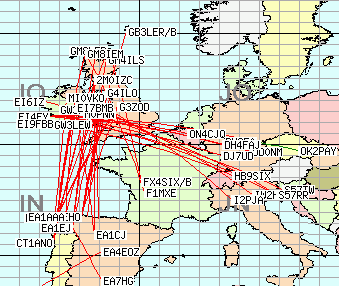 As I was checking the bands for new unwanted noises I heard a CW signal on the 6m band. That turned out to be EB1EHO, whom I worked for my first Sporadic-E contact of the year. I spent an hour or so on the band and worked several stations on the west coast of Spain and one in Portugal, CT1ANO.
As you can see from the DX Sherlock map, the reflective Sporadic-E cloud appeared to be located somewhere over South Wales. I did hear a Scottish station working EA6/M0DLL on the island of Menorca. The DX was right down in the noise and not copyable on my dipole but might have been workable if I had a beam. So clearly there was Sporadic-E about elsewhere.
This opening was a nice treat for a Bank Holiday and I hope is an indicator of things to come this year.

Julian Moss, G4ILO, is a regular contributor to AmateurRadio.com and writes from Cumbria, England. Contact him at [email protected].
Sometimes three strikes is a good thing
For those of you outside the US who might not be familiar with baseball, there’s a common saying that says “three strikes and you’re out”. This refers to the fact that you are allowed to “miss” a pitch three times before you are no longer allowed to bat. (For you purists, given that this isn’t a baseball blog, I’m going to ignore foul balls, etc.) Taken figuratively, the expression is often used to mean that you only get so many tries at something before you have to stop. In my case, I had the opposite happen over the last week.
About a week ago I wrote about how I’d contacted my first new DXCC entity of 2010, BX5AA in Taiwan. Strike one. Earlier this week, I wrote about my second new DXCC this year, VR2XMT. Strike two. Now I’m very happy to be able to write about strike three.
On Friday morning, I was again working from home, this time because I had some reports to complete that had to be done by the end of the day. It’s often easier to do these kinds of things from home since I get disturbed less often. (And yes, I actually got everything done.) P29TL, Tom had been spotted quite a bit recently on 20m, and while I’d heard him a bit earlier in the morning, he wasn’t really coming in strong enough to work. On top of that, given the location (Papua, New Guinea) the folks on the west coast had a much better path to him and were apparently working him easily. As with my contact with VR2XMT a few days earlier, I turned down the volume on the radio while I worked on my reports, until I realized that I could hear Tom more clearly and there were fewer folks calling him. In fact, the folks that were working him seemed to be mostly on the east coast, meaning that the band conditions had changed. Sure enough, I called him a few time (he was using upper sideband on 20m), and after a while he replied to my call and gave me a 5×5 signal report (I gave him 5×7). Strike three!
Fortunately, in the DXing game, I’m not limited to just three strikes, so I’m looking forward to working some more “new ones” this year. It just goes to show that even though over the last couple of weeks the conditions have taken a dip, it’s still possible to make some really good contacts. (For reference, PNG is around 9,000 miles from my location.)

David Kozinn, K2DBK, is a regular contributor to AmateurRadio.com and writes from New Jersey, USA. Contact him at [email protected].
My NRD-525 and other goodies are on the block…
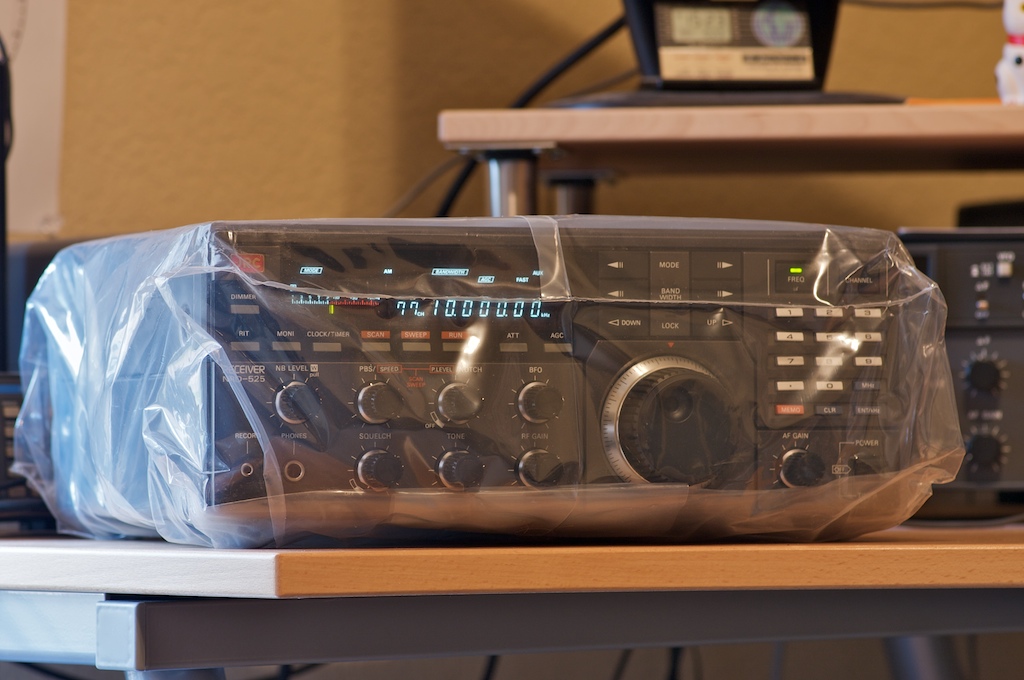
Fiscal realities are forcing me to sell off more of my JRC collection, this time a mint, new-in-box, untouched-by-human-hands NRD-525 HF Receiver along with likewise mint CMK-165 VHF/UHF Converter and CFL-232 500 Hz Crystal Filter. All three now on eBay as separate auctions.
 Ham Radio Deluxe |
 W5SWL Electronics |
 Ham Radio Prep |
 KB3IFH QSL Cards  Hip Ham Shirts  HamRadioAuctions HamRadioAuctions Reliance Antennas Reliance Antennas Enigma Shop Enigma Shop |  morseDX  Ni4L Antennas  R&L Electronics R&L Electronics antennas.us antennas.us QRV QRV |
- Matt W1MST, Managing Editor
