 |
 QRP on Echolink
 6 June 2010 | by
 My gardener XYL Olga has been waiting for rain as eagerly as I have been hoping for a Sporadic-E opening on 2m and today she got what she hoped for. As I was shack-bound I decided to hook the IC-910H up to the computer.
A few days ago I noticed to my amazement that the accessory connector on the IC-910H is exactly the same as the one on the FT-817. I could have simply used the interface I used with the ‘817, except that I had shortened the serial cable to make it the same length as the audio cables when used with a USB to serial adapter. My new PC has two real serial ports one of which was earmarked for exactly this purpose so I had to make up a new, longer cable before I could get started.
On the audio side I needed to use a USB audio “dongle” as the on-board sound card is used by the K3. I already use a Daffodil USB sound adapter for the computer audio. The dongle I used for the IC-910H is an even cheaper, more basic one than the Daffodil and I had purchased it to make an interface for my Echolink node. It appears to be satisfactory for that. Hopefully it will also be good enough for 1200baud APRS packet using the AGWPE sound card software as well. I doubt that it would be good enough for any kind of weak signal work like WSPR, as I observed a few weeks ago that the Daffodil adapter could not reproduce my recordings of weak CW bounced off the Moon from Arecibo. But I don’t plan on doing EME or even WSPR or PSK31 on VHF anyway.
I set up APRSIS32 with the AGWPE software so I will be able to run an APRS gateway again when not needing the VHF radio for any other purpose. This may be useful as there seems to be an increase in APRS activity in the area. As well as Colin 2E0XSD getting set up on RF I have tracked G1TGY driving around the area. I’m not sure if I have the audio levels correct as I haven’t heard any APRS to see if I can decode it and APRSIS32 doesn’t support transmit through AGWPE yet.
I also installed the Echolink software on the shack computer and set up my Echolink node / hotspot. This is a personal node operated under the remote control provisions of my license so it is a bit wasteful that I have to generate 5W or RF – the minimum the IC-910H will go down to – and then dissipate it all in a dummy load to stop it being heard outside my property boundary. However it is nice to have the node available again as my back is playing up a bit today and it enables me to do some ham radio from a reclining chair downstairs or even lying on the bed if I need to.
Whilst setting up Echolink I noticed a conference called *QRP* which I hadn’t seen before. I see that several QRP bloggers have been trying Echolink recently so perhaps we could use this conference for an occasional get-together? I’ll connect to *QRP* more often over the next few days to see what if anything goes on there.

Julian Moss, G4ILO, is a regular contributor to AmateurRadio.com and writes from Cumbria, England. Contact him at [email protected].
ICQ Podcast Series Three Episode Twelve (06 June 2010) – Introduction to Four Metres
Series Three Episode Eleven of the ICQ Amateur / Ham Radio Podcast. News Stories include:
- Is the term 'Amateur Radio' still relevant?
- Redefining Electrical Current Law
- New ICOM Handportable Radios
- IC-9100 Satellite Base Station
- 3D views for beacons maps
- Extension of 40-metre band in Kenya
- WIA Centenary callsign is hot
- Wireless microphone ban
- NZ enforces Amateur Radio regulations
- NZ amateur radio study guides
- Radio Hams assist search
- Questions withdrawn from NCVEC Pool
- VHF & Up at the RSGB Convention
- French QSL mystery resolved
- NASB launches International Shortwave Survey
- Abandoned distress beacon triggers search
Your feedback, upcoming events and Martin (M1MRB) provides an introduction to four metres.
Colin Butler, M6BOY, is the host of the ICQ Podcast, a weekly radio show about Amateur Radio. Contact him at [email protected].
Shack spotlight – W9EVT, George Elm
Ed note: This is a new category for our site and I hope to have future “Shack Showcase” entries. I don’t know how many will be like George below…… but…….
OK, really?
George, why do you have to make us look THIS bad. Really man……. thanks!
I stumbled on George’s website and QRZ bio recently and it took me days to pick my jaw up from the floor. I’ve learned a lot from my elmers, but this guy has it all.
Here’s a little info about George from his QRZ page (which has more lookups than any I’ve seen yet – almost 150,000):
George Ulm, W9EVT was born in the Free City of Danzig in 1930. In the mid-1930s he moved to Chicago with his family. After W.W.II, he produced some of the first convention exhibits for the Radio Parts Show in the Windy City. His business later expanded to world’s fairs and conventions such as the CES in Las Vegas and Chicago. George is a Korean Conflict veteran, taught electronics in the Navy Air Corps, developed and put on air the first two meter amateur repeaters in the mid west.
George has lived in Mexico, Europe, Africa and Australia with ham calls associated with each part of the world. In the early 1960s he purchased an apple and cherry farm on Washington Island, WI. At retirement he decided to raise antennas on the property instead of fruit. He lives there year round with his wife, Susan, his dogs, Ivan and Bosun and a very talkative African Gray Parrot, B.B.
Look at one (trust me….. he has many) of his vintage operating positions:

And, unlike a lot of guys that have been active since before I was even born, let alone licensed…… he’s more than made the jump to modern technology:

Here is just some of the eye candy:


George also has a rental property on the island if you’re looking for a little spot to relax.
George’s information can be found on his QRZ page at:
Or his personal page at:
http://www.greengate-wibb.com/?page_id=5
If you know of any shacks that I should feature (in this new category) feel free to contact me via the contact form or comment below.
Jonathan Hardy, KB1KIX, is a regular contributor to AmateurRadio.com and writes from Connecticut, USA. Contact him at [email protected].
More numbers stations/espionage information from Simon Mason
 As mentioned previously, since I was a kid (long before being a radio amateur) I’ve been fascinated by numbers stations. Every now and then I go on a search online to find more sites to satisfy my curiosities – there’s tons of ‘em out there.
This time, let me take you to the URL of Simon Mason, but he has a disclaimer about the material on his site:
The information presented in this section is for entertainment purposes only and does not disclose any information not already in the public domain. No assassination attempts are required! Thank you.
Rather tongue and cheek, but…… one can never be too sure!
His site looks rather old, but don’t let that discourage you – there is a TON of stuff here (and it’s updated). Not only are there plenty of pages devoted to various numbers stations, but a plethora of videos and radio shows devoted to the subject.
Simon has written a small book that is freely downloadable on his website called “Secret Signals: A Euronumbers Mystery” (available in HTML and MS Word format).
I can go on and on about the site, but just go check it out! If you like this sort of thing, you’ll be there for hours!
http://www.simonmason.karoo.net/page30.html
Jonathan Hardy, KB1KIX, is a regular contributor to AmateurRadio.com and writes from Connecticut, USA. Contact him at [email protected].
My 10,000 Hour RadioSport Challenge | 9,803 – 24 = 9,779 Hours To Go
I enjoyed CQ WPX CW despite storm conditions that drove the A-index into double digits. It was a first for my low power, low profile station and I suffered through a deplorable Saturday afternoon. Propagation really matters in the game of RadioSport in addition location, antenna systems, station engineering, operator skill set, and strategy.
There is a lot to learn and accomplish within the art and science of RadioSport.
Friday Night Lights.
I did not settle into the chair until mid-evening after returning home from work then deployed my wire antenna system for the low bands. The south leg of the wire antenna goes up later in the evening after 20m shuts down. I stow the vertical when operating on the low bands in the evening because the wire is too close to the second antenna.
Friday night rocked between 0200 – 0500UTC as 39 -Qs went into the log. I jumped a little early from 20m to 40m and it is a habit of mine. I need to pay attention to the play book knowing 40m is generally noisy at this time of the year.
Storm.
I keep notes on propagation and the receiver floor literally dropped out when the A-index spiked at 28 through Saturday afternoon. I was simply not heard through the noise deciding instead that napping through the day was a better idea. I could not compete against a double digit number.
Sunday Is Different.
I’m noticing a trend that Friday night and all day Sunday really makes a difference in my log. Historically, I have not scored as many -Qs on Saturday however, neither have I experienced a zen-like event when propagation produces epic conditions. It is like surfing, one continues returning to waves time and time again, when all of a sudden the cosmos falls into place.
I know that event is somewhere out there on the time line!
The Bands.
I scored double digits across four bands for the first time ever and called CQ more times than not on the low bands. I did not use memory functions when sending the exchange as well. My biggest surprise was a 10m opening into Oceania and South America late Sunday afternoon. I was thrilled when LU1HF ignited my cans with his stellar signal.
The high bands were fun and 20m produced the best results with 50 -Qs in the log.
I managed a pair of excellent hours on 40m that is 0500UTC (13 -Qs) and 1300UTC (11 -Qs). I was pleasantly surprised on 80m late Sunday morning but my timing on this band was totally off.
Conclusion.
Overall, I logged 116 -Qs and 73 prefixes, totalling 15,549 points effectively beating my score from last year. The storm did not help the low bands where I wanted to log as many JA-stations as possible on Saturday morning. They are excellent operators and the noise was too much for low power, low profile into Asia.
There is more fun work inside the shack relaxation zone and many thanks to all who pulled out my signal through CQ WPX CW weekend!
Contest on.

Scot Morrison, KA3DRR, is a regular contributor to AmateurRadio.com and writes from California, USA.
3830 Claimed Scores | NS Summer Ladder VIII | Low Power
 Atlantic Single Operator.
- N4AF | 50 Qs | 32 Mults | 1,600 Points [PVRC].
- N1LN | 44 Qs | 34 Mults | 1,496 Points [PVRC].
- NO3M | 44 Qs | 32 Mults | 1,408 Points [NCC].
n = 7 scores submitted in this division.
East Central Single Operator.
- N4OGW | 50 Qs | 36 Mults | 1,800 Points [ACG].
- K9BGL | 51 Qs | 34 Mults | 1,734 Points [SMC].
- K8MM | 48 Qs | 34 Mults | 1,632 Points [MRRC].
n = 13 scores submitted in this division.
West Central Single Operator.
- N3BB | 54 Qs | 40 Mults | 2,160 Points [CTDXCC].
- W5JAW | 52 Qs | 39 Mults | 2,028 Points [CTDXCC].
- WD0T (@KD0S) | 54 Qs | 35 Mults | 1,890 Points.
n = 6 scores submitted in this division.
West Single Operator.
- K7SS | 57 Qs | 33 Mults | 1,881 Points [WWDXC].
- W7OM | 44 Qs | 27 Mults | 1,188 Points [WWDXC].
- W7WHY | 41 Qs | 22 Mults | 902 Points [WVDXC].
n = 3 scores submitted in this division.
NCCC in CA/NV Single Operator.
- N6RO | 45 Qs | 29 Mults | 1,305 Points.
- K6VVA | 43 Qs | 30 Mults | 1,290 Points.
- W0YK | 42 Qs | 30 Mults | 1,260 Points [Loma Prieta Contest].
n = 6 scores submitted in this division.
Our 100 foot tower whom looms large in Central Texas continues dominating the fastest 30 minutes in RadioSport. Congratulations, Jim, N3BB for turning in another fine performance and leading the Central Texas DX and Contest Club (CTDXCC) to its fourth banner position!
73 from the shack relaxation zone.

Scot Morrison, KA3DRR, is a regular contributor to AmateurRadio.com and writes from California, USA.
888 miles using a hand-held
This afternoon 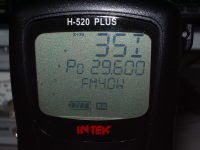 I made my first DX contact using a hand-held radio. It was a fine, warm day, so after lunch I left Olga doing things in the garden and went for a stroll with the H-520 10m FM radio. I took a footpath through fields to the north of the town that led up to the Carlisle road. It’s quite high up there, with great views down into the town and to the mountains beyond. However I was only carrying what would fit in my pockets, so the camera got left behind.
I used to take a 2m radio up there but I don’t think I ever made a contact so I lost interest. The other problem with that path is that you sometimes have to run the gauntlet of a herd of cattle. In the UK it’s illegal to put a bull into a field through which is a public right of way. However there is no such restriction on cows. They can be quite inquisitive, and there have been a few cases recently of people being knocked down and injured while walking through a field of cattle. It is quite frightening being followed across a field at less than the safe stopping distance by a couple of hundred tons of beefburgers in the making, as happened to Olga and I a couple of years ago. Shouting “horseradish sauce” at them has no effect at all!
Today, fortunately, the bovine creatures kept out of my way. I found a suitable operating spot, put the whip antenna on the Intek and started calling CQ. After a few minutes I had a call from Zdenek OK1AQW, coincidentally the same station that got away from me yesterday. Today he was strength 9 on the S meter, the same as Roger G0MWE had been from just a few miles away. We moved off the calling frequency and completed a solid 5 minute QSO, kept short only because Zdenek was receiving a lot of interference from other stations on the same frequency.
My report was initially 57, but was amended to 59 dropping to 51. At one point Zdenek informed me that I was coming over another British station that was calling on the frequency. He was running 100W to a quarter wave vertical and I think he was a bit surprised to hear I was running only 2.5W to a 140cm telescopic whip!
Incidentally it turns out OK1AQW doesn’t live near Prague at all as I wrote yesterday. His QRZ.com page is wrong. He is actually more than 100km east of Prague, about 10km from the Polish border, in locator JO80eb. I calculate that to be a distance of 888 miles or 1,430km. Not bad for a voice contact using a battery powered hand-held radio and whip antenna. Don’t you just love Sporadic E?
I didn’t manage any other contacts. I heard DO5DGH calling CQ repeatedly but he didn’t hear me. But this was a nice taste of what is possible. Some people might wonder why someone who owns nice radios like a K3 and even an FT-817 should put so much effort into trying to make contacts using a modified hand-held CB but I think to talk to someone direct using a battery powered self contained hand-held radio, without the aid of a satellite, a repeater or internet linking, is the ultimate challenge and far more exciting than anything I could achieve even if I had the full legal power, a tower and a beam!

Julian Moss, G4ILO, is a regular contributor to AmateurRadio.com and writes from Cumbria, England. Contact him at [email protected].
 Ham Radio Deluxe |
 W5SWL Electronics |
 Ham Radio Prep |
 KB3IFH QSL Cards  Hip Ham Shirts  HamRadioAuctions HamRadioAuctions Reliance Antennas Reliance Antennas Enigma Shop Enigma Shop |  morseDX  Ni4L Antennas  R&L Electronics R&L Electronics antennas.us antennas.us QRV QRV |
- Matt W1MST, Managing Editor
