 |
 Noises off
 13 June 2010 | by
 Show me a tidy shack and I’ll show you the shack of someone who doesn’t spend much time tinkering with equipment, or someone who has been nagged by his XYL to make the shack tidy and curses every time he needs to connect or disconnect something – which at G4ILO seems to be several times a week.
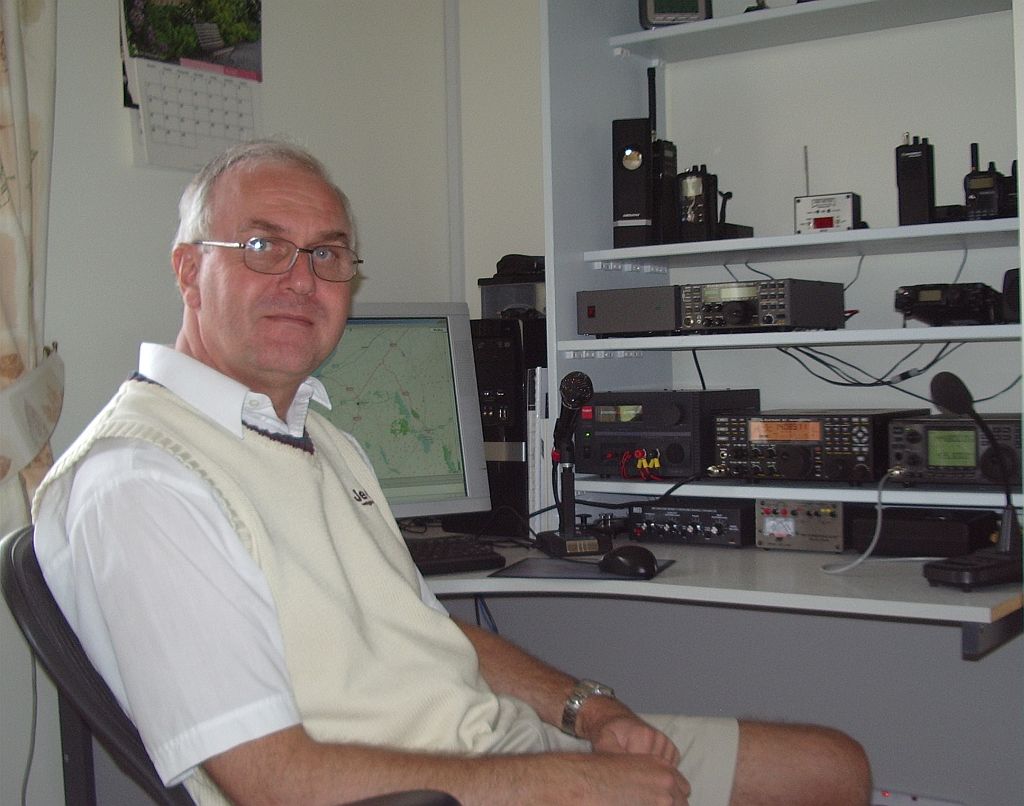 When I switched on the computer this morning there appeared to be a Sporadic-E opening building on 2m to the south east so I switched on the IC-910H and turned the SuperMoxon in that direction. Nothing was heard, so I switched to the vertical instead and was puzzled as to why the band noise was so much greater on the beam than the Slim Jim.
The opening passed, as all such openings have this year with nothing heard or worked, and I decided to investigate. I switched the computer off and the noise fell to the same level as on the vertical. Eventually, after much trial and error and cursing because the cables can only be reached by groping blind (with the aid of a shaving mirror or a picture of the back of the rig) behind the equipment I established that the problem was the serial cable providing PTT control to the interface connecting the 910H to the computer. Even when it was disconnected from the radio, plugging it in to the serial port on the computer caused the noise level to jump up.
This was a cheap interface I’d bought some time ago for the FT-817. The serial cable supplied wasn’t screened, but I’d shortened it to use with a USB to serial adapter without a lot of spare cable lying around. This had resulted in it being too short to use with a real serial port, so I had replaced the cable. I had used screened cable for the replacement, but although I had connected the copper shield to the GND pin of the RS-232 port, it wasn’t connected to the body or shell of the plug, which in any case was plastic.
I managed to solder to the metal flange of the plug, the bit that pushes on to the socket on the PC, and connect a short wire from that to the GND pin and the shield. That seemed to do the trick, and the noise level is now the same when the beam is pointing towards the shack as it is on the vertical. Problem solved, for once! Nevertheless I do sometimes wonder if computers are worth all the trouble they cause to us radio enthusiasts.

Julian Moss, G4ILO, is a regular contributor to AmateurRadio.com and writes from Cumbria, England. Contact him at [email protected].
Back to front
 Last night for the first time in a very long time I operated RTTY. I made ten contacts in the BARTG RTTY 75 contest. The reason was that Elecraft had released a beta version of firmware for the K3 that enhances the built-in DSP modems to support the 75baud RTTY mode that was being used in the contest. Now that the K3 also supports a way to get decoded text into a computer program I thought it would be fun to give it a try.
For those unfamiliar with the K3, the transceiver boasts a built-in Morse decoder plus DSP based modems (encoders and decoders) for PSK31, standard 45.5baud RTTY and now 75baud RTTY. As the K3 doesn’t allow direct input from a keyboard, the usual way to use this facility is to send text using a Morse paddle and read received text on a scrolling 7-character window of the K3 display. However, using a program like KComm it is possible to send and receive text using software commands over the CAT interface as well. Since, like most things that require good motor skills, I’m hopeless with a paddle (or key) at anything much above 12wpm, that’s what I did.
I installed the new firmware and it decoded 75baud RTTY signals perfectly, so I waited for the contest to begin. After it did, I soon found that although people were hearing me they weren’t decoding me. I got lots of QRZ?, ??????? and SRI NO PRINT. I started to get frustrated and began thinking that RTTY is an obsolete mode that has no place in the 21st century because I know I could have made contact with these stations easily using PSK31 and a fraction of the power.
I decided to switch to soundcard mode and use Fldigi to try to make some contest contacts, and then found that people were replying to me on the first call! So clearly there was something wrong with the RTTY being generated by my K3.
This morning I tried receiving some of my transmitted RTTY using the FT-817 and Fldigi on my NC-10 netbook. When the RTTY was generated by Fldigi it was received perfectly. However when it was generated by the K3 I received gibberish unless I switched the K3 to REV DATA mode (i.e. reverse sideband.) Since I was receiving the RTTY perfectly OK using the normal sideband I presume that the K3’s transmitted RTTY was reversed. I have reported it to Wayne and await comments.
Unfortunately I did have some problems with KComm as well. After a while, it started aborting the transmission of any macro after the first few diddles. Like many programs, it has grown to the point where it is hard to understand what is going on any more and my interest in programming has fallen off a cliff in the last few months. I don’t know if I will ever get around to fixing the problems and releasing the final version. I do like using it, and KComm is the only program that really supports the K2 and K3 properly because it doesn’t treat them like a Kenwood TS2000 (whose command set it nominally shares) but was written to take account of the way these radios actually work.

Julian Moss, G4ILO, is a regular contributor to AmateurRadio.com and writes from Cumbria, England. Contact him at [email protected].
RadioSport Video
Contest on.

Scot Morrison, KA3DRR, is a regular contributor to AmateurRadio.com and writes from California, USA.
RadioSport History | CQ World Wide DX CW 1981
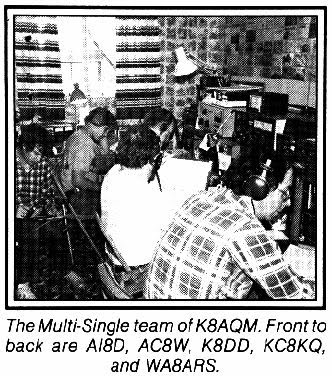 There are many ways to enter RadioSport and one of them is finding a group of operators who share the competitive spirit. One may not want to spend an entire weekend in the pilot’s chair or other commitments may compete for attention. A multi-single entry is an excellent opportunity to share resources, time, and establish new friendships.
Participating in this category made a significant difference in my attitude about RadioSport as a teenager. I spent hours inside the cans learning how-to listen for needed multipliers. A day existed, when paper dupe sheets tracked the log, and I learned precision and orderliness. A mistake in the dupe sheet would result in a significant point penalty.
Additionally, competing in this category set my personal future standard in terms of operating skill, station engineering, and sportsmanship. I modeled those who sat in the pilot’s chair and admired their operating skill especially when rate met or exceeded one’s capacity to write with a pencil.
Cox and Brockman stated, “In the battle of the Goliaths, W2PV captured the top world Multi-Multi score, no easy feat for a USA station.” (1982)
Furthermore, “The contest community around the world will remember this fall when the signals are strong and clear that a few of our friends are not present. W2PV, UI8LAG, and W3KT have become silent keys. Each one contributed to what the contest stands for: enjoyment and excellence.” (Cox & Brockman, 1982)
I want to remember their words as the technological wave rolls into the future of ham radio. Has competitive pursuit finally crossed the border where enjoyment and excellence does not exist or even count anymore? Is RadioSport beginning to miss the forest for the trees?
There exists somewhere in the future, conditions like 1981, when the cosmos fell into place and records fell like dominoes. Cox and Brockman stated, “The top USA All Band score was decided by less than a minute’s operating time on a good band.” (1982)
The North California Contest Club in the same year went from 9 million in 1980 to 160 million. One day the west coast will again stake its claim inside the club box.
Multi-Multi titans in 1981 were W2PV, N2AA, and W3LPL.
Single Operator All Band in the USA was K1GQ.
Single Operator All Band World was 9Y4VT (N6AA).
Top Three Clubs in the United States were Northern California Contest Club, Yankee Clipper Contest Club, and Frankford Radio Club.
Top Three International Clubs were Lithuanian Contest Group, Voroshilovgrad Radio Club, and Kaunas Polytechnic Institute R.C.
If one wants to enter RadioSport think about creating a team of like-minded operators who enjoy the game while pursuing excellence.
73 from shack relaxation zone.
Reference: Cox, B. K3EST, Brockman, L. N6AR (1982, October). CQ Magazine: 1981 CQ World Wide DX Contest: C.W. Results. pp. 20 – 34.

Scot Morrison, KA3DRR, is a regular contributor to AmateurRadio.com and writes from California, USA.
RadioSport History | CQ World Wide DX CW 1981
There are many ways to enter RadioSport and one of them is finding a group of operators who share the competitive spirit. One may not want to spend an entire weekend in the pilot’s chair or other commitments may compete for attention. A multi-single entry is an excellent opportunity to share resources, time, and establish new friendships.
Participating in this category made a significant difference in my attitude about RadioSport as a teenager. I spent hours inside the cans learning how-to listen for needed multipliers. A day existed, when paper dupe sheets tracked the log, and I learned precision and orderliness. A mistake in the dupe sheet would result in a significant point penalty.
Additionally, competing in this category set my personal future standard in terms of operating skill, station engineering, and sportsmanship. I modeled those who sat in the pilot’s chair and admired their operating skill especially when rate met or exceeded one’s capacity to write with a pencil.
Cox and Brockman stated, “In the battle of the Goliaths, W2PV captured the top world Multi-Multi score, no easy feat for a USA station.” (1982)
Furthermore, “The contest community around the world will remember this fall when the signals are strong and clear that a few of our friends are not present. W2PV, UI8LAG, and W3KT have become silent keys. Each one contributed to what the contest stands for: enjoyment and excellence.” (Cox & Brockman, 1982)
I want to remember their words as the technological wave rolls into the future of ham radio. Has competitive pursuit finally crossed the border where enjoyment and excellence does not exist or even count anymore? Is RadioSport beginning to miss the forest for the trees?
There exists somewhere in the future, conditions like 1981, when the cosmos fell into place and records fell like dominoes. Cox and Brockman stated, “The top USA All Band score was decided by less than a minute’s operating time on a good band.” (1982)
The North California Contest Club in the same year went from 9 million in 1980 to 160 million. One day the west coast will again stake its claim inside the club box.
Multi-Multi titans in 1981 were W2PV, N2AA, and W3LPL.
Single Operator All Band in the USA was K1GQ.
Single Operator All Band World was 9Y4VT (N6AA).
Top Three Clubs in the United States were Northern California Contest Club, Yankee Clipper Contest Club, and Frankford Radio Club.
Top Three International Clubs were Lithuanian Contest Group, Voroshilovgrad Radio Club, and Kaunas Polytechnic Institute R.C.
If one wants to enter RadioSport think about creating a team of like-minded operators who enjoy the game while pursuing excellence.
73 from shack relaxation zone.
Reference: Cox, B. K3EST, Brockman, L. N6AR (1982, October). CQ Magazine: 1981 CQ World Wide DX Contest: C.W. Results. pp. 20 – 34.
Scot Morrison, KA3DRR, is a regular contributor to AmateurRadio.com and writes from California, USA.
QRP antenna
I bought a copy of Practical Wireless today and noticed the following in the Waters and Stanton ad inside the front page.
 It isn’t often words fail me, but three hundred quid delivered for a hand held QRP antenna?!? I guess it would perform about as well as my home-made Wonder Loop.

Julian Moss, G4ILO, is a regular contributor to AmateurRadio.com and writes from Cumbria, England. Contact him at [email protected].
Avoiding the Microsoft Tax
I need a new office notebook. Yesterday, while working on something a thin bright blue vertical line appeared on the screen. It’s still there this morning. I guess the TFT display is going on the fritz. Well, this Toshiba Satellite M60 is 4 1/2 years old and has been in heavy use 10 hours a day 5 days a week for nearly all that time, so I can’t complain. Time for a replacement. The trouble is, I use Linux on my work PC and it doesn’t seem to be possible to buy a high-spec laptop with Linux ready installed and working on it.
 Obviously, I’d like to avoid paying for a copy of Windows I’m not going to use. If you’ve ever seen it on sale, you’ll know that the cost of a copy of Windows is quite substantial. Since, thanks to Microsoft’s obsessive copy protection, it will be an OEM copy locked to the hardware and without installation media I won’t even be able to install and use this copy under VirtualBox if I want to.
But also, as it’s a work machine, I’d like to buy one on which the operating system is supported and all the hardware works with it. I’ve installed operating systems far too many times in my life to have any enthusiasm for doing it one more time, and I know from experience that laptops often contain hardware that isn’t supported out of the box by Linux.
When we bought a new laptop for Olga a couple of years ago I bought a budget HP laptop that came with Windows Vista – which ran so slowly it took two hours just to finish it’s automated initial setup routine. I installed Linux but had an anxious couple of hours as I couldn’t get the wi-fi adapter to be recognized. I did in the end, and the chances are that any problems with whatever system I got this time could be resolved after hours of ferreting through support forums. But that long ago ceased being fun and I would really prefer to avoid it.
However, it is virtually impossible to buy a PC or laptop with Linux installed and supported. Dell appears to offer a small selection of laptops preinstalled with a long superseded version of Ubuntu. There is also a firm called The Linux Emporium that offers a limited range of Lenovo laptops with Ubuntu installed on them. But they have nothing that meets my spec. This old Toshiba has a 17in display with WGXA+ 1440×900 resolution and I’m not going to settle for anything smaller. So it seems the only way I am going to get what I want is to buy the laptop I want, pay the Microsoft Tax, throw away Windows and do my own Linux installation.
Is it any wonder that Microsoft enjoys such a virtual monopoly when people who buy PCs don’t even know there is an alternative? Why hasn’t the EU done something about this? It has taken months and cost millions to force Microsoft to install a screen that lets people choose what web browser to use, despite the fact that a) the browser market already has healthy competition and b) switching browsers later on if you want to isn’t a problem. But it has done nothing about a situation that forces people to pay for a Microsoft operating system even if they know enough not to want one. Even if computer manufacturers don’t want to offer Linux because they don’t wish to support it, they should at least be required to offer the OS as an optional extra so those who don’t want it don’t have to pay for it.

Julian Moss, G4ILO, is a regular contributor to AmateurRadio.com and writes from Cumbria, England. Contact him at [email protected].
 Ham Radio Deluxe |
 W5SWL Electronics |
 Ham Radio Prep |
 KB3IFH QSL Cards  Hip Ham Shirts  HamRadioAuctions HamRadioAuctions Reliance Antennas Reliance Antennas Enigma Shop Enigma Shop |  morseDX  Ni4L Antennas  R&L Electronics R&L Electronics antennas.us antennas.us QRV QRV |
- Matt W1MST, Managing Editor
