 |
 Try some Cornbread Road
 31 July 2010 | by
Image by permission from KE9V
Jeff, KE9V, has recently released a podcast called Cornbread Road. It is quite a different type of amateur radio podcast. It is not a commentary or discussion of amateur radio, it is a story with amateur radio involved in it. The production quality is high and I have found the story captivating. Jeff tells me the next episode, number 6, is out tomorrow (Sunday 1st Aug.). If you have not already sampled Cornbread Road give it a try, I recommend it.


Alan Steele, VA3STL, is a regular contributor to AmateurRadio.com and writes from Ottawa, Ontario. Contact him at [email protected].
Feeding the WA5VJB cheap Yagis
The WA5VJB cheap Yagis are a great way to get on VHF/UHF without spending a fortune on commercial antennas. While it is practical on the UHF/microwave bands to use a copper driven element, it is less practical on the 144 and 222 MHz bands. I know that McMaster carries copper and brass rods, too. But, I also like to have a coax connector at the feedpoint. Since I am in the process of building what amounts to a “super cheap Yagi” (note that’s not a “super-cheap Yagi,” the hyphen matters; will report on this in the future), I figured I would share my feedpoint for aluminum driven elements.
While wandering through the electrical aisle of the local big box hardware retailer about six months ago, I discovered the Thomas and Betts ADR6-B2 (try the ADR6 for a drawing of a similar part) grounding lug. This looked like a good candidate for the cheap Yagi feedpoint, especially costing only $1 for a pair. In order to fit an SO-239 flange-mount connector to the ADR6-B2, I cut off the portion of the lug with the bolt hole and drilled my own hole (#43) and tapped it 4-40. I did the same to the other piece. I did not cut off the lug on the second one, but I should. Then, I soldered a short piece of wire to the center conductor of the SO-239 jack and added a lug to it. Here are the parts so far:
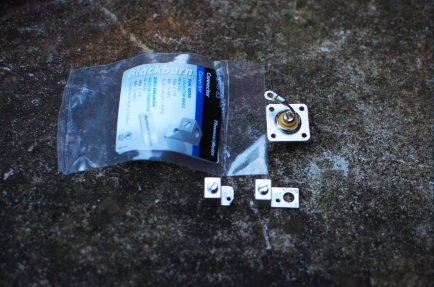
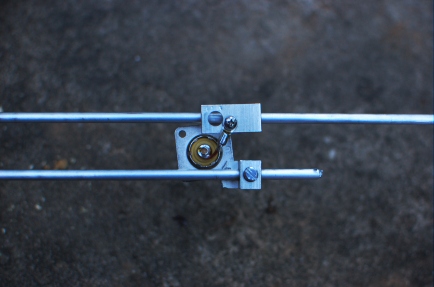
Then, I assembled the whole mess on the J-shaped driven element (dummy used for photos) using two 3/8″ 4-40 screws and a lock washer. Note that the ADR6 lugs are installed on opposite sides of the element.
And, after installing on the wooden boom, it looks like this:
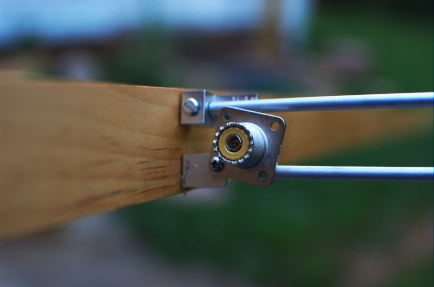
It’s not quite square and some mechanical strengthening is in order before it goes up in the air. But, this is a considerable improvement over what I’m using now. Ty-wraping the coax to the boom will provide considerable relief to the connector and it’s attachment. More details will be forthcoming on the antenna, if it works. Stay tuned!
Ethan Miller, K8GU, is a regular contributor to AmateurRadio.com and writes from Maryland, USA. Contact him at [email protected].
Don’t Call On The Calling Frequency!
We have an amateur in the area who likes camp out on the six meter calling frequency and have his voice keyer automatically call CQ for a few hours some evenings. It's logical to do such a thing as no one will know the band is open unless someone is transmitting and someone receives the transmissions. But it's terribly annoying to listen to and I find myself getting frustrated when people do this. I know others feel the same way as well. Despite being a calling frequency it's impolite to use it for calling for long periods of time.
Perhaps what we should really have are multiple calling frequencies based on areas such as grid square fields, the first two characters of the Maidenhead Locator System (i.e. "FN", "EM", "CN", etc.). You could camp out on the frequency for your grid square field and call CQ all you like, but if you just wanted to listen for an opening, you could leave your receiver on one of the other grid square field frequencies and not have to worry about a local station clogging the frequency for long periods of time.

Anthony Good, K3NG, is a regular contributor to AmateurRadio.com and writes from Pennsylvania, USA. Contact him at [email protected].
Handiham World for 28 July 2010
Welcome to Handiham World!

Update: Larry Huggins, KA0LSG, Handiham Volunteer, holds the Wouxun HT on cover of Worldradio
Last week’s mention of the Wouxun talking dual band handheld radio created quite a stir, so we are devoting some time to a follow up. I heard from a number of our readers and listeners who said that the PDF online version of the “With the Handihams” article was difficult to read because of the PDF layout. Although the magazine has done a great job making the layout easy to follow for sighted readers, I have heard that there is a need for a more straightforward text version for our blind readers and listeners. I have placed the text of the article on the Handiham website, as well as a link to an audio version of the article read by Bob Zeida, N1BLF, who reads for us and for The Talking Information Center of the Massachusetts Reading network. Since we didn’t specify retailers, we also provide you a link to some sources.
Those of you who listen to this podcast will hear Bob reading “With the Handihams”.
Before we get to those resource links, there is word that Wouxun is interested in developing a talking dual-band base/mobile rig. I read about this on a discussion thread on the Blind-Hams mailing list. At this point, they are interesting in learning what accessibility features are most needed, so this may be a rare opportunity for anyone who wants to have a say in the early design of a radio to get their voice heard. To comment on this, you may email Ed at Wouxun: [email protected]. That is also the address to request a price list and ordering information. The Wouxun.us website states “Due to having minor surgery, I will not be shipping orders between July 26 – Aug 7. During this time I will answer emails and take orders.” With this in mind, I would guess that you may need a bit of patience in communicating with Ed, especially if you have questions. I would urge our readers and listeners to keep the questions simple and don’t ask a bazillion of them. In fact, the website is easily navigated and you can find the answers to your question there. The pricing is under $110 + shipping, and a variety of accessories are available. Remember that you can get this radio in a dual band version that includes 2 meters and either 70 cm (440 MHz) or 1.25 m (222 MHz.) The pricing is the same for either combination.
Please see the Handiham.org website for the story & resource links.
Our thanks to CQ Publications and the Blind Hams Mailing List for helping us get the word out about accessible technology.
For Handiham World, I’m…
Patrick Tice
[email protected]

Pat Tice, WA0TDA, is the manager of HANDI-HAM and a regular contributor to AmateurRadio.com. Contact him at [email protected].
LHS Episode #044: SELFish and Far Afield
 It’s time for a new episode of Linux in the Ham Shack. I can hear everyone cheering in unison from here. Richard’s Internet service was down for the recording so he had to bring some portable computers over to his father’s house and attempt to get everything done from there. Unfortunately, all did not go well. I was able to cobble together the broken bits of audio into something that sounds like a podcast. There’s even music, some production value and–most amazing of all–actual content. Thank you to everyone who stopped by for the live recording. Because I’ve been so busy over the last couple of weeks, we’re going to be doing it all again tomorrow night, July 27th. Hope to see everyone in the chat room and please enjoy this latest installment of the program. There are lots of new things in the works that I can’t mention right now, but it will all be a lot of fun and it all means more stuff for you out there to listen to. As if you already didn’t have enough to do. Don’t forget to send in that feedback, especially audio feedback. We want to hear from you. Until then, keep it real.
73 de The LHS Guys
Russ Woodman, K5TUX, co-hosts the Linux in the Ham Shack podcast which is available for download in both MP3 and OGG audio format. Contact him at [email protected].
200 Ohm Feed Point Off-centre Fed Dipole

The off-centre dipole installed on Field Day 2010 (photograph and copyright of Chris Weisner, VA3SM)
As I mentioned in the earlier Field Day 2010 report, the CUARC group built two antennas for the event. In this post I will describe the first one of these, an off-centre fed dipole.
The common place for the feed point of the off-centre fed dipole is at a 1/3 : 2/3 split in the arms. This has the advantage of providing low SWR (with a 4:1 balun) at even harmonic frequencies, such as 20m and 10m for an antenna cut for the fundamental frequency of 40m (around 66ft). Whereas a centre-fed dipole will only have the odd harmonics which for a 40m (7MHz) dipole is 15m (21MHz).
Rather than use the traditional off-centre length split of 1/3 : 2/3 for our Field Day antenna, it was decided to follow the design proposed by Richard Formato, K1POO, in two technical correspondences published in QST 1,2 and followed up with further article with by Dale Gaudier, 3. In this design the feed point is moved closer to the 1/6 point on the short arm, the advantage being stated in the articles that you should get a 200Ω feedpoint there and so a low SWR on 40m, 20m, 15m and 10m bands when using a 4:1 balun, with no need for an antenna tuner unit. The emphasis on the 15m band is intentional as a low SWR on that band is not usually possible with an off-centre fed dipole with the feed at 1/3 : 2/3 and a 4:1 balun. Four bands on one 69 foot wire antenna with no tuner looked very attractive for Field Day.
The antenna was cut carefully prior to Field Day and the end insulators were added. When cutting the antenna the length measurement included the ‘pig-tail’ connections that I have on the 4:1 balun. The diagram below shows the arrangement of the antenna.

The off-centre fed dipole for 40m, 20m, 15m and 10m
On the day the antenna was installed between two trees at about 35ft off the ground. While the second antenna was being constructed (to be featured in a later post) its SWR was measured with my Autek RF-1 antenna analyzer. The results were taken by Maria, VA3MMI and Gil, VE3JRY and are tabulated below.
_______________________________________________
Band (m) 2:1 VSWR Range (MHz) Minimum VSWR
40 3.1 : 1 (at 7.38 MHz)
20 13.29 – 14.65 1.4 : 1
15 21.20 – 22.31 1.5 : 1
10 27.78 – 29.25 1.7 : 1
_______________________________________________

Maria, VA3MMI and Gil, VE3JRY record the SWR (photograph and copyright of David Scott, VE3ZZU)
The overall results were very pleasing, although the 40m band was a little disappointing. This higher than expected SWR on 40m was also encountered by Dale, M0AOP/K4DG, and was reported 3 by him to be due to the severe imbalance in the antenna, so requiring a choke balun to remove the stray RF on the coax. We did not try a choke balun, since we were unlikely to operate on 40m, that was another station’s band of operation. However we had an antenna tuner unit if we needed to try and tame the SWR. It was very good to see the SWR profile observed in reference 3 was repeatable.
On Sunday morning Maria, VA3MMI, returned with a portable analyzer borrowed from work and did a sweep analysis. The response is below and markers have been inserted to show the minimum SWR associated with the bands. Thanks goes to Maria for the measurement and the plot.

Off-centre fed dipole SWR plot, with markers.
It would be interesting to remeasure the SWR response again with a choke balun in place. I expect the SWR will drop below 2:1 within the 40m band as found by the author of reference 3. If this does happen then four bands and no tuner needed makes this antenna one for serious consideration on HF. Even without a low SWR on 40m the antenna offers three bands and it performed well on 15m and 10m for us on Field Day.
As a final note, I should reiterate the warning by Dean Straw, N6BV, at the end of reference 1 where he warns about using the antenna on 30m, 17m or 24m, as a very high SWR could damage the balun at the feedpoint.
References
1. “Improved Feed for the Off-Centre-Fed Dipole” R. A. Formato, K1POO, Technical Correspondance, QST, May 1996 p76.
2. “Off-Centre-Fed Dipole Comments, Part 2″, R. A. Formato, K1POO, Technical Correspondance, QST, October 1996 pp72-73.
3. “Choke the OCFD” D Gaudier, M0AOP/K4DG, Technical Correspondance, QST, September 1997, pp82-83.
Note: all three of the above papers are collected together in “More Wire Antenna Classics Volume 2″ ARRL, (1999).
The Field Day photographs above are from the Ottawa Valley Mobile Radio Club’s photo gallery.


Alan Steele, VA3STL, is a regular contributor to AmateurRadio.com and writes from Ottawa, Ontario. Contact him at [email protected].
FOBB Ain’t Broke… SO…
Various QRP related email reflectors and lists are full of chatter about the Flight Of the BumbleBees (FOBB). Comments about the CW being too fast and the weather being too hot at this time of year make it sound like a broken event. IMHO it is far from being broken! It is probably the premier QRP event of the year. And I say, if it ain’t broke… yep, you guessed it, don’t fix it.
Sunday the bands were full of QRP ops, both home based and portable, so the activity really did make a BUZZ despite band conditions that have not been all that helpful to hf qrp contacts. The weather was HOT, but hey, find some shade, altitude or water and go for it. Historically this is the time of year for this event and as others have commented, it keeps our activity up during the summer time when vacations and mowing the grass take their toll on ham radio activity.
As far as fast cw, I’m not fast (not even close hi hi), but it sure is fun listening to the buzz on the bands rather than QRN and a high noise level with only a few weak signals. Certainly I am not a hard core contester. My cw skills are still in need of practice, but isn’t that what events like this provide? I often have to listen multiple times to get the callsign and info but that repetition and practice pushes my speed and confidence level up every time I try. After listening to a fast op several times I have the info I need and then I jump in and have fun making a contact at speeds faster than my comfort zone. Most of us slow guys can send faster than we can receive, right? Come on in, the water is fine, and FUN!
My XYL, Connie and I drove over to Honeymoon Island State Park on the Gulf Coast in Dunedin, Florida. This is a very pretty beach, not overly crowded most of the time and has been one of the top rated beaches in the US for several years. The weather cooperated, there was no sign of the BP oil spill that has run so many tourists to other locations, and we snagged a primo spot to operate right next to the water.The only negative, if you call it that, was that the view was sometimes distracting, but sure was enjoyable.

K4UPG Distracting View from my FOBB 10 Site

K4UPG Honeymoon Island FOBB Site July 2010
My trusty Sierra and Buddistick provided plenty of action so I never switched over to my mini-bac Delta Loop backup antenna. I also stuck to 20m the whole contest since 40m has been in such poor condition here in Florida lately.
One of the great things about these events is the leveling of the playing field. It is fun to contact the guys that write the articles, create the websites and design the equipment that we use for our hobby. My score was modest at 26 QSO’s, 18 Bumblebees and 17 states and provinces but it was one fantastic day of activity for me! Being able to connect with the big guns of QRP was a thrill too!

W8DIZ Stops By to say Hello to K4UPG

K4UPG search and pounce FOBB 10
For me, one of the highlights was when W8DIZ rode over to meet me as I was setting up my site. Diz lives about 3.5 miles from Honeymoon island and is a regular bicycle visitor of this great beach location. I’ve been a customer of his toroid and kit business and have benefited from the info he has shared, not to mention being one of the movers and shakers of the Famous Flying Pigs QRP group. Diz I was honored that you took time out from a busy family day to swing by and say HI! Thanks for the help getting our screen house up too!
Thanks to Adventure Radio Society and the guys that put this event on for all of us. We appreciate the effort it takes and you deserve the very best of 73′s from all of us.
72,
Kelly K4UPG BB #10
Kelly McClelland, K4UPG, is a regular contributor to AmateurRadio.com and writes from Florida, USA. Contact him at [email protected].
 Ham Radio Deluxe |
 W5SWL Electronics |
 Ham Radio Prep |
 KB3IFH QSL Cards  Hip Ham Shirts  HamRadioAuctions HamRadioAuctions Reliance Antennas Reliance Antennas Enigma Shop Enigma Shop |  morseDX  Ni4L Antennas  R&L Electronics R&L Electronics antennas.us antennas.us QRV QRV |
- Matt W1MST, Managing Editor
