 |
 KE9V.net
 17 August 2010 | by
 Is it just my computer, or has Jeff KE9V’s blog site gone QRT? His last posting in the Blogger “Reading List” feed was to do with the controversy over the Ground Zero mosque, but when I click through the page has gone, as has his entire site except for one placeholder page. I don’t know what Jeff had to say on the subject or whether it had anything to do with his site now being down.

Julian Moss, G4ILO, is a regular contributor to AmateurRadio.com and writes from Cumbria, England. Contact him at [email protected].
Another great cockup
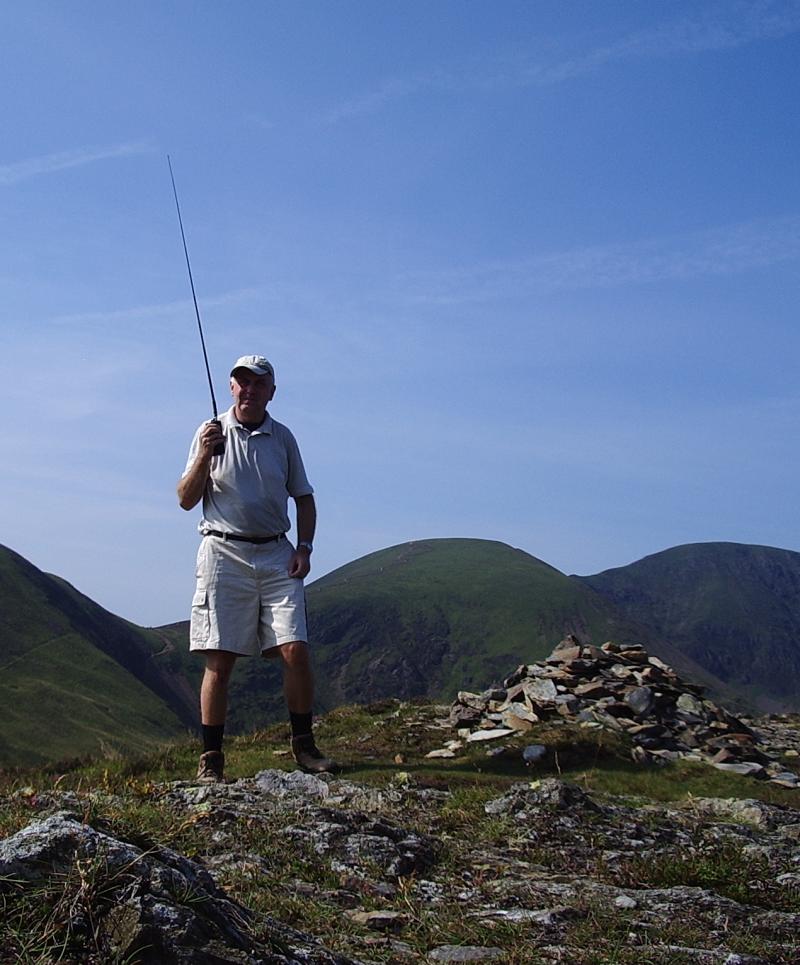
Another weekend of glorious weather. I decided to make an early start on Sunday and try a slightly more ambitious Wainwrights On The Air (WOTA) activation than normal. The plan was to walk over Barrow and Outerside and, if my legs still had enough energy left in them, Causey Pike. Though a much easier walk than those undertaken by Phil, G4OBK, I haven’t done much hill walking since getting married nearly 8 years ago and am not as fit as I used to be. This would be the longest walk I’d done for a long time.
I set off in the warm sunshine at about 9.30 and after about 15 minutes heard “CQ WOTA” from Phil who had arrived on the summit of Dodd, the other side of Bassenthwaite Lake. I was afraid I might have missed him while I was on the road. His expected arrival had been an hour earlier and I’d waited to try to catch him from the home station. But the day was warming up and he might have had a change of plan so I decided I couldn’t wait any longer. Dodd was a new summit worked for me so I was glad to have caught him. It also meant that Phil’s effort hadn’t been in vain because Dodd is a difficult hill to get contacts on.
The path I was taking passed along the flank of Barrow. To reach the summit I would have to backtrack on a higher path. On the map it didn’t look far but in reality it looked quite a long walk so I decided to get Barrow on the way back and started the climb to Outerside. It was a pleasant and not difficult climb, but sweaty work in the growing heat. Eventually I reached the top (first picture) from where I made several contacts on 2m using the telescopic 5/8 wave antenna, including another with Phil G4OBK/P who had by now reached Carl Side.
I was not inclined to hang around on the summit which was plagued with flying ants – as were all the Lakeland summits judging by the comments of other hill-toppers. I descended the other side of the hill and made my way back to the main path from where I saw a track up the side of Causey Pike which looked like a shortcut. I crossed the path and made my way to the track, where I sat down and ate my packed lunch as there were no insects in that area.
Causey Pike is a narrow ridge with several undulations along its length. In fact I seem to remember one walkers guide I read a few years ago referring to it as Causey Pikes. My Ordnance Survey map shows it as a long, narrow island surrounded by the 2,000 foot contour (it’s an old map, made before they went metric.) I have walked along it several times over the years since I first came to the area but I had never given much thought to exactly which of the undulations was the actual summit was because at the time it didn’t matter.
The shortcut looked too short to reach 2,000 feet. I set off, and after about 15 minutes reached the crest. From there it didn’t look like 2,000 feet either. To my left, after a few more feet of climbing, was a small plateau which was followed by a sharp descent into the valley. To my right, the crest of the ridge rose steadily for what looked like another 400 or 500 feet. “The summit must be up that way” I thought, so I turned right and off I went. On the way I stopped to work Ian, 2E0EDX/P on Brim Fell, for another summit that I wouldn’t have worked from home.
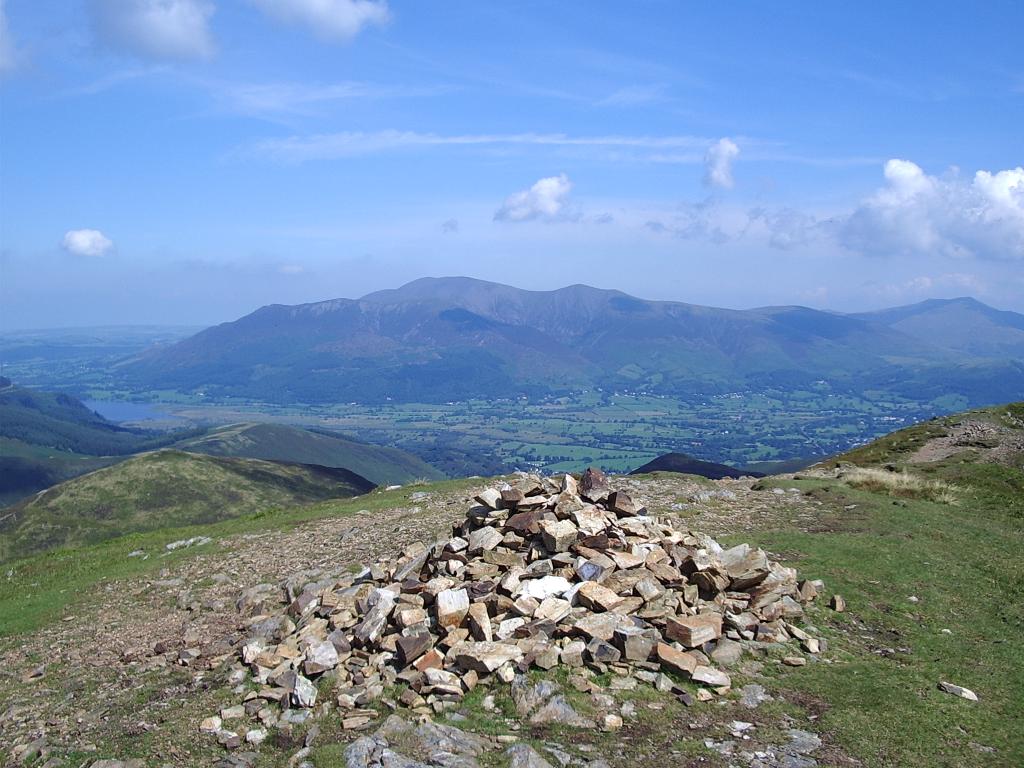
Eventually I arrived at the highest point which was surmounted by a rough stone cairn. I started to call “CQ WOTA” and made several contacts from what I described as the summit of Causey Pike, including one with Colin, 2E0XSD whom I asked to check whether my position was showing on aprs.fi. He confirmed that it was, and the details tallied with what my VX-8GR GPS was showing.
I started to make my way off the fell on my way home by the main footpath when I was called by Phil, G4OBK, to pass on a message that Colin didn’t think I was on Causey Pike when I made the contacts. Since Colin sometimes has a bit of fun at my expense due to an error I made during an earlier activation the thought crossed my mind that he was having a wind-up. Shortly after that I received an APRS message from Colin which stated that I was on Scar Crags, not Causey Pike. I had never heard of Scar Crags but I knew that there was another hill nearby called something Crags (having checked it is Ard Crags) so I thought that perhaps the position of the labels on the map may have caused Colin to mistake my position and decided to carry on descending.
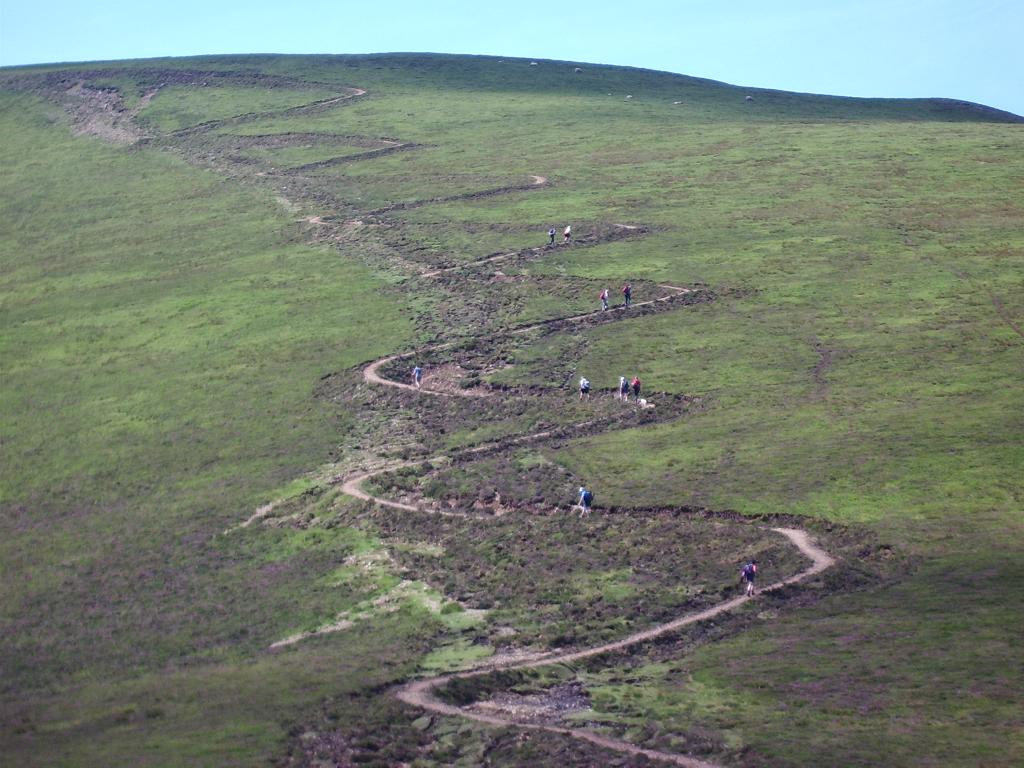
While all this was going on I was watching a couple of mountain bikers zooming down a zig-zag path that had been made on the side of the fell named Sail opposite where I was standing. This unsightly path has been made because the number of boots (and presumably tyres) ascending and descending the fell had destroyed the original path and made it dangerous. Britain is an overcrowded island and the number of visitors, particularly in recent years as more people take holidays at home, is literally causing the hills to wear out!
Further down the path back to the car the surface had been repaired by tipping truckloads of small rocks into the channel caused by thousands of boots, so that instead of a gentle walk down I had to pick my way from rock to rock like on a rocky beach. Not a particularly welcome activity for legs that were becoming tired. The battery of my VX-8GR finally expired during a contact with a SOTA summiteer in Northumberland whose call I heard on the walk down, so there being no point in taking the loop over Barrow I walked straight back to the car and came home.
Back home, examination of my position report on aprs.fi showed that Colin had been right. I had indeed been on Scar Crags when making my “Causey Pike” contacts.
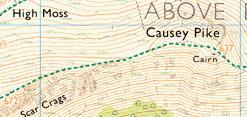
I had never heard of Scar Crags before and was completely unaware that it was the name of a Wainwright summit. However, had I stopped and looked at the map at the time it is unlikely that it would have convinced me that Colin was right. In this small grab from the online version of the map Scar Crags is shown at the bottom of the crags, which would suggest to me that it was the name of the cliffs and not of the actual summit. And the plateau that I now think may have been Causey Pike did not seem as prominent as the contours on the map make it look. Perhaps all the millions of boots have worn it flat, too. Only seeing my GPS position on the map and looking at Wainwright’s book made me realize that this was another great cockup (as distinct from Great Cockup.)
It’s rather embarrassing to make such a public mistake, as well as frustrating to have missed the opportunity to activate the real Causey Pike. I will just have to try again one day. And next time, perhaps I’ll also activate Barrow.

Julian Moss, G4ILO, is a regular contributor to AmateurRadio.com and writes from Cumbria, England. Contact him at [email protected].
Antenna Ideas: Please Keep ‘em Coming!
After last week’s plea for antenna ideas for my antenna restricted condo, I received a good number of comments both on and off blog. Thanks for those… great food for thought. That is why I enjoy our QRP community. We don’t hesitate to share ideas with one another.
This morning as I took my daily walk around the lake, I met our condo association president. He graciously is allowing me to sink a pipe that will serve as a base to set up my Jackite poles in the backyard. I will be able to pop a cap on the top and keep the dirt and water out and just slide my fiberglass poles into the mount and be on the air in no time. YAHOO… that is a pretty good solution for now.

C Pole Antenna by W0VLZ
But being the antenna tweak that I am, I continue to look for the best alternatives I can find. I’ve started to put together the parts for the C Pole antenna that Niel W0VLZ pointed out to me. He has a fine site with lots of good QRP info too.
So, do you have another idea that can top that one? Or maybe you have a thought for what kind of vertical setup I might use with the new mount?
I’m standing by for my next project assignment.
72,
Kelly K4UPG
Kelly McClelland, K4UPG, is a regular contributor to AmateurRadio.com and writes from Florida, USA. Contact him at [email protected].
Non-Ham / Non-Radio Enthusiast Wants Simple 2m Radio (Whiskey Tango Foxtrot?)
"I'm part of an emergency response communictions team in my retirement community. After I got my ticket, I went looking to buy a 2 meter band radio. A note: I am not a "ham" or a "radio amateur" or "enthusiast"; the only time I would get on the air would be in an emergency."The reader goes on to talk about the complexity of "feature rich radios" and how a recent QST radio review touched upon the issue of "technology bloat" and how this affects usability which struck a chord with the reader. He goes on:
"I would want a radio that can be operated out of the box by anybody within seconds, not after reading the fine print of a manual...... This begs the question: Why don't they make a simple 2 meter radio for people like me who use their radios only for emergency use?"Admittedly I'm not a big fan of emcomm, but as I've mentioned before I respect its place in amateur radio when it's actually beneficial and not merely a way to play radio and pretend we're important, but this letter flabbergasted me. If you're not a "ham" or a "radio enthusiast" (despite being an FCC licensed radio amateur) and all you want is a simple push-to-talk radio to communicate, why do you need a ham license or a ham radio in the first place? Just get a set of business radios and file the FCC forms for a Part 90 or Part whatever license, send in your check for the nominal fee and be done with it? One of the purposes of amateur radio can be emcomm, but it's not intended to be yet another way to get a batch of handie-talkies that mindless drones can operate. That's why there are several tests and there are technical proficiency questions in these tests. Furthermore, ignoring the technical skillset that is germane to amateur radio for a moment, is it unreasonable to expect emergency response communications team participants to actually read a radio manual and understand the basic functions of the radios regardless of complexity before an emcomm event occurs?
I'm sure the reader has good intentions, however there is clearly a mismatch here between the nature of amateur radio and this emcomm application .

Anthony Good, K3NG, is a regular contributor to AmateurRadio.com and writes from Pennsylvania, USA. Contact him at [email protected].
Back From Vacation
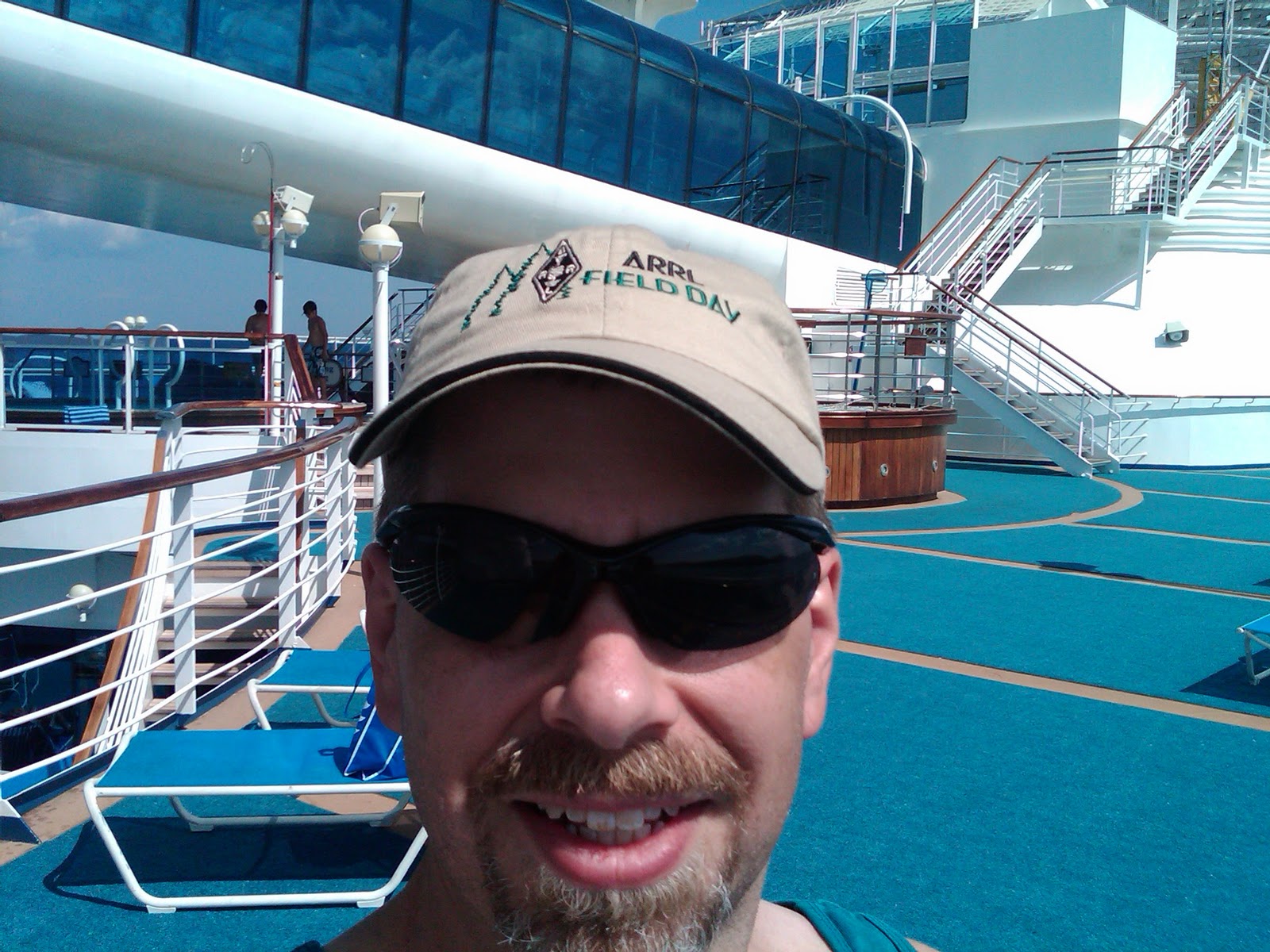
Things have been noticeably quiet here on the blog and in the shack this past week because I was on vacation. For the first time me, the XYL, and the harmonic went on a cruise. I think it was the first time I've been on a real vacation in 15 years where I could actually get away from work. I didn't even touch a computer, though admittedly I had my Blackberry along which fully worked when we were in port and also worked with voice and SMS (no EVDO) out at sea as the ship was equipped with its own cellular service. No, believe it or not, I did not bring a ham rig. I figured I wouldn't have enough time to use it and I was right. It was also great not having direct access to the news or normal TV broadcasts so I could fully disconnect from the crisis du jour.



We took Princess Cruises' vessel Caribbean Princess out of New York City and went up the coast and stopped at Newport, Rhode Island; Boston, Massachusetts; Saint John, New Brunswick; and Halifax, Nova Scotia. The ship is an amazing engineering feat for us geeks. The ship has a passenger capacity of about 3,600 and a crew complement of 1,200. It's powered by six diesel generators, totaling 64 megawatts of capability, if my calculations are correct. The main propulsion is two 18' propellers in the aft powered by electric motors. There are also forward and aft thrusters that can be rotated much more freely than the rudders which enable the ship to spin on a dime in a tight harbor. Fuel capacity and usage is measured in tons and not liters or gallons, with the capacity about 3,500 tons. In talking with one of the navigation officers, I believe he said the trip from NYC to Halifax consumed 1,800 tons of fuel. (He was Italian and there was a bit of language barrier.)
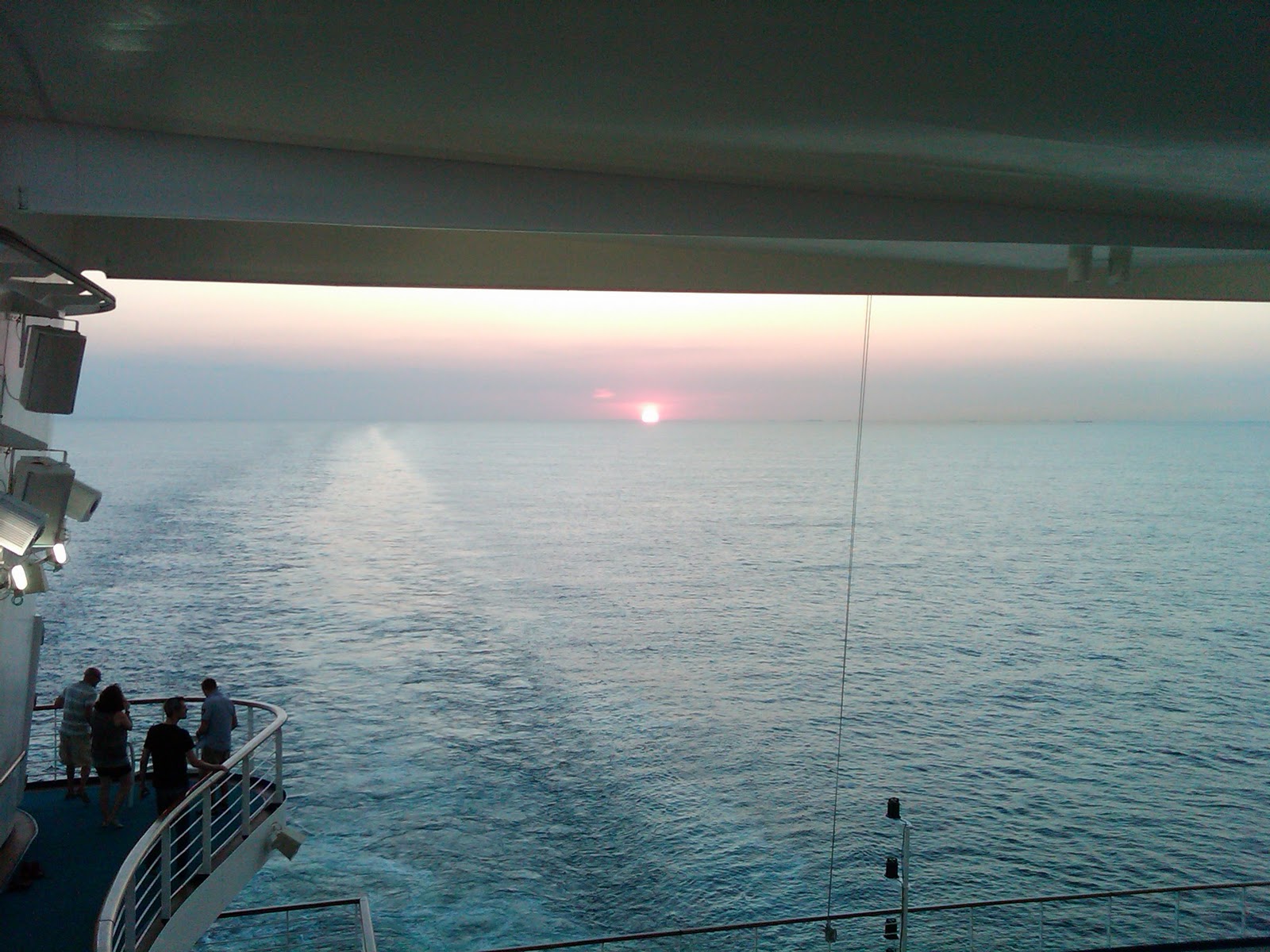
I could write a book about the trip and the excursions, but I'll close by saying if you can afford it and have never taken a cruise, I encourage you do it because you'll have the time of your life.

Anthony Good, K3NG, is a regular contributor to AmateurRadio.com and writes from Pennsylvania, USA. Contact him at [email protected].
ICQ Podcast Series Three Episode Seventeen – Low Frequency (15 August 2010)
Series Three Episode Seventeen of the ICQ Amateur / Ham Radio Podcast. News Stories include:
- Illegal FM stations is 'terrorism' in Pakistan
- New 10GHz world record
- Wireless Telegraphy devices exemption changes
- RCE Standards Committee report
- Spanish fishery pirates
- 433MHz and 3.6MHz in New Zealand
- IARUMS to clean-up 40 metres
- National radio frequency plan gazetted
- Free 'QSL Gateway' from USA to Europe
- ROS development definitely continues
- VK8NSB SSTV Repeater
- German Radio Amateur arrested in Lebanon
- More geomagnetic storms?
- High efficiency solar cells
- Plasma TV interference complaints
- Irish church intruders
Your feedback, upcoming events and Roger Lapthorn (G3XBM) joins Martin (M1MRB) to discuss low frequency.
Colin Butler, M6BOY, is the host of the ICQ Podcast, a weekly radio show about Amateur Radio. Contact him at [email protected].
First contacts with the Warbler

Olivia QSO with VE3FMC using a Warbler
Despite Summer not being the best time of year for 80m QSOs I have made a couple of contacts over the last two nights with the recently completed Warbler.
The first was a PSK31 contact with AE1Q who was about 285 miles away in Belgrade Lakes, Maine. The next was an Olivia 8/500 contact with VE3FMC in St Thomas, Ontario, about 325 miles away. Both QSOs proved to be tougher copy for the other stations as the Warbler puts out only about 2 Watts. However, they were successful QSOs and as can be seen by the picture above the Warbler receives well.
AE1Q gave me an IMD report which was -24 dB which is reasonable given the simplicity of the rig, but I would like it to be below -30dB.
I was fortunate and pleased that the second contact was using Olivia. This is a nice mode for QRP. For those wanting to try Olivia I recommend you read the information on the Olivia website by Gary, WB8ROL, including his QST article. Gary writes great articles (including one in the recent amateur radio edition of Linux Journal) and I have enjoyed a few Olivia QSOs with him.
Finally, if you do want to try Olivia or any multifrequency keying mode with the Warbler, you must remember that you are operating on LSB with the Warbler. Most digimode operators will be using USB so the frequencies will be reversed. The digimode software, Fldigi, offers a simple solution to this, you must select the “Rv” or ‘reverse’ button (see the lower right of the Fldigi window above, which is selected and green). You do not need to worry about this button if you just use PSK31 as it is symmetrical about a centre frequency.


Alan Steele, VA3STL, is a regular contributor to AmateurRadio.com and writes from Ottawa, Ontario. Contact him at [email protected].
 Ham Radio Deluxe |
 W5SWL Electronics |
 Ham Radio Prep |
 KB3IFH QSL Cards  Hip Ham Shirts  HamRadioAuctions HamRadioAuctions Reliance Antennas Reliance Antennas Enigma Shop Enigma Shop |  morseDX  Ni4L Antennas  R&L Electronics R&L Electronics antennas.us antennas.us QRV QRV |
- Matt W1MST, Managing Editor
