 |
 Transformation of Radio Amateurs of Canada
 14 August 2010 | by
Radio Amateurs of Canada is the national amateur radio organization here in Canada. It has just had its annual general meeting and coming out from this is a call for transformation. Peter of the RAC blog has sent me a link to the important news and I thought I would pass it on, as I know I have a few Canadian readers of my blog.
I am not going to comment here on what I have read, but will think about it and probably send my thoughts and ideas to RAC. Take a look at the proposal and if you want, send your thoughts to either RAC or post them here, it would be good to have an open discussion. If you are not a Canadian please still take a look at the details, as other national organizations may be heading in a similar direction, or have faced similar issues.
If you have thoughts and opinions on what you want from a national amateur radio organization please make a comment.


Alan Steele, VA3STL, is a regular contributor to AmateurRadio.com and writes from Ottawa, Ontario. Contact him at [email protected].
Zener diodes – the basics
Stumbled upon another great video from AllAmericanFiveRadio on Youtube. He has an incredible and vast collection of radio related, radio restoration, electronic theory…. tons of good stuff.
While I’m at it…..
I’ve mentioned this course here before, but NPTLHRD in India have a GREAT basic electronics course. One lecture is purely on Zener diodes. Here are two video lectures. The first one is on wave shaping with diodes and a more in-depth discussion on Zener diodes in the second video.
Jonathan Hardy, KB1KIX, is a regular contributor to AmateurRadio.com and writes from Connecticut, USA. Contact him at [email protected].
Inconvenient spurious
During the middle of the day here 30m becomes virtually dead and there is nothing to see on HF APRS. I decided to try some digital modes. After a quick tune around I couldn’t hear any digital apart from PSK. These days, if there’s propagation there is PSK activity.
I had quick listen on 15m and even spotted a couple of stations to PSK Reporter, but signals were really weak so I dropped down to 17m. On 17m I have to use the MFJ magnetic loop, which I needed to re-tune from 30m. As I did so I was startled by a loud buzz from the Kenwood TM-D710 on the VHF APRS channel. I turned the volume down, suspecting a spurious but not knowing if it was the fault of the K3 or the Kenwood.

I made several European contacts using PSK31 before lunch including Veljo, ES0OU on Saaremaa Island, which is IOTA EU-034. None of my contacts wanted chat, though you have to realize that English is not the first language for any of these stations, if they speak it at all. I suppose here in Europe we have to be thankful for macros.
After lunch I walked into town with Olga. On my return the receiver was still on 17m and had spotted a long list of stations to PSK Reporter. KU1T, Zibi from Glengary, WV (pictured above) was one of those spotted. I waited and eventually saw his trace appear on the screen. I gave him a call and he replied. Copy was in and out of QSB so it was one of those contacts where a conversation would not have been possible. KComm told me this was my first USA contact on 17m.
Later, a few seconds with the calculator revealed the reason for the strong interference with the VHF APRS frequency. 18.100MHz, the carrier frequency used when operating in the 17m PSK31 band segment, is exactly one eighth of 144.800MHz!

Julian Moss, G4ILO, is a regular contributor to AmateurRadio.com and writes from Cumbria, England. Contact him at [email protected].
Rough justice
Some UK readers may already know of the case of Carl Johnson, M3VWP, who was prosecuted for driving without due care and attention, found guilty, fined and received three points on his driving license for operating his 2m mobile rig whilst driving.
In the UK it is, quite rightly, illegal to use a mobile phone whilst driving – though you can see this law being flouted every day of the week. There is, however, an exemption for the use of two-way radio, which applies to ham radio mobile operation. You could argue – and personally I would argue – that if it’s dangerous to use a mobile phone then it is no less dangerous to use a ham radio. But that’s beside the point. It is not illegal to use a ham radio whilst driving and unless he was actually driving dangerously as a result, M3VWP should never have been prosecuted for it.
Nevertheless, he was, and when summoned to court he decided to represent himself. Despite the existence of many holes in the prosecution’s case – according to his letter in Practical Wireless, Carl was stationary at traffic lights when spotted by the officer, who after an hour at the roadside apparently admitted he didn’t know the relevant law himself – M3VWP was found guilty. He decided not to appeal.
Of course, it’s just my opinion, and I know only what I have read, but I feel sure that if M3VWP had been professionally represented in court, or had appealed, he would probably have got off. A good solicitor might have got the point across that the law against using mobile phones did not apply in this case and that Carl could hardly have “not been in proper control of his vehicle” as he was stationary when spotted by the police.
Unfortunately in the UK only the very poor or the very rich have access to justice. If you’re poor, you receive legal aid, but if you have any means at all you have to pay the exorbitant legal fees yourself, and only the very wealthy can afford to take such a hit to their bank balance. One can only feel sorry for M3VWP for being convicted when he did nothing wrong. It seems that it doesn’t matter what the law says, if the police think you’ve broken it then that’s it.
Radio amateurs in the UK take note. Operating your radio whilst mobile could cost you a hefty fine and even, if you already have some points, lose you your driving license.

Julian Moss, G4ILO, is a regular contributor to AmateurRadio.com and writes from Cumbria, England. Contact him at [email protected].
Countdown to Zero: When All Else Fails?
Regardless of your political leanings (the producer of this movie, Lawrence Bender, also produced Al Gore’s An Inconvenient Truth), the subject of Countdown to Zero should be of interest and concern to everyone. At the very least, I think we can all agree that these weapons should be accounted for and not be in the hands of terrorists and rogue nations. If the movie is (or will be) playing in your area, see it.
Electromagnetic pulse (EMP) from an atomic blast is a real threat to our communication infrastructure, including our ham radio equipment. A single weapon detonated over the United States could wipe out most communications equipment from coast to coast. Don’t take my word for it, though. Read this excerpt from The Commission to Assess the Threat to the United States from Electromagnetic Pulse (EMP) Attack’s Executive Report:
EMP IS CAPABLE OF CAUSING CATASTROPHE FOR THE NATION
The high-altitude nuclear weapon-generated electromagnetic pulse (EMP) is one of a small number of threats that has the potential to hold our society seriously at risk and might result in defeat of our military forces.
The damage level could be sufficient to be catastrophic to the Nation, and our current vulnerability invites attack.
Briefly, a single nuclear weapon exploded at high altitude above the United States will interact with the Earth’s atmosphere, ionosphere, and magnetic field to produce an electromagnetic pulse (EMP) radiating down to the Earth and additionally create electrical currents in the Earth. EMP effects are both direct and indirect. The former are due to electromagnetic “shocking” of electronics and stressing of electrical systems, and the latter arise from the damage that “shocked”—upset, damaged, and destroyed—electronics controls then inflict on the systems in which they are embedded. The indirect effects can be even more severe than the direct effects.
Matt Thomas, W1MST, is the managing editor of AmateurRadio.com. Contact him at [email protected].
No improvement
I know that one of the purposes of my website is meant to be to demonstrate that you can play ham radio even if you can’t have outside antennas. But sometimes the frustrations of not quite being able to achieve what you want to make become almost too much.
On Tuesday I replaced my home made ribbon cable Slim Jim 2m antenna with a commercial dual band colinear from Moonraker. I wasn’t sure the home made antenna was working as well as it possibly could. Originally I planned to replace the Slim Jim with a single band 5/8 wave Sirio, but after a month waiting for Radioworld to deliver it I cancelled the order and gave up. Then I got the Kenwood TM-D710 which is a dual band transceiver, so I decided I should have a dual band antenna to give me the option of running a public Echolink node on 70cm.
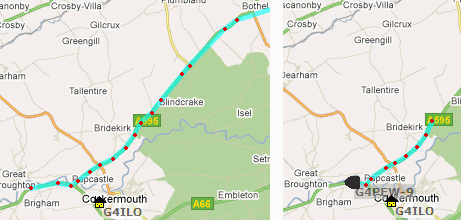
During the last few days I have been searching for signs of improvement in my 2m receive capability, but the signs haven’t been good. I’m hearing a frustrating number of APRS “braaps” that are just not strong enough to decode.
The antenna certainly works. I’m getting almost end-stop signals from the repeaters GB3DG and GB3LA, whilst GB3AS is about S5 with a bit of noise on it. I have had a couple of solid contacts using the antenna but nothing to form a basis for comparison until today, when Noel G4PEW drove past.
On the left of the screengrab you can see his track on Monday, when I was still using the Slim Jim. On the right you can see today’s track, received using the new antenna. It’s a lot shorter. I certainly heard a lot of packets after the last one shown by the grey blob, but none were strong enough to decode.
If only I could have the antenna outside the attic, up above the apex of the roof, I’m sure that extra little bit of height would make all the difference.

Julian Moss, G4ILO, is a regular contributor to AmateurRadio.com and writes from Cumbria, England. Contact him at [email protected].
APRSBB: APRS Client for Blackberry
I’m a big Blackberry fan and I was pretty excited to read G4ILO’s post a few days ago about APRSBB, a soon-to-be-released APRS client for Blackberry. I tracked down the developer, Chris Struttman KJ4HPQ of The Blue Array Network LLC, who agreed to be interviewed about what he’s been working on and what we can expect from the project:
Matt Thomas, W1MST, is the managing editor of AmateurRadio.com. Contact him at [email protected].
 Ham Radio Deluxe |
 W5SWL Electronics |
 Ham Radio Prep |
 KB3IFH QSL Cards  Hip Ham Shirts  HamRadioAuctions HamRadioAuctions Reliance Antennas Reliance Antennas Enigma Shop Enigma Shop |  morseDX  Ni4L Antennas  R&L Electronics R&L Electronics antennas.us antennas.us QRV QRV |
- Matt W1MST, Managing Editor
