 |
 Mobile In New York City
 19 August 2010 | by
Hallowed ground?
But I digress....

Anthony Good, K3NG, is a regular contributor to AmateurRadio.com and writes from Pennsylvania, USA. Contact him at [email protected].
Handiham World for 18 August 2010
Welcome to Handiham World!
Second remote base station goes into beta testing phase
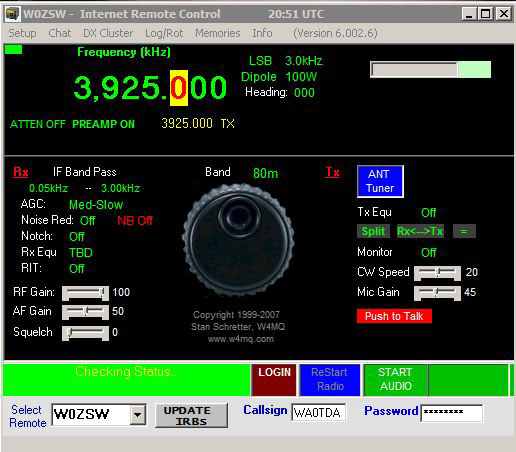
With the addition of the W0ZSW remote base at Handiham headquarters, members now have a choice of two remote base stations. Users who have signed up for access to the “Handiham Remote Base” (W0EQO) will be added automatically to the list for W0ZSW, with the same password. The remote base concept has been gaining in popularity as more of us want to be able to use an HF radio without the need to drag along a lot of extra gear while traveling. Some users live in condos or antenna-restricted areas and simply want to expand their operating horizons beyond VHF and UHF repeaters. The remote base stations allow users to operate real HF radios connected to real antennas, and make friends far and wide on the HF bands.
The W0EQO station at Courage North, a Kenwood TS-480SAT equipped with the VG-S1 voice module, is preferred by our members who are blind. We have a Kenwood TS-570S set up at this time in the W0ZSW station at Camp Courage. The two stations are quite a distance apart, hundreds of miles, so they can be used at the same time with no chance of interference between the two. W0EQO is in the tall pines of northern Minnesota, near the headwaters of the Mississippi river. The location is a very quiet one, with little interference. We have reports of users making very successful DX contacts. The station operates on 80 through 10 meters. This is due to the capabilities of the current antenna, a G5RV, which will not tune on 160 or 6 meters. The W0ZSW remote base station has a 300 foot “W0OXB Special” antenna, up an average of 45 feet. This antenna covers 160 through 6 meters, including the WARC bands. The W0EQO station will hopefully get an upgraded antenna system later this year, bringing it more in line with the W0ZSW station for band coverage and performance. Camp Courage is about 40 miles west of Minneapolis.
The DSL internet service has given us a great deal of trouble at Camp Courage, so the W0ZSW station has been off line as much or more than it has been on line. We hope to remedy this situation soon, but I have been tied up in meetings and office work and have been running behind with this project. One other issue with the W0ZSW remote is that we do not have the frequency speech readout working. The TS-570 does have the VS-3 voice module, but apparently the software does not support the voice readout. It may be necessary to replace the radio with another model for which the speech output will work if we cannot find a solution for the TS-570.
Lyle, K0LR, and Eliot, KE0N, have been working with me on this project and we are anxious to get it out of beta testing and on the air for our users. Please keep watching the Handiham website and this newsletter for the latest updates.
73,
Patrick Tice, WA0TDA
Handiham Manager
[email protected]

Pat Tice, WA0TDA, is the manager of HANDI-HAM and a regular contributor to AmateurRadio.com. Contact him at [email protected].
Sound card packet modem
Last night I spent a couple of hours trying a program that had been mentioned by Chris, G4HYG in the Cross Country Wireless Yahoo group called AX25-SCS. It is a sound card modem for 300baud and 1200baud packet which was written by Frank Perkins, WB5IPM for use with a now unsupported APRS program called APRS-SCS (nothing to do with the SCS that makes TNC hardware.) Chris claimed it works better than AGW Packet Engine at decoding HF APRS. It is also freeware. I had never heard of this program before despite quite a bit of time spent searching for packet sound card software. You can get it from the TAPR website, installation is simply a matter of unzipping it into a folder, and there is a .pdf file that tells you almost all you need to know to run it.
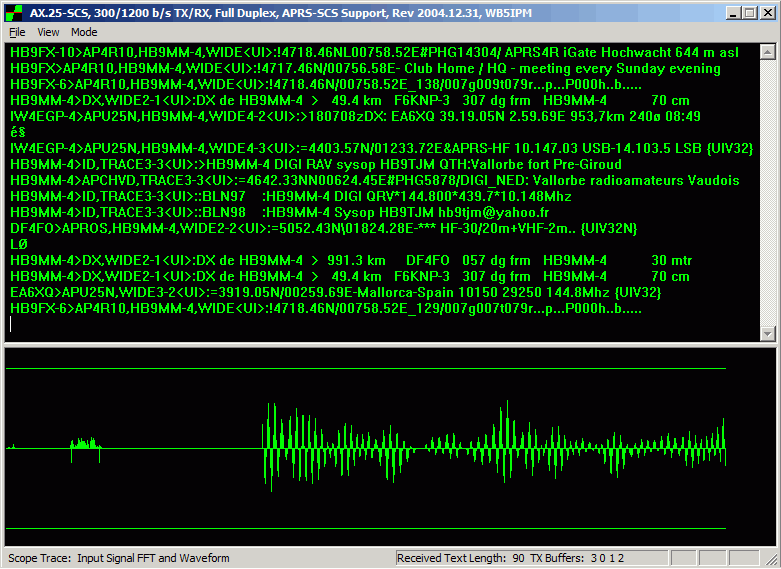
One of the things the documentation doesn’t tell you is that AX25-SCS uses the default Windows sound card. For testing, I had to make the sound card used by my Elecraft K3 the default. This is not convenient, as it robs my computer of the ability to play sound through the speakers (and risks broadcasting Windows sounds and web audio over the airwaves) so sadly I am unable to make permanent use of it.
The documentation also doesn’t advise you to select “Cancel APRS-SCS support” when you first run it. If you don’t, nothing will appear in the window until an APRS client connects to it, making you think that the program just isn’t working.
For HF use you need to select 300baud from the menu, as 1200baud is the default. You also need to select Enable SCS TX to allow transmission. It would be a bit of an annoyance that you have to do this every time you start the program as the settings are not remembered.
Once the receiver is tuned in – AX25-SCS uses the KAM standard 1600 / 1800Hz tones for HF – and the sound levels adjusted so that packets are being decoded, you can close and then restart the program this time choosing “Enable APRS-SCS support” from the initial dialog. After that, start APRSIS32 and create a KISS TNC RF port at address 127.0.0.1 port 4000. When APRSIS32 connects, the display should appear on the AX25-SCS window as it did before and this time any packets received should be displayed in APRSIS32 as well. Beacons and messages sent from APRSIS32 should result in audio being generated by the sound card modem for transmission.
For transmit, APRS-SCS requires the transceiver to use VOX. This is not a problem with my K3 which supports VOX via the rear audio connections and which allows the delay to be adjusted down to a very short interval, but it would make the program unusable with other transceivers like the FT-817 which don’t.
I tried running APRS-SCS and AGWPE Pro in parallel to see which was the better decoder but it was difficult to do a fair trial as APRS-SCS needs a lower level of audio input so the signal level was either too high for one program or too low for the other. As far as I could tell, APRS-SCS appeared more tolerant of off-frequency signals but less sensitive to weak ones than AGWPE Pro. This is also the verdict of Chris, G4HYG.
I would be willing to give APRS-SCS more of a try, but the inability to specify which sound card to use makes that impractical. It’s a pity that APRS-SCS is not open source so that someone could fix that and the other minor niggles, because it is a nice program that is quite easy to set up and use with APRSIS32.

Julian Moss, G4ILO, is a regular contributor to AmateurRadio.com and writes from Cumbria, England. Contact him at [email protected].
LHS Episode #046: The TuxTel Conglomerate
 Episode #044 of Linux in the Ham Shack makes its debut, and even on time. We’re still trying to catch up on a little bit of a backlog so this episode is mostly feedback from listeners. We touch on a variety of topics including packet radio, the AX.25 kernel driver for TNCs, the importance of Linux and Open Source, Android and emerging Linux markets, and much, much more.
Thanks for taking the time to download us and being an ever-faithful listener. We would be nothing without you and we want to let you know that we appreciate each and every pair of ears that hears us every fortnight. Don’t forget to send us your feedback, whether it be as a comment on the Web site, a voice mail submitted via our toll-free hot-line or an e-mail to one or both of us. Also, please don’t forget about making donations or buying some of our LHS merchandise if you have the wherewithal to do so. Enjoy our current offering and we’ll be back live in a week for more rowdy fun.
73 de The LHS Guys
Russ Woodman, K5TUX, co-hosts the Linux in the Ham Shack podcast which is available for download in both MP3 and OGG audio format. Contact him at [email protected].
Nice Nagoya
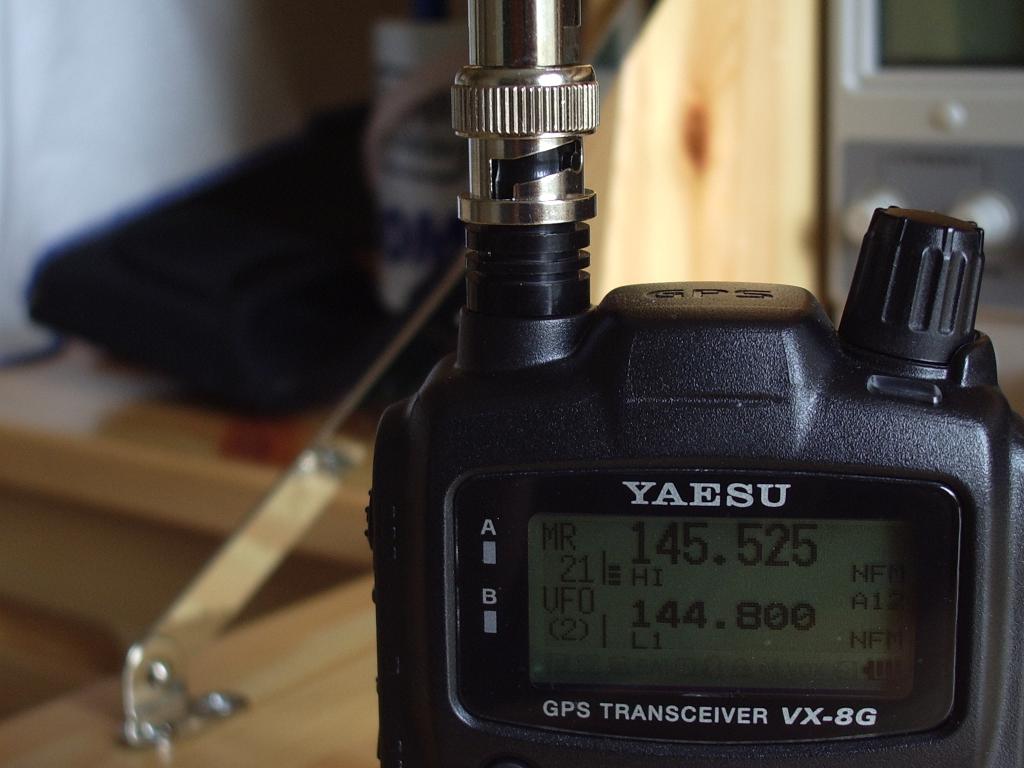
As regular readers may recall, I have a pathological hatred of SMA connectors when used as antenna connectors for hand-held radios, which has become even more entrenched since I had the centre pin of the TH-F7E stock antenna break off in the adapter I use for testing such antennas on my antenna analyzer. I now have an SMA to BNC adapter permanently installed on my VX-8GR. The picture on the right shows my latest adapter which is anodized black and looks like an integral part of the radio. The previous one I used was gold plated with a knurled body and whilst it worked perfectly and provided a robust fitting for the BNC antennas it looked a bit ugly.
If you never change the antenna on your HT then one of these adapters isn’t necessary, but SMA connectors were never designed for multiple connections and disconnections (in one email group I saw someone state they were rated for 100 disconnections) so if you want to change between a short stubby antenna for inconspicuous local use and one with more gain the BNC adapter is the way to go.

All of my BNC whips are 2m antennas, which is fine most of the time as almost all my operating is done on 2m, but there are rare occasions when I might want to use 70cm and removing the BNC adapter in order to attach the stock antenna kind of defeats the object of it. So I ordered from eBay a Nagoya NA-701 antenna which is a short dual band whip similar in size to the ones supplied with amateur dual band handhelds but with a BNC connector.
I tried it out on my antenna analyzer and it showed a nice sharp SWR curve with the minimum around 147MHz. It could be better, but it’s closer than some stock antennas I’ve tested. I couldn’t check it on 70cm as my antenna analyzer doesn’t go up that high.
I need to devise way to make comparative tests of all these HT antennas, because asking for signal reports or seeing if you can hit a repeater is a pretty crude measure of performance that won’t reveal small differences. This little antenna doesn’t perform as well as a six inch monoband helical on 2m, nor a quarter wave telescopic, but that is only to be expected. The beauty of the BNC adapter is that if you need a gain antenna you can easily whack on something like my 5/8 wave Black Whip, which you certainly couldn’t use with a standard SMA connector.

Julian Moss, G4ILO, is a regular contributor to AmateurRadio.com and writes from Cumbria, England. Contact him at [email protected].
XTalset Society, neat articles for new homebrewers
XTalset society has been around for awhile. They are a great starting point for anyone either new to homebrewing or anyone teaching someone who is new to radio (and I’m not necessarily talking about ham radio). Great crystal set projects that truly amaze.
They are also a great resource for purchasing materials to help you on your crystal set journey.
Here are some of the articles I found useful – free for everyone!
How to Read Schematics
The AM Broadcast Band
A Big Ole Hunk of Galena Crystal
Crystal Set FAQs
How Crystal Sets Work
Variable Cap Lineup & Mounting
Equivalent Series and Parallel Circuits
XS-800 Antenna Measurement Bridge
Q of a Coil With Some Unused Turns
Mag-Coupling Selectivity-Sensitivity pdf file.
A Great Teacher: The Crystal Set pdf file, courtesy QEX (ARRL).
Derivation of Step Attenuator R Formulas pdf file.
The Trap Coil Q Measurement Method Revisited (for high Q coils in particular) pdf file.
About Q pdf file, Discusssion on Q Formulas/Measurement.
The AM RF Signal pdf file, Discusssion on makeup of an AM RF Signal.
Anatomy of Crystal Set Modeling: Equivalent Circuit Substitutions pdf file, with spice app.
XS-OB1 Kit Manual (updated 05-01-08) pdf file.
Different OAT BOX COILS pdf file.
XS-801 Kit Drawings pdf file.
Mechanical Dimensions for Mounting Variable Capacitors pdf file.
To take a look at these articles, head over to their site at:
http://www.midnightscience.com/article-index.html
Or their front page at:
http://www.midnightscience.com
Jonathan Hardy, KB1KIX, is a regular contributor to AmateurRadio.com and writes from Connecticut, USA. Contact him at [email protected].
Mystery beacon
For the last three hours or so I’ve been driven mad by an APRS beacon on 2m that I can’t decode and which is not being gated to the internet by Richard MM1BHO’s gateway. The amount of activity on VHF APRS round here is so low that I normally leave the receiver audio on so that I can hear whether anyone is about. The signal I’m hearing is quite solid, obviously from a fixed station or a stationary mobile, and though it isn’t massively strong – just about making 1 bar on the Kenwood’s signal strength meter – it sounds fully quieting and as good as other signals I hear which are decoded.
I tried both wide and narrow FM modes and when that didn’t help I switched the antenna over to the FT-817 so I could try the AGWPE sound card decoder. I even tried plugging the antenna into the VX-8GR to see if that could decode it, but no joy. Listening to the sound of the beacon compared to the sound of my VX-8GR’s beacon, the one I can’t decode is quite a bit louder. I think it might be over-deviated.
So on the off-chance that someone trying APRS round here might read my blog, I thought I’d publish this posting. If it’s you, try turning the audio into the transmitter down and you might get gated.

Julian Moss, G4ILO, is a regular contributor to AmateurRadio.com and writes from Cumbria, England. Contact him at [email protected].
 Ham Radio Deluxe |
 W5SWL Electronics |
 Ham Radio Prep |
 KB3IFH QSL Cards  Hip Ham Shirts  HamRadioAuctions HamRadioAuctions Reliance Antennas Reliance Antennas Enigma Shop Enigma Shop |  morseDX  Ni4L Antennas  R&L Electronics R&L Electronics antennas.us antennas.us QRV QRV |
- Matt W1MST, Managing Editor
