 |
 Non-Ham / Non-Radio Enthusiast Wants Simple 2m Radio (Whiskey Tango Foxtrot?)
 16 August 2010 | by
 "I'm part of an emergency response communictions team in my retirement community. After I got my ticket, I went looking to buy a 2 meter band radio. A note: I am not a "ham" or a "radio amateur" or "enthusiast"; the only time I would get on the air would be in an emergency."The reader goes on to talk about the complexity of "feature rich radios" and how a recent QST radio review touched upon the issue of "technology bloat" and how this affects usability which struck a chord with the reader. He goes on:
"I would want a radio that can be operated out of the box by anybody within seconds, not after reading the fine print of a manual...... This begs the question: Why don't they make a simple 2 meter radio for people like me who use their radios only for emergency use?"Admittedly I'm not a big fan of emcomm, but as I've mentioned before I respect its place in amateur radio when it's actually beneficial and not merely a way to play radio and pretend we're important, but this letter flabbergasted me. If you're not a "ham" or a "radio enthusiast" (despite being an FCC licensed radio amateur) and all you want is a simple push-to-talk radio to communicate, why do you need a ham license or a ham radio in the first place? Just get a set of business radios and file the FCC forms for a Part 90 or Part whatever license, send in your check for the nominal fee and be done with it? One of the purposes of amateur radio can be emcomm, but it's not intended to be yet another way to get a batch of handie-talkies that mindless drones can operate. That's why there are several tests and there are technical proficiency questions in these tests. Furthermore, ignoring the technical skillset that is germane to amateur radio for a moment, is it unreasonable to expect emergency response communications team participants to actually read a radio manual and understand the basic functions of the radios regardless of complexity before an emcomm event occurs?
I'm sure the reader has good intentions, however there is clearly a mismatch here between the nature of amateur radio and this emcomm application .

Anthony Good, K3NG, is a regular contributor to AmateurRadio.com and writes from Pennsylvania, USA. Contact him at [email protected].
Back From Vacation
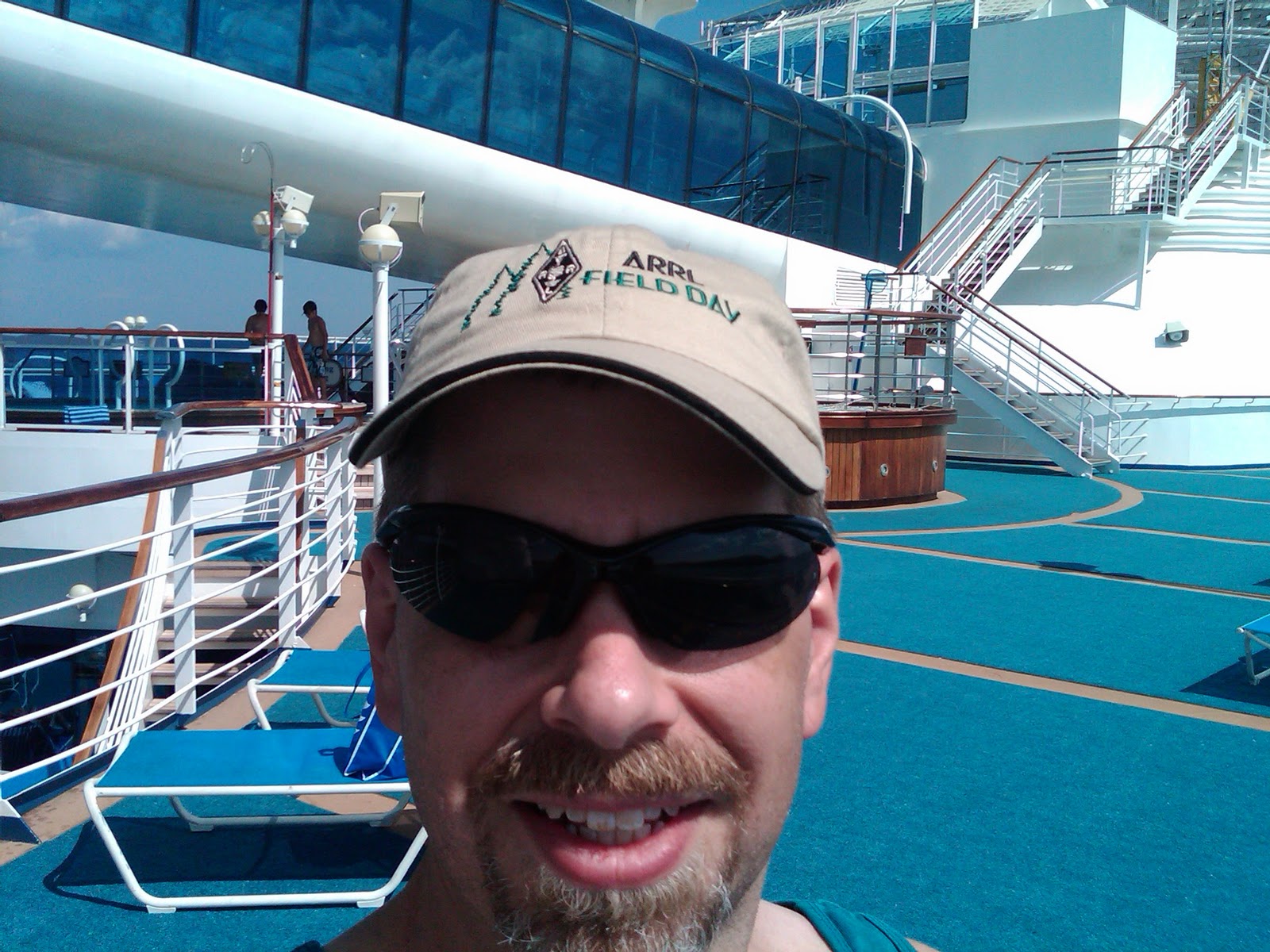
Things have been noticeably quiet here on the blog and in the shack this past week because I was on vacation. For the first time me, the XYL, and the harmonic went on a cruise. I think it was the first time I've been on a real vacation in 15 years where I could actually get away from work. I didn't even touch a computer, though admittedly I had my Blackberry along which fully worked when we were in port and also worked with voice and SMS (no EVDO) out at sea as the ship was equipped with its own cellular service. No, believe it or not, I did not bring a ham rig. I figured I wouldn't have enough time to use it and I was right. It was also great not having direct access to the news or normal TV broadcasts so I could fully disconnect from the crisis du jour.
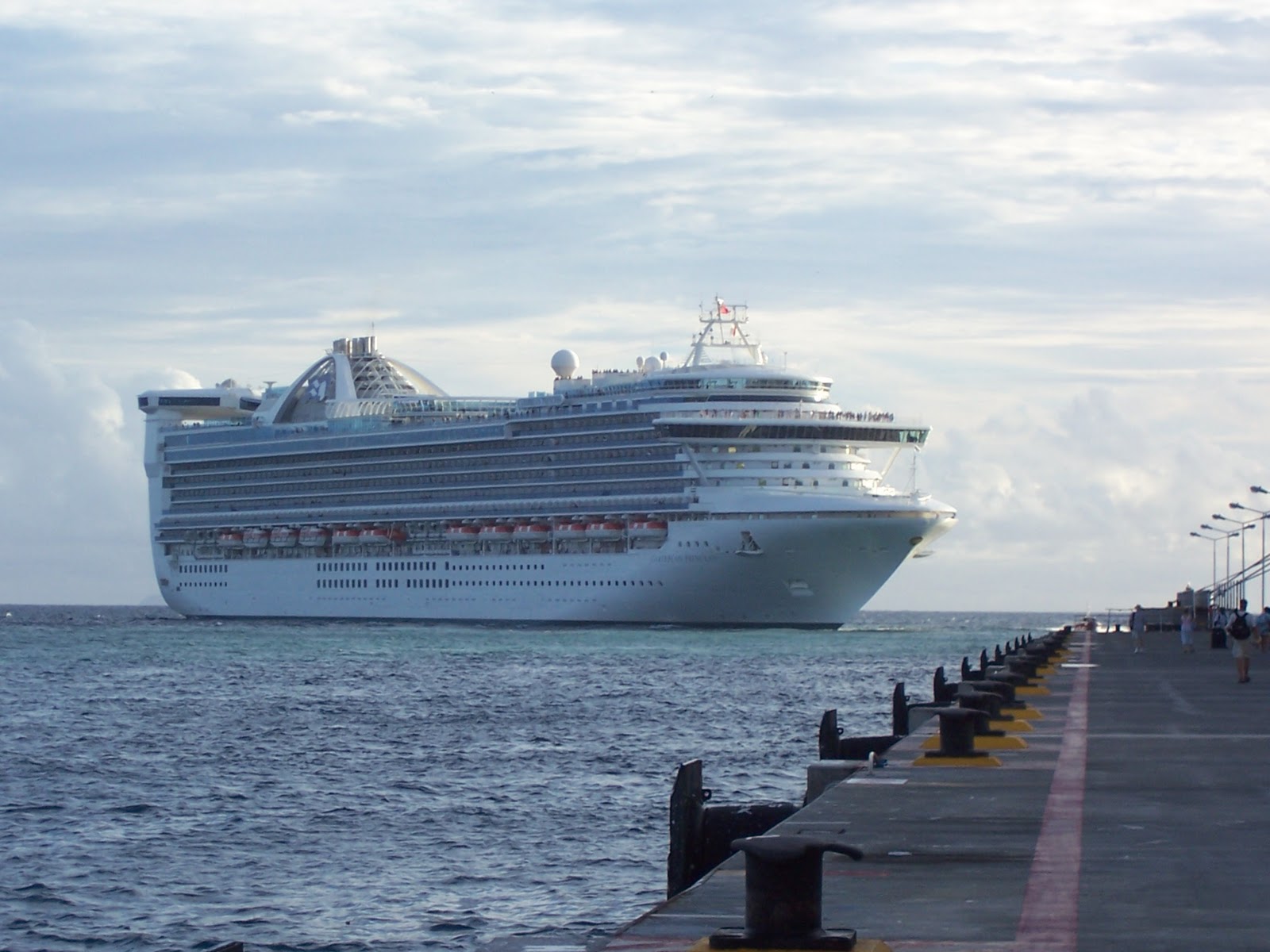


We took Princess Cruises' vessel Caribbean Princess out of New York City and went up the coast and stopped at Newport, Rhode Island; Boston, Massachusetts; Saint John, New Brunswick; and Halifax, Nova Scotia. The ship is an amazing engineering feat for us geeks. The ship has a passenger capacity of about 3,600 and a crew complement of 1,200. It's powered by six diesel generators, totaling 64 megawatts of capability, if my calculations are correct. The main propulsion is two 18' propellers in the aft powered by electric motors. There are also forward and aft thrusters that can be rotated much more freely than the rudders which enable the ship to spin on a dime in a tight harbor. Fuel capacity and usage is measured in tons and not liters or gallons, with the capacity about 3,500 tons. In talking with one of the navigation officers, I believe he said the trip from NYC to Halifax consumed 1,800 tons of fuel. (He was Italian and there was a bit of language barrier.)

I could write a book about the trip and the excursions, but I'll close by saying if you can afford it and have never taken a cruise, I encourage you do it because you'll have the time of your life.

Anthony Good, K3NG, is a regular contributor to AmateurRadio.com and writes from Pennsylvania, USA. Contact him at [email protected].
ICQ Podcast Series Three Episode Seventeen – Low Frequency (15 August 2010)
Series Three Episode Seventeen of the ICQ Amateur / Ham Radio Podcast. News Stories include:
- Illegal FM stations is 'terrorism' in Pakistan
- New 10GHz world record
- Wireless Telegraphy devices exemption changes
- RCE Standards Committee report
- Spanish fishery pirates
- 433MHz and 3.6MHz in New Zealand
- IARUMS to clean-up 40 metres
- National radio frequency plan gazetted
- Free 'QSL Gateway' from USA to Europe
- ROS development definitely continues
- VK8NSB SSTV Repeater
- German Radio Amateur arrested in Lebanon
- More geomagnetic storms?
- High efficiency solar cells
- Plasma TV interference complaints
- Irish church intruders
Your feedback, upcoming events and Roger Lapthorn (G3XBM) joins Martin (M1MRB) to discuss low frequency.
Colin Butler, M6BOY, is the host of the ICQ Podcast, a weekly radio show about Amateur Radio. Contact him at [email protected].
First contacts with the Warbler

Olivia QSO with VE3FMC using a Warbler
Despite Summer not being the best time of year for 80m QSOs I have made a couple of contacts over the last two nights with the recently completed Warbler.
The first was a PSK31 contact with AE1Q who was about 285 miles away in Belgrade Lakes, Maine. The next was an Olivia 8/500 contact with VE3FMC in St Thomas, Ontario, about 325 miles away. Both QSOs proved to be tougher copy for the other stations as the Warbler puts out only about 2 Watts. However, they were successful QSOs and as can be seen by the picture above the Warbler receives well.
AE1Q gave me an IMD report which was -24 dB which is reasonable given the simplicity of the rig, but I would like it to be below -30dB.
I was fortunate and pleased that the second contact was using Olivia. This is a nice mode for QRP. For those wanting to try Olivia I recommend you read the information on the Olivia website by Gary, WB8ROL, including his QST article. Gary writes great articles (including one in the recent amateur radio edition of Linux Journal) and I have enjoyed a few Olivia QSOs with him.
Finally, if you do want to try Olivia or any multifrequency keying mode with the Warbler, you must remember that you are operating on LSB with the Warbler. Most digimode operators will be using USB so the frequencies will be reversed. The digimode software, Fldigi, offers a simple solution to this, you must select the “Rv” or ‘reverse’ button (see the lower right of the Fldigi window above, which is selected and green). You do not need to worry about this button if you just use PSK31 as it is symmetrical about a centre frequency.


Alan Steele, VA3STL, is a regular contributor to AmateurRadio.com and writes from Ottawa, Ontario. Contact him at [email protected].
Transformation of Radio Amateurs of Canada

Radio Amateurs of Canada is the national amateur radio organization here in Canada. It has just had its annual general meeting and coming out from this is a call for transformation. Peter of the RAC blog has sent me a link to the important news and I thought I would pass it on, as I know I have a few Canadian readers of my blog.
I am not going to comment here on what I have read, but will think about it and probably send my thoughts and ideas to RAC. Take a look at the proposal and if you want, send your thoughts to either RAC or post them here, it would be good to have an open discussion. If you are not a Canadian please still take a look at the details, as other national organizations may be heading in a similar direction, or have faced similar issues.
If you have thoughts and opinions on what you want from a national amateur radio organization please make a comment.


Alan Steele, VA3STL, is a regular contributor to AmateurRadio.com and writes from Ottawa, Ontario. Contact him at [email protected].
Zener diodes – the basics
Stumbled upon another great video from AllAmericanFiveRadio on Youtube. He has an incredible and vast collection of radio related, radio restoration, electronic theory…. tons of good stuff.
While I’m at it…..
I’ve mentioned this course here before, but NPTLHRD in India have a GREAT basic electronics course. One lecture is purely on Zener diodes. Here are two video lectures. The first one is on wave shaping with diodes and a more in-depth discussion on Zener diodes in the second video.
Jonathan Hardy, KB1KIX, is a regular contributor to AmateurRadio.com and writes from Connecticut, USA. Contact him at [email protected].
Inconvenient spurious
During the middle of the day here 30m becomes virtually dead and there is nothing to see on HF APRS. I decided to try some digital modes. After a quick tune around I couldn’t hear any digital apart from PSK. These days, if there’s propagation there is PSK activity.
I had quick listen on 15m and even spotted a couple of stations to PSK Reporter, but signals were really weak so I dropped down to 17m. On 17m I have to use the MFJ magnetic loop, which I needed to re-tune from 30m. As I did so I was startled by a loud buzz from the Kenwood TM-D710 on the VHF APRS channel. I turned the volume down, suspecting a spurious but not knowing if it was the fault of the K3 or the Kenwood.
I made several European contacts using PSK31 before lunch including Veljo, ES0OU on Saaremaa Island, which is IOTA EU-034. None of my contacts wanted chat, though you have to realize that English is not the first language for any of these stations, if they speak it at all. I suppose here in Europe we have to be thankful for macros.
After lunch I walked into town with Olga. On my return the receiver was still on 17m and had spotted a long list of stations to PSK Reporter. KU1T, Zibi from Glengary, WV (pictured above) was one of those spotted. I waited and eventually saw his trace appear on the screen. I gave him a call and he replied. Copy was in and out of QSB so it was one of those contacts where a conversation would not have been possible. KComm told me this was my first USA contact on 17m.
Later, a few seconds with the calculator revealed the reason for the strong interference with the VHF APRS frequency. 18.100MHz, the carrier frequency used when operating in the 17m PSK31 band segment, is exactly one eighth of 144.800MHz!

Julian Moss, G4ILO, is a regular contributor to AmateurRadio.com and writes from Cumbria, England. Contact him at [email protected].
 Ham Radio Deluxe |
 W5SWL Electronics |
 Ham Radio Prep |
 KB3IFH QSL Cards  Hip Ham Shirts  HamRadioAuctions HamRadioAuctions Reliance Antennas Reliance Antennas Enigma Shop Enigma Shop |  morseDX  Ni4L Antennas  R&L Electronics R&L Electronics antennas.us antennas.us QRV QRV |
- Matt W1MST, Managing Editor
