 |
 LHS Episode #046: The TuxTel Conglomerate
 18 August 2010 | by
  Episode #044 of Linux in the Ham Shack makes its debut, and even on time. We’re still trying to catch up on a little bit of a backlog so this episode is mostly feedback from listeners. We touch on a variety of topics including packet radio, the AX.25 kernel driver for TNCs, the importance of Linux and Open Source, Android and emerging Linux markets, and much, much more.
Thanks for taking the time to download us and being an ever-faithful listener. We would be nothing without you and we want to let you know that we appreciate each and every pair of ears that hears us every fortnight. Don’t forget to send us your feedback, whether it be as a comment on the Web site, a voice mail submitted via our toll-free hot-line or an e-mail to one or both of us. Also, please don’t forget about making donations or buying some of our LHS merchandise if you have the wherewithal to do so. Enjoy our current offering and we’ll be back live in a week for more rowdy fun.
73 de The LHS Guys
Russ Woodman, K5TUX, co-hosts the Linux in the Ham Shack podcast which is available for download in both MP3 and OGG audio format. Contact him at [email protected].
Nice Nagoya
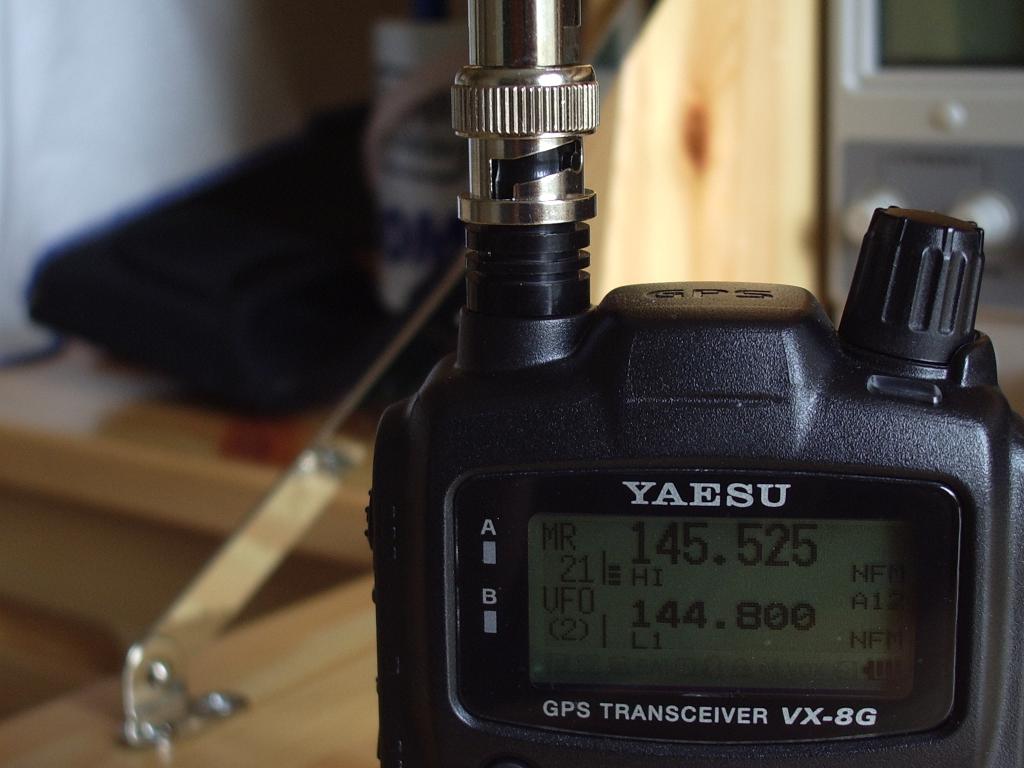
As regular readers may recall, I have a pathological hatred of SMA connectors when used as antenna connectors for hand-held radios, which has become even more entrenched since I had the centre pin of the TH-F7E stock antenna break off in the adapter I use for testing such antennas on my antenna analyzer. I now have an SMA to BNC adapter permanently installed on my VX-8GR. The picture on the right shows my latest adapter which is anodized black and looks like an integral part of the radio. The previous one I used was gold plated with a knurled body and whilst it worked perfectly and provided a robust fitting for the BNC antennas it looked a bit ugly.
If you never change the antenna on your HT then one of these adapters isn’t necessary, but SMA connectors were never designed for multiple connections and disconnections (in one email group I saw someone state they were rated for 100 disconnections) so if you want to change between a short stubby antenna for inconspicuous local use and one with more gain the BNC adapter is the way to go.

All of my BNC whips are 2m antennas, which is fine most of the time as almost all my operating is done on 2m, but there are rare occasions when I might want to use 70cm and removing the BNC adapter in order to attach the stock antenna kind of defeats the object of it. So I ordered from eBay a Nagoya NA-701 antenna which is a short dual band whip similar in size to the ones supplied with amateur dual band handhelds but with a BNC connector.
I tried it out on my antenna analyzer and it showed a nice sharp SWR curve with the minimum around 147MHz. It could be better, but it’s closer than some stock antennas I’ve tested. I couldn’t check it on 70cm as my antenna analyzer doesn’t go up that high.
I need to devise way to make comparative tests of all these HT antennas, because asking for signal reports or seeing if you can hit a repeater is a pretty crude measure of performance that won’t reveal small differences. This little antenna doesn’t perform as well as a six inch monoband helical on 2m, nor a quarter wave telescopic, but that is only to be expected. The beauty of the BNC adapter is that if you need a gain antenna you can easily whack on something like my 5/8 wave Black Whip, which you certainly couldn’t use with a standard SMA connector.

Julian Moss, G4ILO, is a regular contributor to AmateurRadio.com and writes from Cumbria, England. Contact him at [email protected].
XTalset Society, neat articles for new homebrewers
XTalset society has been around for awhile. They are a great starting point for anyone either new to homebrewing or anyone teaching someone who is new to radio (and I’m not necessarily talking about ham radio). Great crystal set projects that truly amaze.
They are also a great resource for purchasing materials to help you on your crystal set journey.
Here are some of the articles I found useful – free for everyone!
How to Read Schematics
The AM Broadcast Band
A Big Ole Hunk of Galena Crystal
Crystal Set FAQs
How Crystal Sets Work
Variable Cap Lineup & Mounting
Equivalent Series and Parallel Circuits
XS-800 Antenna Measurement Bridge
Q of a Coil With Some Unused Turns
Mag-Coupling Selectivity-Sensitivity pdf file.
A Great Teacher: The Crystal Set pdf file, courtesy QEX (ARRL).
Derivation of Step Attenuator R Formulas pdf file.
The Trap Coil Q Measurement Method Revisited (for high Q coils in particular) pdf file.
About Q pdf file, Discusssion on Q Formulas/Measurement.
The AM RF Signal pdf file, Discusssion on makeup of an AM RF Signal.
Anatomy of Crystal Set Modeling: Equivalent Circuit Substitutions pdf file, with spice app.
XS-OB1 Kit Manual (updated 05-01-08) pdf file.
Different OAT BOX COILS pdf file.
XS-801 Kit Drawings pdf file.
Mechanical Dimensions for Mounting Variable Capacitors pdf file.
To take a look at these articles, head over to their site at:
http://www.midnightscience.com/article-index.html
Or their front page at:
http://www.midnightscience.com
Jonathan Hardy, KB1KIX, is a regular contributor to AmateurRadio.com and writes from Connecticut, USA. Contact him at [email protected].
Mystery beacon
For the last three hours or so I’ve been driven mad by an APRS beacon on 2m that I can’t decode and which is not being gated to the internet by Richard MM1BHO’s gateway. The amount of activity on VHF APRS round here is so low that I normally leave the receiver audio on so that I can hear whether anyone is about. The signal I’m hearing is quite solid, obviously from a fixed station or a stationary mobile, and though it isn’t massively strong – just about making 1 bar on the Kenwood’s signal strength meter – it sounds fully quieting and as good as other signals I hear which are decoded.
I tried both wide and narrow FM modes and when that didn’t help I switched the antenna over to the FT-817 so I could try the AGWPE sound card decoder. I even tried plugging the antenna into the VX-8GR to see if that could decode it, but no joy. Listening to the sound of the beacon compared to the sound of my VX-8GR’s beacon, the one I can’t decode is quite a bit louder. I think it might be over-deviated.
So on the off-chance that someone trying APRS round here might read my blog, I thought I’d publish this posting. If it’s you, try turning the audio into the transmitter down and you might get gated.

Julian Moss, G4ILO, is a regular contributor to AmateurRadio.com and writes from Cumbria, England. Contact him at [email protected].
KE9V.net
Is it just my computer, or has Jeff KE9V’s blog site gone QRT? His last posting in the Blogger “Reading List” feed was to do with the controversy over the Ground Zero mosque, but when I click through the page has gone, as has his entire site except for one placeholder page. I don’t know what Jeff had to say on the subject or whether it had anything to do with his site now being down.

Julian Moss, G4ILO, is a regular contributor to AmateurRadio.com and writes from Cumbria, England. Contact him at [email protected].
Another great cockup
Another weekend of glorious weather. I decided to make an early start on Sunday and try a slightly more ambitious Wainwrights On The Air (WOTA) activation than normal. The plan was to walk over Barrow and Outerside and, if my legs still had enough energy left in them, Causey Pike. Though a much easier walk than those undertaken by Phil, G4OBK, I haven’t done much hill walking since getting married nearly 8 years ago and am not as fit as I used to be. This would be the longest walk I’d done for a long time.
I set off in the warm sunshine at about 9.30 and after about 15 minutes heard “CQ WOTA” from Phil who had arrived on the summit of Dodd, the other side of Bassenthwaite Lake. I was afraid I might have missed him while I was on the road. His expected arrival had been an hour earlier and I’d waited to try to catch him from the home station. But the day was warming up and he might have had a change of plan so I decided I couldn’t wait any longer. Dodd was a new summit worked for me so I was glad to have caught him. It also meant that Phil’s effort hadn’t been in vain because Dodd is a difficult hill to get contacts on.
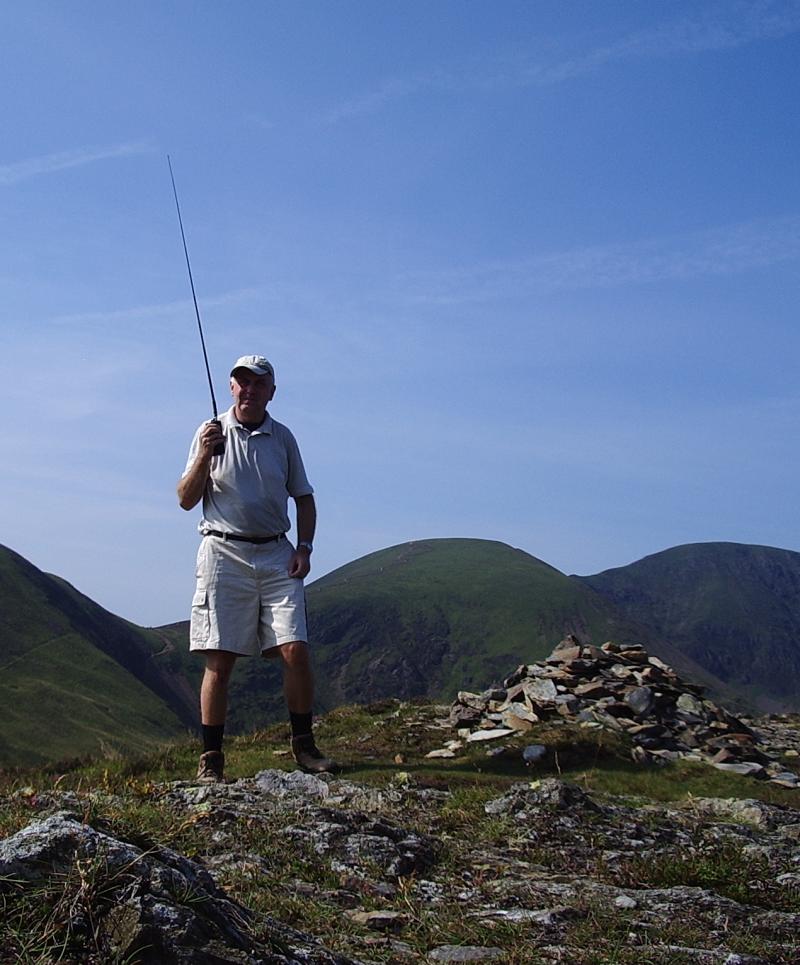
The path I was taking passed along the flank of Barrow. To reach the summit I would have to backtrack on a higher path. On the map it didn’t look far but in reality it looked quite a long walk so I decided to get Barrow on the way back and started the climb to Outerside. It was a pleasant and not difficult climb, but sweaty work in the growing heat. Eventually I reached the top (first picture) from where I made several contacts on 2m using the telescopic 5/8 wave antenna, including another with Phil G4OBK/P who had by now reached Carl Side.
I was not inclined to hang around on the summit which was plagued with flying ants – as were all the Lakeland summits judging by the comments of other hill-toppers. I descended the other side of the hill and made my way back to the main path from where I saw a track up the side of Causey Pike which looked like a shortcut. I crossed the path and made my way to the track, where I sat down and ate my packed lunch as there were no insects in that area.
Causey Pike is a narrow ridge with several undulations along its length. In fact I seem to remember one walkers guide I read a few years ago referring to it as Causey Pikes. My Ordnance Survey map shows it as a long, narrow island surrounded by the 2,000 foot contour (it’s an old map, made before they went metric.) I have walked along it several times over the years since I first came to the area but I had never given much thought to exactly which of the undulations was the actual summit was because at the time it didn’t matter.
The shortcut looked too short to reach 2,000 feet. I set off, and after about 15 minutes reached the crest. From there it didn’t look like 2,000 feet either. To my left, after a few more feet of climbing, was a small plateau which was followed by a sharp descent into the valley. To my right, the crest of the ridge rose steadily for what looked like another 400 or 500 feet. “The summit must be up that way” I thought, so I turned right and off I went. On the way I stopped to work Ian, 2E0EDX/P on Brim Fell, for another summit that I wouldn’t have worked from home.
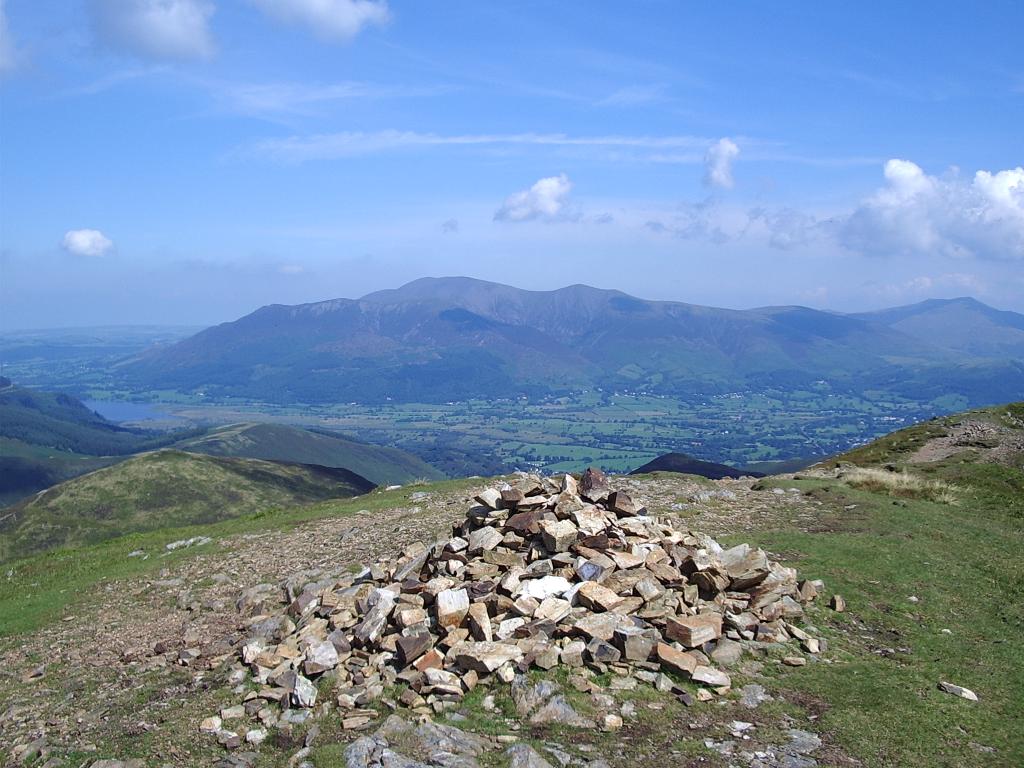
Eventually I arrived at the highest point which was surmounted by a rough stone cairn. I started to call “CQ WOTA” and made several contacts from what I described as the summit of Causey Pike, including one with Colin, 2E0XSD whom I asked to check whether my position was showing on aprs.fi. He confirmed that it was, and the details tallied with what my VX-8GR GPS was showing.
I started to make my way off the fell on my way home by the main footpath when I was called by Phil, G4OBK, to pass on a message that Colin didn’t think I was on Causey Pike when I made the contacts. Since Colin sometimes has a bit of fun at my expense due to an error I made during an earlier activation the thought crossed my mind that he was having a wind-up. Shortly after that I received an APRS message from Colin which stated that I was on Scar Crags, not Causey Pike. I had never heard of Scar Crags but I knew that there was another hill nearby called something Crags (having checked it is Ard Crags) so I thought that perhaps the position of the labels on the map may have caused Colin to mistake my position and decided to carry on descending.
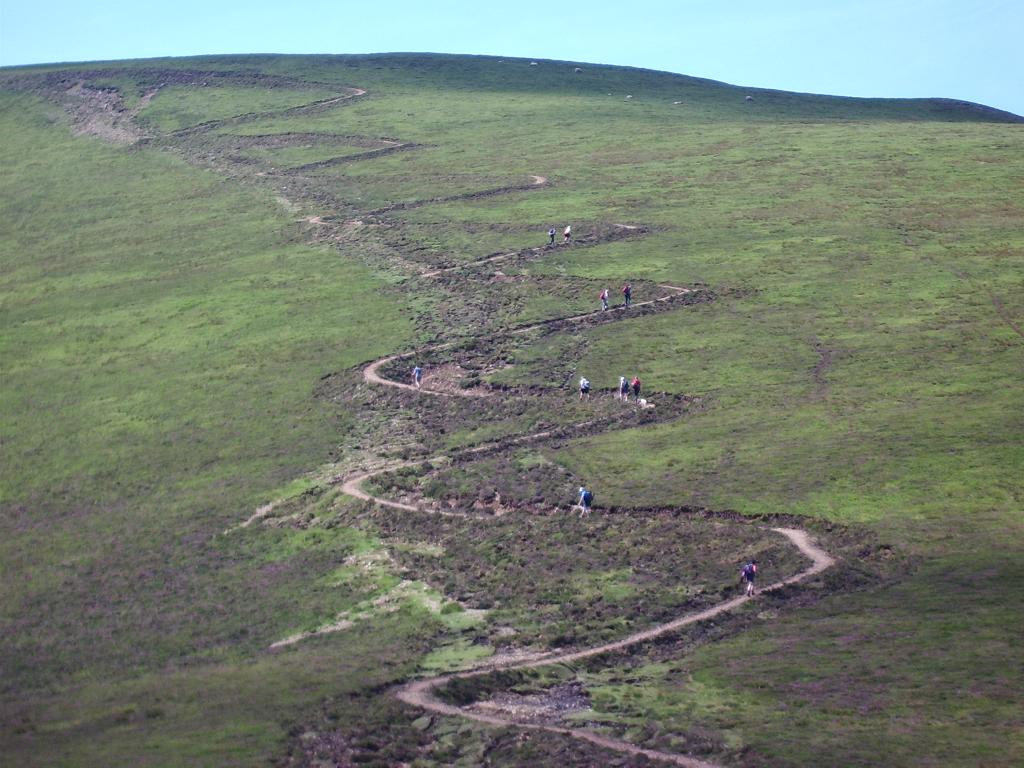
While all this was going on I was watching a couple of mountain bikers zooming down a zig-zag path that had been made on the side of the fell named Sail opposite where I was standing. This unsightly path has been made because the number of boots (and presumably tyres) ascending and descending the fell had destroyed the original path and made it dangerous. Britain is an overcrowded island and the number of visitors, particularly in recent years as more people take holidays at home, is literally causing the hills to wear out!
Further down the path back to the car the surface had been repaired by tipping truckloads of small rocks into the channel caused by thousands of boots, so that instead of a gentle walk down I had to pick my way from rock to rock like on a rocky beach. Not a particularly welcome activity for legs that were becoming tired. The battery of my VX-8GR finally expired during a contact with a SOTA summiteer in Northumberland whose call I heard on the walk down, so there being no point in taking the loop over Barrow I walked straight back to the car and came home.
Back home, examination of my position report on aprs.fi showed that Colin had been right. I had indeed been on Scar Crags when making my “Causey Pike” contacts.
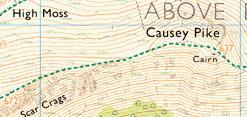
I had never heard of Scar Crags before and was completely unaware that it was the name of a Wainwright summit. However, had I stopped and looked at the map at the time it is unlikely that it would have convinced me that Colin was right. In this small grab from the online version of the map Scar Crags is shown at the bottom of the crags, which would suggest to me that it was the name of the cliffs and not of the actual summit. And the plateau that I now think may have been Causey Pike did not seem as prominent as the contours on the map make it look. Perhaps all the millions of boots have worn it flat, too. Only seeing my GPS position on the map and looking at Wainwright’s book made me realize that this was another great cockup (as distinct from Great Cockup.)
It’s rather embarrassing to make such a public mistake, as well as frustrating to have missed the opportunity to activate the real Causey Pike. I will just have to try again one day. And next time, perhaps I’ll also activate Barrow.

Julian Moss, G4ILO, is a regular contributor to AmateurRadio.com and writes from Cumbria, England. Contact him at [email protected].
Antenna Ideas: Please Keep ‘em Coming!
After last week’s plea for antenna ideas for my antenna restricted condo, I received a good number of comments both on and off blog. Thanks for those… great food for thought. That is why I enjoy our QRP community. We don’t hesitate to share ideas with one another.
This morning as I took my daily walk around the lake, I met our condo association president. He graciously is allowing me to sink a pipe that will serve as a base to set up my Jackite poles in the backyard. I will be able to pop a cap on the top and keep the dirt and water out and just slide my fiberglass poles into the mount and be on the air in no time. YAHOO… that is a pretty good solution for now.

C Pole Antenna by W0VLZ
But being the antenna tweak that I am, I continue to look for the best alternatives I can find. I’ve started to put together the parts for the C Pole antenna that Niel W0VLZ pointed out to me. He has a fine site with lots of good QRP info too.
So, do you have another idea that can top that one? Or maybe you have a thought for what kind of vertical setup I might use with the new mount?
I’m standing by for my next project assignment.
72,
Kelly K4UPG
Kelly McClelland, K4UPG, is a regular contributor to AmateurRadio.com and writes from Florida, USA. Contact him at [email protected].
 Ham Radio Deluxe |
 W5SWL Electronics |
 Ham Radio Prep |
 KB3IFH QSL Cards  Hip Ham Shirts  HamRadioAuctions HamRadioAuctions Reliance Antennas Reliance Antennas Enigma Shop Enigma Shop |  morseDX  Ni4L Antennas  R&L Electronics R&L Electronics antennas.us antennas.us QRV QRV |
- Matt W1MST, Managing Editor
